



Your hard work and preparation paid off. You’ve received a verbal job offer—great! A verbal job offer is the first step toward your new position, but you still need to follow a procedure to make sure it’s the right job with the right salary and benefits for you.
In this article, we show you how to respond to a verbal offer, secure a written offer and make a decision that will benefit you and your career by discussing the following:
- What is a verbal job offer?
- Best way to respond to a verbal job offer
- Follow-up steps to a verbal job offer
- Receiving a written offer
- How to accept a job offer
What is a verbal job offer?
Just as it sounds, a verbal job offer is one extended by either the person who interviewed you, the head of the department or an HR employee for a job in the company. The first distinction you must make is whether this was an informal “we really like you and you’ll hear from us soon” or a serious offer of employment.
Verbal job offers will come through in-person or phone contact with an authorized employee or representative of the company. A serious offer will contain the following:
- The title of the position
- The salary and other compensation such as commission or bonuses
- The date the company would like you to start
- Other benefits and conditions of your employment
When your interview ends with positive feedback about your candidacy and smiles all around, that’s a great sign, but definitely not a job offer. If your interviewer says something like, “We’d love to have you join us,” you may respond by saying that you would be excited to join the company and look forward to a formal job offer.
A verbal offer example should sound something like this: “Hello, this is Mary Conroy calling from The Best Company. I’m pleased to offer you the position of Senior Support Specialist at a salary of $56,000 annually along with our other excellent benefits.”
Why would HR make a verbal offer?
A company may choose to make a verbal offer for two key reasons:
- To move quickly to fill the position
- To see how interested you really are in the job, especially if they have another strong candidate waiting for a response
Neither of these is a reason for you to rush into a decision.
Best way to respond to a verbal job offer
Whether you’re standing in front of the person or hanging on their every word on the phone, your immediate response to a job offer should be, “Thank you so much for offering me the position” or another sincere expression of gratitude.
This is also a perfect opportunity to ask whether they will be following up with a written offer. Remember that a verbal job offer is not a legal contract. In addition, your emotions may be running high and you may miss an important detail of the working conditions.
Here are the steps you should take while talking with the person who has made the offer:
- Expression your appreciation for the offer
- Tell HR that you will need time to think about the position
- Request the details such as salary, benefits, etc.
- Ask when you can expect a follow-up written offer
- Compose a thank you email
After you end the discussion, take your time to consider all the aspects of the job. Don’t be shy about seeking more information, after all this is a big life decision and you want to be sure you’re making the right career move for you.
Don’t neglect to send a follow-up verbal offer email. This important step serves three purposes:
- It gives you the opportunity to thank your contact more formally
- It shows that you are definitely interested in the position
- It reminds them that you are waiting for a written offer.
Dear Ms. Conroy,
I was excited to hear from you Tuesday regarding the Senior Support Specialist position at The Best Company. Thank you for your phone call and for answering my questions about the offer.
I look forward to reviewing the details of the offer conditions and the position responsibilities in your written offer letter.
Sincerely,
Jason Escalera
If you’ve decided that you’re no longer interested in the job and want to turn it down, be polite and let them know. Another opportunity that’s more suited to you may arise with that company, so don’t burn that bridge. In addition, there may be someone out there for whom the position is perfect and they are anxiously waiting to hear. Here’s an adaptable example of an email to decline a verbal job offer:
Dear Ms. Conroy,
I was excited to hear from you Tuesday regarding the Senior Support Specialist position at The Best Company. Thank you again for the offer.
Upon further reflection, I have decided that the position is not a good fit for me. Please keep me in mind if you have an opening that better matches my skills and experience.
I appreciate your time and wish you the best in finding the right candidate.
Sincerely,
Jason Escalera
Follow-up steps to a verbal job offer
You have a verbal offer but no written offer yet. That doesn’t mean you can’t start negotiating. In fact, if you successfully negotiate before the written offer is complete, you will avoid some of the back and forth that occurs during the final stages of the job hunt.
After ensuring that you have the details correct and deciding that you want the job under the right conditions, it’s time to hammer out a deal that works for you and the company. You may have discussed compensation during the interview, but since the HR department represents the company’s interests, you should be looking out for yourself.
Remember that a compensation package includes more than your salary. You may ask for information about:
- Health insurance
- Paid time off
- Flexible scheduling
- Remote work policy
- Bonuses and commission (if applicable)
- The review process
- The job responsibilities and expectations
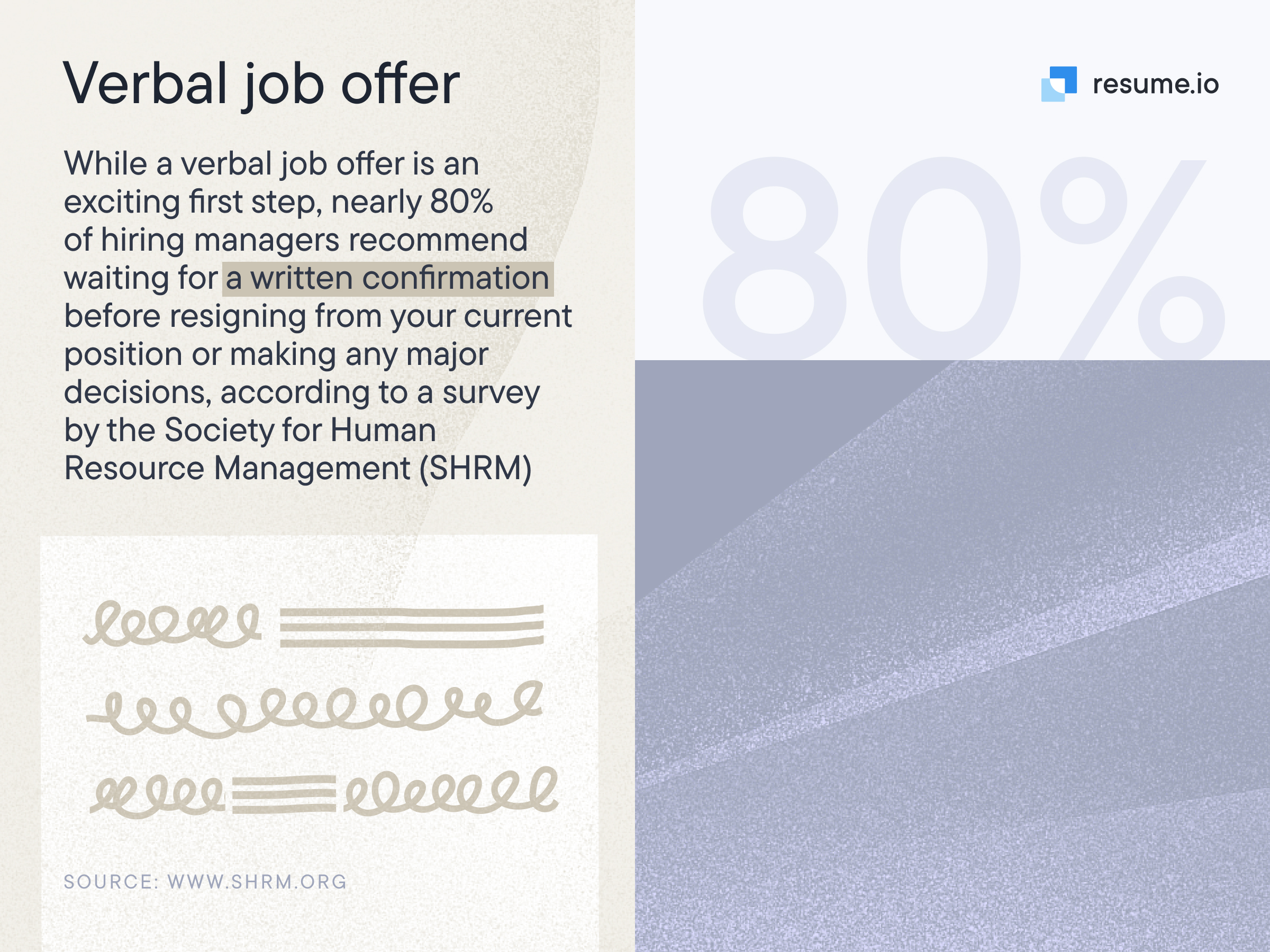
The HR employee may or may not provide you with all of this verbally since this also leaves them open to miscommunications. That’s why it is vitally important that you request a written job offer, even if you have informally agreed to terms.
- Take notes when receiving your verbal offer
- Ask for a written offer
- Repeat back the information to double check that you understand it
- Think that asking for information will label you “difficult”
- Agree to employment without a written contract
- End the conversation confused about the details
Receiving a written offer
You’ve talked with HR and been assured that you will be receiving a written offer shortly. This interim time is perfect for you to think through the offer, come up with any other questions that you didn’t ask already and imagine yourself in this new position.
Envision yourself in the field, talking to customers, at your desk, designing a website, whatever your main function is. Now that you have the verbal offer, is this truly the job for you? Does your philosophy and that of the company coincide? Are the style and culture right for you?
If you answer yes to all of those, and it’s been more than a couple of days since you asked for a written offer, don’t get impatient. There are many reasons this stage may take longer than you want it to. It could be as simple as a person on vacation or a change in hiring procedure that lengthens the process.
You may follow up to see if the contract is imminent. Under the assumption that HR is busy and that’s why you have not received an offer, start with an email that allows your recipient to respond in their own time instead of a phone call they must answer immediately.
Dear Ms. Conroy,
I was happy to hear from you Tuesday regarding the Senior Support Specialist position at The Best Company. Thank you again for the offer. I look forward to joining the team and making a contribution.
Along those lines, I am awaiting your written offer so I can grasp all the requirements and benefits of the position and make a final decision.
Again, I am excited about the opportunity and appreciate your time.
Sincerely,
Jason Escalera
After sending your email, give the person a day or two to respond. If you get ghosted after a verbal offer, you might even wonder whether you really want to work for a company that operates like that?
How to accept a job offer
This may be the job of your dreams, or it may be the end of a long, exhausting job search and you’re just happy to have an end in sight. Regardly, we caution against accepting a verbal job offer.
Once you have received the written offer letter, read it carefully to ensure that it matches the verbal offer or the conditions you negotiated after receiving the initial offer. Check for conditions such as a background check or drug testing and clarify the procedures for those tests.
If you have already discussed a start date, but the offer letter took longer than expected to arrive, it’s time to renegotiate. You’ll want to give your current employer (if you have one) at least the standard two weeks and if you choose, perhaps a week off between jobs to go into your new position fresh.
Once everything is settled to your satisfaction, go ahead and sign the offer letter if required and attach it to an email confirming that you accept the position.
Dear Ms. Conroy,
I am pleased to accept your offer of employment as a Senior Support Specialist position at The Best Company. I look forward to joining the team on the agreed upon date of June 10 and making a contribution to the IT support department.
I have attached the signed written offer letter. Please let me know if there are any steps I need to take before beginning my tenure.
Again, I am excited about the opportunity and appreciate all you have done for me so far.
Sincerely,
Jason Escalera
Key takeaways
A verbal job offer may be the first step in obtaining your dream job, but you have a way to go. Make sure you understand all the terms and conditions of employment. Take time to negotiate an acceptable compensation package and get everything in writing before you agree to take the offer.
Exhibit patience while you wait for the process to proceed. HR personnel at small companies may have a variety of responsibilities while those at large firms may be juggling the hiring of multiple workers at once.
Avoid burning the bridge at your current employer by giving at least two weeks notice. Keep all your interactions professional and remember that sending a well-crafted thank you never hurts.


