



A Word resume template is a preformatted Microsoft Word document with ready-made sections for your experience, education, and skills, so you can edit it and send it anywhere.
Resume.io offers free Word resume templates you can download as Word or PDF, including clean layouts built to pass an applicant tracking system.
This guide covers where to find Word templates, how to build a resume in Word without one, which format works best, and when to send Word or PDF.
Does Word have free resume templates, and how do you find them?
Yes. Microsoft Word includes a small set of free, built-in resume templates, and you can open them in a few clicks.
Word offers only a handful for free, and some are reserved for paid Microsoft 365 plans, so many job seekers turn to larger libraries for more choice.
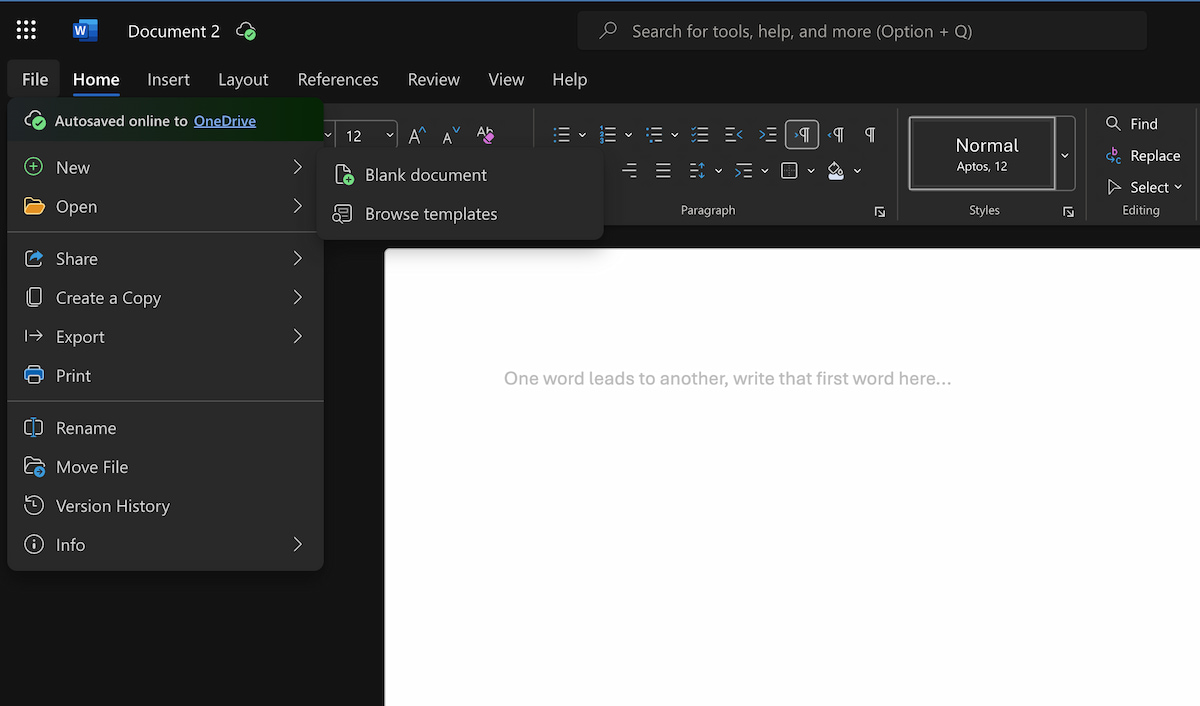
Here is how to open the built-in templates in Word:
- Open Microsoft Word
- Go to File, then New
- Type "resume" into the search box
- Double-click the template you want
- Replace the placeholder text with your own details
The built-in selection is limited, and several of the fancier options use columns, text boxes, or graphics that can confuse an ATS.
For more variety, Resume.io offers free Word resume templates with cleaner, recruiter-ready layouts, including a simple, single-column design, that still open and edit in Word.
How do you create a resume in Word without a template?
You can build a resume in Word from a blank document in about eight steps.
Start with a clean page, set simple formatting, then add each section in order.
Building from scratch takes a little longer than a template, but it gives you full control, and our guide on how to write a resume covers what to put in each section.
- Open a blank document in Word
- Set one-inch margins under Layout, then Margins
- Choose a clear font such as Calibri or Arial, 10 to 12 point for body text
- Add a header with your name, phone number, email, and city
- Write a short professional summary of two to four sentences
- Add work experience in reverse-chronological order, with bulleted achievements
- Add education, then a focused skills section
- Save as a Word file, then export a PDF copy for applications
Keep the layout to a single column and avoid tables or image boxes.
A plain structure is easier to edit later and far safer when a Word resume passes through screening software.
If building from a blank page feels slow, our AI resume builder sets up the structure and formatting for you.
| Element | Recommended setting |
|---|---|
| Font | Calibri, Arial, or Times New Roman |
| Body text size | 10 to 12 points |
| Heading size | 14 to 16 points |
| Margins | 0.5 to 1 inch on all sides |
| Line spacing | 1.0 to 1.15 |
| Layout | Single column |
| File name | Firstname-Lastname-Resume |
What is the best resume format to use in Word?
For most job seekers, the reverse-chronological format is best in Word.
It lists your most recent role first, reads clearly, and is the layout recruiters and screening software expect.
Two other formats suit specific situations, so choose the one that matches your experience rather than the one that looks busiest.
| Format | Best for | Watch out for |
|---|---|---|
| Reverse-chronological | Most job seekers with steady work history | Gaps show clearly |
| Functional | Career changers or limited work history | Some recruiters and systems distrust it |
| Combination | Strong skills plus relevant experience | Can run long if not trimmed |
Whichever format you pick, the writing matters more than the styling.
Amanda Augustine, Resume.io's resident career expert, advises that a standout resume is "an easy-to-read, typo-free document that presents a compelling career narrative."
You can see these formats across our effective resumes for different roles.
For most job seekers a one page resume is enough, with a second page only for a long career.
Are Word resume templates ATS-friendly?
Some are, and some are not.
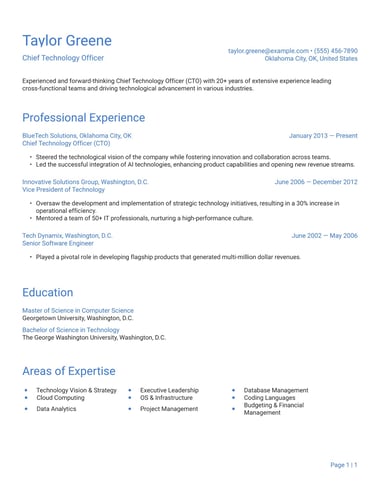
Simple, single-column Word templates with standard headings pass an ATS cleanly.
Templates that rely on columns, tables, text boxes, or graphics can be misread, which means sections of your resume may never reach a person.
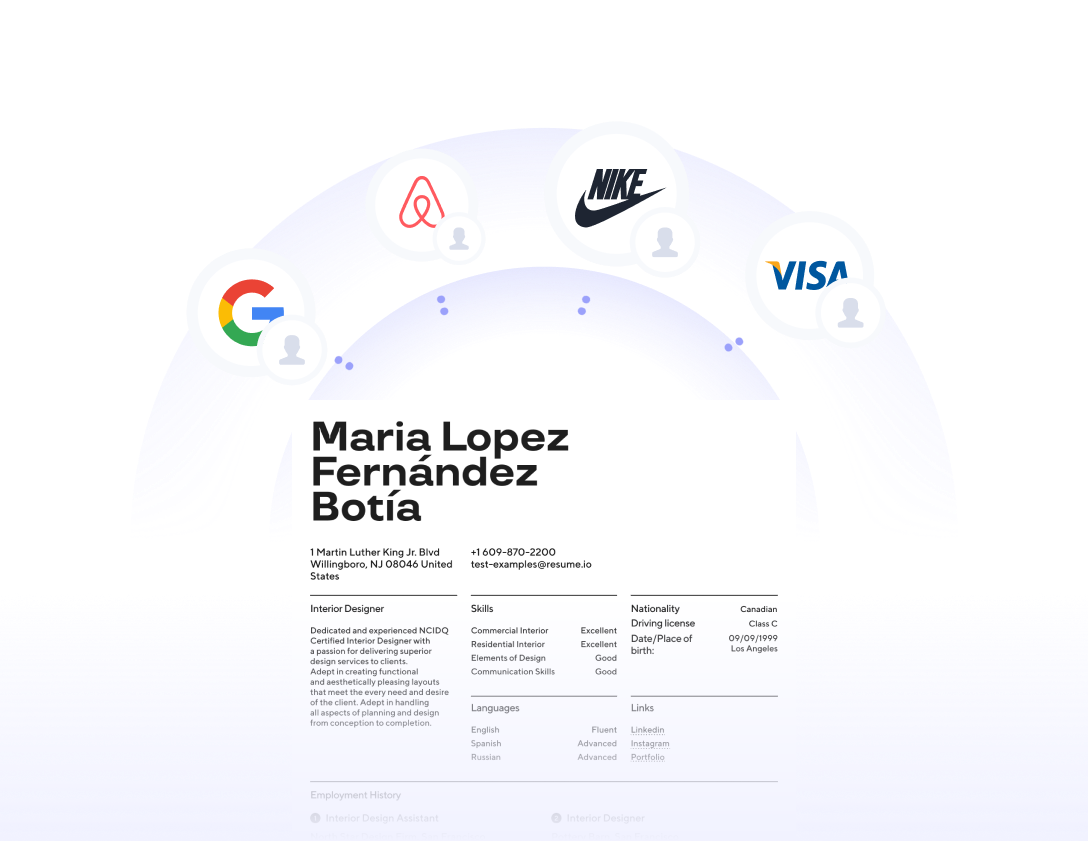
The stakes are real: 75% of resumes are rejected by an applicant tracking system before they reach a hiring manager (Resume.io, Cover Letter Statistics Report, 2025).
To stay safe, choose a plain layout, use normal headings like "Work Experience" and "Education," and avoid images or skill charts.
Our Word templates are built to parse correctly, so a clean, ATS-friendly resume reaches the recruiter intact.
Is it better to send a resume as Word or PDF?
Usually PDF, unless the job posting asks for Word.
A PDF locks your formatting so the resume looks the same on any device, and most modern screening systems read it without trouble.
Send a Word file only when an application form or recruiter specifically requests a .docx.
| Word (.docx) | ||
|---|---|---|
| Formatting | Can shift between devices | Stays fixed |
| Editing | Easy to update | Not easily edited |
| When to use | When the posting requires it | Default for most applications |
Keep both versions on hand, since with Resume.io you can download your resume as Word or PDF for free and always have the format a given employer asks for.
A Google Docs version is available too if you prefer to edit there rather than in Word.
Job-specific example Word resumes
No matter your field or experience level, there is a template that can work for you.
Here are a few examples from our template library that give you the tools to create a resume that gets noticed.
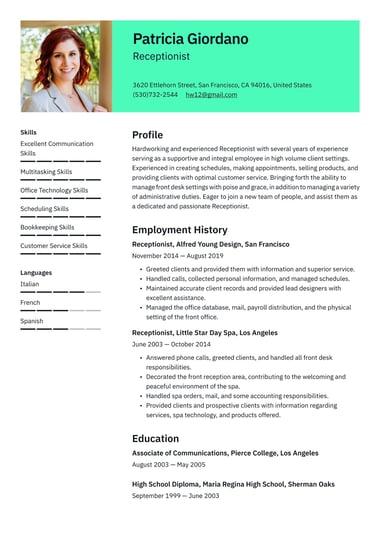
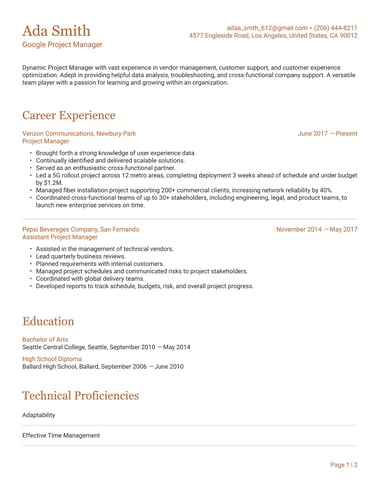
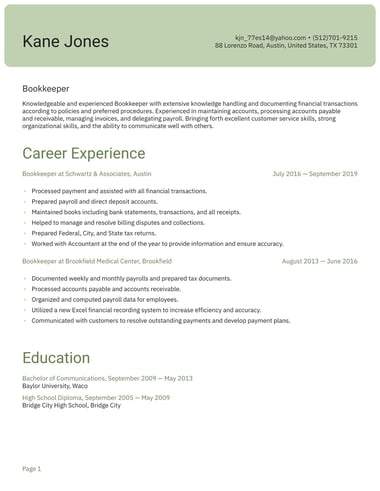
1. Athens template: ATS-friendly Word resume
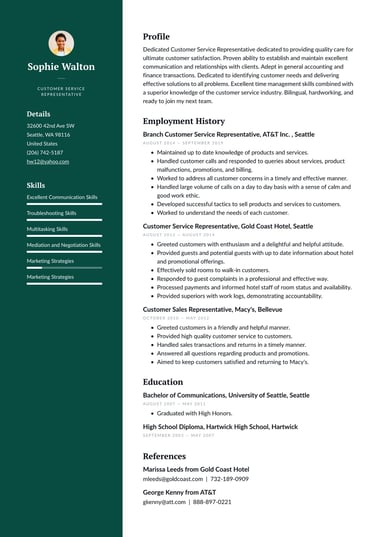
Perfect for passing through the ATS with ease, this template has a straightforward format, minimal graphics, and an easy-to-read font, perfect for bookkeepers and other professionals who like to keep their work organized and accomplishment-forward.
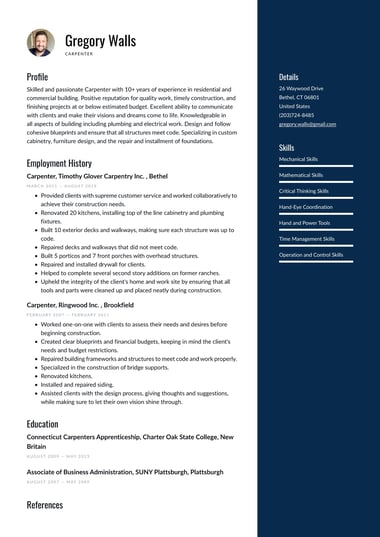
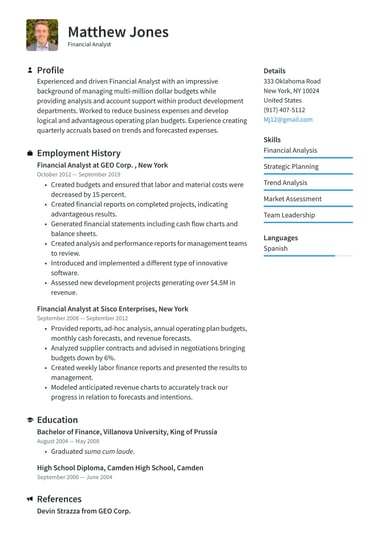
2. Sydney template: Picture Word template
This has a visually appealing layout that includes a space for a profile, often seen in academic fields.
Also good for creative industries when you want to personalize your brand.
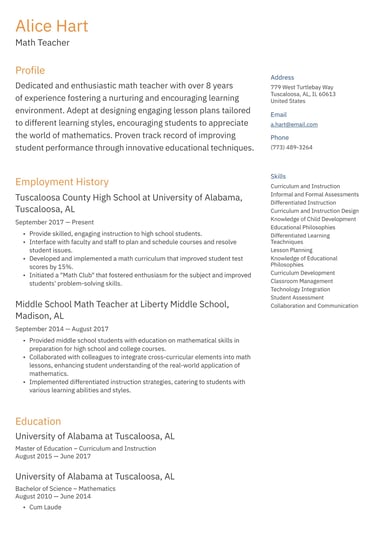
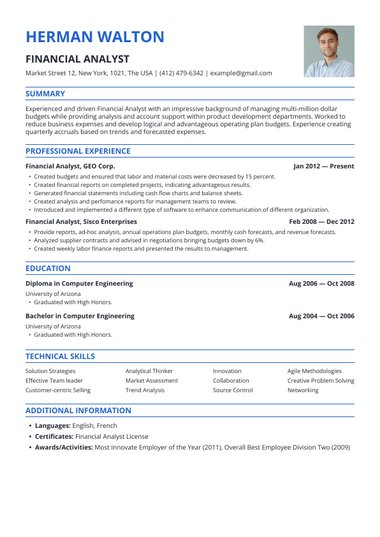
3. Stockholm template: Modern Word resume design
Sleek, contemporary design for professionals who want to stand out visually while keeping the focus on content.
Useful for roles that are client-facing or require strong communication skills, as it makes a positive statement at first glance.
Key takeaways
- Word has a few free built-in resume templates, reachable through File, then New, then searching "resume."
- You can also build a resume in Word from a blank document in about eight steps, using a single-column layout.
- Reverse-chronological is the best format for most job seekers, with functional and combination formats for specific cases.
- Plain, single-column Word templates are the safest choice for passing screening software.
- Send a PDF by default, and keep a Word version ready for applications that request one.
Frequently asked questions
Here are quick answers to common questions about Word resume templates.
Can you create a resume in Word for free?
Yes. Microsoft Word includes a small set of free resume templates, and you can also start from a blank document at no cost.
For more free designs that still open in Word, you can download our templates as a Word file.
How do you save a Word resume as a PDF?
Go to File, then Save As, and choose PDF from the file-type menu.
You can also use File, then Export, then Create PDF. Saving a PDF keeps your layout fixed so it looks the same for every recruiter.
What font works best for a Word resume?
Stick to clean, widely available fonts such as Calibri, Arial, or Aptos.
Use 10 to 12 point for body text and a slightly larger size for your name and headings.
Plain fonts are easier to read and safer for screening software.