



Technical skills for a resume are the job-specific tools, systems, and technical knowledge you use to do your work effectively.
Highlighting the right technical skills helps employers quickly understand what you can do, how you work, and whether you meet the role’s requirements.
What are technical skills?
Technical skills for a resume are specialized abilities related to tools, software, systems, or methodologies used in a specific role or industry.
Unlike soft skills, they are learned through training, education, or hands-on experience and are often easier for employers to measure, compare, and verify during hiring.
Here are a few common technical skills examples you might recognize from your own work experience.
Quick examples:
- Programming languages such as Python, Java, or SQL
- Data analysis tools like Excel, Tableau, or Power BI
- IT systems including cloud platforms, databases, or network tools
- Engineering and design software such as CAD or MATLAB
- Healthcare systems like electronic health records (EHRs)
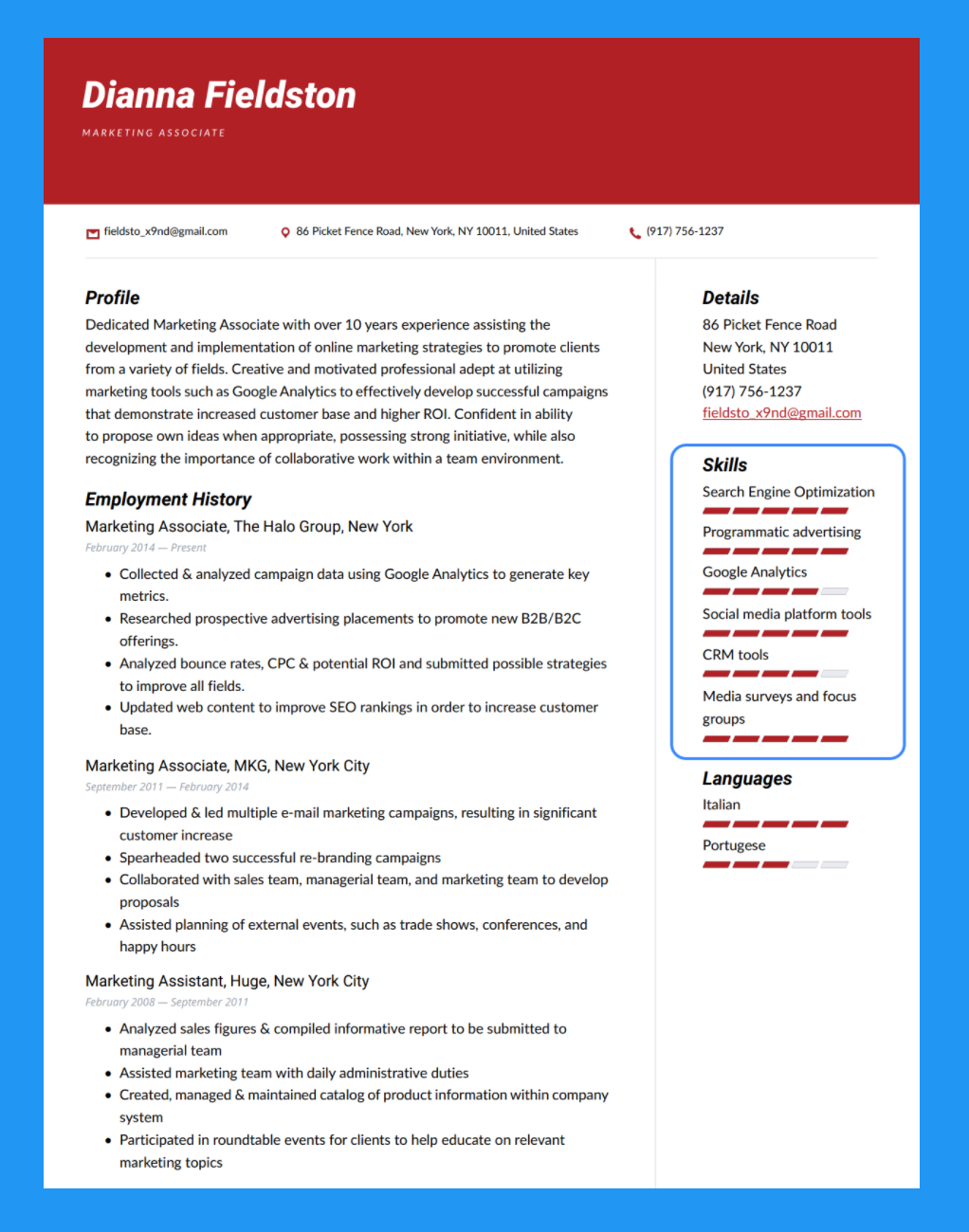
- Marketing platforms including SEO tools, analytics software, or CRMs
Later in this guide, you’ll find detailed technical skills for a resume examples grouped by industry, tools, and job duties.
In most cases, the advice below applies to both resumes and CVs, although terminology may vary by country.
Why are technical skills important on a resume?
Technical skills are important because they show employers you can actually perform the tasks required for the job.
In many roles, technical skills determine whether you meet the minimum requirements, pass applicant tracking systems, and move forward in the hiring process.
- They prove job readiness
- They help resumes pass ATS filters
- They show how quickly you can contribute
- They often influence salary and role level
How do you include technical skills on a resume?
You should include technical skills throughout your resume, not just in one section.
The most effective resumes reinforce technical skills in the summary, skills section, and work experience, showing both what you know and how you’ve used it.
How do you include technical skills on a resume?
You should include technical skills throughout your resume, not just in one list.
The strongest resumes reinforce technical skills in the professional summary, skills section, and work experience so employers can see both what you know and how you’ve used it in real situations.
Where should technical skills appear on a resume?
To make your technical skills easy to spot and understand, place them in multiple sections rather than isolating them in a single list.
Technical skills in a resume summary
A resume summary is the best place to highlight your most valuable and rare technical skills, especially those that directly match the job description.
This helps hiring managers quickly assess whether your background fits the role.
Technical skills in the resume skills section
The skills section should list your most relevant technical skills in a clear, scannable format.
This section helps applicant tracking systems and recruiters quickly confirm that you meet the job’s technical requirements.
Technical skills in your work experience
Your work experience section is where technical skills carry the most weight.
Showing how you used technical skills to achieve results is more convincing than listing them on their own.
What are the best technical skills for a resume by industry?
The best technical skills for a resume depend on your industry, role, and level of responsibility.
Employers expect different tools, systems, and technical knowledge across fields, so choosing skills that match your job target is more effective than listing every technical skill you have.
Below are examples of technical skills for a resume grouped by industry.
Use these lists to identify skills you already have or to understand which technical skills employers commonly expect in similar roles.
Computer science and IT technical skills for a resume
| Skill area | Examples of technical skills |
|---|---|
| Programming languages | Python, Java, C++, SQL |
| Systems and infrastructure | Operating systems, cloud platforms, virtualization |
| Automation and scripting | Bash, PowerShell, task automation |
| Data and databases | Database design, database management |
| Security | Encryption, access controls, system security |
Marketing technical skills
| Skill area | Examples of technical skills |
|---|---|
| Analytics and data | Google Analytics, reporting dashboards |
| Search and advertising | SEO, SEM, programmatic advertising |
| Platforms and tools | Content management systems, CRM tools |
| Research and insights | Media surveys, focus groups |
| Design and planning | Wireframing tools, campaign planning software |
Finance and accounting technical skills
| Skill area | Examples of technical skills |
|---|---|
| Accounting systems | ERP systems, SAP, Sage |
| Standards and compliance | GAAP, auditing processes |
| Financial analysis | Financial statements, forecasting |
| Software tools | Excel, accounting software |
| Tax and reporting | Tax preparation software |
Engineering technical skills
| Skill area | Examples of technical skills |
|---|---|
| Design and modeling | CAD software, 3D modeling |
| Systems and testing | Systems design, QA testing |
| Programming tools | MATLAB, Visual Basic |
| Documentation | Blueprinting, technical documentation |
| Analysis | Structural or systems analysis tools |
Software engineering technical skills
| Skill area | Examples of technical skills |
|---|---|
| Development | Coding, software architecture |
| Testing and quality | Code testing, product testing |
| Data structures | Algorithms, data structures |
| Collaboration tools | Source control, IDEs |
| Security | Encryption, secure development |
Data science technical skills
| Skill area | Examples of technical skills |
|---|---|
| Data processing | Data mining, data analytics |
| Modeling and research | Statistical modeling, quantitative research |
| Databases | Database design, database management |
| Reporting | Quantitative reports, data visualization |
| Advanced analysis | Big data, algorithms |
Healthcare technical skills
| Skill area | Examples of technical skills |
|---|---|
| Patient systems | EHR and EMR management |
| Compliance | HIPAA knowledge |
| Clinical tools | Medical practice management software |
| Certifications | CPR, CNA, RN |
| Imaging systems | PACS and VNA software |
Media and production technical skills
| Skill area | Examples of technical skills |
|---|---|
| Creative software | Adobe Creative Suite |
| Production | Video editing, photography |
| Post-production | Color grading, photo retouching |
| Visualization | Data visualization |
| Equipment | Camera systems and production hardware |
What are examples of technical skills based on tools and job duties?
Technical skills can also be grouped by the tools you use and the job duties you perform.
This approach is especially helpful if your role spans multiple industries or if your technical skills come from hands-on responsibilities rather than a specific job title.
If you’re unsure how to describe your technical background, reviewing skills by tools and duties can help you identify technical skills you already use in your day-to-day work.
Enterprise systems technical skills
| Job duty | Examples of technical skills |
|---|---|
| Business operations | Payment processing systems, automated billing |
| Customer management | CRM platforms such as Salesforce or Oracle NetSuite |
| Planning and continuity | Business continuity planning |
| Resource management | ERP systems such as SAP or Oracle |
Computer and office technology skills
| Job duty | Examples of technical skills |
|---|---|
| Documentation | Word processing, document formatting |
| Data handling | Spreadsheets, databases |
| Communication | Email systems, collaboration tools |
| Presentation | Slide creation and visual reporting |
| Digital platforms | Web tools, social media systems |
Spreadsheet and data handling technical skills
| Job duty | Examples of technical skills |
|---|---|
| Data analysis | Comparative analysis, data modeling |
| Advanced functions | Pivot tables, macros |
| Data integration | Linking spreadsheets to databases |
| Lookup tools | VLOOKUP and similar functions |
| Reporting | Automated reports and dashboards |
Programming and development technical skills
| Job duty | Examples of technical skills |
|---|---|
| Software development | C#, Java, Python, C++, PHP |
| Web development | HTML, CSS, JavaScript |
| Backend systems | SQL, XML, ASP.NET |
| Mobile and app development | Swift, Objective-C |
| Architecture and delivery | Network architecture, solution delivery |
Business analysis and systems tools
| Job duty | Examples of technical skills |
|---|---|
| Data analysis | Data analytics, data modeling |
| Databases | Oracle JDBC, Transact-SQL |
| Development environments | Eclipse IDE |
| Operating systems | UNIX, Oracle Solaris |
| Platforms | AWS software, BI tools |
Key takeaways
- Technical skills for a resume are job-specific abilities related to tools, systems, software, or methodologies you use to perform your work.
- The best technical skills to put on a resume depend on your role, industry, and experience level, not on generic or trending lists.
- Strong resumes show technical skills in multiple places, including the summary, skills section, and work experience.
- Grouping technical skills by industry, tools, or job duties makes them easier for employers and applicant tracking systems to understand.
- In-demand technical skills often relate to data, automation, software proficiency, cloud systems, and security.
- Reviewing job descriptions is the most reliable way to identify which technical skills employers expect for your target role.
- Continually updating and developing your technical skills helps keep your resume competitive as tools and technologies change.
A few extra words around your rare professional skills could make all the difference.
Have look at our resume templates and use our online resume builder to get that dream position.
Frequently asked questions: Technical skills for a resume
These frequently asked questions cover common concerns about technical skills for a resume, including how to choose, list, and prioritise them for different roles and industries.
How do you list technical skills on a resume?
List technical skills in a dedicated skills section using clear, job-relevant terms, then reinforce them in your resume summary and work experience.
The most effective resumes show how technical skills were used to achieve results, not just list tools or software names.
What are examples of technical skills?
Examples of technical skills include programming languages, data analysis tools, industry-specific software, operating systems, and technical methodologies.
Common technical skills for a resume range from SQL and Python to CAD software, cloud platforms, and electronic health record systems, depending on the role.
What are the 7 technical skills?
There is no fixed list of seven technical skills because they vary by job and industry, but common categories include programming, data analysis, system administration, software proficiency, technical documentation, cyber security, and automation.
The best technical skills to put on a resume are those that directly match the job requirements.
What are the top 3 tech skills?
The top tech skills depend on the role, but data analysis, programming, and cloud computing are consistently in demand across many industries.
Employers value these skills because they support decision-making, automation, scalability, and modern business operations.
Which technical skills are in demand?
In-demand technical skills are those that help organizations analyze data, automate work, secure systems, and use digital tools efficiently.
Employers consistently look for skills related to data analysis, programming, cloud platforms, cyber security, and role-specific software.
The exact tools may change over time, but these skill areas remain valuable across industries.
Reviewing job descriptions for your target role is the most reliable way to identify which technical skills are currently in demand.


