



While a resume should reflect the highlights of your career, describing accomplishments takes more than listing what you did.
Strong examples help employers picture how you would perform in their organization, making your value clear from the start.
List of accomplishments for a resume
Resume accomplishments are results that show how your work created measurable impact.
All of them involve taking action that led to a positive result for your employer.
When choosing which accomplishments to include, focus on examples that show how your work made an impact and how that impact relates to what you will be expected to do in your next role.
Here is a list of accomplishments for a resume that you can use as inspiration or a starting point:
- Increased sales or profit margins
- Reduced costs or improved the bottom line
- Improved productivity or time efficiency
- Solved problems through new ideas or process improvements
- Introduced innovations that led to measurable change
- Improved workflows, systems, or procedures
- Earned awards or recognition (with context)
- Achieved promotion or expanded responsibilities
- Supported the development or performance of others
- Delivered strong service to customers or clients
Reference table
| Type of accomplishment | What it shows | Example |
|---|---|---|
| Revenue growth | Ability to drive business results | Increased sales by 20% through targeted outreach |
| Cost savings | Efficiency and financial impact | Reduced operating costs by 15% by improving workflows |
| Productivity | Time and process improvement | Cut reporting time by 30% by automating tasks |
| Problem-solving | Initiative and critical thinking | Developed a system to fix recurring reporting errors |
| Leadership | Team impact and responsibility | Managed and trained a team of 10 employees |
| Recognition | Performance and trust | Promoted within 12 months for strong results |
What are 3 accomplishments you can include on a resume?
Three common types of accomplishments to include are:
- Increasing revenue or performance (for example, improving sales or output)
- Reducing costs or improving efficiency (such as saving time or resources)
- Earning recognition or responsibility (such as promotions, awards, or leadership roles)
In all of these cases, the accomplishment shows the difference you made.

How to list accomplishments in your resume
To list accomplishments effectively, focus on results, not responsibilities.
Strong accomplishment statements clearly show what you did, how you did it, and what impact it had.
This helps hiring managers quickly understand what you can bring.
Step 1: Start with a clear action
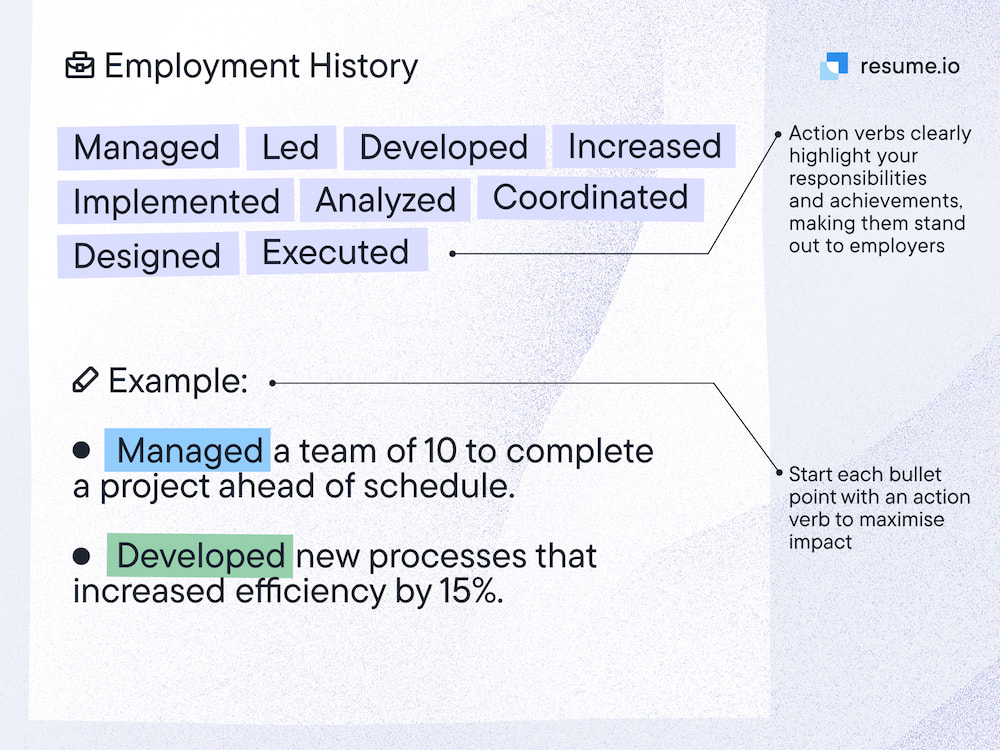
Begin each accomplishment with a strong action verb that shows what you did.
This immediately highlights your role and makes your experience easier to scan.
Be specific about your contribution, especially if you worked as part of a team.
Step 2: Describe the task and context
Briefly explain what you worked on or were responsible for.
Keep this concise and focused on relevant details that help explain the achievement.
Step 3: Show the result with numbers
The result is the most important part.
Show what changed because of your work and include numbers where possible.
You can quantify your accomplishments using:
- Timeframe (how quickly results were achieved)
- Scale (size of the impact)
- Range (consistency or volume of results)
Top tip: When writing your resume, start by listing your responsibilities, then rewrite each one as a result-focused accomplishment.
Example of turning a task into an accomplishment
- Before: Managed social media accounts
- After: Increased social media engagement by 45% over six months through a targeted content strategy
Using the STAR method
You can also structure accomplishments using the STAR method (Situation, Task, Action, Result).
On your resume, focus mainly on the action and result, keeping the context brief.
Use Resume.io’s resume builder to quickly test different accomplishment statements and refine your results-focused bullet points.
What are examples of STAR statements for resume achievements?
STAR statements help you turn responsibilities into clear, results-focused accomplishments by showing the situation, task, action, and result.
On a resume, you should keep the situation and task brief, and focus on the action and measurable result.
Example 1
Situation/Task: Managed social media accounts for a growing brand
Action: Developed and implemented a targeted content strategy
Result: Increased engagement by 45% over six months
Resume version: Increased social media engagement by 45% in six months by implementing a targeted content strategy.
Example 2
Situation/Task: Responsible for onboarding new employees
Action: Created a structured training program
Result: Reduced onboarding time by 30%
Resume version: Reduced onboarding time by 30% by introducing a structured employee training program.
Example 3
Situation/Task: Handled customer complaints
Action: Improved response process and follow-up system
Result: Increased customer satisfaction scores by 20%
Resume version: Improved customer satisfaction scores by 20% by redesigning complaint response and follow-up processes.
Where to list accomplishments in a resume
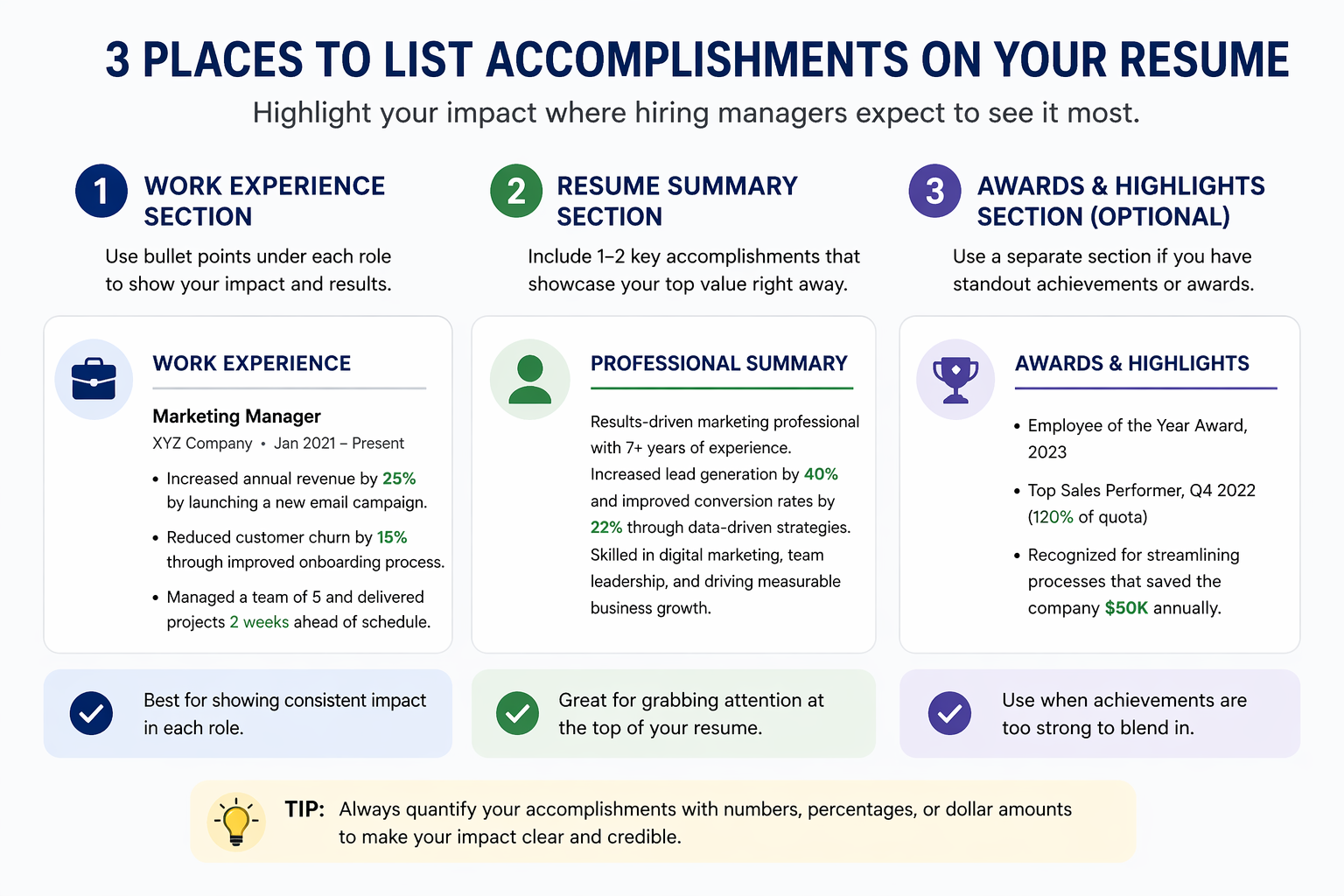
You should include accomplishments in the sections of your resume where employers expect to see proof of your impact.
The most important places are your work experience and your resume summary, where achievements help demonstrate your value quickly.
1. Work experience section
Most resumes include a work experience section with several bullet points for each role.
This is the main place to highlight your accomplishments.
You can include achievements within your bullet points or list them separately if there are several great examples.
Focus on measurable results that show how you contributed in each role.
2. Resume summary section
Your resume summary is one of the first things a hiring manager reads, so it is a strong place to highlight one or two key accomplishments.
Keep them concise and relevant to the role.
A well-chosen achievement at the top of your resume can immediately show your worth and encourage the reader to continue.
3. Optional: Awards and highlights
If awards or recognitions are important in your industry, you can include them either in your work experience or as a separate section.
In most cases, it is more effective to include them alongside the relevant role so they are supported by context.
Examples of achievements in resume by industry
Looking at real examples can help you understand how accomplishments should sound in practice.
Across all industries, the strongest ones clearly show what was done and the result that followed.
Below are examples of resume accomplishments by industry.
Accounting and finance
- Financial analyst: Created a purchasing commodity price dashboard that led to 22% cost savings.
- Accountant: Managed tax reporting for 50+ clients, improving efficiency and identifying savings opportunities.
- Financial advisor: Advised 100+ clients over three years, helping increase passive income by up to 80%.
Healthcare
- Clinic coordinator: Implemented a prescription tracking system and mobile app with 80% adoption.
- Child psychologist: Managed 20+ complex cases per quarter, supporting both patients and families with tailored care plans.
- Nurse: Conducted assessments and procedures for 150+ patients per month in a large hospital setting.
Engineering
- Research engineer: Designed an inflation system for an intragastric balloon that became a market leader within 18 months.
- Health and safety engineer: Led inspections across 12 industrial sites and developed new safety procedures for a 300-person facility.
- Electrical engineer: Managed maintenance for a large-scale manufacturing site with 500+ pieces of equipment.
Marketing
- Digital marketing manager: Increased occupancy by 45% through a multi-channel campaign across five platforms.
- Creative director: Led production of 25 successful campaigns and multiple national billboard projects.
- Social media manager: Managed content and engagement for a brand with 30,000+ followers across four platforms.
Administration
- Administrative assistant: Coordinated travel for 60 press trips, increasing media coverage threefold.
- Office manager: Oversaw operations for a 450-employee headquarters, including events and administrative workflows.
- Receptionist: Managed front desk operations and scheduling in a high-volume corporate office.
Sales
- Sales associate: Exceeded annual sales targets by an average of 45% over six years.
- Account manager: Managed multi-million dollar client contracts and consistently met quarterly goals.
- Sales manager: Reorganized a sales department, increasing team performance by 35% over two years.
IT and technology
- Web developer: Built an e-commerce platform that increased sales by 18%.
- Data analyst: Led a data team and improved data processing workflows.
- Software developer: Contributed to 12 product launches using Java, Python, and C.
Real estate
- Architect: Haines & Barton building design won “best small office” in the 2018 NY IntDes awards.
- Realtor: Closed more than 120 real estate deals over 2 years, from small homes to luxury mansions.
- Interior decorator: Designed large-scale office spaces for IT and biotech companies, with areas of over 1000 square feet and high demands for office ergonomics, comfort and aesthetics.
Remote work accomplishments
- Remote Project Manager: Led a distributed team across 3 time zones, implementing a virtual collaboration system that increased productivity by 27% and reduced meeting times by 35%.
- Remote Customer Service Representative: Handled 40+ daily customer inquiries through multiple digital channels while maintaining a 98% satisfaction rating and resolving issues 15% faster than in-office counterparts.
- Remote Team Leader: Successfully transitioned a 12-person sales team to fully remote operations during the pandemic, developing new digital processes that maintained team performance at 105% of pre-remote targets.
These examples show how accomplishments are written across different roles, focusing on measurable impact.

What are the best practices for listing sports achievements on a resume?
Sports achievements can be valuable on a resume if they demonstrate skills like teamwork, leadership, discipline, or performance under pressure.
The key is to present them in a way that connects to the job you are applying for.
1. Focus on transferable skills
Highlight what the achievement shows about you, not just what happened.
For example, team captain roles show leadership, while competitive results can demonstrate discipline and consistency.
2. Keep them relevant
Include sports achievements if they add value to your application.
This is especially useful if you are early in your career, have limited work experience, or the role involves teamwork or performance.
Avoid listing older or less relevant achievements if you already have strong professional experience.
3. Add context and results
Where possible, treat sports achievements like professional accomplishments.
Include measurable details such as rankings, wins, or improvements.
For example:
- Led college team to regional championship win
- Ranked top 5 in state competition over two seasons
- Trained 15 hours per week while maintaining academic performance
Where do I include these achievements?
You can include sports achievements in:
- Education section (if linked to school or university)
- Activities or extra curricular section
- Work experience (if coaching, training, or leadership is involved)
Key takeaways
Strong resume accomplishments show the impact of your work, not just your responsibilities.
Focus on understandable, measurable results that help employers understand your value quickly.
- Use a simple structure: action, task, and result
- Start with strong action verbs to highlight your role
- Quantify your achievements with numbers, percentages, or timeframes
- Focus on results that are relevant to the job you are applying for
- Include accomplishments in your work experience and summary sections
- Avoid vague statements that do not show measurable impact
Explore our resume examples for more inspiration and guidance.

FAQs for resume accomplishments
Short answers to common questions about choosing and writing strong resume accomplishments.
What are good accomplishments to put on a resume?
Good accomplishments are results that show how your work made a measurable impact.
This often includes increasing revenue, improving efficiency, solving problems, or earning recognition such as promotions or awards.
Focus on achievements that are relevant to the role and supported by clear results.
What are some amazing accomplishments?
Amazing accomplishments are those that show exceptional impact, scale, or progression.
Examples include significantly exceeding targets, leading major projects, saving substantial costs, or being promoted quickly.
The strongest examples combine clear action with impressive, measurable results.


