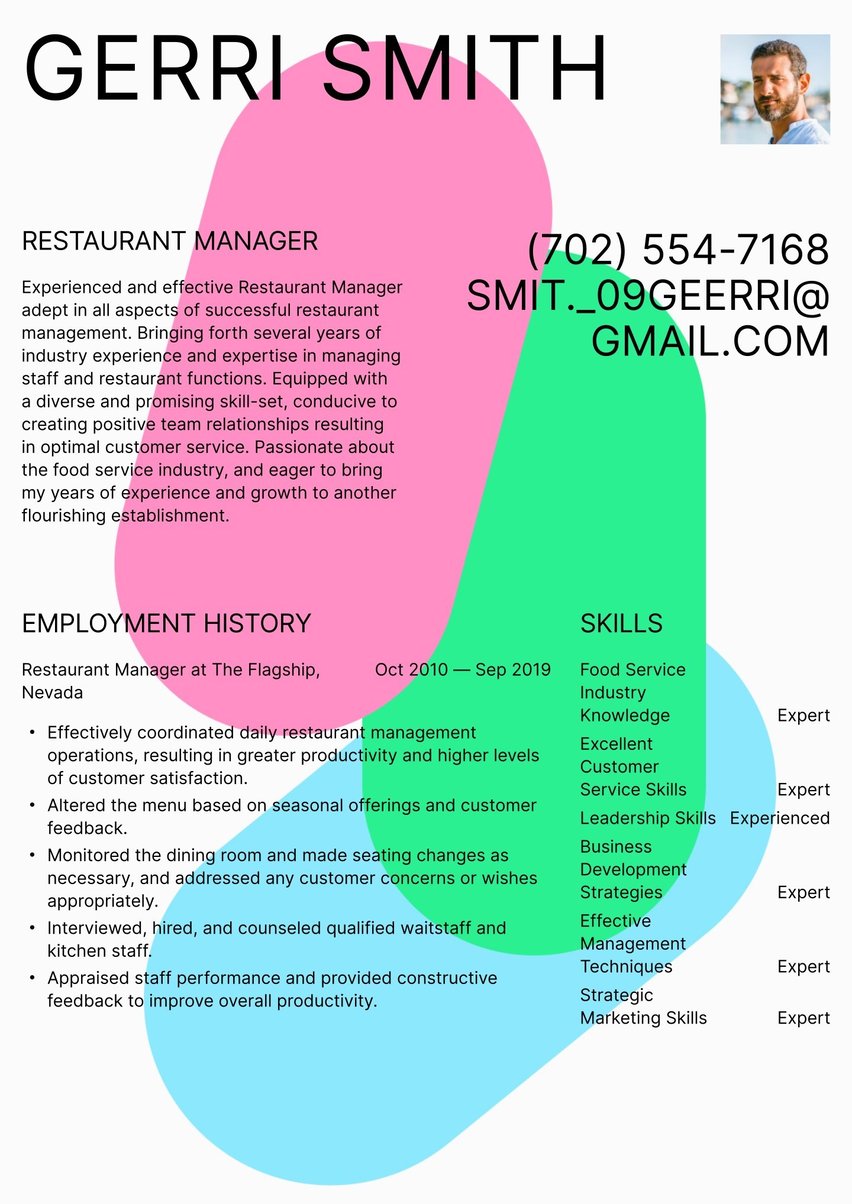


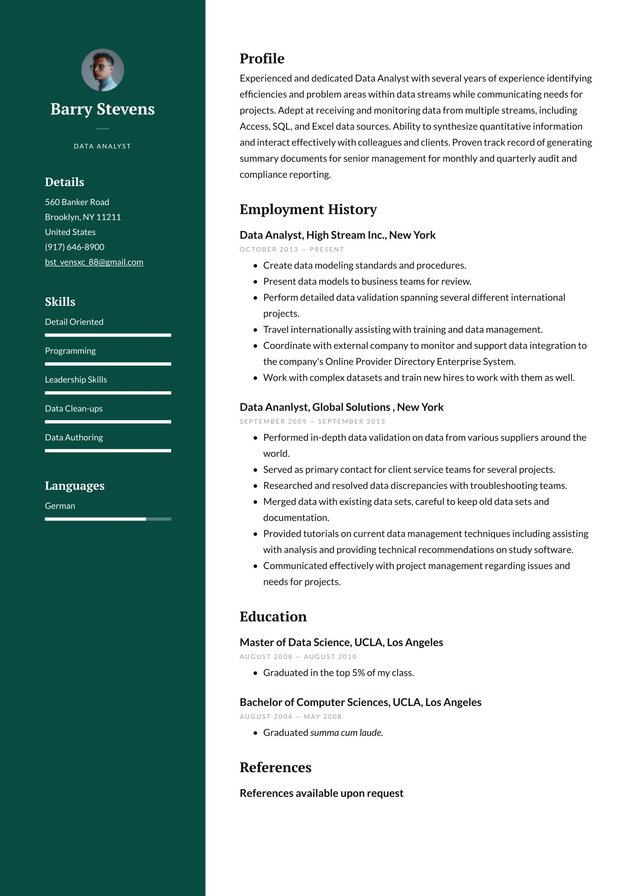
Experienced and dedicated Data Analyst with several years of experience identifying efficiencies and problem areas within data streams while communicating needs for projects. Adept at receiving and monitoring data from multiple streams, including Access, SQL, and Excel data sources. Ability to synthesize quantitative information and interact effectively with colleagues and clients. Proven track record of generating summary documents for senior management for monthly and quarterly audit and compliance reporting.
10/2013 - 08/2019, Data Analyst, High Stream Inc., New York
- Create data modeling standards and procedures.
- Present data models to business teams for review.
- Perform detailed data validation spanning several different international projects.
- Travel internationally assisting with training and data management.
- Coordinate with external company to monitor and support data integration to the company's Online Provider Directory Enterprise System.
- Work with complex datasets and train new hires to work with them as well.
09/2009 - 09/2013, Data Ananlyst, Global Solutions , New York
- Performed in-depth data validation on data from various suppliers around the world.
- Served as primary contact for client service teams for several projects.
- Researched and resolved data discrepancies with troubleshooting teams.
- Merged data with existing data sets, careful to keep old data sets and documentation.
- Provided tutorials on current data management techniques including assisting with analysis and providing technical recommendations on study software.
- Communicated effectively with project management regarding issues and needs for projects.
08/2008 - 08/2010, Master of Data Science, UCLA, Los Angeles
- Graduated in the top 5% of my class.
08/2004 - 05/2008, Bachelor of Computer Sciences, UCLA, Los Angeles
- Graduated summa cum laude.
- German
- Detail Oriented
- Programming
- Leadership Skills
- Data Clean-ups
- Data Authoring
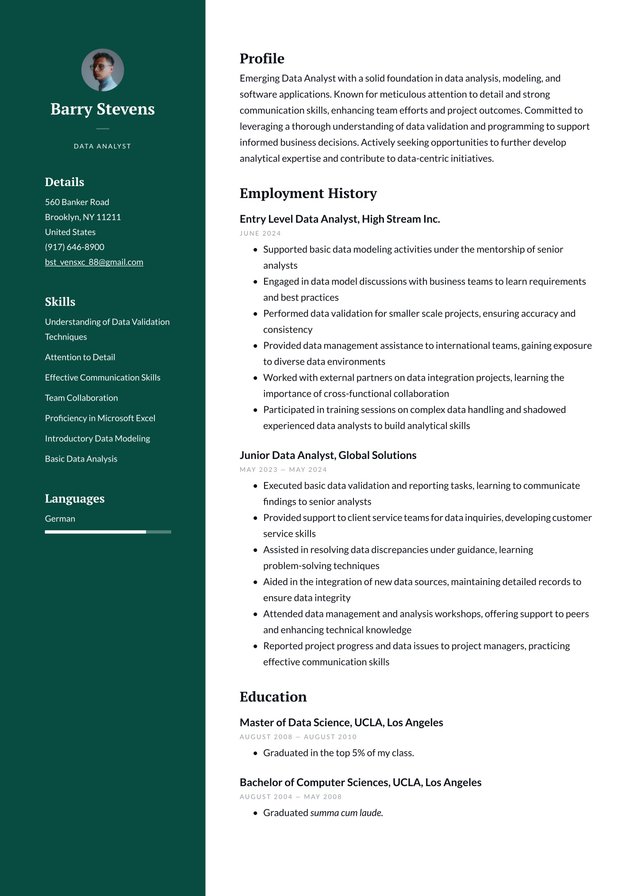
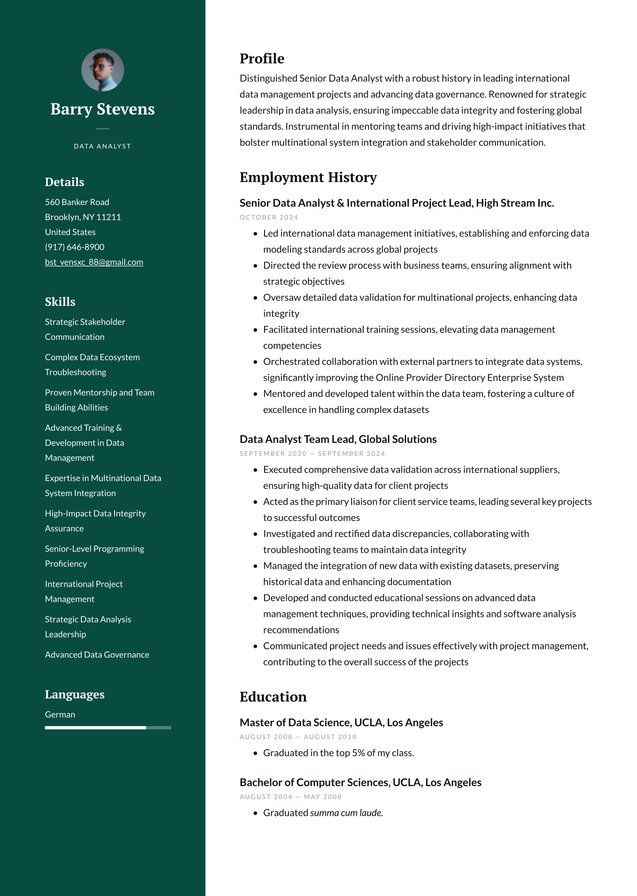
Data analyst roles attract hundreds of applicants, and a resume that lists tools without showing business results rarely makes it past the first screen. This guide gives you real data analyst resume examples alongside practical writing advice to help you build a resume that clears ATS filters, and impresses hiring managers, whether you are just starting out or targeting a senior role.
Related Resume Examples
Business Analyst resume example
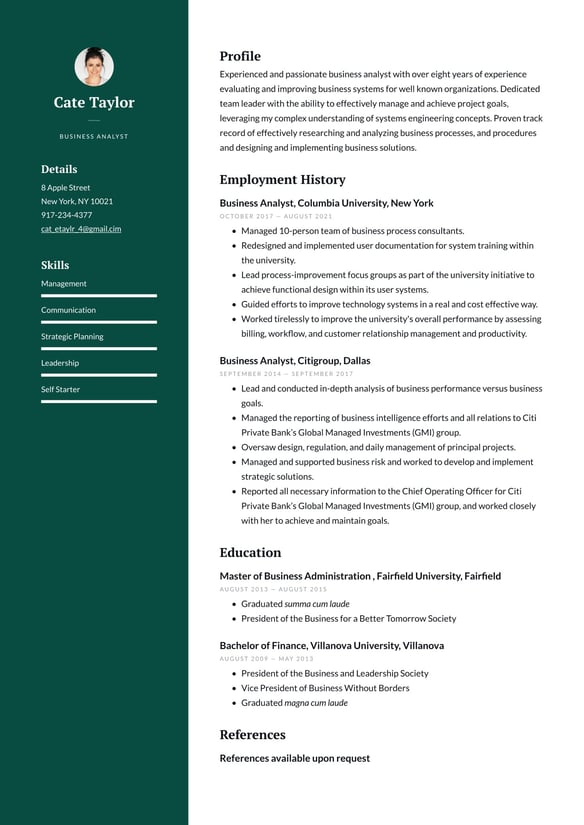
Made to match the analytical precision and strategic mindset of a Business Analyst, this template’s clean layout and structured sections spotlight your expertise in process improvement, leadership, and data-driven solutions—perfect for impressing decision-makers.
Data Scientist resume example

Shaped for analytical precision, this clean, structured layout spotlights your technical expertise and problem-solving skills as a Data Scientist. Its minimalist design highlights key achievements, helping you connect with data-driven teams and decision-makers.
Web Analyst resume example
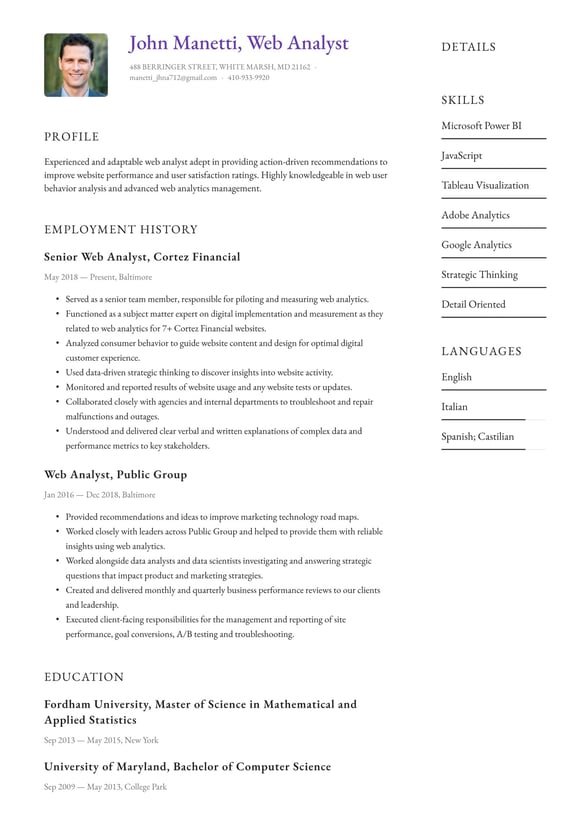
Geared toward data-driven professionals, this sleek, modern layout highlights your analytical expertise as a Web Analyst. Its clean structure and strategic formatting showcase technical skills and insights, impressing decision-makers in tech-focused environments.
Data Engineer resume example
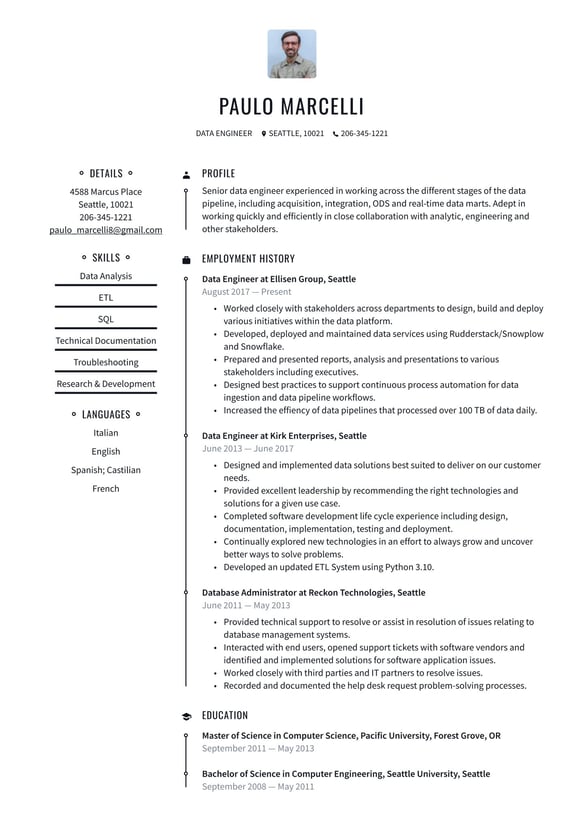
Geared toward data engineers, this sleek, grid-based layout highlights technical expertise and project achievements with precision. Its clean structure and subtle accents showcase your analytical skills and leadership, impressing both technical teams and executive stakeholders.
SQL Developer resume example
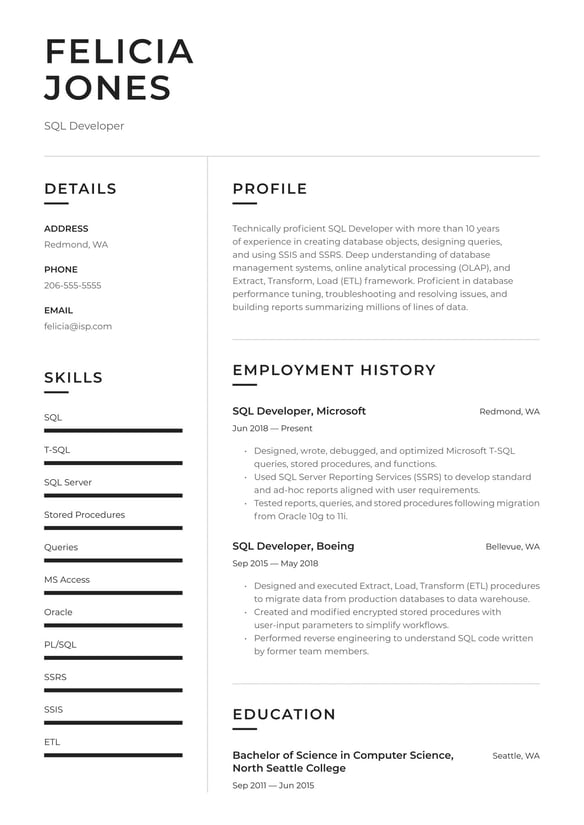
Structured for precision and clarity, this template highlights technical expertise with a clean, data-driven layout tailored to SQL Developers. Its organized sections and subtle accents showcase your database skills, ensuring your expertise resonates with hiring managers.
Tableau Developer resume example

Structured for data-driven professionals, this clean, modern layout highlights your analytical expertise and Tableau mastery. Its organized sections and bold headers showcase your technical skills and achievements, impressing hiring managers in BI and analytics roles.
Business Intelligence resume example
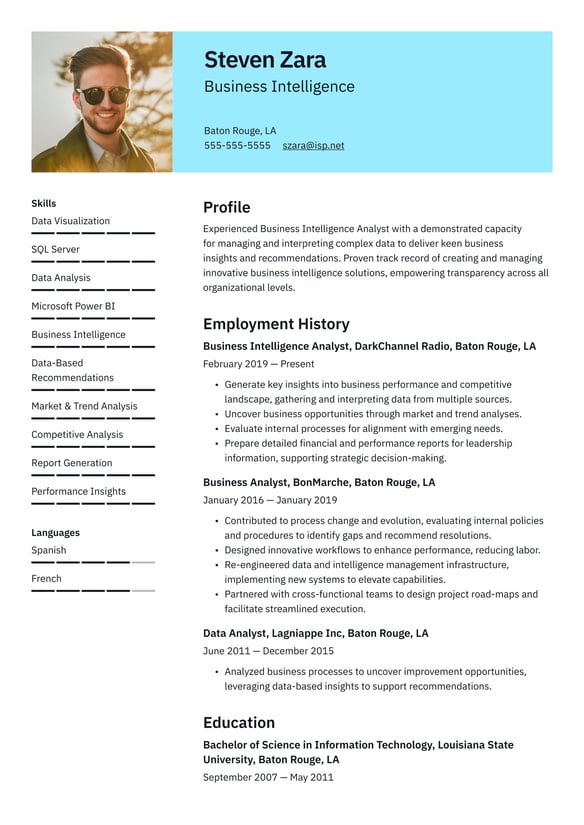
Structured for data-driven professionals, this sleek, modern layout spotlights your analytical expertise and strategic insights as a Business Intelligence Analyst. Its clean design and intuitive formatting amplify your skills, ensuring clarity and impact for decision-makers.
Marketing Analyst resume example

Structured for data-driven thinkers, this clean, modern layout spotlights your analytical expertise and marketing acumen as a Marketing Analyst. Its strategic use of white space and bold headers highlights achievements, ensuring clarity and impact for decision-makers.
How to write a data analyst resume
A strong data analyst resume follows a clear structure, uses the right keywords, and translates technical work into results the business cares about.
The four steps below give you a reliable framework to build from, regardless of your experience level.
1. Choose the right format and layout
Most data analysts should use a reverse chronological format, listing your most recent role first.
Recruiters want to see what you have done lately, and your current or most recent work is the strongest signal of where you are now.
If you are changing careers or have limited work history, a hybrid format balances your skills section with a shorter work history section.
A functional format, which leads with skills above everything else, is rarely recommended for data roles.
It hides the context recruiters need to assess your technical experience in practice, not just in theory.
On layout, keep things clean and simple:
- One column for consistent readability across ATS systems and PDF renders
- Standard fonts such as Arial, Calibri, or Garamond at 10 to 12pt
- Clear section headers in a consistent size
- Margins between 0.5 and 1 inch
- No graphics, icons, or tables inside the skills section
That last point matters more than most candidates realize because ATS parsers read your resume as plain text.
Graphics and tables do not convert cleanly, which means skills or achievements embedded inside them may never be seen by the system scoring your application.
Resume length follows experience level, so entry-level candidates should aim for one page.
Those with one to seven years of experience can extend to two.
Senior analysts with eight or more years may use two pages, though every line should earn its place.
2. Write a summary that shows your impact
Your summary sits at the top of the resume and sets the tone for everything that follows.
Two to four lines is enough to cover your years of experience, the core tools you rely on, the domain or industry you know best, and one achievement with a number attached.
A weak summary lists traits but a strong one shows proof:
- Weak: "Detail-oriented data analyst with strong communication skills seeking a challenging role."
- Stronger: "Data analyst with four years of experience using SQL, Python, and Tableau to support marketing and finance teams. Built automated dashboards that cut weekly reporting time by six hours and improved forecast accuracy by 18%."
The second version tells the reader exactly what tools you use, which teams you support, and what results you produce.
That combination is what prompts a recruiter to keep reading.
Entry-level candidates can reference education and projects in their summary if work experience is limited.
The key is to stay specific rather than aspirational.
"Data analyst graduate with hands-on Python and SQL experience, including a customer churn project analyzing 40,000 records" is far stronger than "motivated self-starter eager to grow in data."
3. Build your skills section for ATS and humans
Your skills section has two jobs: it helps ATS systems match your resume to the role, and it gives a hiring manager a fast read on your technical range.
Group skills by category rather than listing them in a single block.
This makes the section scannable and easier for ATS to parse correctly.
A well-structured skills section for a data analyst role might look like this:
- Languages: SQL, Python, R
- Business intelligence: Tableau, Power BI, Looker
- Databases: PostgreSQL, MySQL, Snowflake, BigQuery
- Analytics methods: A/B testing, statistical analysis, forecasting, ETL
- Tools: Excel, Git, Jupyter, Google Analytics
Research from Resume.io shows that 41% of recruiters look at the skills section first on a resume, which makes relevance and organization more important than length.
Only list tools you can speak to confidently in an interview.
4. Turn your experience into business outcomes
Your work experience section carries the most weight.
Each bullet point should follow the same logic: what you did, which tool or method you used, and what result it produced for the business.
Use this formula as your guide throughout: Action verb + tool or method + business result
Examples in practice:
- Analyzed customer churn data using SQL and Python, identifying retention drivers that improved retention by 12% over two quarters.
- Built Tableau dashboards for weekly executive reporting, reducing manual preparation time from eight hours to 30 minutes.
- Automated ETL pipelines with Python scripts, cutting processing time by 45% and improving accuracy across four reporting streams.
Start every bullet with an action verb and avoid passive constructions like "was responsible for" or "helped with."
Strong verbs for data roles include: analyzed, built, automated, modelled, developed, designed, optimized, identified, and presented.

What are the most important keywords to include in a data analyst resume?
The most important keywords are the tools, methods, and outcomes named in the job description you are applying for.
Matching your language directly to what each employer asks for is what clears ATS filters and resonates with the person reviewing your application.
That said, the terms below appear consistently across data analyst postings and are worth including where your experience genuinely supports them.
Technical tools and languages
- SQL, the single most requested skill across data analyst roles
- Python or R
- Tableau, Power BI, or Looker
- Excel, including pivot tables and Power Query
- Snowflake, BigQuery, or PostgreSQL
Methods and processes
- ETL (extract, transform, load)
- A/B testing
- Statistical analysis
- Data cleaning and transformation
- Forecasting
- Dashboard development
Business and outcomes language
- KPIs and metrics
- Stakeholder communication
- Decision support
- Revenue impact
- Efficiency improvement
A common error is listing tools without context.
"Python" on its own signals much less than "Python (Pandas, NumPy) for data cleaning and automation."
Specificity shows real experience and gives ATS systems more text to match against the job description.
Read each job posting carefully and note the exact phrasing used.
If an employer writes "data pipeline development" rather than ETL, use their wording.
If they say "self-service dashboards," reflect that language back.
These small alignment choices consistently make the difference between passing and failing automated screening.

How do I improve the ATS score for my data analyst resume?
To improve your ATS score, mirror the language in the job description, use a clean single-column layout, avoid graphics and tables inside your skills section, and save your file as a standard PDF or Word document.
These four changes address the most common reasons a resume fails automated screening.
ATS systems score resumes by matching your text against the job requirements.
They cannot read images or reliably interpret graphics.
Only 25% of resumes pass ATS screening, and 98% of Fortune 500 companies use these systems to filter applicants before a human ever sees the document.
The most effective steps to improve your score:
- Use exact phrases from the job description rather than synonyms: If the posting says "data visualization," use that phrase rather than "data presentation."
- Put your job title clearly at the top of each work history entry: ATS systems look for role titles to confirm relevance.
- Include a dedicated skills section: Embedding skills only inside experience bullets makes them harder for some systems to identify and score.
- Use standard section labels: Headers like "Career History" can confuse some parsers. Stick to: Work Experience, Skills, Education, and Certifications.
- Name your file clearly: For example: FirstName-LastName-DataAnalystResume.pdf.
One useful check before submitting is to paste your resume text into a plain text document and read it back.
If anything looks garbled, misaligned, or disappears entirely, your formatting may be causing problems in ATS systems.
What tools and skills should I list on a data analyst resume?
List the tools and skills that match the role you are applying for, grouped by category so both resume systems and the person reviewing your application can read them at a glance.
The categories below reflect what appears most consistently across data analyst job postings.
1. Querying and databases
SQL is the foundation of most data analyst roles and should appear on almost every application.
Include the specific databases you have worked with, such as PostgreSQL, MySQL, Snowflake, or BigQuery, rather than writing "databases" as a catch-all.
2. Programming languages
Python is increasingly expected rather than optional.
Include the libraries most relevant to your work: Pandas and NumPy for data manipulation.
Add Matplotlib or Seaborn for visualization, and Scikit-learn if you have worked on any predictive modelling.
R remains relevant in certain industries, particularly finance, healthcare, and academia.
3. Business intelligence tools
Tableau and Power BI are the most commonly requested.
If you know Power BI, mention DAX and Power Query specifically.
These details signal genuine depth rather than surface-level familiarity.
Looker and Qlik appear more often in enterprise and SaaS environments.
4. Cloud platforms
Cloud data tools are increasingly standard, especially at mid to senior level.
AWS (Redshift, S3), Google Cloud (BigQuery), and Microsoft Azure appear regularly in postings.
Even foundational familiarity is worth listing if it is accurate.
5. Spreadsheets
Excel remains a core tool across most organizations.
Highlight pivot tables, XLOOKUP, and Power Pivot where relevant rather than listing Excel as a single entry.
6. Soft skills
Data storytelling, stakeholder management, and cross-functional collaboration appear regularly in job descriptions.
These carry more weight in your summary and experience bullets than in a standalone soft skills list.
The table below shows the difference between naming a tool and demonstrating one:
| Tool | Average bullet | High-impact bullet |
|---|---|---|
| SQL | Used SQL to pull data from company databases | Optimized SQL queries using CTEs, reducing data retrieval time by 40% |
| Power BI | Created dashboards for the sales team | Built Power BI dashboards tracking real-time KPIs, cutting report preparation time by three hours weekly |
| Python | Used Python for data cleaning | Wrote Python automation scripts that saved the team 10 hours of manual processing each week |
What are the key elements to include in a data analyst resume?
A complete data analyst resume includes seven sections: contact information, a professional summary, a technical skills section, work experience, projects, education, and certifications or links.
Each section has a specific job to do, and handling any one of them poorly weakens the overall application.
Here is what each section needs to deliver:
- Contact information: Name, professional email, phone number, LinkedIn profile, and a portfolio or GitHub link if you have one. City and state is enough for location if you choose to include it.
- Professional summary: Two to four lines covering your experience level, the tools you rely on most, your domain or industry knowledge, and one measurable result. Make it specific to the role.
- Technical skills: Grouped by category, as covered in the tools section above. Keep it honest. Every item listed here is fair game in an interview.
- Work experience: Reverse chronological order. Each role should show your title, employer, dates, and three to five bullet points using the action-tool-result formula. Attach a figure to every outcome you can.
- Projects: Particularly important for entry-level candidates, career changers, and bootcamp graduates. For each project, describe the problem you were solving, the tools you used, your key findings, and include a link to GitHub or a public portfolio where possible. A well-documented project with clear methodology often outweighs a generic job title in an early-career application.
- Education: Degree, institution, and graduation year. Newer analysts can add relevant coursework or academic projects. Experienced analysts do not need GPA.
- Certifications and links: Google Data Analytics Certificate, Microsoft Power BI certification, Tableau Desktop Specialist, and AWS data analytics certifications are all worth including, particularly earlier in your career when they help compensate for a shorter work history.
How should I tailor my data analyst resume for different job applications?
To tailor your data analyst resume, identify the three to five requirements the employer emphasizes most, then make sure those appear in your summary, your skills section, and at least two experience bullets.
You do not need to rewrite everything, just target the parts of your resume that make the biggest difference to each reader.
Targeting is not only about keywords, it is about making a recruiter feel that your resume was written for their role rather than distributed to fifty companies.
A practical approach:
- Read the job description three times: First for the required skills, second for the business context, third for the exact language the employer uses to describe the role.
- Mirror their wording: If they write "business intelligence reporting," use that phrase. If they say "self-service dashboards," reflect it back.
- Reorder your skills: Put the tools they prioritize at the top of your skills section for that application.
- Adjust your summary: Swap in the most relevant achievement for each role. A retention analysis result carries more weight at a customer success company than it does in a finance function.
- Highlight the most relevant project: If applying to a marketing analytics role, lead with a marketing-related project rather than a financial dashboard example. If the role is in e-commerce, put your sales or conversion analysis work front and center.
Save a master version of your resume with your full experience and all your achievements listed.
From that, create tailored versions for each application.
This way you never lose content while keeping each submission tightly focused.
Tailoring your resume is not extra effort, it is the difference between applications that get read and those that do not.
What should I highlight in a data analyst resume summary?
Your summary should highlight your years of experience, the tools you rely on most, the domain or industry you know best, and one result with a number attached.
Two to four sentences is enough to answer the question a hiring manager has before reading anything else: what does this person do, and how well do they do it?
The summary is not the place for soft skills or career objectives.
Phrases like "passionate about data" or "seeking a challenging role" fill space without adding information.
Recruiters move through summaries in seconds, so every word needs to do a job.
What a strong summary includes:
- A clear role identity, such as "data analyst" rather than "results-driven professional"
- Years of experience and any relevant domain (finance, healthcare, e-commerce, SaaS)
- Two or three tools relevant to the role you are applying for
- One specific outcome with a figure attached
For experienced analysts, the summary should reflect seniority.
Mention cross-functional work, stakeholder influence, or team leadership where it is accurate.
For career changers moving into data analysis, the summary is the right place to bridge your previous background with your new direction.
A former marketing manager applying for a marketing analyst role has domain expertise that is genuinely valuable, and a well-written summary makes that connection immediately clear to the reader.
What makes an effective data analyst resume stand out?
The strongest data analyst resumes share one quality: they make it easy for a hiring manager to answer three questions in under 30 seconds.
What tools does this person know? What business problems have they solved? What measurable results did they produce?
When those answers are visible at a glance, the resume does its job.
The difference between a resume that gets read and one that does not usually comes down to a few consistent habits.
1. Specific results over task descriptions
"Created reports" says nothing.
"Built automated Power BI reports that reduced monthly reporting effort by 15 hours" tells a recruiter what you built, why it mattered, and what the outcome was.
Every bullet in your experience section should aim for that level of specificity.
Back each claim up with a figure wherever you can.
2. Business language alongside technical language
Analysts who describe only the technical process miss the bigger picture.
Recruiters and hiring managers, many of whom are not technical themselves, need to see the value your work created.
Translate your outputs into terms that resonate: retention improvement, cost reduction, revenue impact, time saved, or better decision-making at leadership level.
3. Formatting that works for ATS and for humans
A clean single-column layout with consistent headers and grouped skills passes automated screening and remains easy to navigate for the person reading it.
Anything decorative risks breaking the parser before your resume reaches a human.
4. Honest, focused content
A resume that lists every tool you have ever opened is less convincing than one that lists the ten you use confidently and can discuss in depth.
Depth over breadth signals genuine experience and hiring managers notice the difference.
Is the data analyst job market growing?
Yes, and significantly.
Data analysis is one of the fastest-growing fields in the US, with demand projected to rise by 35% over the next decade according to the Bureau of Labor Statistics.
That growth is being driven by businesses relying more heavily on data to guide decisions, and by the tools available to analyze that data becoming more powerful and accessible.
A few figures that put the opportunity in context:
- The global data analytics market is projected to grow from $7.03 billion in 2023 to $303.4 billion by 2030.
- The Bureau of Labor Statistics expects 59,400 more data science roles to exist in 2032 than exist today.
- Around 15% of data analytics roles sit within IT services and consulting, making it one of the largest single sectors for the field.
For job seekers, this matters beyond reassurance.
A growing field means more roles, more variation in the types of companies hiring, and more room to specialize over time.
A resume that is well-positioned now, with the right tools, clear results, and tailored language, puts you in a strong place to take advantage of that growth as it continues.
Frequently asked questions
These questions come up regularly from job seekers writing a data analyst resume for the first time or adapting one for a new stage in their career.
How do I write a data analyst resume with no experience?
Lead with a strong skills section and a projects section, placed above your work history.
Personal projects that use real datasets, work through end-to-end analysis, and present clear findings demonstrate genuine capability even without a job title to point to.
Kaggle competitions, bootcamp projects, coursework assignments, and publicly available datasets all provide material worth showcasing.
Write your summary around what you can do rather than apologizing for what you have not yet done.
What should I highlight in a senior data analyst resume?
Focus on leadership, cross-functional stakeholder work, and results at scale.
Move beyond individual task descriptions and concentrate on projects where you owned the analysis end to end, shaped a business decision, or guided a team.
Outcomes tied to revenue, cost savings, or operational efficiency carry the most weight at senior level.
Proficiency in more advanced tools such as dbt, Airflow, or Snowflake also signals the technical depth employers expect when hiring for experienced roles.
How can I make my entry-level data analyst resume stand out?
Be specific about the tools and methods you have used, even in academic or personal projects.
Hiring managers reviewing entry-level applications know you have limited experience.
What they are looking for is evidence of how you think and work.
A well-documented project with a clear problem statement, a described methodology, and a link to a public portfolio will consistently outperform a resume that lists skills without showing how they were applied.
Relevance and clarity matter more than volume.
How long should a data analyst resume be?
One page for students and those with under one year of experience.
One to two pages for analysts with one to seven years.
Two pages for senior analysts with eight or more years.
Regardless of level, every line should add something a recruiter could not reasonably infer.
A second page filled with padding weakens the application rather than strengthening it.
Should I include a portfolio link on my data analyst resume?
Yes, if your portfolio genuinely adds to what your resume already shows.
A GitHub profile with well-documented projects, a Tableau Public account with published dashboards, or a personal site with case studies all give the person reviewing your application a way to verify your skills beyond the bullet points.
Keep the link current and make sure any public work is something you are comfortable being asked about in detail during an interview.