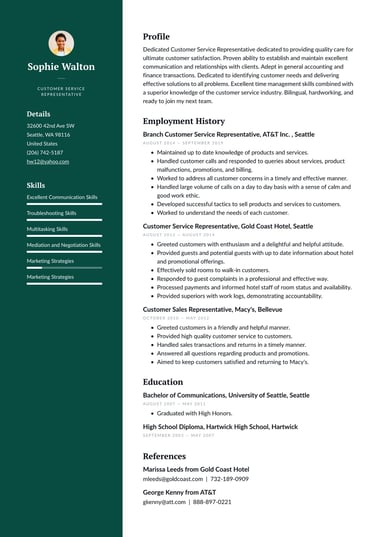

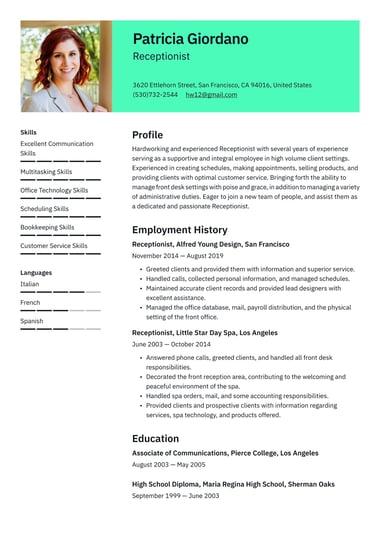
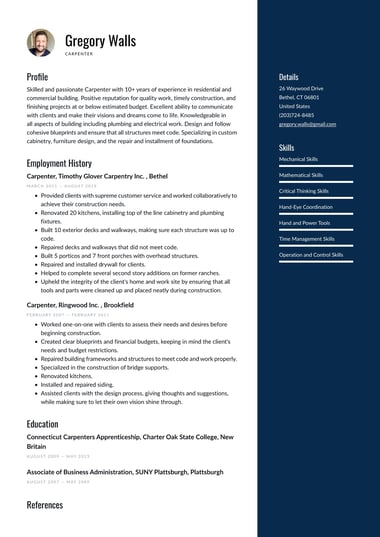
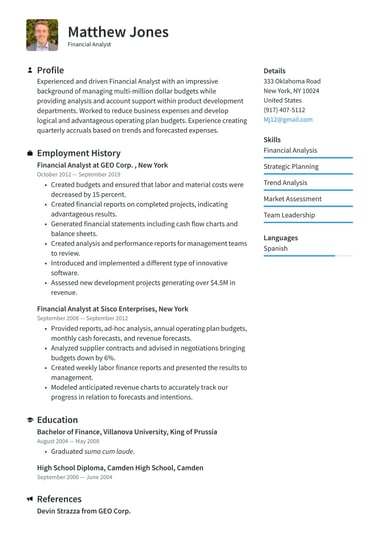
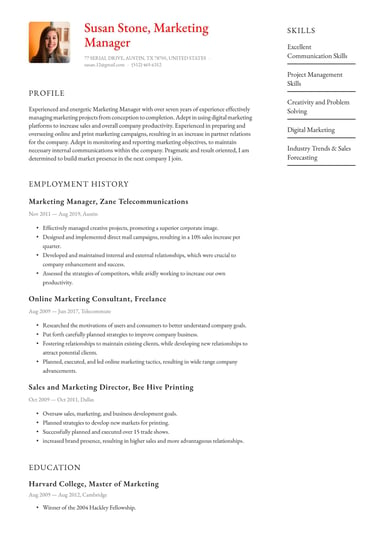
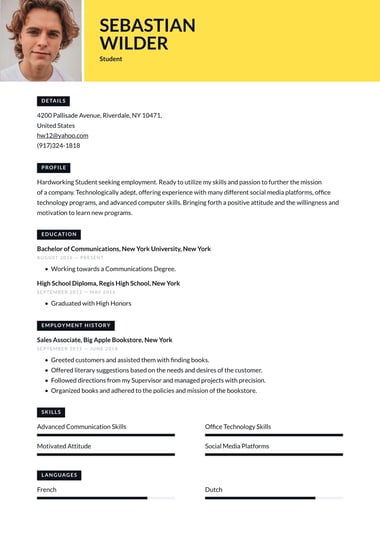
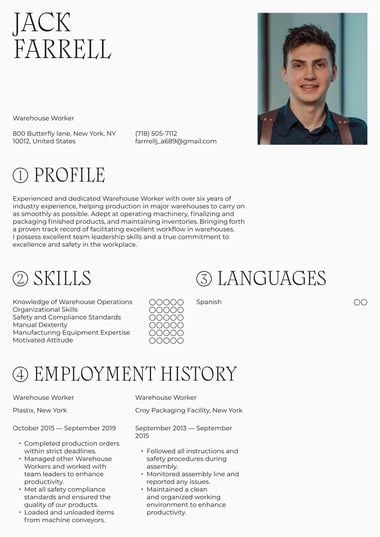
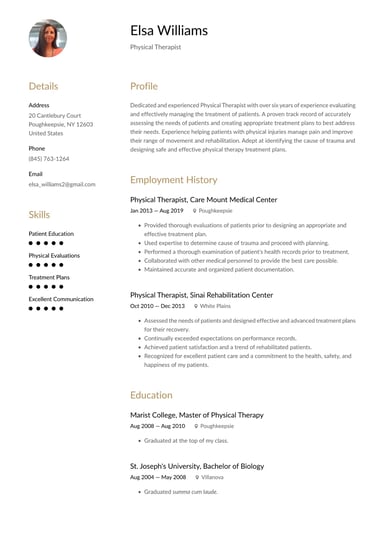
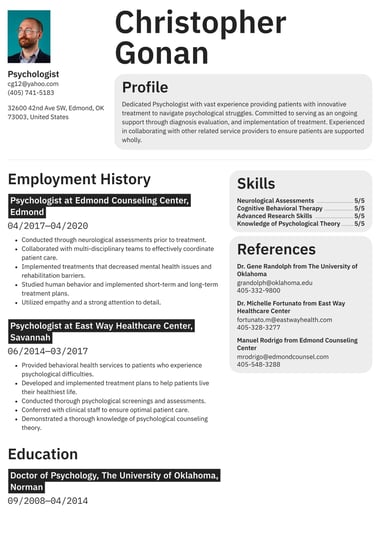
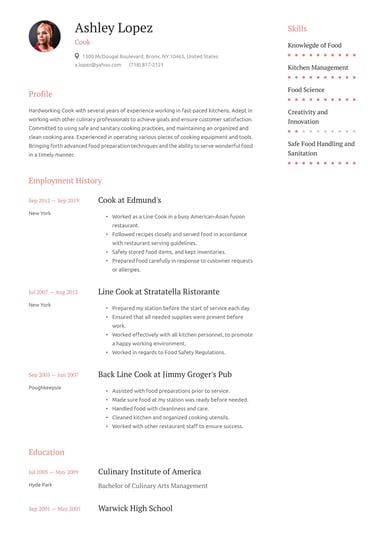
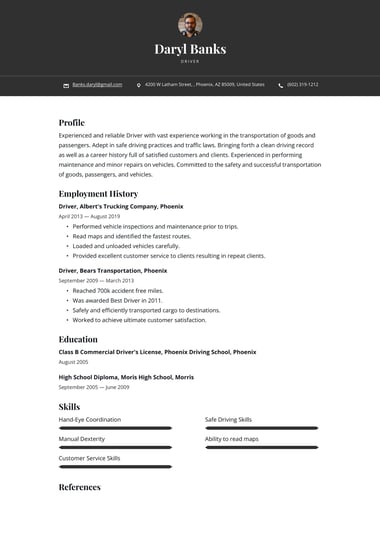
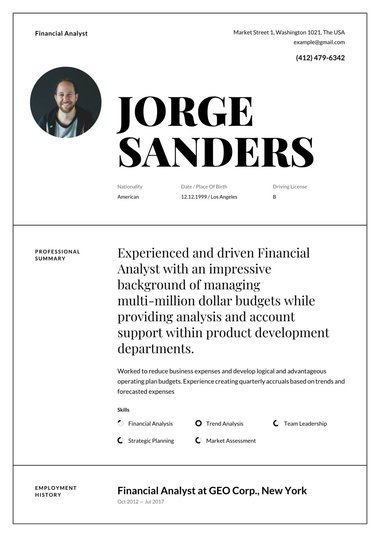
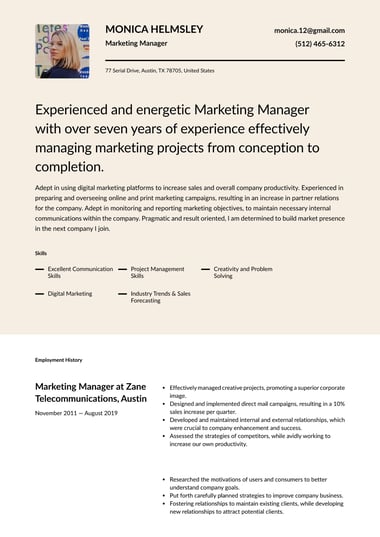
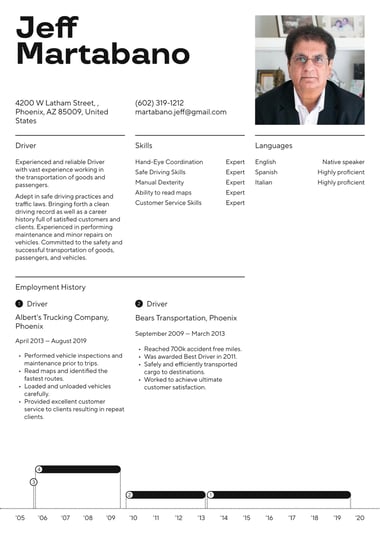
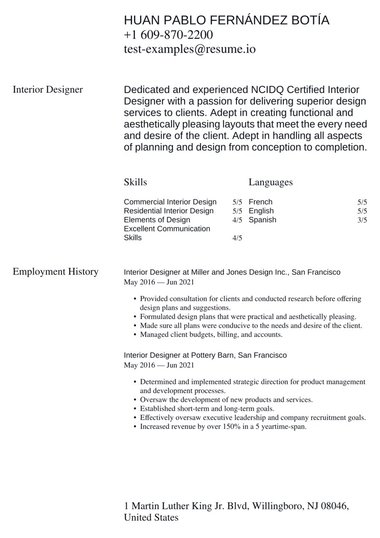
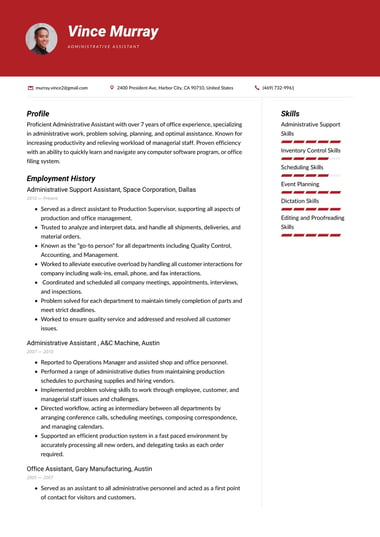
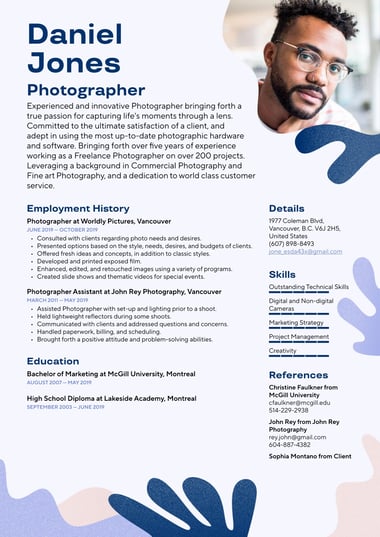
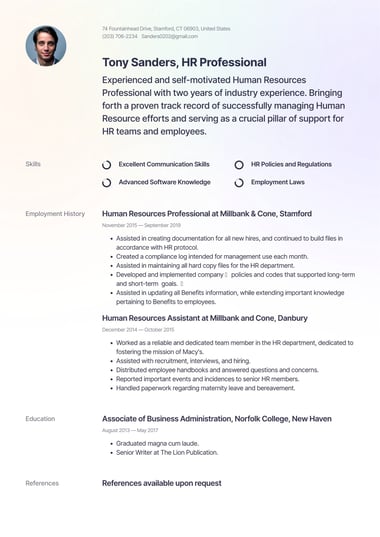
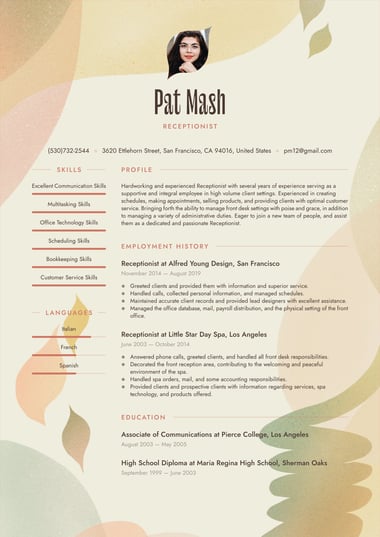
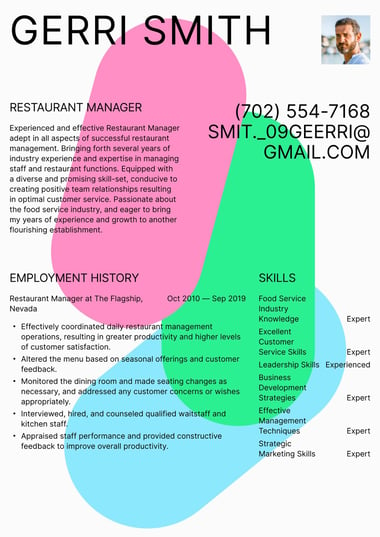


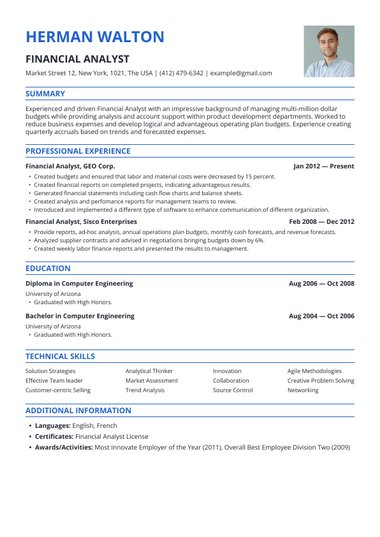
Resume.io picture resume templates give your headshot a set place at the top of the page, so it sits neatly beside your name and contact details.
Before you create a resume online with a photo, check whether the employer and country you are applying to actually expect one.
Is it appropriate to put a photo on your resume?
A photo on your resume is appropriate only when the employer asks for one, the country you are applying in expects one, or your role depends on your appearance.
For most US jobs, a photo is not necessary: including one is not unprofessional, but employers rarely expect it, and a headshot takes space away from your skills and experience.
A photo belongs on your resume if you can answer yes to any of these three questions, and it should stay off if all three answers are no:
- Does the job posting ask for a photo?
- Are you applying in a country where resume photos are standard?
- Does your work depend on your appearance, as it does in acting, modeling, or broadcast journalism?
Recruiters move quickly, and with 61% of hiring managers reading the experience section first (Resume.io, Resume Statistics Report, 2025), every inch given to a photo is space your achievements could use.
A photo also reveals details such as age, race, and sex, which US laws, including the Age Discrimination in Employment Act and Title VII of the Civil Rights Act, prohibit employers from using in hiring decisions.
That is why many US employers would rather not receive resume photos at all, even though including one is legal, and why your headshot is better placed on your LinkedIn profile and online portfolio, where recruiters expect to see it.

Which countries expect a photo on a resume?
Photo expectations depend on where you apply.
In the US, UK, Canada, Australia, Ireland, New Zealand, and South Africa, leave the photo off unless the role requires one, while in much of continental Europe, the Middle East, Latin America, and Asia, a professional headshot is common and sometimes expected.
| Region | Photo expected? | Examples |
|---|---|---|
| English-speaking countries | No | US, UK, Canada, Australia, Ireland, New Zealand, South Africa |
| German-speaking Europe | Common | Germany, Austria, Switzerland |
| Southern and Western Europe | Common, often optional | France, Spain, Italy, Belgium, Portugal |
| Middle East | Common | United Arab Emirates, Saudi Arabia, Qatar |
| East Asia | Often expected | Japan, China, South Korea |
| South and Southeast Asia | Common | India, Philippines, Thailand, Malaysia |
| Latin America | Common | Brazil, Mexico, Argentina |
Norms are shifting in several countries, including Germany, where anti-discrimination rules mean employers cannot require a photo, even though many applicants still include one out of custom.
Before you apply, read the job posting, look at how employees at the company present themselves on LinkedIn, and follow any application guidelines the employer provides.

What if a US job posting asks for a photo?
If a US job posting asks for a photo, include one if you want to be considered, and make sure it is a professional headshot.
Requests are most common for appearance-based roles, such as acting, modeling, and on-camera work, but they occasionally appear in hospitality and customer-facing jobs too.
A few points help you handle the request well:
- Follow the instructions: Use the format and size the employer asks for, and send the photo the way they specify.
- Keep it professional: Use the same headshot standards as any resume photo, with a plain background and interview-ready attire.
- Keep your resume photo-free elsewhere: Customizing your resume for each application means using a version without a photo everywhere else.
- Trust your judgment: When a photo request seems unrelated to the job, it is reasonable to ask the employer why it is needed before you apply.
Pros and cons of a picture resume
A picture resume can help in creative fields and in countries where photos are standard.
In the US and other English-speaking markets, the drawbacks usually outweigh the benefits, since a photo can invite bias and take space from your experience.
Pros
- Builds a personal connection: Recruiters see the face behind the name, which can make your application more memorable.
- Supports creative and client-facing roles: When your work relies partly on your appearance or personal brand, a photo reinforces your visual identity.
- Meets international norms: In countries where photos are standard, including one keeps your application in line with local expectations.
Cons
- Can invite bias: A photo reveals details such as age, race, and sex, which have no bearing on your ability to do the job.
- Not standard in English-speaking markets: Recruiters in the US, UK, Canada, and Australia rarely expect a photo, so one can look out of place.
- Takes up space: A headshot uses room that could hold another achievement or more relevant skills, such as a hard or soft skill or in-demand AI skills.
- Harder for some systems to read: Applicant tracking systems cannot read images, and some image-heavy layouts parse poorly.
How do you add a photo to your resume?
Add a photo in the top corner of your resume, next to your name and contact details, at roughly passport-photo size.
Use a template with a dedicated photo space so the image does not push the key parts of your resume out of place, and keep all key information as text rather than inside the image.
- Pick a template with a photo slot: Picture resume templates reserve space at the top, so your layout stays balanced.
- Place it near your name: Top left or top right works best, beside your contact information.
- Keep it small: About the size of a passport photo is enough, so your name, summary, and experience still lead the page.
- Use a high-quality file: Upload a sharp JPG or PNG that stays clear when printed.
- Export as a PDF: A PDF keeps the photo and layout in place, unless the employer requests another format.
- Keep a version without a photo: For US applications and online portals, send a photo-free version built on a classic resume template or one of our ATS resume templates.
How to choose a photo for your picture resume
Choose a recent, professional headshot with good lighting, a plain background, and your full face visible.
Dress the way you would for an interview in your field, and use the same photo across your resume, LinkedIn, and portfolio so your personal brand stays consistent.
- Use a professional headshot: Frame the photo from the chest up, with natural makeup, professional attire, and good lighting.
- Choose high quality: Use a high-resolution image, and print on a color printer if you submit a hard copy.
- Keep it simple: Crop the photo tightly, with no props or busy backgrounds.
- Keep it current: Use a photo that looks like you today, and refresh it whenever you are updating your resume.
- Stay consistent: Match the photo on your resume to your LinkedIn profile or online portfolio.
- Dress for your field: Wear professional attire for corporate roles, while a smart casual look is fine for creative ones.
- Smile naturally: A relaxed, natural expression reads as approachable and confident.
Photos to avoid: selfies, group shots, full-body photos, sunglasses or hats, heavy filters or editing, and anything taken at a party or on vacation.
An outdated or overly casual photo is one of the more avoidable resume mistakes, and the same resume tips that shape your content apply to the headshot: keep it current, relevant, and professional.
Job-specific example picture resumes
For fields where a photo is encouraged, these templates include it without sacrificing space or distracting the hiring manager.
Browse more effective resumes by job title, or explore the full range of resume templates to compare designs with and without a photo.
Vienna template
Best suited for creative professionals, like photographers, where a visual identity is key.
Madrid template
Useful in industries like real estate, where personal branding may help establish trust with clients.
Lisbon template
Ideal for roles like motion graphics artists, where showcasing creativity is important.
Key takeaways
- A resume photo is appropriate only when the employer asks for one, the country expects one, or your role depends on your appearance.
- In the US and other English-speaking countries, leave the photo off and put your headshot on LinkedIn instead.
- Photos are common or expected in much of continental Europe, the Middle East, Latin America, and Asia.
- Including a photo is legal in the US, but employers cannot use it to make hiring decisions based on age, race, sex, or other protected traits.
- When you do include a photo, keep it small, place it near your name, and keep a photo-free version for other applications.
Frequently asked questions
A few questions come up often when deciding whether to use a picture resume template.
Is it okay not to put a picture on a resume?
Yes, leaving the photo off is the standard choice in the US, UK, Canada, and Australia, where recruiters do not expect one and a photo-free resume keeps the focus on your experience.
Add a photo only when the employer, the country, or the role calls for it.
Is it illegal to put a photo on your resume in the US?
No, it is not illegal to include a photo on your resume in the US.
What is illegal is an employer making hiring decisions based on age, race, sex, or other protected traits a photo can reveal, which is why many US employers prefer resumes without photos.
Can a picture resume pass an ATS?
Yes, a picture resume can pass an ATS if the rest of the content is text-based.
Applicant tracking systems skip the image itself, so your name, contact details, and experience must appear as regular text, never inside the photo or a graphic.