

The best AI skills to put on a resume are prompt engineering, generative AI tools like ChatGPT and Claude, workflow automation, and AI-assisted data analysis, and you do not need to be technical to list them.
What matters most is showing how you used AI to reach a measurable result, not just naming the tools you have tried.
The sections below cover which skills to include, how to match them to your profession, and how to phrase them so recruiters and applicant tracking systems take notice.
What are the best AI skills to put on a resume?
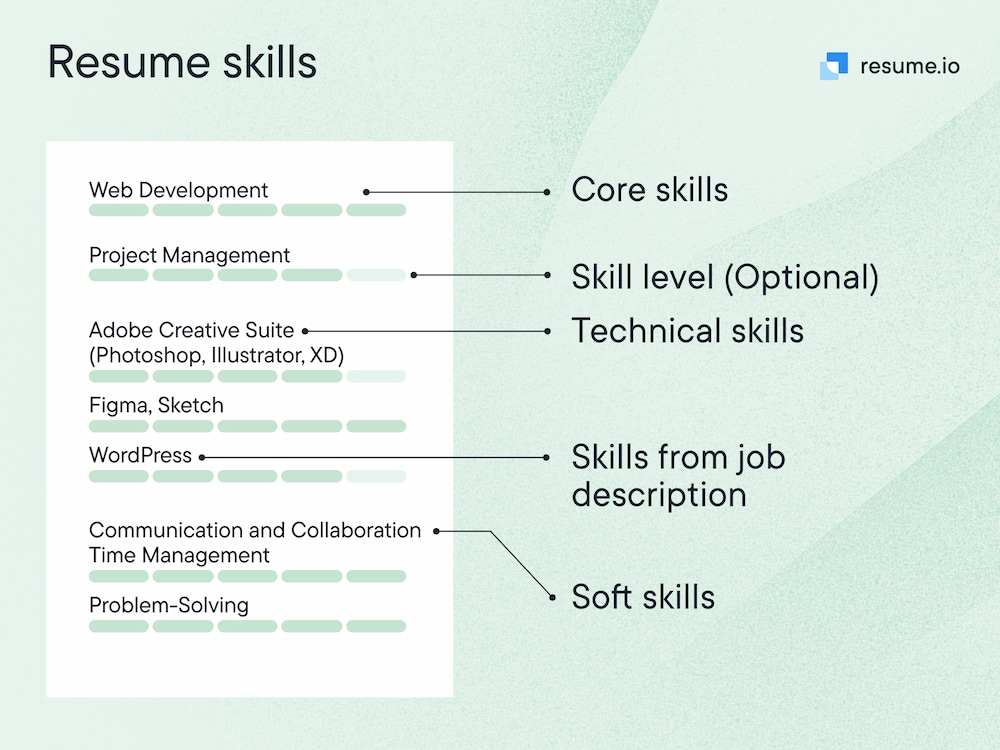
The best AI skills for a resume fall into two groups: practical skills almost any professional can use, and technical skills for specialist roles.
Most job seekers should lead with practical skills, because these now apply across finance, healthcare, marketing, and operations, not only technology teams.
Practical AI skills that suit nearly every role include:
- Prompt engineering: Writing clear, specific instructions that get accurate, useful results from tools like ChatGPT, Claude, or Google Gemini.
- Generative AI tools: Using assistants such as ChatGPT, Microsoft Copilot, and Midjourney to draft content, summarize information, or create images.
- Workflow automation: Connecting tools with platforms like Zapier to remove repetitive manual work.
- AI-assisted analysis: Using AI to interpret data, spot patterns, and support decisions.
- AI literacy: Understanding what AI can do, where it falls short, and how to use it responsibly.
Technical AI skills suit data, engineering, and research roles, and carry more weight there:
- Machine learning and deep learning: Building and training models, often with TensorFlow or PyTorch.
- Natural language processing: Developing tools that understand and generate human language.
- Python and SQL: Writing code to build AI systems and manage the data that feeds them.
- Model deployment and MLOps: Moving models into live use and keeping them accurate over time.
The right mix depends on your target role.
A marketing manager and a machine learning engineer both benefit from AI skills, but the specific ones they highlight should look very different.
What AI skills matter most for your profession?
The AI skills that matter most are the ones tied directly to your target role, so a marketing resume should feature very different skills from an engineering or HR resume.
Recruiters scan for relevance first, which means role-specific AI skills carry far more weight than a generic list.
The tables below break down high-impact AI skills by profession, what each one does, and how to show it on a resume.
AI marketing skills
Marketing teams adopted AI early, so these skills are now close to expected for content, campaign, and growth roles.
| Skill | What it does for the role | How to show it on a resume |
|---|---|---|
| AI content generation | Speeds up drafting of copy, emails, and social posts | Tie it to output volume or time saved |
| SEO and ad optimization tools | Improves targeting and search visibility | Quote a change in traffic or click-through rate |
| Audience and campaign analytics | Turns customer data into sharper targeting | Name the metric you improved |
| Prompt engineering | Produces on-brand, usable AI output faster | Mention a prompt library or workflow you built |
AI skills for programmers
For software and data roles, employers want proof you can build with AI, not just use it.
| Skill | What it does for the role | How to show it on a resume |
|---|---|---|
| AI-assisted coding | Speeds up writing, reviewing, and debugging code | Reference a tool such as GitHub Copilot and the time saved |
| Machine learning frameworks | Builds and trains models for real systems | Name TensorFlow or PyTorch and the model outcome |
| Retrieval-augmented generation | Grounds AI in company data for accurate answers | Describe the system you built and its accuracy gain |
| Model deployment and MLOps | Keeps models running reliably in production | Quote a release-time or stability improvement |
AI skills for HR
Recruiting and people teams use AI to handle high candidate volumes, so these skills signal both efficiency and fairness.
| Skill | What it does for the role | How to show it on a resume |
|---|---|---|
| AI resume screening tools | Sorts large applicant pools faster | Mention volume handled or time-to-shortlist |
| Talent and people analytics | Informs hiring and retention decisions | Quote a retention or hiring metric you moved |
| HR workflow automation | Removes repetitive admin from onboarding and scheduling | Name the process you automated |
| Responsible AI use | Reduces bias risk in hiring decisions | Describe a fairness or compliance step you led |
Creative AI skills
Design and creative roles now blend human direction with AI tools, so the aim is to show judgment, not just tool access.
| Skill | What it does for the role | How to show it on a resume |
|---|---|---|
| AI image generation | Produces concepts and assets quickly | Tie it to assets produced or turnaround time |
| AI video editing | Speeds up cuts, captions, and revisions | Quote time saved per project |
| Generative design workflows | Explores more options in less time | Describe how it changed your process |
| Creative direction with AI | Guides AI output toward a clear brief | Frame yourself as the decision-maker, not the tool |
AI communication skills
As AI handles more routine drafting, the human ability to interpret and judge its output becomes more valuable, especially in cross-functional roles.
| Skill | What it does for the role | How to show it on a resume |
|---|---|---|
| Critical evaluation of AI output | Catches errors and hallucinations before they ship | Describe a review process you owned |
| Data storytelling | Explains what AI-processed numbers mean for the business | Quote a decision your analysis informed |
| AI-human collaboration | Keeps human judgment in the loop on AI work | Frame yourself as the final reviewer |
| Translating technical concepts | Bridges technical and non-technical teams | Name the two groups you connected |
Practical AI skills
These everyday skills apply to almost any non-technical role and are usually the easiest to prove with a quantified bullet.
| Skill | What it does for the role | How to show it on a resume |
|---|---|---|
| AI productivity tools | Saves time on routine daily tasks | Quote hours saved per week |
| AI-assisted research | Speeds up gathering and summarizing information | Tie it to a faster turnaround |
| AI-driven reporting | Automates recurring reports and documentation | Quote the reduction in prep time |
| No-code automation | Connects apps without writing code | Name the workflow and what it replaced |

How do you list AI skills on a resume?
To list AI skills on a resume, place them where recruiters and applicant tracking systems will find them, then prove each one with a specific result.
Recruiters often spend only seconds on a first scan, so your AI skills need to be easy to spot and backed by evidence.
Follow these steps:
- Pull the AI keywords from the job description. Match the exact terms the employer uses, such as prompt engineering or machine learning, so your resume aligns with the role and clears the ATS.
- List named tools in your skills section. Group AI tools and platforms clearly, for example ChatGPT, Copilot, and Python, so they parse cleanly and scan fast.
- Prove the top skills in your work experience. Write bullet points that show how you applied AI to a real task and what changed as a result.
- Add training in your education or projects section. Include AI courses, certifications, or self-built projects, which helps most if you are early in your career or changing fields.
- Read it back for honesty. Every AI skill listed should reflect something you can actually discuss in an interview.
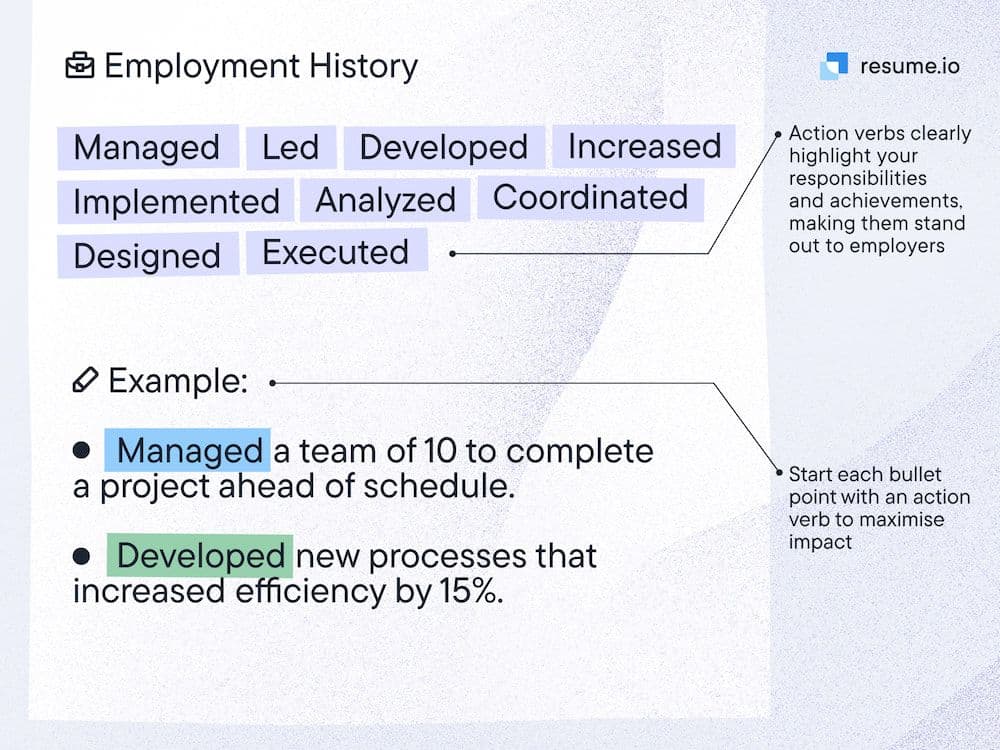
The single most effective way to phrase an AI skill is with a simple formula:
Action verb + AI tool or method + purpose + measurable result.
This turns a flat label into proof.
The contrast below shows the difference between a weak entry and a strong one:
| Weak entry | Strong entry |
|---|---|
| AI tools: ChatGPT, Copilot | Used ChatGPT and Microsoft Copilot to automate weekly reporting, cutting preparation time by 40% |
| Prompt engineering | Built and maintained a prompt library that lifted content output by 60% |
| Machine learning | Deployed machine learning models in Python that improved churn prediction accuracy by 18% |
The strong versions work because they name the tool, the task, and the outcome.
Each strong entry leads with an action verb, which is what makes a skill credible to a hiring manager and quotable to an applicant tracking system.
Where should AI skills go on your resume?
AI skills belong in three places: your skills section, your professional summary, and your work experience, with the right emphasis for each.
The skills section is for fast matching, the summary is for framing, and the work experience section is where you prove impact.
Using all three reinforces the same message without repeating it word for word.
| Section | Purpose | What to include |
|---|---|---|
| Skills section | Quick scanning and ATS matching | Named tools, platforms, and methods in a clean list |
| Professional summary | Framing your value up top | One or two sentences linking AI skills to results |
| Work experience | Proving real impact | Quantified bullets showing AI used on the job |
| Education or projects | Showing growth and initiative | Certifications, courses, and self-built AI projects |
A common mistake is repeating the same AI skills identically in every section.
Instead, name the tool in your skills list, frame it in your summary, and prove it through your accomplishments in the experience section.
Even one strong bullet showing AI used to save time or improve a result can carry real weight with employers who understand the technology.

What AI skills are employers looking for in 2026?
In 2026, employers increasingly want candidates who can apply AI to real work, not just describe it.
The demand has shifted from "Can you use AI?" to "How effectively can you build AI into your workflow?"
Across most industries, a handful of skills now stand out as a shared baseline.
The AI skills currently in highest demand include:
- Prompt engineering: Including advanced techniques like setting constraints and reducing AI errors
- Generative AI tool proficiency: Hands-on use of platforms such as ChatGPT, Claude, and Copilot
- Workflow automation: Using no-code tools to connect AI to everyday tasks
- AI-human collaboration: Acting as the human reviewer who checks AI work for accuracy and nuance
- AI ethics and governance: Understanding data privacy, bias, and responsible use.
This demand is grounded in real investment.
Most companies (92%) plan to invest more in AI technology over the next few years (McKinsey & Company AI in the Workplace, 2025).
Employers also want evidence over labels, so the AI skills that stand out are the ones attached to a clear outcome, such as a named tool that cut a process time or lifted a result, rather than a vague claim of being "AI-savvy."
How can you improve your AI skills?
You can improve your AI skills through a mix of short courses, hands-on practice, and staying current as tools change.
The fastest progress usually comes from applying AI to real tasks rather than only studying it, because employers value demonstrated use over theory.
Workplace use is climbing quickly, the share of US employees using AI on the job rose from 21% to 40% between 2023 and 2025 (Gallup, 2025).
To build AI skills you can put on a resume:
- Take a structured course. Platforms like Coursera and Udemy offer beginner options, and Google AI runs free introductions such as Google AI Essentials.
- Build a small project. Automate a task or create something with a generative tool, then document the process and result.
- Earn a relevant certification. Credentials such as Microsoft Azure AI Fundamentals add credibility and useful keywords.
- Stay current. Follow a short AI newsletter or digest so you keep pace with new tools.
You do not need to master everything.
Outside AI-focused roles, employers rarely expect deep expertise, so showing steady learning and practical use is often enough to stand out.
Which AI skills should you leave off your resume?
Leave off AI skills you cannot back up, outdated claims, and anything irrelevant to the role.
A resume has limited space, and every weak line works against the strong ones.
Listing a tool you have barely opened can also backfire in an interview, where you may be asked to explain it.
Avoid these on an AI resume:
- Skills you cannot demonstrate. If you cannot describe how you used it and what happened, leave it off
- Vague buzzwords. Phrases like "AI wizard" or "AI-savvy" say nothing on their own
- Irrelevant tools. Skills that do not connect to the target role only dilute your resume
- Exaggerated expertise. Claiming deep machine learning skill you do not have is easy to expose.
There is one important nuance.
Employers value AI skills, but many are wary of resumes that appear entirely AI-written.
Using AI to brainstorm or sharpen your bullet points is sensible, but the final resume should sound like you and reflect your real experience.
The goal is to show you can work with AI thoughtfully, not that you handed the whole task to a machine.
Are there any certifications or courses to highlight AI skills on a resume?
Yes, several respected certifications and courses can strengthen the AI skills on your resume, and they help most when you pair the credential with proof you have used the skill.
Certifications signal commitment and add useful keywords, but on their own they carry less weight than a real example of applying the tool.
Employers want to see that the learning translated into work.
Credentials worth highlighting include:
- Google AI Essentials: A short, beginner-friendly course covering everyday AI use, good for non-technical roles.
- Microsoft Azure AI Fundamentals: A recognized entry-level certification that pairs well with cloud and data roles.
- AWS Certified AI Practitioner: A solid choice for candidates targeting technical or engineering positions.
- Coursera and Udemy specializations: Flexible options, including free courses, that cover machine learning, prompt engineering, and generative AI.
List these in your education or certifications section, then reinforce them elsewhere on the page.
If a course led to a project or a result at work, mention that outcome in your experience section so the credential connects to something real.
It is also worth choosing credentials strategically, since the AI certifications most worth adding to a resume vary by role and industry.
Key takeaways
- Lead with practical AI skills like prompt engineering, generative AI tools, workflow automation, and AI-assisted analysis, since these now apply across almost every industry.
- Match your AI skills to your profession, a marketing resume should feature different AI skills from an engineering or HR resume.
- Phrase every AI skill with a measurable result using the formula: action verb, AI tool, purpose, and outcome.
- Place AI skills across your skills section, summary, and work experience, but vary the wording rather than repeating them identically.
- Leave off any AI skill you cannot explain in an interview, and avoid submitting a resume that reads as entirely AI-generated.
Frequently asked questions
A few questions come up often when adding AI skills to a resume.
Should I put ChatGPT as a skill on my resume?
Yes, if you have used it for relevant, professional tasks.
Rather than listing "ChatGPT" alone, show how you used it, for example to automate research or draft reports, and include the result.
That phrasing is far more convincing to a hiring manager than a tool name on its own.
What AI skills are most in demand?
Prompt engineering, generative AI tool proficiency, workflow automation, and AI-human collaboration are among the most in-demand skills in 2026.
Employers across industries now treat basic AI fluency as an expectation, and they consistently prefer candidates who can show measurable outcomes over those who only list tools.
Do you need AI skills if you are not in tech?
No, AI skills are not mandatory outside tech, but they are an increasingly strong advantage.
Companies in finance, healthcare, marketing, and many other fields now use AI tools daily.
Showing that you can use AI to save time or improve a result can set you apart, even in a non-technical role.