


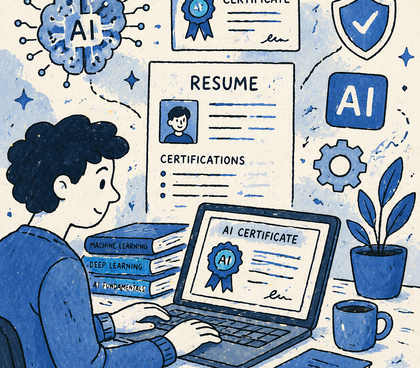
AI certifications can strengthen your resume when they show practical, job-relevant skills such as prompt engineering, machine learning, or AI strategy.
The most valuable certifications come from recognized providers like Google, IBM, or Microsoft and match the level and focus of the role you are applying for.
Which AI certifications are best for a resume?
The best AI certifications for a resume depend on your career level and goals, but employers consistently value programs from recognized providers like Google, IBM, Microsoft, and AWS.
Strong options focus on practical AI skills such as prompt engineering, machine learning, or AI strategy, and clearly connect to the type of role you are targeting.
| Career goal | Certification | Provider | Best for |
|---|---|---|---|
| Beginner (general AI) | Google AI Essentials | Entry-level understanding of AI tools and workflows | |
| Beginner (non-technical) | AI For Everyone | DeepLearning.AI | Business-focused introduction to AI concepts |
| Technical engineering | IBM AI Engineering Professional Certificate | IBM | Machine learning and AI model development |
| Cloud AI | Azure AI Engineer Associate | Microsoft | AI solutions using cloud platforms |
| Cloud AI | AWS Machine Learning – Specialty | Amazon Web Services | Advanced ML and cloud-based AI systems |
| Business & leadership | AI Adoption: Driving Business Value | MIT | Strategy, implementation, and ROI of AI |
| Operations | PSM AI Essentials | Scrum.org | Applying AI in agile and team workflows |
| Marketing with applied AI | AI for Marketing | HubSpot | Using AI in campaigns and customer strategy |
| Specialized roles | Generative AI for Marketing | University of Virginia | AI in marketing and customer experience |
| Specialized roles | Generative AI for Legal Services | Vanderbilt University | AI applications in legal work |
You do not need multiple certifications to make an impact.
One or two well-chosen courses that match your target role are more effective than listing several unrelated programs.
For example, a marketing professional benefits more from applied AI certifications than a technical machine learning course they will not use.
Employers are not just looking for proof that you have studied AI.
They want to see that you understand how it applies to real work.
Choosing certifications that align with your day-to-day responsibilities makes your resume stronger and easier to evaluate.
How do I choose the right AI certification for my resume?
To choose the right AI certification for your resume, focus on relevance to your target role, the credibility of the provider, and the practical skills you will gain.
The best choice is not the most advanced or expensive course, but the one that clearly supports the type of work you want to do.
1. Start with your target role
Look at job descriptions you are applying for or aiming toward.
Identify whether they require AI skills for technical work, business strategy, or tool usage.
Your certification should match those expectations directly.
2. Choose the right level
Beginner courses are valuable if you are new to AI or changing fields.
More advanced certifications only make sense if you already use AI in your work or are applying for technical roles.
3. Prioritize recognized providers
Certifications from companies like Google, Microsoft, or IBM are easier for recruiters to evaluate.
They signal standardization and credibility, especially during resume screening.
4. Focus on practical outcomes
Choose courses that teach usable skills such as prompt engineering, data analysis, or AI implementation.
Avoid certifications that are purely theoretical or too broad to demonstrate impact.
5. Limit how many you include
One or two relevant certifications are usually enough.
Listing too many can dilute your resume and make it harder for hiring managers to understand your strengths.
Most hiring managers are scanning quickly, not analyzing every course in detail.
A well-chosen certification acts as a clear signal of capability, especially when it reinforces your existing experience.
If it does not connect to your work or the job you want, it adds little value.
This is especially important for AI, where interest is high but expectations are still forming.
Employers are looking for practical understanding, not just exposure to the topic.
Are AI certifications worth it on a resume?
Yes, AI certifications are worth including on a resume when they show practical, job-relevant skills and come from credible providers.
They are especially useful for early-career professionals or career changers, but they do not replace experience or guarantee job offers.
Certifications help signal that you are building relevant AI skills, especially if your experience does not yet reflect them.
However, employers still prioritize how you apply those skills in real situations.
A certification is most effective when it supports your experience or shows how you use AI tools in your work.
How do I list AI certifications on a resume?
List AI certifications in a dedicated certifications section or within your education section, depending on their relevance and importance.
Include the certification name, provider, and completion date, and only add certifications that clearly support the job you are applying for.
Use this structure when adding AI certifications:
- Certification name
- Provider (organization or platform)
- Completion date
Example:
Google AI Essentials, Google, 2025
Where to place AI certifications
- Certifications section: Best if you have multiple certifications or they are important for the role.
- Education section: Works well for recent graduates or if the certification supports your academic background.
- Skills or projects section (optional): Only if you actively use AI tools and want to show application, not just completion.
Keep your certifications easy to scan.
Hiring managers typically spend only a few seconds reviewing each resume, so clear formatting matters as much as the certification itself.
If the certification is highly relevant, you can also reference it in your experience section by showing how you apply those skills in your work.

Can I take AI courses online for my resume?
Yes, you can take AI courses online and include them on your resume, as long as they come from credible providers and teach practical skills.
Many respected AI certifications are fully online, including programs from Google, IBM, and universities, making them accessible regardless of your location or experience level.
Online AI courses are now the standard, not the exception.
Employers are familiar with platforms like Coursera, edX, and LinkedIn Learning, and they recognize certifications from major providers delivered through these platforms.
The key is not whether the course is online, but whether it is relevant and reputable.
A short, focused course that teaches usable skills is often more valuable than a longer program that does not connect to your target role.
What to look for in an online AI course
- Recognized provider (Google, IBM, Microsoft, universities)
- Clear learning outcomes (prompting, automation, data analysis)
- Practical application, not just theory
- Reasonable completion time you can explain in an interview
Which AI certifications should I avoid on a resume?
You should avoid AI certifications that are not relevant to your target role, come from unknown providers, or do not teach practical skills.
Certifications only add value when they help employers understand what you can do, not just what you have completed.
Common mistakes to avoid
- Unrecognized or low-credibility providers: If a recruiter cannot easily identify the source, the certification carries less weight.
- Overly generic courses: Broad “introduction to AI” courses without clear skills can be difficult to evaluate.
- Too many certifications: Listing several unrelated courses can dilute your resume and make your focus unclear.
- Outdated or irrelevant topics: Certifications that do not reflect current tools or your target role add little value.
Employers are not counting how many certifications you have.
They are looking for clear signals that you understand how to apply AI in a real work context.
A smaller number of relevant, recognizable certifications is easier to assess and makes your resume better overall.
Key takeaways
- The best AI certifications come from recognized providers like Google, IBM, and Microsoft and match your target role
- One or two relevant certifications are more valuable than listing many unrelated courses
- Certifications are most effective when they show practical, job-ready skills
- Online AI courses are widely accepted, as long as they are credible and relevant
- Certifications support your resume, but they do not replace experience or proven results
FAQs for AI certificates
These quick answers cover common questions about choosing and using AI certifications on your resume.
Are free AI certifications valuable?
Yes, free AI certifications are valuable if they come from reputable providers and teach practical skills.
Employers focus more on relevance and credibility than cost, so a well-chosen free course can strengthen your resume just as much as a paid one.
Which AI certification is most in demand?
AI certifications from major providers like Google, Microsoft, and IBM are among the most in demand because they are widely recognized and aligned with industry tools.
The most relevant certification depends on your role, such as machine learning for technical jobs or generative AI for business roles.
How many AI certifications should I list on my resume?
Most candidates should list one to three AI certifications, depending on their relevance.
Including too many can make your resume harder to scan and reduce clarity, while a small number of targeted certifications keeps your focus clear for employers.


