


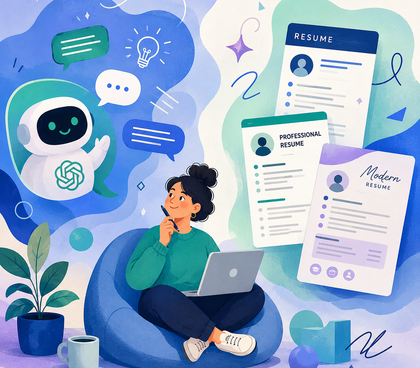
ChatGPT can help you write and refine resume content but an AI resume builder creates a complete, formatted, ATS-ready document from scratch.
For most job seekers, the best approach combines both: use ChatGPT to sharpen your language, then build and export your resume through a purpose-built tool like the Resume.io AI resume builder.
What is the difference between ChatGPT and an AI resume builder?
| ChatGPT | Resume.io AI resume builder | |
|---|---|---|
| Purpose | General writing assistant | Dedicated resume creation platform |
| ATS compliance | None built in | Built in by default |
| Formatting and templates | None, text only | Professional templates, PDF export |
| Job description matching | Manual (you prompt it) | Automatic keyword scoring |
| Resume scoring | No | Yes, target 90%+ for best results |
| Cover letter tool | Generic output | Job-specific cover letter generator |
| Job matching | No | Yes, matches your resume to live jobs |
| Hallucination risk | High, may invent metrics or details | Low, draws only from what you provide |
| Speed | Moderate, depends on prompt quality | 5x faster than writing independently |
| Cost | Free tier; Plus plan $20/month | Free to start; affordable paid plans |
| Who built it | OpenAI | Recruiters and HR professionals |
ChatGPT is a general-purpose AI writing tool, whereas a top AI resume builder is a dedicated platform built specifically to create job applications.
They do different things, and understanding that distinction is the most important step before deciding how to use them.
ChatGPT responds to prompts.
You describe your experience and it generates text.
It does not know your industry's ATS standards, cannot produce a properly formatted document, and has no direct connection to job listings.
The quality of its output depends almost entirely on how well you prompt it.
The AI resume builder works differently.
It guides you through the process, generates content based on your job title and field, scores your resume against job descriptions in real time, and exports a properly structured PDF that ATS systems can parse.
Built by recruiters and tested by HR professionals, it draws on millions of successful applications.
The firm answer: AI resume builders are better
For most job seekers, a dedicated AI resume builder is the stronger choice.
It handles formatting, ATS compliance, scoring, and job matching automatically, things ChatGPT cannot do.
ChatGPT is a useful addition for refining specific bullet points or rephrasing content, but it is not a resume builder and should not be used as one.
If you are starting from scratch, need a polished and export-ready document, or want to tailor your resume to a specific job listing, start by using AI resume builder.
Bring ChatGPT in afterward if you want to rework specific sections.
Is an AI resume builder or ChatGPT better for writing resume content?
An AI resume builder produces stronger resume content for most job seekers because it is trained on your specific field and draws only from the experience you actually provide, not a statistical average of every resume ever written.
Unedited ChatGPT output tends to cluster around the same constructions: "results-driven professional," "spearheaded cross-functional initiatives," "leveraged data-driven insights."
When everyone uses the same general tool with the same prompts, applications begin to sound identical.
There is also an accuracy risk: ChatGPT does not know your real work history, and a weak prompt will fill the gaps with invented metrics and responsibilities that are not yours.
ChatGPT can add value when used to refine a specific bullet point or adjust tone, but it should not be the tool you use to write your resume from top to bottom.
How do they compare on price?
ChatGPT is free to use at a basic level, with the more capable GPT-4o model available on the Plus plan at $20 per month.
The Resume.io AI resume builder is free to start, you can create a basic resume and test the AI writing tools at no cost.
For access to all templates, unlimited AI assistance, and the full ATS scoring and job-matching features, there are affordable paid plans.
For most job seekers, the free tier of the builder is enough to see whether it works for them before committing to anything.
Which is better for formatting and ATS compliance?
The AI resume builder is the clear choice here, ChatGPT produces plain text with no formatting capability, no template system, and no knowledge of how ATS software parses documents.
When you generate content in ChatGPT, you still need to copy it into a word processor, format every section manually, and export to PDF, which typically adds 45 minutes or more and often produces a document that breaks ATS parsing entirely.
ATS systems are used by the large majority of employers to filter applications before a human ever sees them, and a resume that fails that screening is invisible, you do not receive a rejection, you receive silence.
Resume.io's AI resume builder identifies keywords from your target job description, structures sections in the order hiring systems expect, and exports clean PDFs that pass digital screening automatically.
The built-in scoring tool shows you exactly where your application stands and what to improve before you submit.
Who is each tool best for?
The right choice depends on where you are in the process and what you need the tool to do.
| Use the Resume.io AI resume builder if... | Use ChatGPT if... |
|---|---|
| You are building a resume from scratch | You already have a formatted, ATS-compliant resume |
| Your existing resume is outdated or overdue a full refresh | You only need to rephrase or reposition specific sections |
| You need a formatted, export-ready PDF | You are repositioning experience for a career change |
| You want automatic keyword matching to a job description | You want to adjust tone for a specific employer |
| You are not confident writing about your own experience | You want to strengthen individual bullet points quickly |
| You want ATS compliance handled without manual effort | You prefer open-ended prompting over a guided process |
For most job seekers, the builder is the right starting point and ChatGPT is a useful finishing tool, not the other way around.
How do you use ChatGPT and an AI resume builder together?
For job seekers who want to draw on both tools, the most effective workflow is sequential: create your resume in a resume builder first, then use ChatGPT to refine specific sections before your final export.
1. Start in the Resume.io AI resume builder
Enter your work history, job titles, and target role.
The builder generates suggested content for each section based on your field and experience, this is your structured, ATS-ready starting point.
2. Score your resume against the job description
Paste the job posting into the builder and it will identify missing keywords and show your match score.
Aim for 90% or above.
Export a draft and download your formatted resume to review the full document in context.
3. Take specific sections to ChatGPT for refinement
If you want to strengthen a bullet point or adjust tone for a particular employer, paste that section with a clear instruction, for example: "Rewrite this bullet point to emphasize leadership rather than process, using only the details provided."
Apply only suggestions that accurately reflect your experience, and remove any invented metrics before submitting.
4. Return to the builder for your final version
Paste refined content back in, re-run the ATS score, and export your final PDF.
This approach gives you the formatting compliance and job-matching intelligence of the builder, with the language flexibility of ChatGPT where it adds genuine value.
The builder handles the structure; ChatGPT handles the polish.
Do jobs check if you used ChatGPT on your resume?
Most employers do not run formal AI detection software on resumes but what hiring managers say they notice is quality: applications that sound generic, list responsibilities without achievements, and use identical phrasing to thousands of others.
The real risk of unedited ChatGPT output is not detection, it is dilution: when your resume reads like every other application, it does not stand out.
Nvidia's Chief Software Architect Jonathan Ross, speaking at the Sohn Investment Conference in May 2026, reframed the conversation entirely.
Citing a 2025 academic study on AI self-preferencing in hiring, he noted that candidates whose applications were written using AI were 23% to 60% more likely to be shortlisted when processed by a compatible AI screening model.
"AI likes to use AI," he said.
That finding means AI-assisted resume writing is not the liability many assume, it can improve your chances when the tool is built for recruitment and trained on real hiring outcomes, which is exactly what separates a dedicated builder from a general-purpose chatbot.

Is it okay to make a resume with ChatGPT?
Yes, using AI to help write your resume is not dishonest, and most hiring processes do not prohibit it.
What matters to employers is whether your resume accurately reflects your skills and experience, not which tool you used to draft it.
ChatGPT on its own produces a draft, not a finished resume, without formatting, ATS optimization, or job-specific keyword matching, the burden of all those steps falls on you, and unedited output tends to read as generic.
The AI resume builder was designed to address every one of those limitations: content trained on real hiring outcomes, resume templates reviewed by HR professionals, ATS compliance built in, and output that sounds like you rather than a statistical average of every resume ever written.
Key takeaways
- ChatGPT is a writing assistant, not a resume builder. It cannot format documents, check ATS compliance, or match your application to a job description without significant manual effort.
- A dedicated AI resume builder like Resume.io handles the full process: content generation, keyword optimization, ATS-ready formatting, and PDF export in a single workflow.
- The most effective approach for most job seekers is to build in the platform first, then use ChatGPT to refine specific bullet points before final export.
- Research cited by Nvidia's Chief Software Architect in 2026 found that AI-written resumes can be 23-60% more likely to be shortlisted by AI screening systems, making purpose-built AI tools an active advantage in modern hiring.
- The risk of AI-assisted resumes is not detection. It is unedited, generic output that makes applications blend together. Purpose-built tools reduce that risk by generating job-specific content drawn from your actual experience.

Frequently asked questions
The questions below address what job seekers most often want to know about using AI for their resume.
Can ChatGPT pass ATS screening?
Not reliably. ChatGPT produces text without any knowledge of how ATS systems parse documents.
Formatting choices that look correct in a word processor, tables, columns, graphics, often fail ATS parsing entirely.
A dedicated AI resume builder with built-in ATS compliance is a far more reliable route to getting your application in front of a human reviewer.
What is the best way to use ChatGPT for resume writing?
Use it for language refinement on specific sections, not for generating your full resume from top to bottom.
Give it a clear prompt with real details from your own experience, ask it to strengthen a bullet point or adjust tone, and verify that every suggestion accurately reflects what you achieved.
Check everything against your real work history before submitting.
Should I tell employers I used AI to write my resume?
You are not required to disclose it, and most job postings do not ask.
What matters to employers is that your resume is accurate and genuinely represents your experience.
If everything on it is true and you can speak to it in an interview, how you drafted it is not the issue.


