

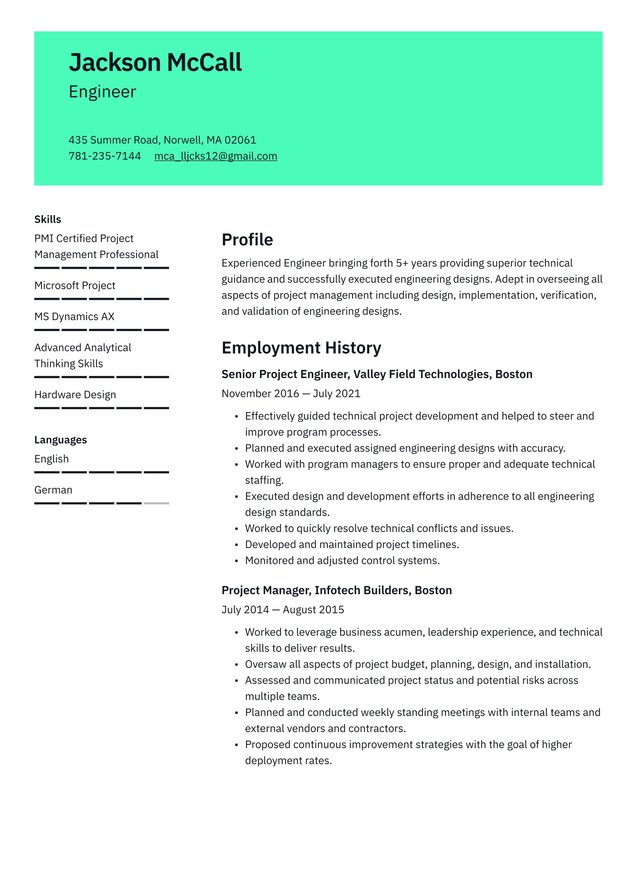
Experienced Engineer bringing forth 5+ years providing superior technical guidance and successfully executed engineering designs. Adept in overseeing all aspects of project management including design, implementation, verification, and validation of engineering designs.
11/2016 - 07/2021, Senior Project Engineer, Valley Field Technologies, Boston
- Effectively guided technical project development and helped to steer and improve program processes.
- Planned and executed assigned engineering designs with accuracy.
- Worked with program managers to ensure proper and adequate technical staffing.
- Executed design and development efforts in adherence to all engineering design standards.
- Worked to quickly resolve technical conflicts and issues.
- Developed and maintained project timelines.
- Monitored and adjusted control systems.
07/2014 - 08/2015, Project Manager, Infotech Builders, Boston
- Worked to leverage business acumen, leadership experience, and technical skills to deliver results.
- Oversaw all aspects of project budget, planning, design, and installation.
- Assessed and communicated project status and potential risks across multiple teams.
- Planned and conducted weekly standing meetings with internal teams and external vendors and contractors.
- Proposed continuous improvement strategies with the goal of higher deployment rates.
09/2014 - 05/2016, Master of Science in Systems Engineering, Boston University, Boston
09/2009 - 05/2013, Bachelor of Science in Computer Engineering, Northwestern University, Chicago
- English
- German
- PMI Certified Project Management Professional
- Microsoft Project
- MS Dynamics AX
- Advanced Analytical Thinking Skills
- Hardware Design
An engineering resume has one job: to prove you can turn technical skill into measurable results before a hiring manager finishes their first scan. Whether you build bridges, circuits, or software, this guide walks you through every decision, from format to keywords to the mistakes that quietly sink strong candidates. Below you will find adaptable examples for the most common engineering specialties, ready to tailor to your own experience.
Related Resume Examples
Civil Engineer resume example

Aligned with the precision and structure required in civil engineering, this template’s clean layout and organized sections highlight your technical expertise and leadership. Its professional design ensures your skills resonate with clients and stakeholders.
Mechanical Engineer resume example

Optimized for precision and professionalism, this clean, structured layout highlights your technical expertise and problem-solving skills as a Mechanical Engineer. Its balanced design emphasizes your achievements, helping you impress both technical teams and decision-makers.
Electrical Engineer resume example

Customized for Electrical Engineers, this sleek, grid-based layout highlights your technical expertise and problem-solving skills. Its clean structure and subtle accents emphasize your achievements, ensuring your qualifications resonate with hiring managers in engineering-focused industries.
Structural Engineer resume example

Created for structural engineers, this clean, grid-based layout highlights precision and organization—key traits for your field. Its balanced formatting showcases technical expertise and project achievements, ensuring your skills resonate with clients and employers alike.
Software Engineer resume example
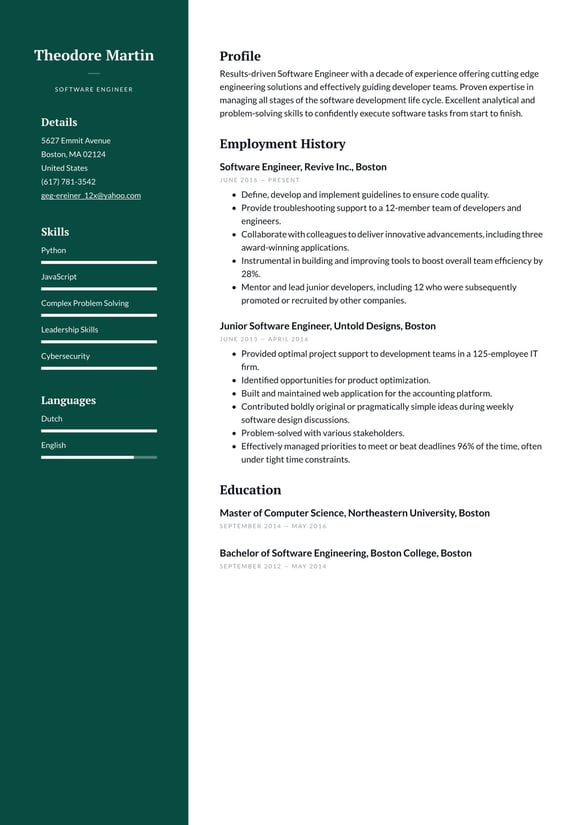
Engineered for precision and clarity, this sleek, modern template spotlights your technical expertise and leadership skills as a Software Engineer. Its clean layout and structured sections amplify your achievements, impressing hiring managers in tech-driven industries.
Senior Software Engineer resume example
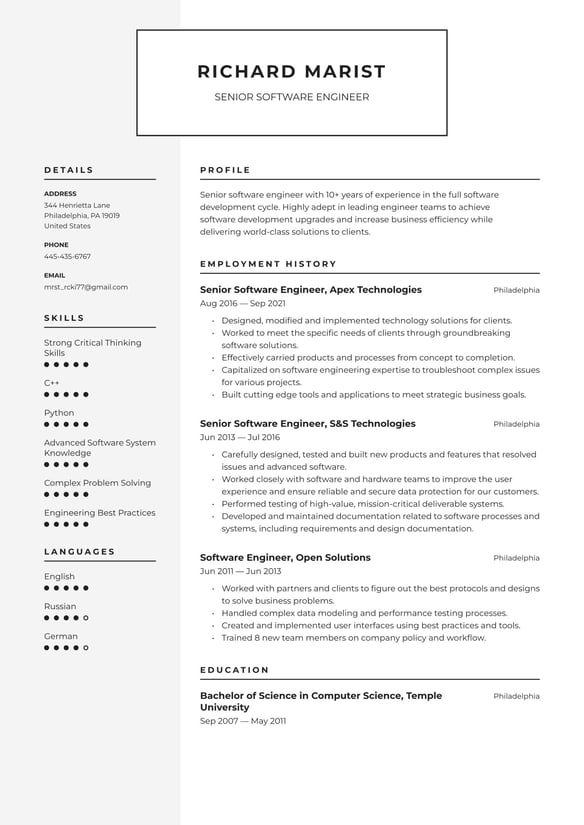
Designed for showcasing technical mastery and leadership, this clean, modern layout highlights your engineering expertise and team impact as a Senior Software Engineer. Its structured sections emphasize achievements, making your skills shine for hiring managers.
Data Engineer resume example
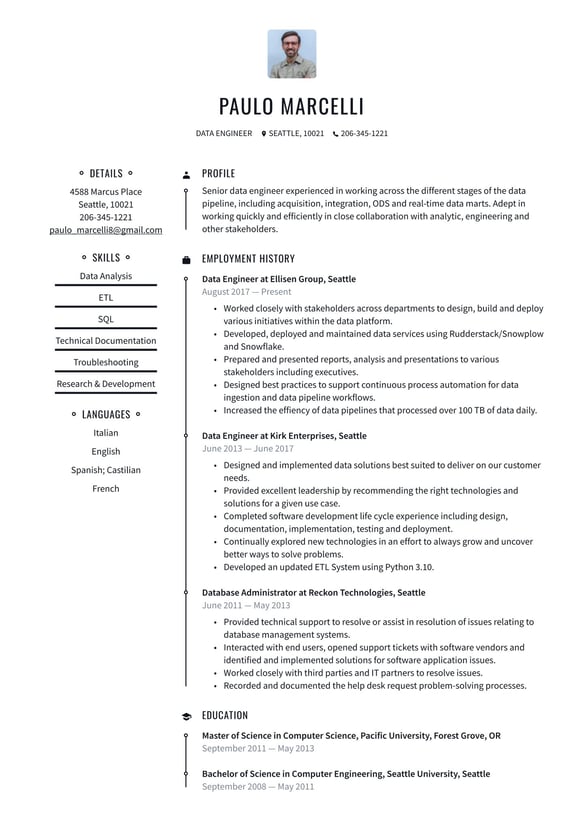
Created for data engineers, this clean, grid-based layout highlights your technical expertise and problem-solving skills with precision. Its structured design emphasizes key achievements, helping you connect with data-driven teams and decision-makers effortlessly.
Engineering Manager resume example

Focused on clean lines and a structured layout, this template highlights your leadership and technical expertise as an Engineering Manager. Its balanced design emphasizes key achievements, helping you inspire confidence in both teams and executives.
DevOps Engineer resume example
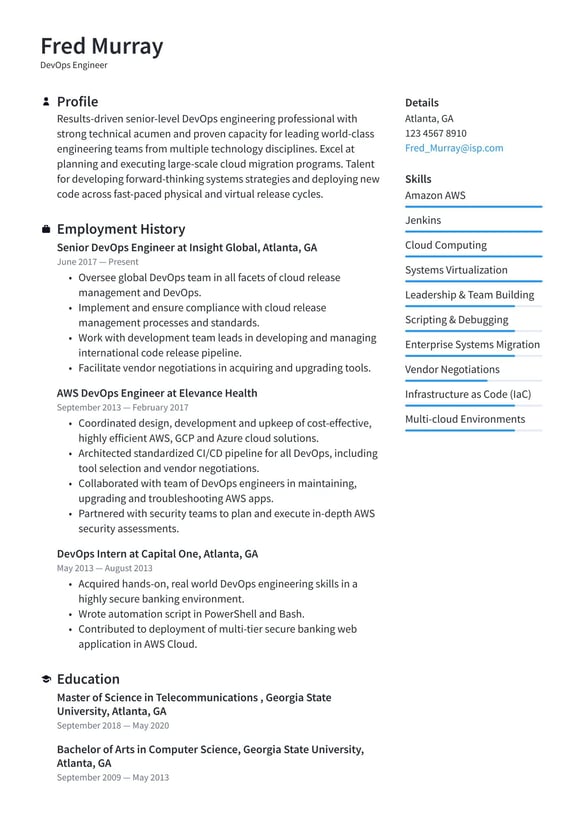
Crafted for tech-savvy innovators, this clean, structured layout spotlights your technical expertise and leadership skills as a DevOps Engineer. Its balanced design highlights key achievements, ensuring your cloud and CI/CD mastery resonates with hiring managers.
These examples show what effective engineering resumes look like across the field's major specialties.
Because engineering is a family of professions rather than a single job, start with the example closest to your discipline: mechanical engineer, chemical engineer, structural engineer, systems engineer, or AI engineer.
How to write an engineering resume
Writing an engineering resume comes down to four clear steps that apply across every discipline.
Work through them in order and you will have a complete, focused document.
Step 1: Open with a focused summary
Your summary is three to four lines that name your discipline, your years of experience, and your strongest measurable result.
Hiring managers reviewing engineering candidates decide within seconds whether the specialty matches their opening, so state it plainly in the first line.
- Example: "Civil engineer with 6 years of experience delivering municipal water infrastructure projects up to $12M on time and within budget."
Step 2: Lead with measurable achievements
Engineers document outcomes for a living, and your resume should read the same way.
Replace duty statements with achievements that carry a number: cost saved, efficiency gained, downtime cut, or deadlines beaten.
- Example: "Redesigned hydraulic assembly process, increasing production output by 25% and delivering the project two weeks ahead of schedule."
Step 3: Match the job description
Every engineering posting names specific tools, methods, and standards, and those exact terms are what recruiters and screening software search for.
Mirror the language of the posting wherever it honestly describes your experience.
- Example: A posting asking for "finite element analysis" should see "finite element analysis" on your resume, not "structural simulation."
Step 4: Choose a clean, ATS-safe format
A single-column layout with standard headings ensures your resume passes ATS systems without losing content.
Skip graphics, tables of skills, and text boxes, because parsing software often drops them entirely.
- Example: Use plain headings such as "Work experience," "Skills," and "Education" rather than creative labels like "My toolbox."
What are some effective ways to format an engineering resume?
Reverse chronological is the strongest format for almost every engineering resume because it puts your most recent projects and titles first, which is exactly where recruiters look.
A functional or hybrid layout only makes sense in narrow cases, such as a career changer moving between engineering disciplines.
The table below shows when each option fits.
| Format | Best for | Watch out |
|---|---|---|
| Reverse chronological | Most engineers with a steady work history | Gaps stand out, so be ready to explain them |
| Hybrid | Engineers pivoting between specialties | Skills section can crowd out achievements |
| Functional | Rare cases with minimal work history | Recruiters and parsing software trust it least |
How do you turn engineering duties into achievements?
Turn an engineering duty into an achievement by adding what you changed and how you measured it.
The before-and-after examples below show how routine lines on an engineering resume become evidence a recruiter can compare.
| Duty-only bullet | Achievement bullet |
|---|---|
| Planned and executed engineering designs | Designed 12 HVAC layouts for commercial retrofits, cutting projected energy use 18% below code minimums |
| Worked to resolve technical issues | Traced a recurring PLC fault to a grounding loop, eliminating 6 hours of weekly downtime |
| Developed and maintained project timelines | Built a 14-month schedule in Primavera P6 for a $3.2M bridge rehabilitation, finishing 3 weeks early |
| Monitored and adjusted control systems | Tuned PID loops on 4 production lines, reducing temperature variance by 40% |
Lead with the result when it is the strongest part of the line, and keep tool names in each bullet, since they double as keywords for the software that screens applications.
How can I make my engineering resume stand out to employers?
Quantified project outcomes separate a strong engineering resume from an average one faster than any design choice.
Engineering hiring managers see hundreds of resumes listing the same software and the same degrees, so the differentiators are proof of scale and proof of impact: budget size, team size, percentage improvements, and safety or compliance records.
Licenses and certifications matter here too, especially a PE license, an EIT designation, or discipline-specific credentials such as PMP or Six Sigma.
One insight from our work with engineering job seekers: candidates consistently over-document technical depth and under-document business impact, yet the resumes that convert to interviews are the ones that translate a technical decision into money, time, or risk.
If a bullet cannot answer "so what did that change," rewrite it until it can.
What skills should I highlight in an engineering resume?
Highlight a balanced mix of discipline-specific computer skills and the collaborative skills that engineering teams run on, grouped so both a recruiter and a parser can scan them in seconds.
Your skills section should hold your top six to eight, tailored to each posting, while the rest appear naturally inside your experience bullets.
Hard skills
- Design and simulation software for your discipline (SolidWorks, AutoCAD, CATIA, ANSYS, Revit)
- Programming and data tools (Python, C++, MATLAB, SQL)
- Analysis methods (finite element analysis, GD&T, computational fluid dynamics)
- Standards and methodologies (OSHA, ASME, Lean Six Sigma)
Soft skills
- Cross-functional communication with non-technical stakeholders
- Project planning and deadline management
- Problem-solving under budget and time constraints
- Team leadership and mentoring.
Group your technical skills by category rather than listing tools at random, because a skill listed but never demonstrated in a bullet reads as padding.

How do you list projects on an engineering resume?
List projects on an engineering resume in their own section when you are a student or recent graduate, and inside each job entry once you have professional experience.
Give every project a title, your role, the tools you used, and one result with a number, so a recruiter can see the engineering behind it.
Projects are often the strongest evidence an early-career engineer has, because they show design decisions made under real constraints.
A capstone that hit its weight target, or a robot that placed at a regional competition, tells an employer more than a list of courses.
Experienced engineers can apply the same thinking to work projects by naming the scope, the constraint, and what changed.
| Project type | What to include | Example bullet |
|---|---|---|
| Senior design or capstone | Team size, your role, constraints, outcome | Led thermal design for a 4-person capstone team, keeping the enclosure 18°F under its temperature limit using ANSYS Fluent |
| Personal build | Tools, components, what it does | Built a solar-powered irrigation controller with an Arduino and a 3D-printed housing, cutting garden water use by 30% |
| Research | Lab, method, result | Tested 40 composite samples on an Instron machine, supporting a paper presented at a regional conference |
| Competition team | Team, subsystem, result | Designed suspension uprights for a Formula SAE car that finished 12th of 80 teams |
Order projects by how closely they match the job ad, and cut any that repeat a skill another project already shows. One strong project with a measured result does more for an engineering resume than several that only describe the task.
How can I effectively showcase AI expertise in my engineering resume?
Show AI expertise the same way you show any engineering skill: name the specific tools and frameworks, then prove impact with a measurable result.
Listing "AI" or "machine learning" as a bare keyword does little, because hiring managers now expect specificity.
Name the framework (TensorFlow, PyTorch), the technique (computer vision, predictive modeling), and the outcome it produced.
For example, "Built a predictive maintenance model in Python that reduced unplanned equipment downtime by 30%" tells a recruiter far more than "experience with AI."
This applies across disciplines, not just software: a mechanical engineer using generative design, a civil engineer applying AI to traffic modeling, and a process engineer deploying anomaly detection are all legitimate AI contributions worth quantifying.
Place your strongest AI achievement in your summary or top experience bullet, and keep the tool names in your skills section so the terms are matched during automated screening.
Are there specific keywords that hiring managers look for in engineering resumes?
Yes, and they come directly from the job description you are answering.
Engineering postings are unusually precise: they name exact software versions, methodologies, licenses, and standards, and both human reviewers and ATS software match against those exact phrases.
Common categories include tool names (SolidWorks, Revit), methods (Lean manufacturing, Agile), credentials (PE, EIT), and regulatory terms (OSHA compliance).
Skills describe what you can do; keywords are how the employer phrases it, and the phrasing is what gets matched.
How can I optimize my engineering resume with the right keywords?
Mirror the posting's language word for word wherever it truthfully describes your experience, and place the most important terms in your summary and skills section where scanning software weighs them heaviest.
Run the draft through an ATS resume checker before submitting to confirm the match.
Never claim a tool or credential you do not hold, because engineering claims get verified quickly in technical interviews.
How can I highlight my experience effectively in an engineering resume?
Present your experience in reverse chronological order with three to six achievement bullets per role, each opening with a strong action verb and closing with a measurable result.
Structure each bullet around a compressed STAR pattern: the situation and task in a few words, then the action, then the outcome.
For example, "Led redesign of plant safety protocol for hazardous materials handling, cutting workplace incidents by 40%."
Cover roughly the past ten years in detail and summarize anything older in a single line.
If you are early in your career, projects, internships, and co-op placements carry the same weight, so present university capstone work with the same action-and-result structure you would use for a paid role.
How should I tailor my engineering resume for different job applications?
Tailor by adjusting three things for every application: your summary, your skills box, and the order of your bullets.
Read the posting, identify the three requirements it repeats or lists first, and make sure your summary addresses them directly.
Then reorder each role's bullets so the most relevant achievement sits at the top, because recruiters rarely read past the first two lines of any position.
This matters more in engineering than in most fields, since a mechanical engineering resume aimed at an HVAC role and one aimed at automotive manufacturing should look meaningfully different despite drawing on the same career.
Ten focused applications will outperform fifty identical ones.
What technical skills should you list for your engineering specialty?
List the software, methods, and codes used in your engineering specialty, matched to the job ad.
A civil engineer and an electrical engineer share few tools, so named software and standards show a recruiter you can start work with less training than a generic skills list suggests.
| Specialty | Software and tools | Methods | Codes and standards |
|---|---|---|---|
| Mechanical | SolidWorks, ANSYS, MATLAB | FEA, CFD, GD&T | ASME Y14.5 |
| Electrical | AutoCAD Electrical, MATLAB, PSpice | Circuit design, PLC programming | NEC, IEEE standards |
| Civil | Civil 3D, HEC-RAS, SAP2000 | Hydraulic modeling, site design | ACI 318, AASHTO |
| Structural | ETABS, RISA, Revit | Load analysis, seismic design | ASCE 7, AISC 360 |
| Chemical | Aspen Plus, HYSYS, MATLAB | Process simulation, HAZOP | OSHA Process Safety Management |
| Systems | MATLAB/Simulink, Cameo, Jira | Requirements management, model-based systems engineering | ISO/IEC/IEEE 15288 |
Codes and standards are the column most engineering resumes leave out, even though regulated work depends on them.
A recruiter hiring a structural engineer may search for ASCE 7 by name, and a mechanical engineer who lists GD&T to ASME Y14.5 signals drawing-ready experience.
State your level when it helps, such as “proficient in SolidWorks, familiar with ANSYS.”
Overstating a tool you cannot use in a technical interview costs more than leaving it off your list of technical skills.
What are common mistakes to avoid when writing an engineering resume?
The most damaging mistake is listing responsibilities instead of results, which makes an experienced engineer read like a job description.
This matters because attention is scarce: 24% of hiring managers spend under 30 seconds reviewing a resume (Resume.io Resume Statistics, 2025), so a duty list buries your strongest evidence in the seconds you cannot afford to waste.
Close behind it is jargon overload: acronyms and niche terminology that an HR screener cannot parse will stall your resume before a technical reviewer ever sees it, so define or contextualize specialist terms.
Other frequent errors include burying a PE license or key certification at the bottom of the page, using dense multi-column layouts that fail parsing, and stretching the document past two pages.
Finally, do not submit one generic engineering resume across specialties; a posting for a structural role expects structural evidence, not a general engineering overview.
How do you list a PE license or FE certification on an engineering resume?
List a Professional Engineer (PE) license in two places on an engineering resume: after your name as “P.E.” and in a licenses section with the state, license number, and year issued.
Show Fundamentals of Engineering (FE) exam results or Engineer in Training (EIT) status the same way, and mark anything still in progress.
Only engineers licensed by a state board can legally use the P.E. title.
Employers therefore treat it as a firm qualification, and some roles require it to approve and seal drawings.
Placing it beside your name means a recruiter sees it before reading anything else.
Some states use Engineer Intern (EI) instead of EIT, so use the title your state board issues.
| Status | After your name | In the licenses section |
|---|---|---|
| Licensed PE | Jordan Lee, P.E. | Professional Engineer (P.E.), [State] Board of Professional Engineers, License No. [number], 2022 |
| Passed the FE exam | Jordan Lee, EIT | Engineer in Training (EIT), [State] Board of Professional Engineers, Certificate No. [number], 2024 |
| FE exam scheduled | No title | Fundamentals of Engineering (FE) exam, NCEES, scheduled for March 2027 |
| PE license pending | Jordan Lee, EIT | Professional Engineer (P.E.), PE exam passed, license pending state board approval |
Keep other certifications, such as Six Sigma, PMP, or LEED AP, in the same section below your licenses.
A state license carries the most weight for engineering roles, so it should lead.
Key tips for writing a compelling engineering resume
- Open with a summary that names your discipline, years of experience, and one quantified achievement in the first two lines.
- Write achievement bullets that end in a number, such as percentage improvement, dollars saved, or deadlines beaten.
- Mirror the exact tool, method, and credential terms from each job posting so both recruiters and screening software find a match.
- Name specific AI tools and quantify their impact rather than listing "AI" as a bare skill.
- Tailor your summary, skills box, and bullet order for every application rather than sending one generic version.
Frequently asked questions about engineering resumes
Engineering job seekers, especially students, often ask these questions while finishing a resume.
Should I include my GPA on an engineering resume?
Yes, if you graduated recently and your GPA is 3.0 or higher.
Many engineering employers screen new graduates by GPA, so leaving it off can raise questions.
Remove it once you have a few years of professional engineering experience.
Should I list coursework on an engineering resume?
Yes, for students and recent graduates, when the courses match the job.
List upper-level classes the posting mentions, such as thermodynamics or control systems, in one line under your degree as relevant coursework.
Drop it once internships or full-time work can show the same skills.
Can an engineering resume be two pages?
Yes, for engineers with long careers, many projects, or licenses and publications to list. An engineering resume can run to two pages when every line supports the application. Students and early-career engineers should keep to one page, which comfortably fits that level of experience.
Should an engineering resume have an objective or a summary?
A summary works better for most engineering resumes.
It states your specialty, years of experience, and a key result in three sentences, which tells a recruiter more than a goal statement.
A short objective helps only when you are a student naming the exact role you want, such as a summer mechanical design internship.
Should I add a portfolio or GitHub link to an engineering resume?
Yes, if it shows finished, documented work related to the job.
Software, electrical, and robotics engineers gain the most from a GitHub link, and mechanical and civil engineers can link a portfolio of drawings, models, or project photos.
Leave the link off an engineering resume if the work is unfinished or confidential.
Should I include high school on an engineering resume?
No, once you are enrolled in or have finished an engineering degree.
A bachelor’s degree replaces high school as your education baseline, so the line only takes up space.
First-year students can keep it briefly if it shows a relevant award, such as a robotics competition win.
Should I list a security clearance on an engineering resume?
Yes, if you hold an active or current security clearance and are applying for defense, aerospace, or government engineering roles.
List the level and status, such as “Active Secret clearance,” near the top of the resume or in its own section.
Never include investigation details or classified project information.