
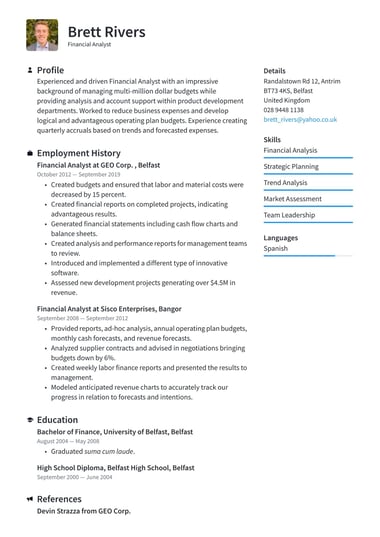
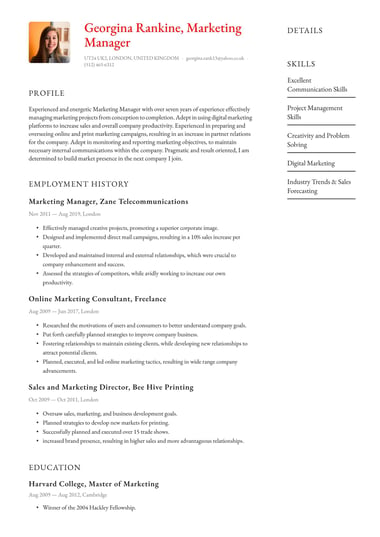
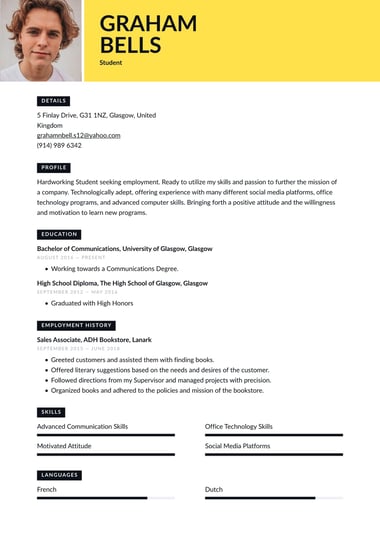
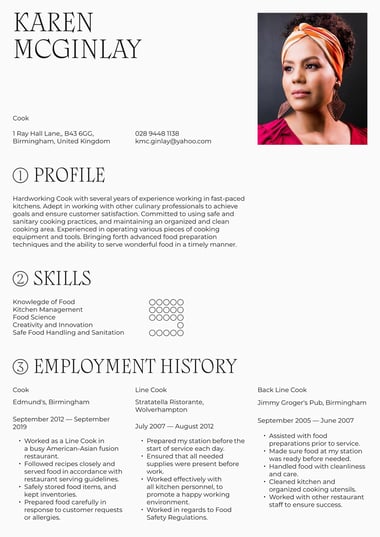
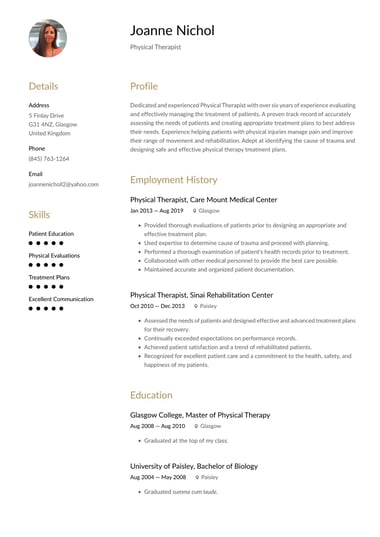

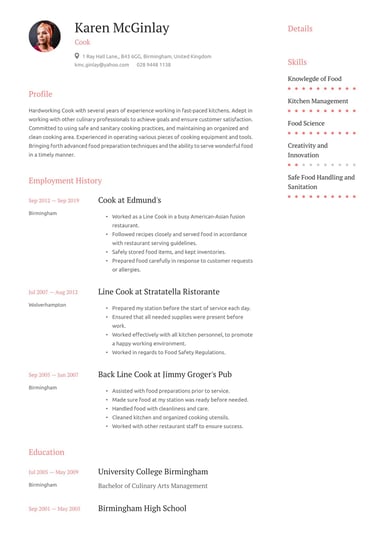
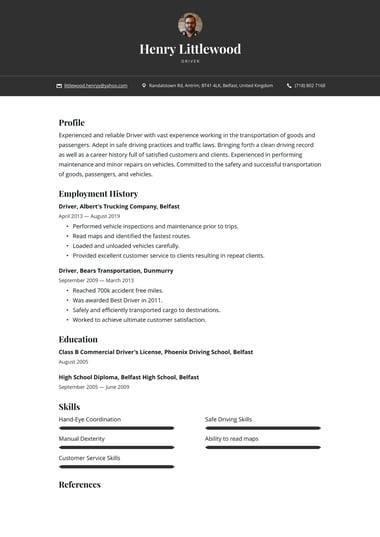
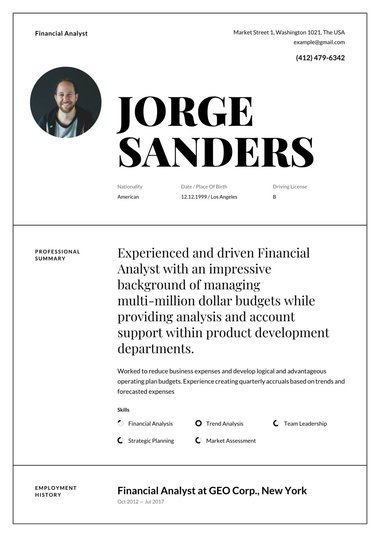
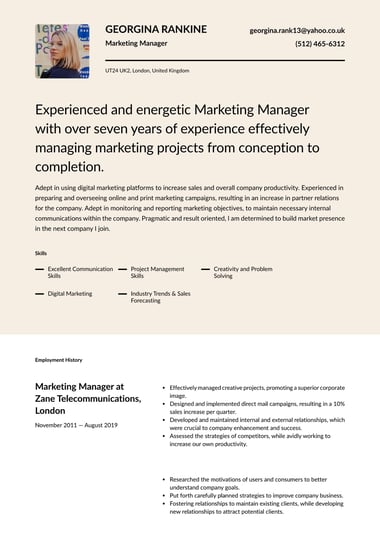
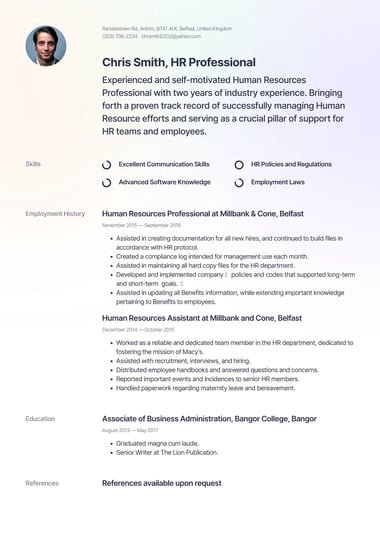
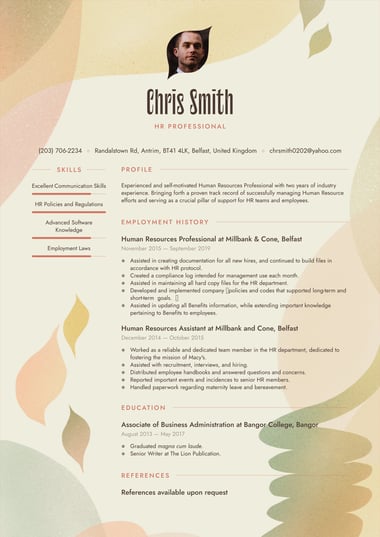



Should you include a photo on your CV?
For most UK jobs, no. UK employers do not expect a photo on a CV, and many prefer to shortlist on skills and experience alone.
Include a photo only when the job advert asks for one, when the role depends on your appearance, or when you are applying in a country where photo CVs are standard.
Choosing not to include a photo on your CV is the normal choice in the UK, so your application will not look incomplete without one.
Many employers prefer it that way, because a picture can reveal characteristics protected under the Equality Act 2010, such as age or race, before anyone has read your experience, and leaving it off also keeps your image out of every inbox you apply to.
Instead of a photo, you can:
- Add your LinkedIn profile URL to your contact details, so recruiters can see your professional photo there if they choose to.
- Use the space for a short personal profile that sums up what you offer for the role.
Resume.io’s resume builder also offers simple, classic, and ATS-friendly CV templates for the many applications that do not need a photo.
Does having a photo on your CV improve your chances of getting hired?
Not reliably. Field studies that sent thousands of test CVs to real employers found that a photo helped some candidates and hurt others, depending on their appearance and gender.
A photo does not make anyone better qualified, so including one mostly adds a risk of bias that you cannot control.
| Study | Country | Test CVs sent | Key finding |
|---|---|---|---|
| López Bóo, Rossi and Urzua | Argentina | 2,540 | A photo made no difference on its own, but candidates’ looks changed callback rates |
| Ruffle and Shtudiner | Israel | 5,312 | Men gained callbacks by adding a photo, while women did best with no photo at all |
In the Argentina study, CVs with photos rated attractive received 36% more callbacks than CVs with photos rated unattractive (López Bóo, Rossi and Urzua, 2013).
The gap was widest for administrative and customer-facing roles, such as receptionist and customer service jobs.
Neither study took place in the UK, where photo CVs are far less common.
For UK job seekers, a photo on your CV hands the recruiter a judgement about your looks, with an outcome that depends on who is reading.
Your experience and skills are the parts of a CV you can actually control.
Are there any industries where including a photo on your CV is recommended or discouraged?
Acting, modelling, and other performance roles are the main UK industries where a CV photo is recommended, because casting decisions depend on how you look.
Most other sectors, from finance and law to healthcare and retail, discourage a photo or simply do not expect one.
When an employer wants a photo, the job advert will usually say so.
| Industry | Photo on your CV? | Why |
|---|---|---|
| Acting and performing arts | Recommended | Casting teams need to see your look and often want a separate headshot as well |
| Modelling | Recommended | Appearance is part of the job, with a portfolio carrying most of the weight |
| TV presenting and promotional work | Only if asked | The job advert usually specifies a headshot when one is needed |
| Aviation, including cabin crew | Check the application | Some airline application processes request a photo, but it is not a sector-wide rule |
| Design and marketing | Not needed | A portfolio shows your skills far better than a photo of you |
| Hospitality, retail, and customer service | Not needed | Customer-facing work does not mean a photo is expected |
| Finance, law, consulting, and office roles | Discouraged | Recruiters want evidence of experience and qualifications |
| Healthcare, science, engineering, and education | Discouraged | Qualifications, registration, and technical skills drive shortlisting |
For acting and modelling, the photo on your CV is part of the application itself.
An actor CV usually pairs a headshot with credits and agent details, while a model CV leads with the photo and links to a full portfolio.
Should you include a photo when applying for jobs abroad?
Yes. Photo CVs remain common in parts of continental Europe and in other regions around the world, and a CV without one can look incomplete to some employers there.
Expectations differ between countries, industries, and individual employers, so check the job advert and local guidance before sending a CV with a photo overseas.
Europass, the European Union’s official CV format, treats the photo as an optional section, which reflects how much practice varies across Europe.
Before sending a CV with a photo abroad:
- Read the job advert and application instructions, since a direct request for a photo settles the question.
- Look up CV guidance for that country, ideally from its public employment service or a local university careers service.
- Keep two versions of your CV, a UK version on a simple layout and an international version on a CV template with a photo.
- Hold your photo to the same professional standard, whichever country you apply to.
Applying to a UK employer from abroad works the other way round.
Remove the photo, along with personal details such as date of birth and marital status, so your CV matches UK conventions.
What are the best types of photos to use on a CV?
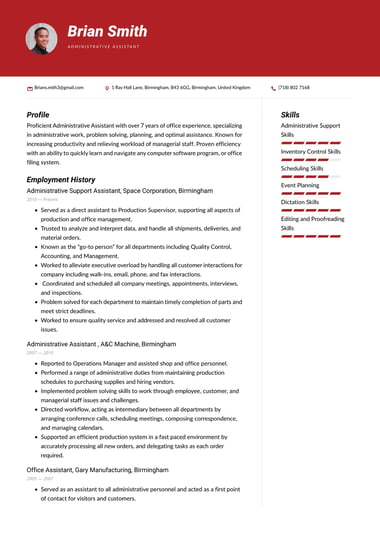
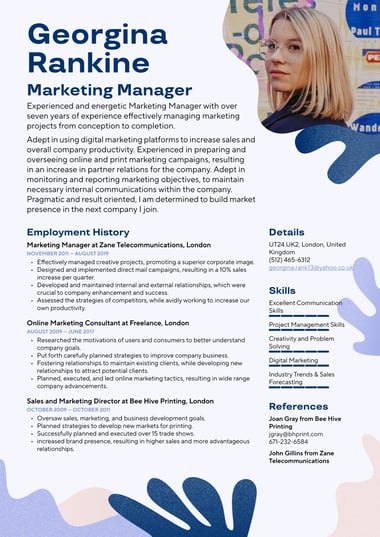
The right photo for a CV is a recent, professional head-and-shoulders shot against a plain background.
You should look like you do on an ordinary working day, dressed for the industry you are applying to, with a relaxed expression and your whole face clearly visible.
| Element | What works | What to avoid |
|---|---|---|
| Framing | Facing the camera, cropped below the shoulders | Full-length or group shots |
| Background | White, light grey, or another soft neutral | Busy rooms and outdoor scenes |
| Clothing | What you would wear to an interview in your industry | Logos, slogans, very casual clothes, or anything distracting |
| Expression | Calm and friendly | Sunglasses, props, or a forced grin |
| Quality | Sharp, evenly lit, and true to colour | Heavy filters and dark shadows |
| Age of the photo | A recent shot that looks like you today | An old photo recruiters will not recognise at interview |
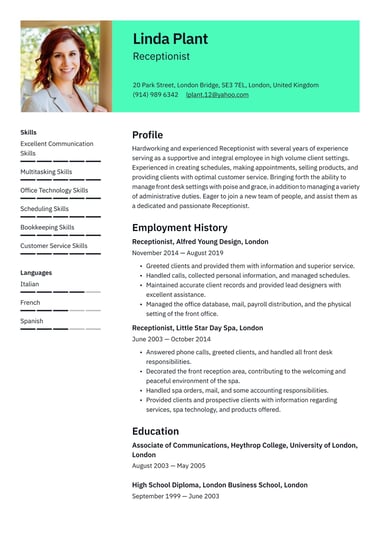
Keep the photo small and place it at the top of the page, next to your name and contact details.
A compact photo leaves room for your experience.
Keeping it in the header also means an applicant tracking system can read the rest of your CV in a clean, logical order.
Using the same photo on your CV and your LinkedIn profile keeps your applications consistent when recruiters look you up.
How do you take a CV photo at home?
You can take a professional-looking CV photo at home with a smartphone and a window.
Ask someone to take the photo or use the camera’s timer, stand in daylight in front of a plain wall, and take plenty of shots so you can choose the one where you look most relaxed.
- Stand facing a window during the day, so soft daylight falls evenly on your face.
- Choose a light-coloured wall behind you, with nothing hanging on it.
- Wear a plain top in a colour that stands out against the wall, so you do not blend into the background.
- Set the camera at eye level on a shelf or a stack of books, or ask a friend to hold it.
- Take plenty of shots, changing your expression and angle slightly between them.
- Crop to your head and shoulders and save the photo as a high-quality JPG.
Use your phone’s rear camera rather than the front-facing one where you can, because it usually takes sharper photos.
Portrait mode can soften the background behind you.
Check the edges of your hair and glasses afterwards, since the effect sometimes blurs them.
Key tips
- Leave the photo off a UK CV unless the job advert asks for one or your appearance is part of the job.
- A photo’s effect depends on who reads your CV, which makes it a risk for most UK applications.
- Acting, modelling, and some jobs abroad are where a photo CV earns its place.
- Keep a separate international version of your CV for countries where photos are standard.
- Choose a recent photo with a plain background and soft daylight.
FAQs
Here are quick answers to other common questions about CV photos.
Is it illegal to put a photo on your CV in the UK?
No, including a photo on your CV is legal in the UK. The Equality Act 2010 places the duty on employers, who must not treat candidates unfairly because of protected characteristics such as age, race, or sex.
Can you use a selfie as your CV photo?
No, a selfie is a weak choice for a CV photo. Holding the phone at arm’s length distorts your features, and the result usually looks casual next to a professional CV.
Should you smile in your CV photo?
Yes, a relaxed smile works well in a CV photo. Aim for the expression you would have when greeting an interviewer, whether or not it shows your teeth.
Should your cover letter include a photo as well?
No, a cover letter does not need a photo, even when your CV has one. Match the cover letter’s fonts and colours to your CV instead, so the two documents look like a set.