

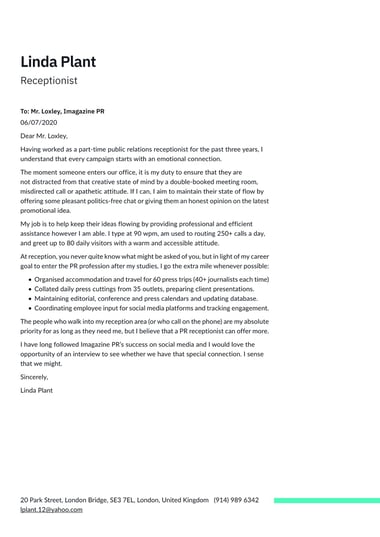
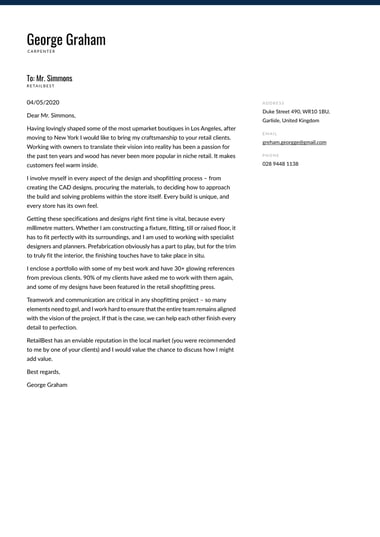
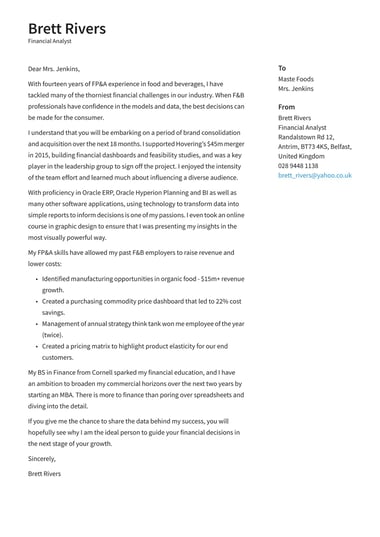
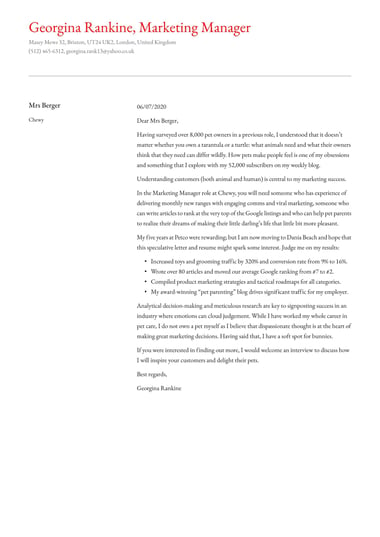
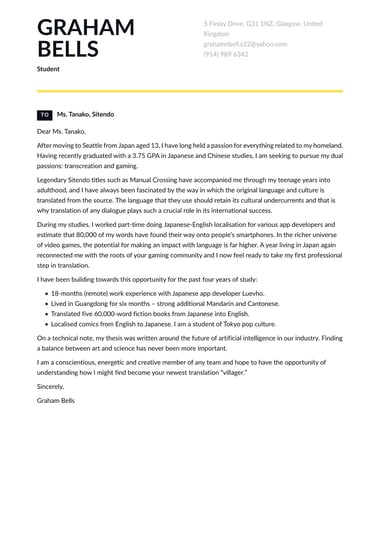
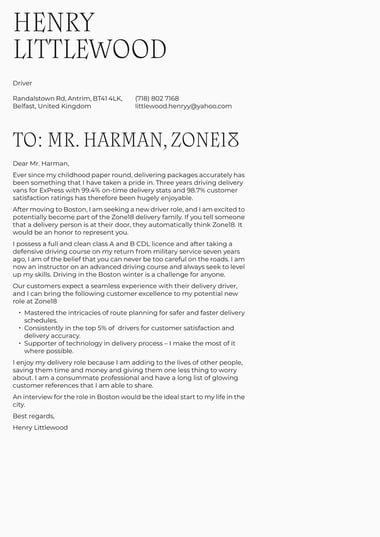
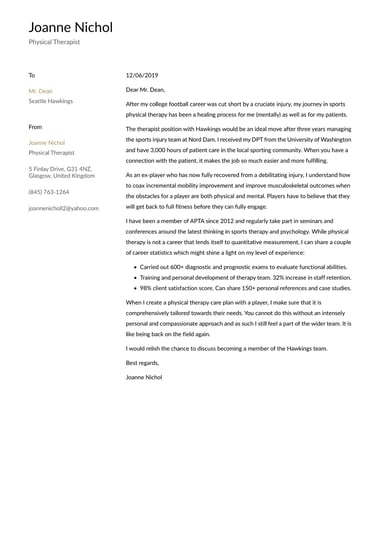
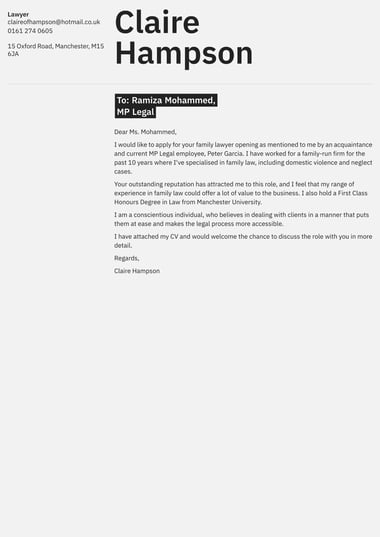

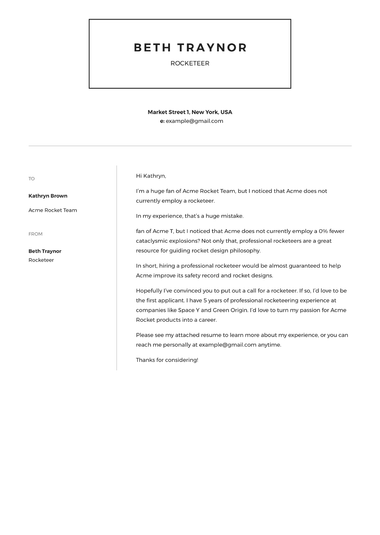
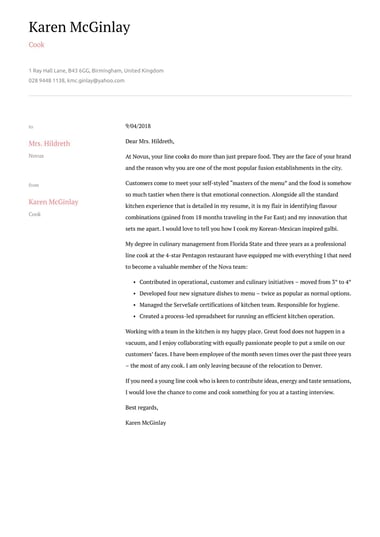
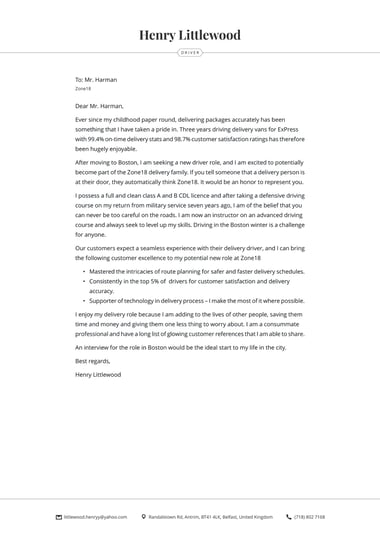
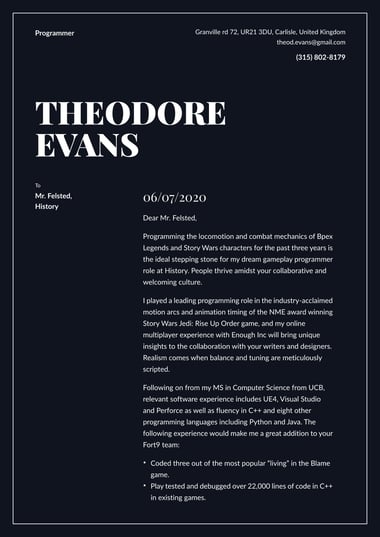
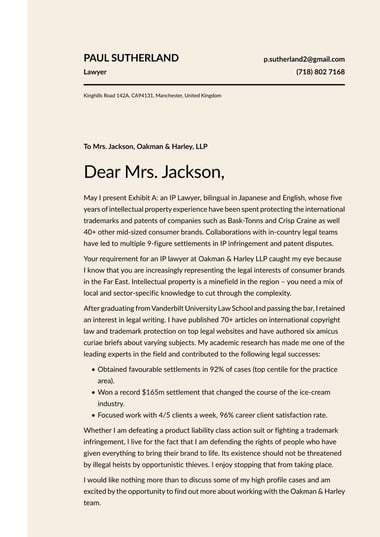
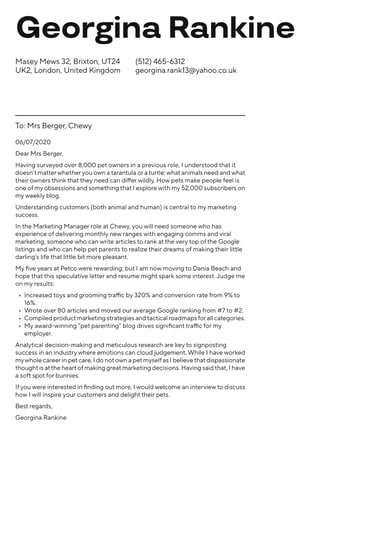
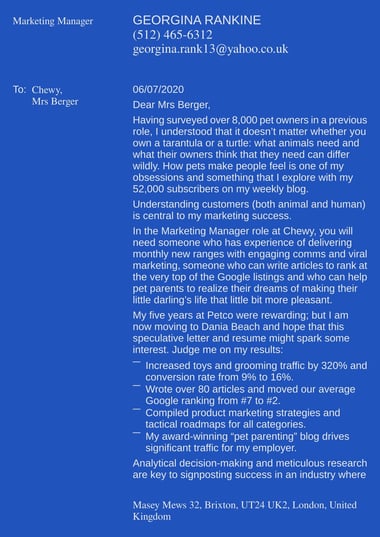
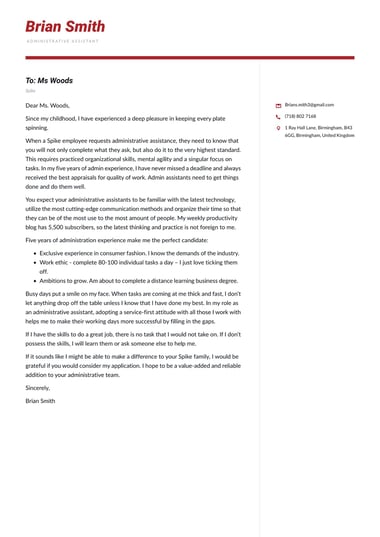
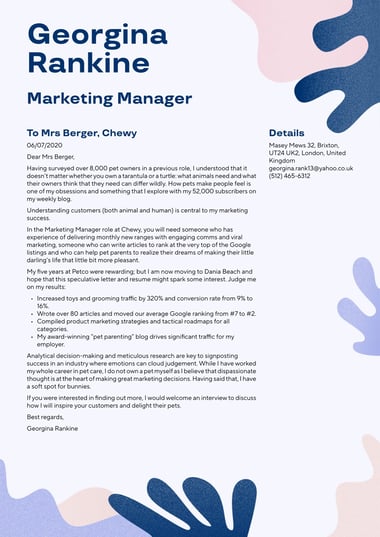
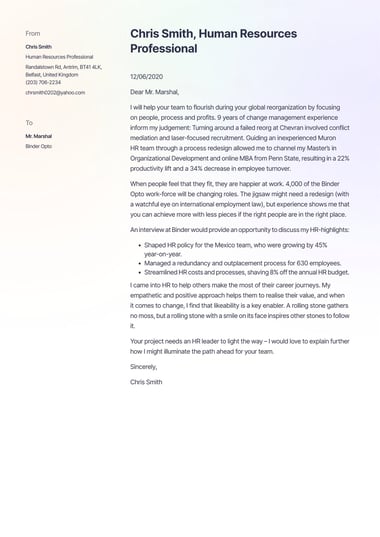
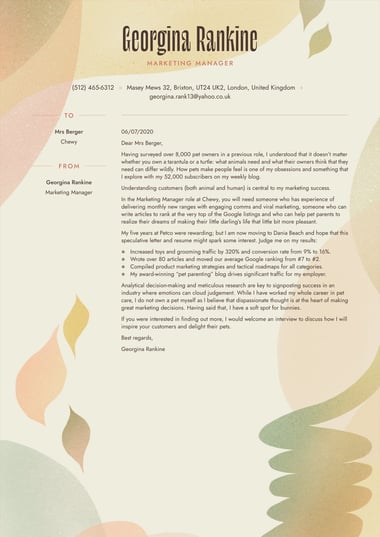
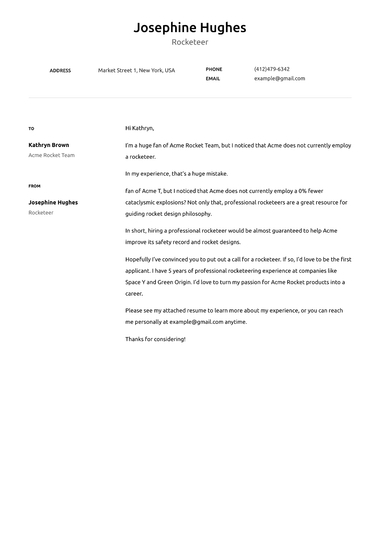
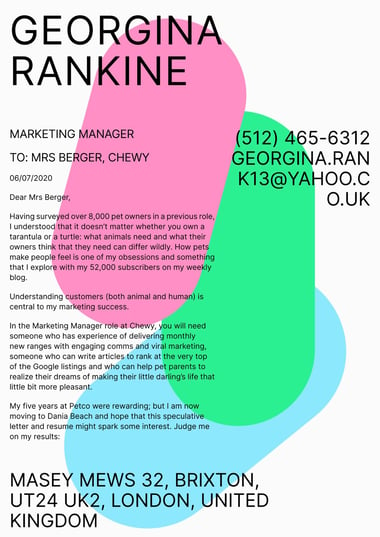
A good cover letter template for UK jobs fits on one side of A4, opens with your contact details and the date, greets the reader by name where possible, and closes with “Yours sincerely” or “Yours faithfully”.
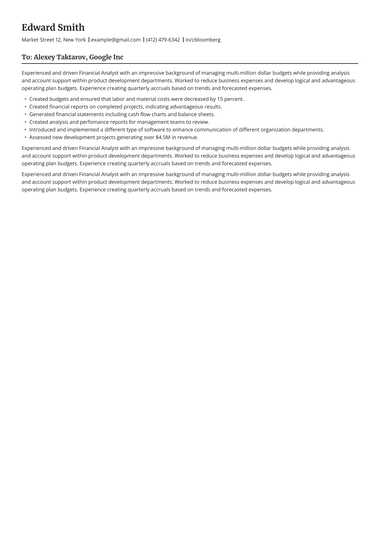
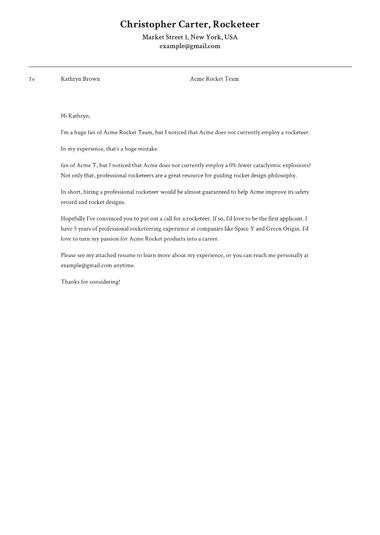
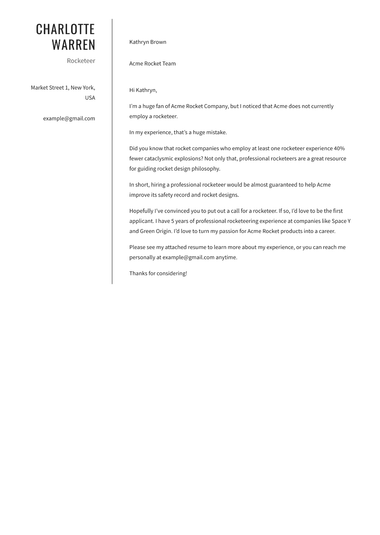
Resume.io cover letter templates follow that layout and share their designs with our CV templates, so your application looks like a matching set.
Which cover letter template should I use?
Choose a cover letter template that suits how you are applying and the sector you work in.
A simple or professional template works for most UK jobs and online application systems, while modern and creative templates suit roles where design counts and a person reads your letter first.
| Your situation | Template style | Resume.io templates to try | Watch out for |
|---|---|---|---|
| Applying through a large employer’s website | Applicant tracking system (ATS) or simple | Prime ATS, Pure ATS, Specialist ATS | Plain formatting survives being pasted into an online form |
| Law, finance, public sector, or healthcare | Professional | Traditional, Corporate, Professional | Keep colour to one accent |
| Office, administration, or sales | Simple or modern | Classic, Clean, Essential | A large header can push your sign-off onto a second page |
| Tech, marketing, or start-ups | Modern | Balanced, Modern, Vivid | Keep the header slim so your opening paragraph sits high on the page |
| Creative and design roles | Creative | Creative, Visionary, Colour Splash | Heavy colour can distract from a short letter |
| Students, school leavers, and graduates | Simple | Classic, Minimalist | A short letter can look sparse in a busy design |
For example, a graduate applying for a first office role suits the Classic template, which keeps a short letter tidy without looking empty.
A designer emailing a small agency has more room for colour with Visionary or Colour Splash.
How do I choose the best background for my cover letter or CV?
Choose a white or very light background for most cover letters and CVs, because it prints cleanly and suits every sector.
Coloured or graphic backgrounds work for creative roles when you email your application directly.
Whichever background you choose, use it on both documents.
| Background | Resume.io examples | Best for | Watch out for |
|---|---|---|---|
| Plain white | Classic, Traditional, Minimalist | Any UK job, especially formal sectors | Add one accent colour if the page feels flat |
| White with a coloured header or sidebar | Professional, Balanced, Essential | Office, sales, and tech roles | Check that your name stays readable against the colour |
| Gradient or tinted | Pastel, Visionary | Creative and customer-facing roles | Tints can look washed out when printed in black and white |
| Graphic elements | Colour Splash | Design, media, and events roles | Busy graphics can crowd a one-page letter |
Text needs strong contrast against its background to stay readable on a phone screen and in print.
Several Resume.io cover letter templates, including Classic, Corporate, and Minimalist, come in a monochrome version for a fully black-and-white page.
What should a UK cover letter template include?
A UK cover letter template needs your contact details, the date, the employer’s details, a greeting, three or four short paragraphs, and a sign-off.
It should fit on one side of A4 and follow British spelling and date formats, such as 10 November 2026, so a UK employer reads it as a local application.
- Your contact details: Your name, phone number, email address, and town or city, plus a LinkedIn link if you have one.
- The date: Written as day, month, and year.
- The employer’s details: The hiring manager’s name and job title, the company name, and the address if you are posting the letter.
- The greeting: A named greeting wherever possible, such as “Dear Ms Patel”.
- The opening paragraph: The job you are applying for, where you saw it, and one line on why you fit.
- The middle paragraph or two: One or two achievements that match the job advert, with numbers where you have them.
- The closing paragraph: Why you want to work for this employer, a note that your CV is attached, and a request for an interview.
- The sign-off: Matched to your greeting and followed by your full name.
Each part has a job to do, and knowing how to write a cover letter paragraph by paragraph makes any template quicker to fill in.
What does a UK cover letter look like?
A UK cover letter looks like a short formal business letter: your details at the top, the date, the employer’s details, a named greeting, three or four paragraphs, and a sign-off that matches the greeting.
Copy the template below, replace everything in square brackets, and delete any line you do not need.
[Your full name]
[Town or city] | [Phone number] | [Email address] | [LinkedIn URL]
[Date, for example 10 November 2026]
[Hiring manager's full name]
[Their job title]
[Company name]
[Company address, if sending by post]
Dear [Mr/Ms/Mx Surname],
Re: [Job title], reference [number, if given]
I am writing to apply for the [job title] role at [company name], advertised on [website or job board]. With [number] years of experience in [field], I would bring [your strongest relevant skill] to your team.
In my current role as [job title] at [employer], I [achievement that matches the advert, with a number if possible]. I have also [second achievement or responsibility], which has given me [skill named in the job description].
I would like to join [company name] because [specific reason linked to the company's work, values, or recent news]. My experience in [area] would help your team [goal from the advert].
My CV is attached with full details of my experience. I would welcome the chance to discuss the role at interview and can be reached on [phone number] or at [email address].
Yours sincerely,
[Your full name]
The template gives you the structure, and the sentences inside it should sound like you.
How do you address and sign off a UK cover letter?
Address a UK cover letter to a named person whenever you can, such as “Dear Ms Patel” or “Dear Mr Jones”, and sign off with “Yours sincerely”.
When you cannot find a name, use “Dear Hiring Manager” and sign off with “Yours faithfully”.
A less formal email to a recruiter you have already spoken to can close with “Kind regards”.
| Who you are writing to | Greeting | Sign-off |
|---|---|---|
| A named person | Dear Ms Patel | Yours sincerely |
| A named person whose title you do not know | Dear Sam Patel | Yours sincerely |
| A team or role, with no name | Dear Hiring Manager | Yours faithfully |
| A recruiter you have already spoken to, by email | Dear Sam | Kind regards |
UK careers service Prospects gives the same rule: “Yours sincerely” for a named contact and “Yours faithfully” for a general greeting.
“Sincerely” on its own and “Best regards” are common in US letters, so swap them out of any template written for the US market.
UK titles take no full stop, so write “Ms” and “Mr” rather than “Ms.” and “Mr.”, and use “Mx” if you know the person prefers it.
When you sign a cover letter sent as a PDF, your typed full name is enough, and a scanned signature is optional.
How do you adapt a cover letter template for your situation?
Keep the same template structure and rewrite the paragraph that explains why you are writing.
A speculative letter asks about future roles and a career change letter explains the move, while a letter with little experience leads with education and transferable skills.
The layout and sign-off stay the same in every case.
| Situation | Paragraph to rewrite | What to put in it |
|---|---|---|
| Speculative application, with no advert | Opening | The team you want to join and the kind of role you are asking about |
| Career change | Middle | Transferable skills and any training or projects in the new field |
| Little or no work experience | Middle | Education, part-time work, volunteering, and placements |
| Graduate | Opening and middle | Your degree, dissertation, or placement, linked to the role |
| Internal role at your current employer | Opening | Your current team and what you have achieved there |
| Short application or quick email | Whole letter | Two paragraphs built around one strong achievement |
Finished letters for graduate, internship, apprenticeship, and part-time job applications show how little of a cover letter template changes in practice, usually just the opening and one middle paragraph.
For quick applications, a short cover letter shows the two-paragraph version, and the wider set of cover letter examples runs from NHS roles to warehouse work.
How can I customise a cover letter template from Resume.io?
To customise a Resume.io cover letter template, choose the design that matches your CV, write your letter in the cover letter builder, and tailor each paragraph to the job advert.
Resume.io cover letter templates share their names and designs with our CV templates, so a Corporate CV pairs with a Corporate cover letter.
- Pick the cover letter template with the same name as your CV template, such as Classic, Corporate, or Balanced.
- Open it in the cover letter builder and add your contact details and the employer’s details.
- Write each paragraph using the builder’s sample phrases and writing tips, then edit them into your own words.
- Run spell check and read the letter aloud to catch anything that sounds stiff.
- Switch to a different template if the design does not suit the job, and check that your text still fits on one page.
- Download your letter as a PDF, or as a Word file on templates labelled DOCX.
If you have not built your CV yet, the Resume.io CV builder uses the same template designs, so a recruiter sees one consistent application from the first page to the last.
What mistakes should you avoid when using a cover letter template?
The most common cover letter template mistakes are leaving placeholder text in, naming the wrong company, and sending one generic letter to every employer.
A template only saves time on layout, so the wording needs as much care as a letter written from scratch.
- Leaving brackets or placeholder text in place, such as “[Company name]”.
- Keeping the company name or job title from a previous application.
- Using US conventions, such as a month-first date like 11/10/2026 or American spelling.
- Relying on generic lines such as “I am a hard-working team player” with no evidence behind them.
- Repeating your CV word for word when the letter should add context to it.
- Opening with “To whom it may concern”, which reads as impersonal.
Templates make letters look alike, so the content has to set yours apart.
As career coach Amanda Augustine, puts it, “Authenticity in job applications is more valued than perfection.”
A specific example from your own work does more for a cover letter than polished but generic wording.
Can I download a cover letter template for free?
You can build a cover letter on any Resume.io template for free and download the text as a TXT file, with no card details needed.
Downloading the finished design as a PDF, or as a Word file on selected templates, needs a 7-day trial or a paid plan.
| Plan | What you can download | How it is billed |
|---|---|---|
| Free plan | Your cover letter as a plain TXT file | Free, with no card needed |
| 7-day trial | PDFs in any template, plus Word files on selected templates | Renews as a subscription unless you cancel within 7 days |
| 6-month or 1-year plan | The same downloads for a fixed period | A one-off payment that does not renew |
Templates labelled DOCX, such as Professional, Corporate, Balanced, and Essential, download as Word files you can edit in Microsoft Word or open in Google Docs, and the Word and Google Docs cover letter template collections group every design that exports this way.
The free TXT download suits anyone happy to format a letter themselves.
Paste the text into a blank Word or Google Docs file, set the page to A4, and add your own fonts and spacing.
How should you send a cover letter?
Send your cover letter as a PDF alongside your CV, unless the advert asks for a Word file or a pasted letter.
When you apply by email, either attach the letter or paste it into the body of the email, and use a subject line with the job title and any reference number.
| How you apply | What to do |
|---|---|
| Online application form | Paste the text into the cover letter box, or upload a PDF if the form allows it |
| Keep the email itself to two or three lines when the letter is attached | |
| Recruitment agency | Send a Word file if the agency asks for an editable version |
| By post | Print on plain white A4 and sign above your typed name |
Name the file clearly, such as Firstname-Surname-Cover-Letter.pdf, so it sits next to your CV in a recruiter’s downloads.
When you paste a letter into an email, the cover letter format changes slightly: your contact details move below your name at the end, rather than sitting in a header.
Key tips
- Choose your cover letter template to match your CV, then check it suits how you are applying.
- Keep a UK cover letter to one side of A4, with British spelling and a day-month-year date.
- Use “Yours sincerely” after a named greeting and “Yours faithfully” after “Dear Hiring Manager”.
- Rewrite the opening and middle paragraphs for every job, and check for leftover placeholder text.
- Send a PDF unless the advert asks for Word or a pasted letter.
Cover letter template FAQs
Here are quick answers to other common questions about cover letters in the UK.
Is a covering letter the same as a cover letter?
Yes, a covering letter and a cover letter are the same document. “Covering letter” is the more traditional British term, and both describe the one-page letter you send with your CV.
What is the difference between a cover letter and a CV?
A CV lists your experience, education, and skills in a structured format, while a cover letter explains in full sentences why you suit one specific job. You can reuse much of your CV between applications, but each cover letter should be written for the role in front of you.
Do I need a cover letter if the advert does not ask for one?
A cover letter is not always required, but sending one gives you space to explain your interest in the role when the application allows it. When an advert does ask for one, Augustine says “you need to show the recruiter that you can read and follow directions.”