


Rising living costs, economic uncertainty, and insufficient retirement savings are pushing more of the older generation back into the workforce or forcing them to stay there far longer than planned.
At the same time, these older job-seekers face entering a hiring market that often feels designed for younger workers in mind, creating an extra barrier when searching for their perfect role.
We surveyed 600 U.S. job seekers aged 50 and above to better understand the realities of job seeking later in life, from navigating financial pressures, prolonged job searches to perceived age discrimination and emotional burnout.
The findings reveal a job market where older candidates frequently feel overlooked, underestimated, and financially cornered.
Key Findings:
- Nearly two-thirds (66%) of over-50 job seekers say financial pressures have forced them to continue working longer than planned, with almost half (46.5%) searching due to rising living costs alone
- Three-quarters (74.3%) believe their age has worked against them in hiring, yet only 3.5% of respondents think age-based bias doesn't exist, suggesting the problem is widely felt but rarely acknowledged
- Half of respondents (50.1%) have felt pressure to hide their age to appear more digitally competent, while 55.7% have applied for roles they are overqualified for due to financial desperation
- Almost half (49%) have been searching for work for more than six months, and 57% say the experience has negatively affected their mental health with frustration (63.7%), anxiety (55.8%), and feeling invisible (30.8%) among the most commonly reported emotions
A Search With No End
For many older workers, finding a new role is not a short-term process.
Bureau of Labor Statistics data shows that the average unemployment duration for 55-64 year olds is 34.4 weeks, more than 8 months. This is significantly longer than the overall US average of 26.2 weeks.
Our survey reflects that reality and found that almost half (49%) of respondents had been searching for work for more than six months including 30% searching for 6-12 months, and a staggering one in five (19%) searching for over a year.
The volume of applications tells its own story. More than one in five (23.3%) had applied for between 11 and 25 jobs, while one in seven (12.6%) had submitted more than 50 applications including 4.8% applying for more than 100 roles.
The data highlights that for many older Americans, job searching has perhaps become less about career progression and experience but more a test of endurance.
Pushed Back into The Market
The overwhelming driver behind later-life job seeking is financial pressure, rather than personal ambition or boredom in retirement.
Almost half (46.5%) said that they were looking for work due to the rising cost of living, with 35% said they needed better pay. A quarter (25%) said their retirement income simply wasn’t enough to support them financially.
Most strikingly, the data found that two-thirds (66%) said financial pressure had forced them to continue working longer than they had originally planned.
These findings paint a clear picture: many older Americans are not working because they want to but because they feel that they cannot afford not to.
The Bias Older Workers Feel, Backed By Data
Age discrimination in the workplace occurs when a person is treated less favorably due to their age during hiring, employment, or career progression. In a job-seeking context, this can mean being rejected for roles, asked inappropriate interview questions, or evaluated through assumptions rather than ability.
In the US, the Age Discrimination in Employment Act (ADEA) protects workers aged 40 and over from discrimination relating to hiring, pay, promotion, and termination. However, unfortunately, proving age discrimination can be difficult, which is why it often goes unchallenged and unreported.
Our survey found that three-quarters (74.3%) of job seekers over the age of 50 believe their age has worked against them in the hiring process. Including:
- 33.5% who say it has “definitely” affected outcomes
- 40.8% who suspect it has
Only 14.2% said that they did not believe that their age had negatively affected their chances of being hired.
When asked more broadly, a staggering 9 in 10 (89%) believe older workers face age-bias during the hiring process, including 41.5% who believe there is significant bias.
For many respondents, the issue wasn’t one dramatic moment but rather a pattern of subtle signals that accumulated over their job search.
What Age Discrimination Actually Looks Like
Age discrimination rarely announces itself openly. Instead, it tends to appear in indirect signals whether that be coded language, assumptions, or interview questions that leave candidates feeling excluded.
When asked whether they had been directly or indirectly asked age-related questions in interviews, over two-fifths (40.7%) said that they had. The most common included:
- Comments about salary expectations: 39.3%
- Comments about being overqualified: 32.2%
- Questions about technology or AI competence: 25.8%
- Questions about adaptability: 24.5%
- Questions about retirement plans: 24.2%
Others reported being asked about energy levels, caregiving responsibilities, or how long they intended to remain in the workforce.
Technology stereotypes were another major theme throughout the findings. Nearly three-quarters (74.1%) said they believe employers make assumptions about their ability to use technology or AI because of their age, regardless of their actual experience. This included 30.8% who believe that employers had “definitely” made assumptions about their digital competence due to their age.
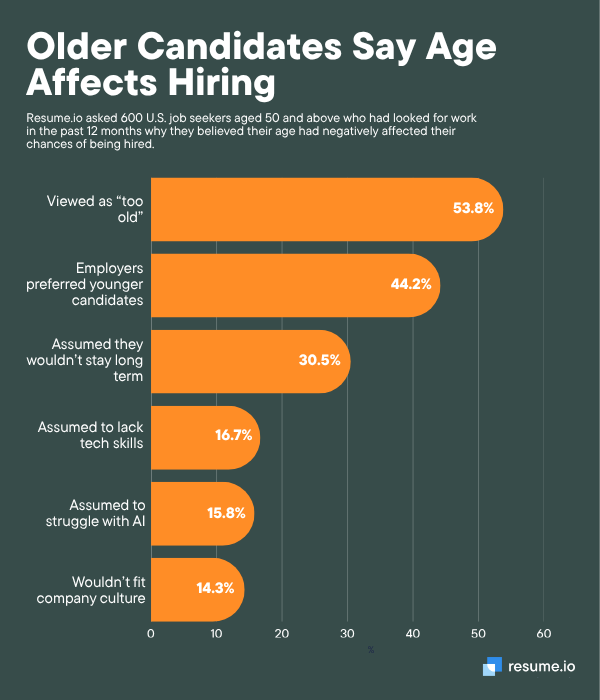
Among those who believed their age affected hiring outcomes, over half (53.8%) said they felt they were simply viewed as “too old,” while 44.2% believed employers preferred younger candidates. Others felt employers assumed they would not stay long term (30.5%), lacked tech skills (16.7%), would struggle with AI tools (15.8%), or would not fit company culture (14.3%).
These experiences rarely appear explicitly in writing or on official records, which is precisely why they often go unchallenged. Yet despite their subtle nature, the patterns are widely recognised making it clear why 89% of older job seekers believing age-based bias exists in the hiring process.
Hiding in Plain Sight
For many over-50 job seekers, age discrimination isn’t just something they suspect from employers, it’s something actively shaping how they present themselves during applications and interviews.
Half (50.1%) said they had felt pressure to hide their age in order to appear more digitally competent to employers, including 13.3% who said this happened frequently.
As a result, many admitted to altering how they approached the job search process. Over a third (35.3%) said they avoided mentioning their age altogether, while 28.8% removed older experience from their resumes. A quarter (25%) said they avoided applying to younger companies or startups, and 19.5% said they updated their appearance for interviews to seem younger.
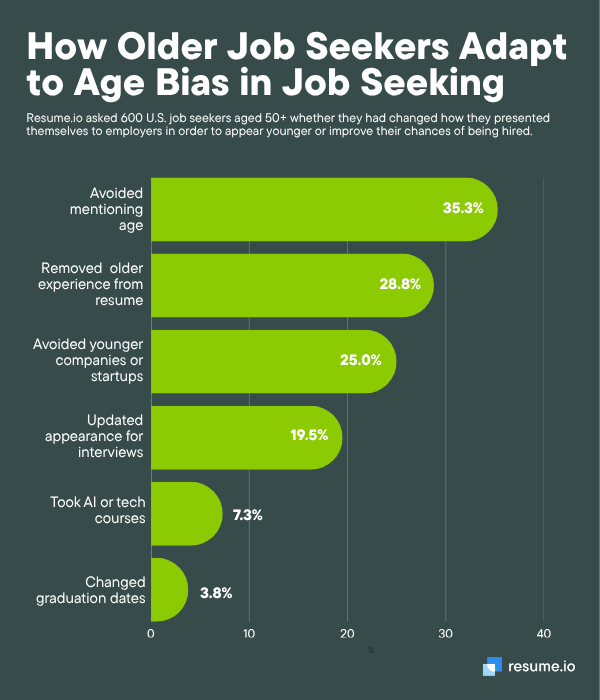
Others took more direct action to counter assumptions around technology and adaptability, with 7.3% taking AI or tech courses specifically to appear more employable. Some even changed graduation dates on their resumes.
Overall, only a third (33.7%) said they had taken none of these actions, highlighting how widespread the pressure to appear younger has become among older job seekers.
The Financial Cost of Being Overlooked
For many over-50s, job searching is no longer about finding the perfect role but for financial survival.
Almost half (46.3%) said they have accepted a lower salary than their previous position, including one in five (20%) who accepted significantly lower pay. Another 28.7% said they had considered taking lower pay but ultimately did not, meaning that overall, three-quarters (75%) at least considered accepting a lower salary.
Not only that, but more than half (55.7%) applied for a role that they were overqualified for due to financial pressures.
The financial impact of prolonged job searches has also created wider pressures:
- 38.7% dipped into personal savings
- 35% took on side hustles or extra income streams
- 31.2% delayed retirement plans
- 28% took on debt
- 24.5% relied on family or partners financially
The data highlights how age-related barriers in hiring can quickly evolve into broader financial insecurity.
The Emotional Toll of Starting Over
Unsurprisingly, beyond the financial impact, many described the emotional strain of searching for work later in life.
Overall, 57% said the experience had negatively affected their mental health, including 15.5% who described the impact as “very negative”.
The most common emotions reported were:
- Frustration (63.7%)
- Anxiety (55.8%)
- Hopelessness (33.8%)
- Feeling invisible because of their age (30.8%)
- Self-doubt (27.8%)
Others describe feelings of burnout (18.3%) and embarrassment (15.8%).
For workers who may have spent decades building careers, experience, and professional identities, it is unsurprising that prolonged unemployment can feel isolating.
Conclusion
The data paints a clear picture: for many Americans over 50, job searching is not a brief transition between opportunities but a prolonged, financially draining, and emotionally exhausting experience. One also compounded by a hiring environment that too often evaluates age before ability.
Yet the same data also shows resilience. Older job seeker are adapting, whether that be updating their skills, reshaping their resumes, and persisting through searches that stretch for several months. Instead of generic advice to "stay positive" or "build their network", they need tools that present their experience clearly and strategically, and a resume that reflects the full value of what they bring, without apology.
If you're navigating a job search later in life, resume.io's professional resume builder can help you frame your experience in a way that speaks directly to what employers are looking for today.
Methodology
We surveyed 600 U.S. adults conducted via Pollfish in May 2026. All respondents were aged 50 or above and were either actively searching for work at the time of the survey or had done so within the previous 12 months. The survey was distributed to a nationally representative sample and weighted to reflect the demographic profile of the broader US population.


