



Elon Musk doesn’t have a publicly available resume, but his career can still be structured into a clear, one-page format that highlights measurable achievements and leadership impact.
This example shows how his roles, accomplishments, and projects could be presented in a concise, recruiter-friendly way.
You’ll also learn what makes his resume stand out and how to apply those same principles to your own.
What would Elon Musk’s resume look like?
Elon Musk’s resume would follow a one-page format that highlights leadership roles, measurable achievements, and major projects across companies like SpaceX and Tesla.
Rather than listing every detail, it focuses on high-impact results and clear career progression, making even a complex career easy for recruiters to scan quickly.
Elon Musk one page resume example
This example shows how Musk’s experience can be built into a clean, readable format.
Even with multiple companies and industries, the resume stays focused on what matters most to employers:
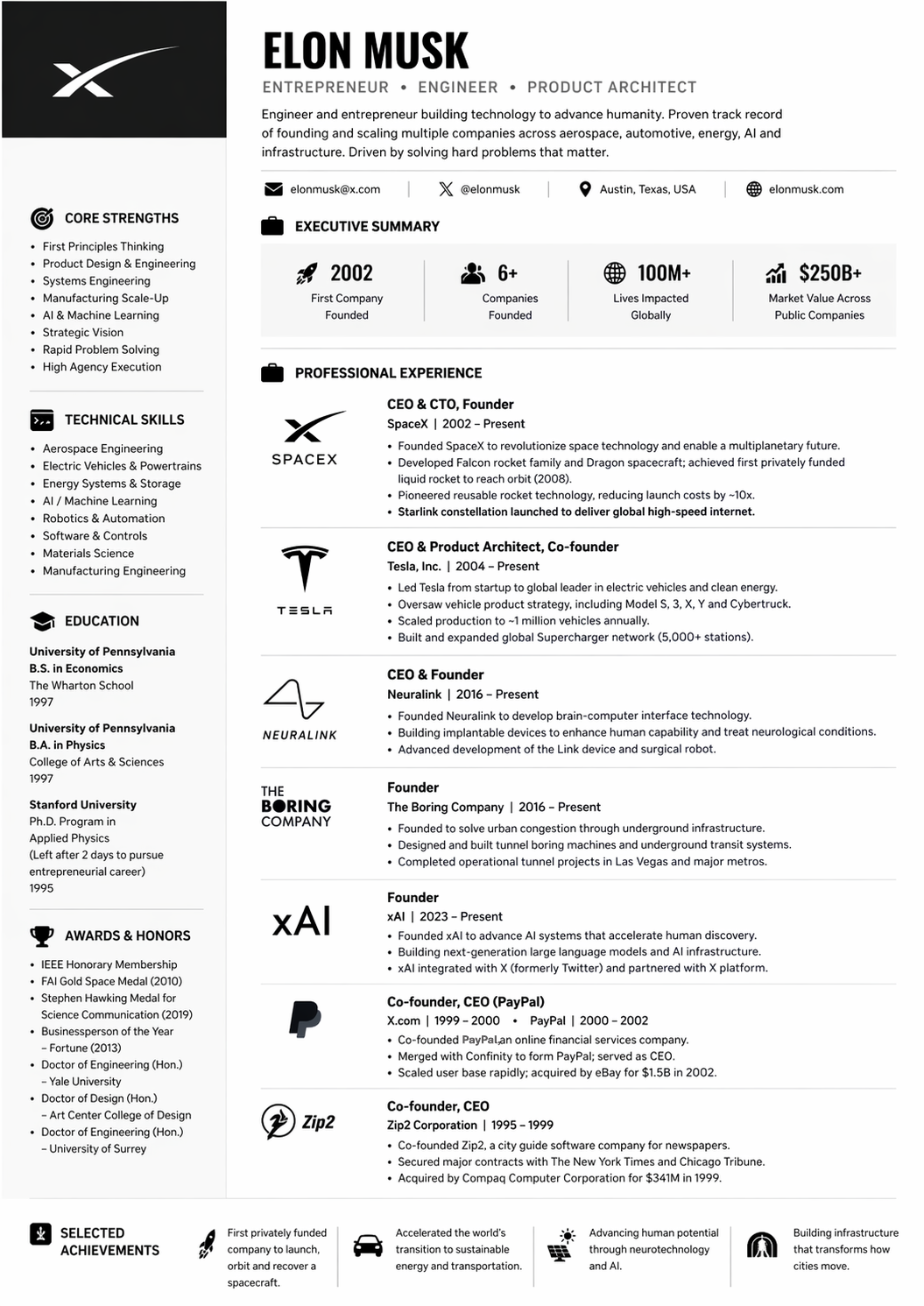
Key elements included in Musk's resume:
- Concise summary that highlights impact and long-term vision: Shows recruiters the candidate’s value within seconds.
- Work experience centered on results, not responsibilities: Focuses on what changed, not just what was done.
- Quantified achievements (revenue growth, scale, innovation impact): Helps employers quickly understand the level of impact.
What makes Elon Musk’s resume stand out?
Elon Musk’s resume stands out because it prioritizes measurable impact, technical depth, and high-level ownership across multiple industries.
Instead of listing routine responsibilities, it focuses on outcomes such as scaling companies, leading innovation, and solving complex problems, which immediately signals value to recruiters and hiring managers.
What makes this resume different from a typical application is not the number of roles, but how they are presented.
The structure reflects how senior and technical candidates are evaluated in real hiring situations.
Key differences:
- Focus on results, not tasks: Each role highlights what was achieved, such as company growth, product development, or industry impact, rather than day-to-day duties.
- Obvious ownership and leadership: Roles are defined by responsibility, such as founder, CEO, or product architect, showing accountability for outcomes.
- Strong use of metrics: Success is supported by numbers where possible, helping recruiters quickly understand scale and impact.
- Technical and strategic balance: The resume reflects both engineering involvement and business leadership, which is often prioritized for senior technical roles.
- Succinct, one-page format: Even with a complex career, the information is distilled into a format that is easy to scan in seconds.
What is a summary of Elon Musk’s professional journey?
Elon Musk’s professional journey spans technology, finance, automotive, and aerospace industries, with a consistent focus on innovation and scale.
He started with Zip2 in the 1990s, which was later sold, before co-founding X.com, which became PayPal and was acquired by eBay.
Musk then founded SpaceX in 2002 to advance space exploration and joined Tesla shortly after, leading its growth in electric vehicles.
Over time, he expanded into projects like SolarCity, Neuralink, and The Boring Company, each focused on long-term technological challenges.
His career reflects a pattern of building, scaling, and leading companies that aim to solve large global problems.
What can you learn from Elon Musk’s resume?
Elon Musk’s resume shows that strong applications focus on impact, clarity, and relevance rather than length.
Even with a complex career, the information is simplified into measurable accomplishments and unambiguous roles.
Job seekers can apply the same approach by prioritizing results, removing unnecessary detail, and structuring content for fast recruiter review.
You can apply these lessons directly when writing or updating your own resume.
1. Focus on measurable impact
Recruiters are not just looking for what you did, but what changed because of your work.
Wherever possible, include numbers such as revenue growth, efficiency improvements, or project outcomes.
2. Keep your resume succinct and structured
Even at a senior level, long resumes are harder to scan.
This example shows how to keep everything on one page by prioritizing the most relevant experience and removing repetition.
When drafting your resume, start with a longer list of achievements, then refine it down to the most relevant points for the role you’re applying for.
This helps you stay concise without losing important detail.
3. Highlight ownership and responsibility
Roles like founder, CEO, or lead engineer clearly signal accountability.
You should aim to show where you took ownership of projects, decisions, or outcomes, even if your job title was more junior.
4. Avoid unnecessary or “fluffy” language
Every word on your resume should add value.
Removing filler words creates space for stronger, more specific achievements and makes your application easier to read.
5. Adapt the approach to your own career level
You do not need Musk’s experience to apply these principles.
The key takeaway is to focus on clarity, relevance, and results, whether you are early in your career or applying for senior roles.
It’s also worth noting that most recruiters in the US and UK do not expect a photo on a resume.
The focus should remain on your skills, experience, and success rather than personal details.

What makes Elon Musk’s CV stand out among tech entrepreneurs?
Elon Musk’s CV stands out among tech entrepreneurs because it combines measurable business impact with hands-on technical involvement.
While many executive resumes focus mainly on leadership or strategy, his highlights both engineering contribution and company growth, making the scale and substance of his work immediately clear to recruiters.
| Feature | Typical tech entrepreneur CV | Elon Musk-style CV |
|---|---|---|
| Focus | Leadership and strategy | Measurable impact and results |
| Technical involvement | Often minimal or implied | Clearly demonstrated alongside leadership |
| Use of metrics | Limited or high-level | Specific numbers showing scale and growth |
| Role presentation | Title-driven | Outcome and responsibility-driven |
| Structure | Can be broad or multi-page | Concise, one-page, easy to scan |
This approach reflects how recruiters assess senior candidates, prioritizing ownership, scale, and measurable outcomes over general responsibilities.
Key takeaways
- Prioritize impact over detail: Focus on what you achieved, not just what you were responsible for.
- Use numbers to support your claims: Quantifying results makes your experience clearer and more credible.
- Keep your resume concise and easy to scan: A one-page format is often enough when content is well structured.
- Remove unnecessary language: Clear, direct wording improves readability and leaves space for stronger content.
When writing your resume, start by listing your most impactful achievements, then organize them under clear roles, and finally refine the wording to remove unnecessary detail.
This mirrors how recruiters review applications, starting with results before scanning structure.


