



Some jobs come with nightmares, some come with six-figure salaries, few come with both.
To find out which frightening careers are actually worth the fear, we scored 23 U.S. jobs on how scary the work is and matched them with the latest federal pay data. The result is a ranking of America’s highest-paying scary job. It also reveals that the scariest work isn't always the most well-paid.
Key Findings:
- Emergency physicians top the list, with a median salary of $335,550. That's more than six and a half times what the typical U.S. worker earns.
- Pathologists are close behind at $312,400.
- Five in six of the scary jobs we ranked pay more than the national median of $50,980.
- The scariest job, animal control officer, pays $45,660, which is 10% below the national median.
The Top 10 Highest-Paying Scary Jobs in America
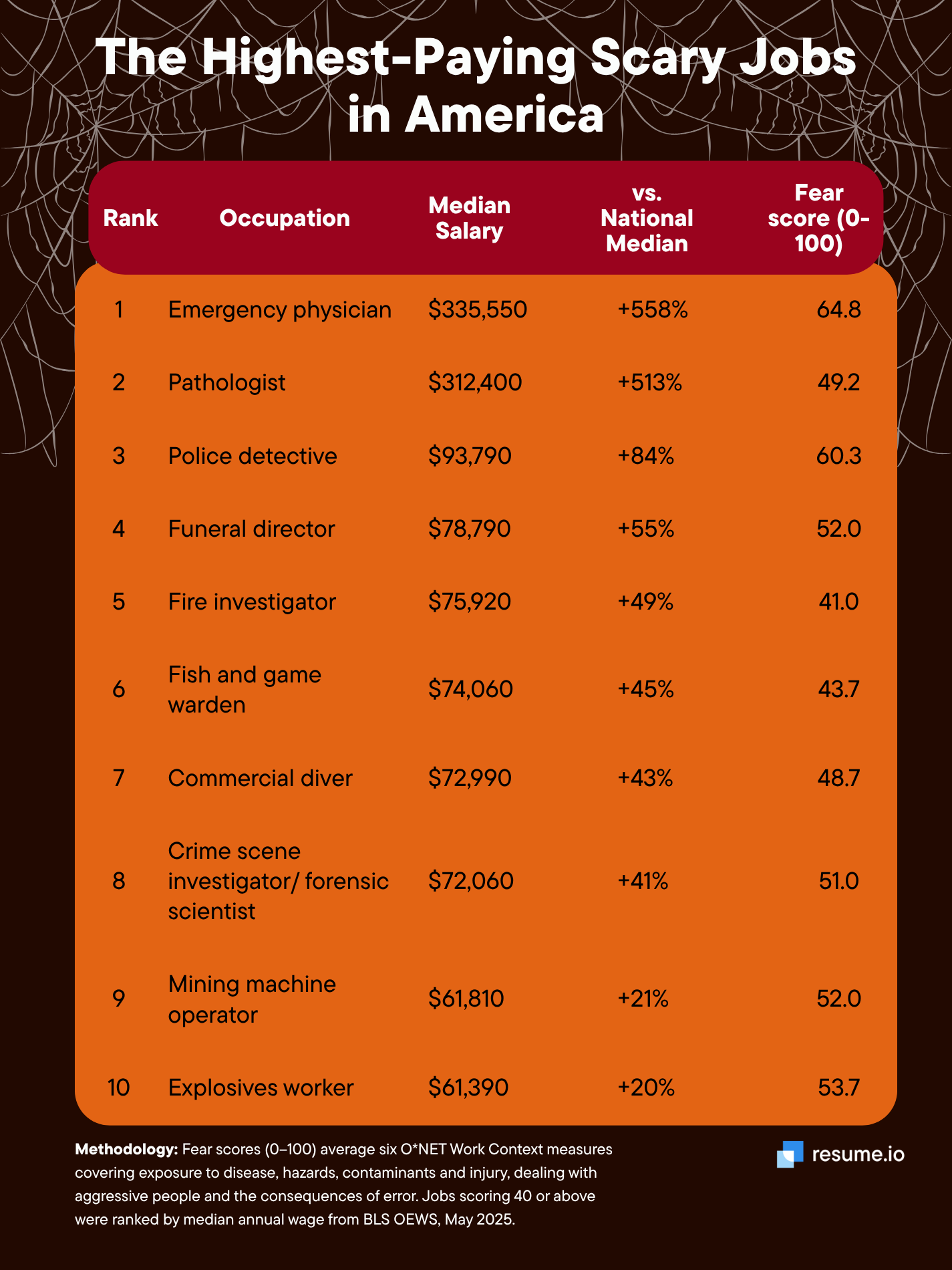
Emergency physicians are the highest-paying scary job in America, earning a median $335,550 a year. Which is more than six and a half times the national median of $50,980.
Pathologists take second place at $312,400, making them the only other scary job on the list to break six figures.
Outside medicine, police detectives earn the most at $93,790, followed by funeral directors ($78,790) and fire investigators ($75,920). Every job in the top 10 pays at least 20% more than the typical American worker earns, with explosives workers completing the list at $61,390.
What Makes Them Scary
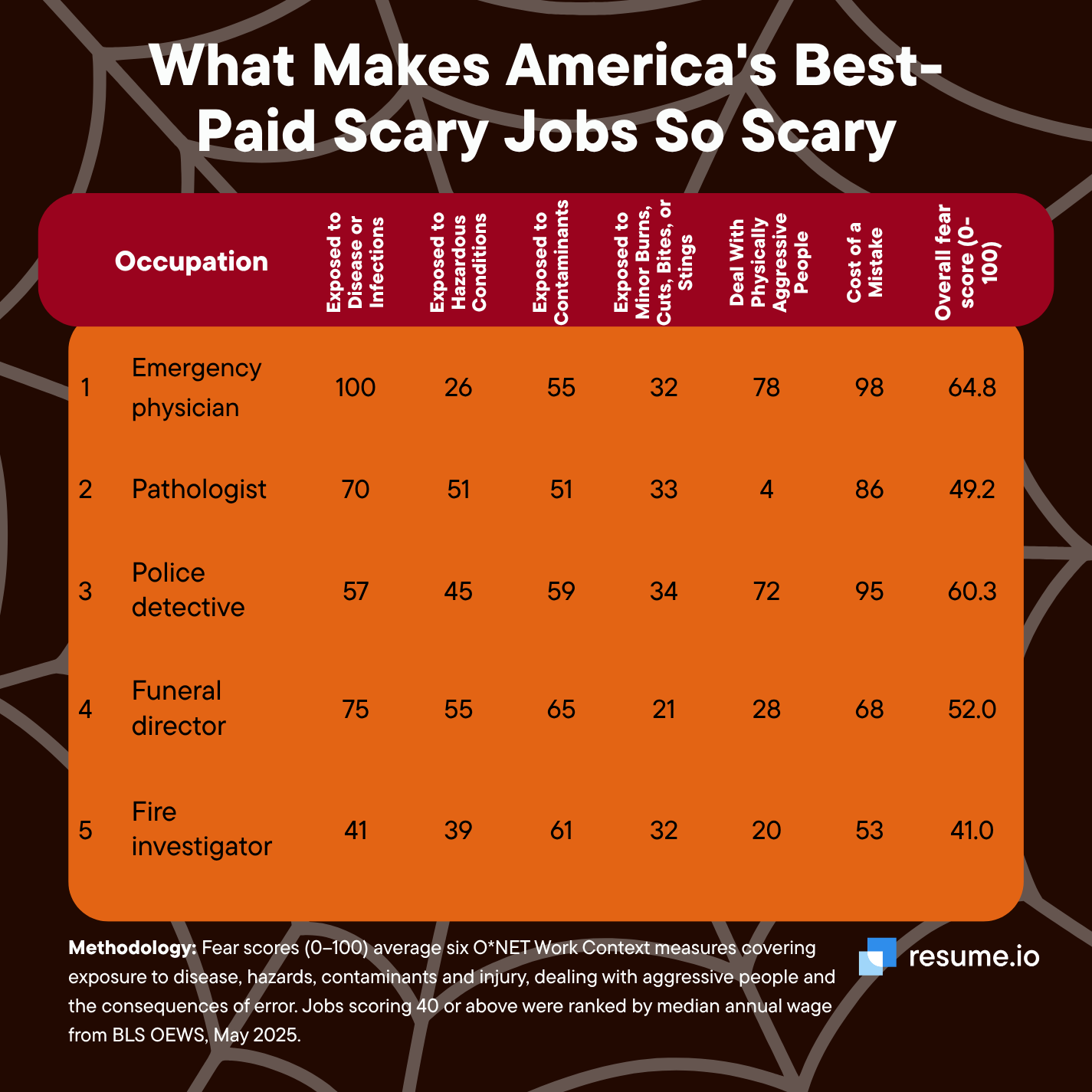
Emergency physicians score a maximum 100 out of 100 for exposure to disease and infection, and 98 for the consequences of getting something wrong. That combination helps to explain both the top spot on pay and fear score among the highest on the list.
Pathologists work behind the scenes with disease and death. They earn the second-highest salary, and the 10% earn close to $450,000.
Police detectives score 95 out of 100 for the consequences of error. They are also the best-paid role on the list outside medicine.
Further down, the danger becomes more physical. Explosives workers score 96 out of 100 for exposure to hazardous conditions, the highest of any job we analyzed. Similarly, Mining machine operators score a maximum 100 for exposure to contaminants.
The Scariest Jobs Don’t Always Pay the Most
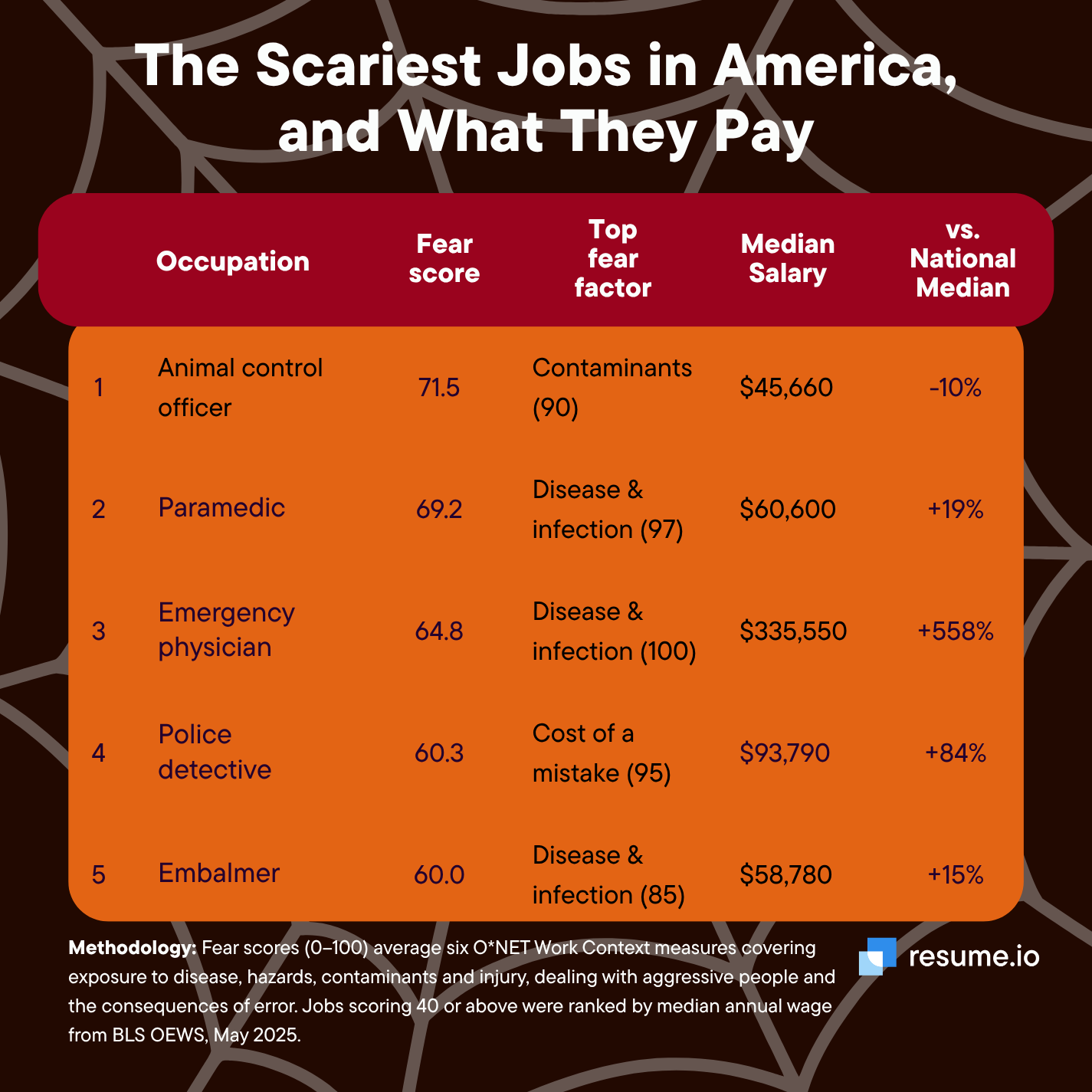
Animal control officers have the highest fear score of any job we ranked at 71.5 out of 100. They score 90 out of 100 for exposure to contaminants, and they face more bites and stings than any other role. Yet they earn just $45,660 a year, 10% below the national median of $50,980. Meanwhile, Emergency physicians earn more than seven times as much.
Disease and infection is the biggest fear factor in three of America's five scariest jobs. Paramedics, the second-scariest job, score 97 out of 100 for exposure to disease and earn $60,600. Emergency physicians rank third and score the maximum 100.
Police detectives come fourth, scoring 95 for the consequences of making a mistake. Embalmers complete the top five, scoring 85 for disease exposure and earning $58,780.
Is the Fear Worth It?
The research finds that scary work doesn't automatically come with a bigger paycheck, but it does build skills that employers value.
It’s important to look beyond the base salary. Hazard pay, overtime and shift premiums can all change what a high-risk role is really worth, so be sure to ask about them before you accept an offer. In many of these careers, experience and certification are where the money is.
It’s important to also ask what support comes with the job. Safety training, funded certifications and a clear path to promotion matter just as much as pay when the work puts you at risk. If an employer can't tell you how people progress, that tells you something.
Your nerve is a transferable skill. Staying calm under pressure, making high-stakes decisions and following strict safety procedures are valued in almost every industry. Whether you're moving into a high-risk career or ready to leave one behind, a strong, up-to-date resume makes that move possible. Resume.io's professional resume builder can help you frame your experience in a way that showcases your best skills.
Methodology
We analyzed 23 U.S. occupations associated with fear, danger, death or the macabre. Each job received a fear score from 0 to 100. The score averages six O*NET Work Context measures: exposure to disease or infections, exposure to hazardous conditions, exposure to contaminants, exposure to minor burns, cuts, bites or stings, dealing with physically aggressive people, and the consequences of making an error. Jobs scoring 40 or above were classed as scary and ranked by median annual wage from the Bureau of Labor Statistics Occupational Employment and Wage Statistics (OEWS), May 2025.
Some job titles map onto broader federal categories:
- Crime scene investigator / forensic scientist uses forensic science technicians.
- Fire investigator combines fire inspectors and investigators.
- Funeral director uses funeral home managers.
- Police detective uses detectives and criminal investigators.
The national median of $50,980 is the median wage for all occupations. O*NET data accessed September 2026.


