


To ask for a raise, research your market value, document the results you have delivered, and request a specific figure in a dedicated meeting with your manager.
Frame the conversation around your impact on the business, choose your timing with care, and be ready to negotiate if the first answer is no.
How do you ask for a raise?
Asking for a raise works best as a prepared, professional conversation rather than an off-the-cuff request.
You build a case around evidence, request a clear number, and give your manager time to consider it.
The steps below turn a nerve-wracking moment into a straightforward business discussion you can steer.
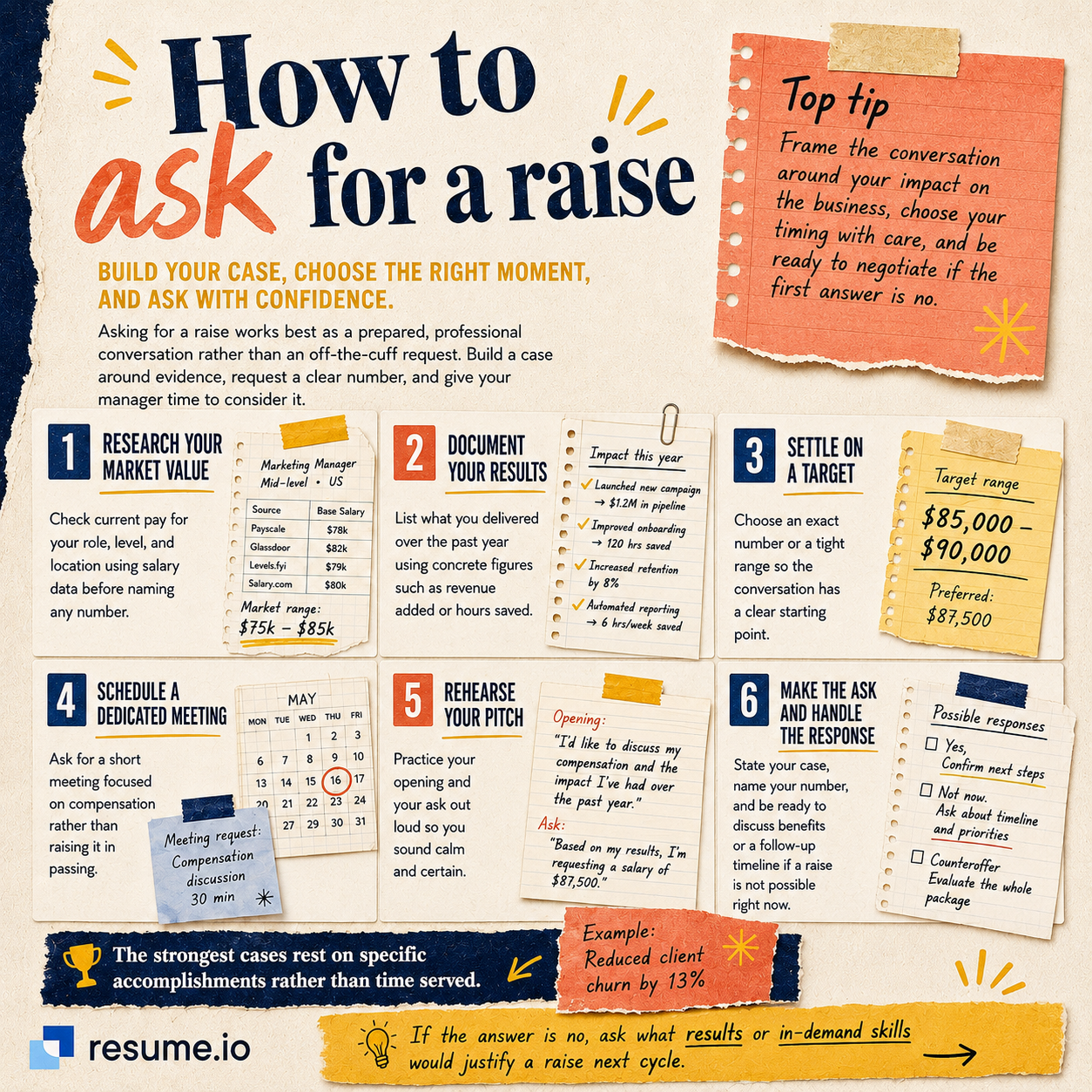
- Research your market value: Check current pay for your role, level, and location using salary data before you name any number.
- Document your results: List what you have delivered over the past year, using concrete figures wherever you can, such as revenue added or hours saved.
- Settle on a target: Choose an exact number or a tight range so the conversation has a clear starting point.
- Schedule a dedicated meeting: Ask for a short meeting focused on compensation rather than raising it in passing.
- Rehearse your pitch: Practice your opening and your ask out loud so you sound calm and certain.
- Make the ask and handle the response: State your case, name your number, and be ready to discuss benefits or a follow-up timeline if a raise is not possible right now.
The strongest cases rest on specific accomplishments rather than time served.
An account manager who reduced client churn by 13%, for instance, would open with that result, not with how many years they have been in the role.
If your manager cannot approve an increase now, ask what results or in-demand skills would justify one next cycle, and treat asking for a raise as a normal part of how you grow your career.
When should you ask for a raise?
The strongest time to ask for a raise is when your value is fresh and visible: after a solid result, during a scheduled review, or a few months before your company sets its next budget.
Avoid periods of layoffs, hiring freezes, or heavy pressure on your manager, when even a fair request tends to get a quick no.
Timing falls into windows that help your case and windows that work against it:
- Strong windows: Just after a completed project or exceeded target, during an annual or quarterly review, or two to three months before your company locks the fiscal year budget
- Weak windows: During company cutbacks or poor results, immediately after a recent raise, or when your own performance has dipped.
The day of the week matters far less than the moment in the business cycle.
If you are choosing between a Friday and a Monday, neither is ideal, because Friday afternoons compete with the weekend and Monday mornings compete with a full inbox.
A midweek morning, when your manager is settled but not yet overloaded, tends to land better and gives them room to consider the request properly.
How much of a raise should you ask for?
How much you should ask for depends on why you are asking.
A standard annual raise usually falls between 3 and 5%, a strong-performance or expanded-role increase between 5 and 10%, and a market correction for underpaid or re-leveled roles between 10 and 20%.
Match your number to your reason and to the evidence you can show.
| Raise range | When it applies | What to bring |
|---|---|---|
| 3 to 5% | Standard annual or cost-of-living increase | Steady performance and current market data |
| 5 to 10% | Strong results or expanded responsibilities | Quantified wins and new duties taken on |
| 10 to 20% | Market correction or a role that has grown more senior | Clear benchmarks showing a real pay gap |
For context, US employers plan average total salary increase budgets of 3.5% for 2026 (Mercer US Compensation Planning Survey, 2026), so a request in the standard band sits close to what most companies have set aside.
Pay can vary widely for the same title, and some of the highest-paying jobs reward similar work very differently, so verify your target against current data for your role before you commit to it.
How do you calculate a raise?
To calculate a raise, divide the pay increase by your current salary and multiply by 100 to get the percentage, or multiply your salary by the percentage to get the dollar amount.
Working in both directions lets you translate a target into real take-home terms before you walk into the meeting.
A worked example makes the math clear:
- From a percentage to dollars: If you earn $60,000 and want a 6% raise, multiply 60,000 by 0.06 to get $3,600, which takes you to $63,600.
- From dollars to a percentage: A $4,000 increase on a $60,000 salary is 4,000 divided by 60,000, which equals 0.067, or about 6.7%.
Run the figure as an annual amount first, then divide by 12 if you want to see the monthly change, since a percentage that looks small can add up to a meaningful sum over a year.
Knowing both numbers keeps you precise in the conversation and stops you from anchoring to a percentage that does not reflect what you actually need.
What is the best wording to ask for a raise?
Strong wording for a raise request is direct, plain, and focused on value.
Thank your manager for their time, state that you would like to discuss your compensation, summarize the results you have delivered, and name your number.
Language that stays factual and confident makes the request easy to approve and easy to carry up the chain.
A simple spoken structure works in most meetings:
"Thank you for making time to meet. Over the past year I have led [specific project] and delivered [quantified result]. Based on my research into pay for this role and the scope I am now covering, I would like to discuss increasing my salary to [figure]. Does that seem reasonable to you?"
Keep the delivery clean by trimming words that undercut your position, such as "just," "only," "I think," and "I feel."
They signal doubt, and a raise request delivered with certainty is easier for a manager to take seriously and act on.
Practicing the wording aloud beforehand helps it come out steady rather than rushed.
How do you ask for a raise in writing?
To ask for a raise in writing, send a short, professional email or letter that states your request, lists two or three quantified results, references market data, and asks for a meeting to discuss.
A written request gives your manager something concrete to forward to the people in HR or senior leadership who control the budget.
A clear template keeps it tight:
Subject: Salary review request - [Your name]
Hi [Manager's name],
I would like to request a review of my current salary. Over the past [timeframe] I have [achievement one with a figure] and [achievement two with a figure], and I have taken on [new responsibility]. Based on these contributions and current market data for [role] in [location], I would like to discuss an adjustment to [figure or range]. Could we find time this week to talk it through?
Thank you for your consideration,
[Your name]
Lead with results and keep the message to a few short paragraphs, since a written ask works much like a promotion request letter: its job is to open the conversation, not to close it.
End by proposing a meeting so the decision happens in a discussion, where you can answer questions directly.
What should you not say when asking for a raise?
When you ask for a raise, avoid anything that pulls the conversation away from your value.
Do not base your case on personal bills, do not measure yourself against a specific colleague, and do not issue an ultimatum you are not prepared to act on.
These lines put your manager on the defensive and weaken a request that your results could otherwise carry on their own.
The most common phrases to leave out include:
- "I need a raise because my costs have gone up": Personal expenses are real, but employers pay for value, so lead with contribution instead
- "[Colleague] earns more than me": Pay comparisons rely on information you may not have in full and can sound like a grievance
- "Give me a raise or I will leave": An ultimatum forces a yes-or-no standoff and can damage trust even when you get the increase.
Keeping the tone collaborative protects the relationship and leaves room for a follow-up if the timing turns out to be wrong.
A calm, evidence-led request is far harder to dismiss than an emotional one.
Can asking for a raise backfire?
Asking for a raise rarely backfires when the request is reasonable and professional.
A well-prepared ask signals ambition, and most managers respect an employee who knows their worth and states it clearly.
The risk lies in how you ask, not in the act of asking itself.
What separates a safe request from a risky one comes down to a few habits:
- Keeps the risk low: A single, well-prepared request tied to results, with space left between asks.
- Raises the risk: Ultimatums, threats to quit, or repeated demands with no new results to show.
Asking politely will not get you fired, and one well-judged request is a normal part of working life.
If a raise is genuinely off the table and your pay sits below the market rate, it can be worth looking at more fulfilling roles elsewhere, or at virtual jobs that often pay more than their office-based equivalents.
Treating a firm no as useful information, rather than a personal rejection, keeps your options open.
How do you ask for a raise if your employer does not discuss pay?
When your employer does not openly discuss pay, treat the raise as a scheduled agenda item rather than waiting for an invitation.
A short, well-prepared meeting works even where there is no formal review cycle, as long as you bring evidence and a clear number.
Where the process is unwritten, your job is partly to uncover how it works:
- Open the door plainly: Ask to "set some time to talk about my role and compensation," so the topic is on the table without pressure.
- Learn the mechanics: Ask how pay decisions are usually made and when budgets are set, which tells you the real timeline for a decision.
- Pin down next steps: Agree the specific results that would earn an increase and a date to revisit, then confirm that summary in writing.
Approaching a quiet pay culture this way turns an awkward unknown into a defined process.
Even if the answer is not yes today, you leave with a clear path and a shared record to hold both sides to.
Key takeaways
- Ask for a raise as a prepared business conversation: research market pay, document quantified results, and request a clear number or range.
- Timing matters more than the day of the week, so ask after a solid result, at a review, or before the next budget is set, and avoid downturns.
- Match your number to your reason, with 3 to 5% for a standard raise, 5 to 10% for strong performance, and 10 to 20% for a genuine market correction.
- Put your request in writing when you need your manager to make the case to the people who hold the budget.
- If the answer is no, ask what would change it, and consider benefits, a follow-up date, or other roles when your pay sits below market.
Frequently asked questions
A few common questions come up whenever people plan how to ask for a raise.
Is a 3% raise in 2026 good?
Not really. A 3% raise trails the 3.4% rise in US consumer prices over the year to July 2026 (US Bureau of Labor Statistics, 2026), which means it slightly reduces your buying power.
It also sits below what most employers set aside for the year, so aim higher when your performance or market rate supports it.
Is a 20% raise a lot to ask for?
It can be, but it is not unreasonable in the right situation.
A 20% raise sits in market-correction territory, which fits when your pay is well below the going rate or your role has grown into a more senior one.
Back it with clear salary data and a record of results, or scale the request to what your evidence supports.
Are there calculators to determine how much of a raise to request?
Yes. Online pay raise calculators turn a percentage into a dollar amount, or work out the percentage from a target salary, which helps you set your number.
Treat the output as a starting point and check it against current market data for your role and location, since a calculator cannot tell you what your work is worth.