


What spacing should a cover letter be?
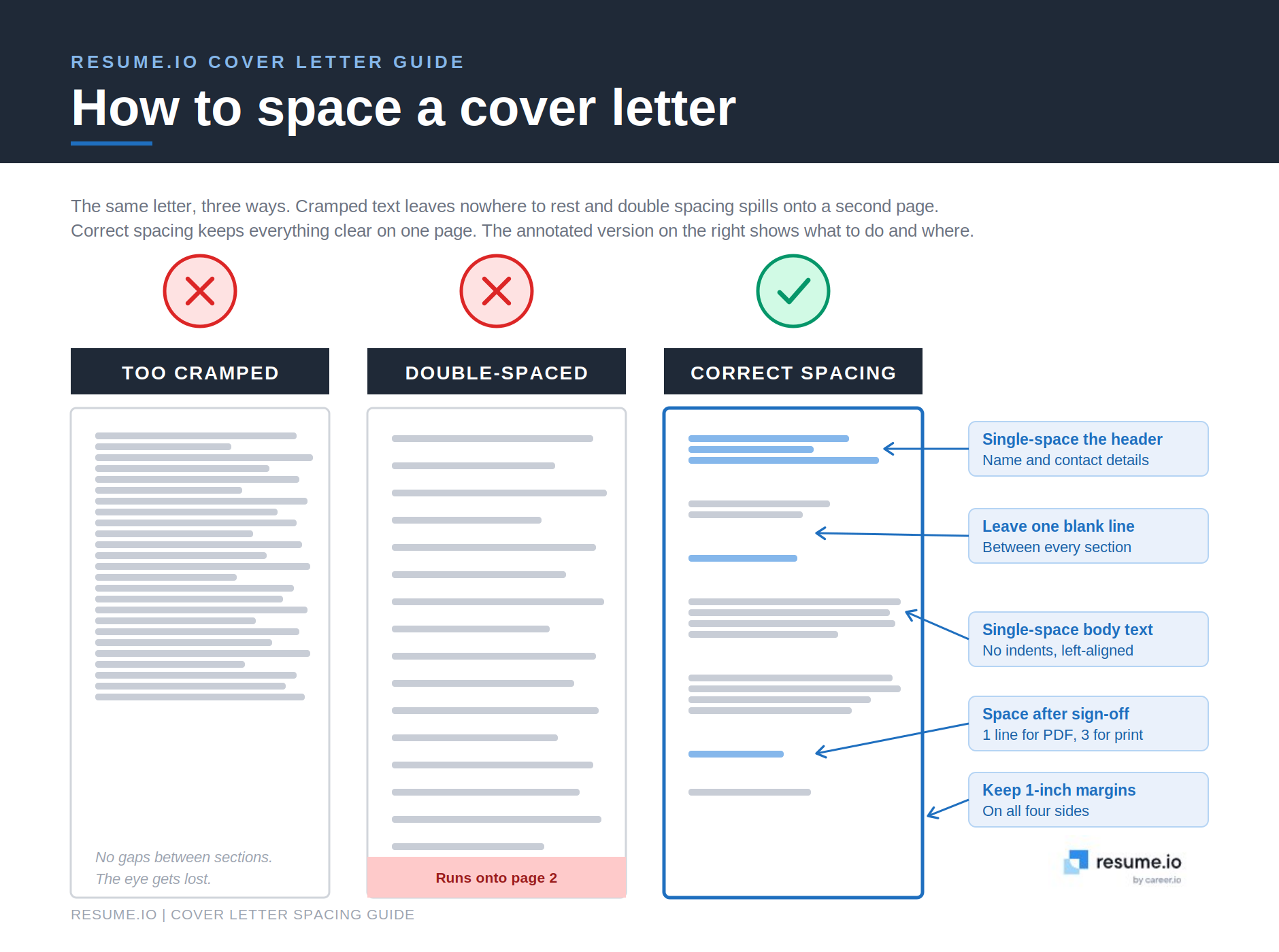
A cover letter should be single-spaced (1.0 line spacing) within each paragraph, with a single blank line separating paragraphs and sections.
If single spacing looks too tight for your font, 1.15 line spacing is a safe, slightly more open alternative.
Do not use double spacing, and do not indent the first line of any paragraph.
A shorter letter also carries more white space, which is part of why 70% of employers prefer cover letters of one-half page or less (Resume.io, 2025).
If your letter looks empty, add a specific example or a quantified result, not extra line spacing.
How should I format the spacing in my cover letter?
Format your cover letter from the top down, single-spacing the content within each section and leaving one blank line between them.
Worked in order, the sections fall into this blueprint:
- Contact information: Your name, job title, and contact details, left-aligned at the top.
- Date: A blank line above and below it.
- Recipient details: The hiring manager's name, title, company, and address.
- Salutation: For example, "Dear Ms. Speedie," with a blank line after it.
- Body paragraphs: Your introduction, middle paragraphs, and closing, each separated by a blank line.
- Sign-off: For example, "Sincerely," followed by space for your name.
- Your name: Single-spaced beneath the sign-off.
This top-to-bottom order is the standard structure recruiters recognize instantly, and it mirrors the format used for almost every professional application.
Keeping every section left-aligned, with that one blank line between each, is what produces the even, balanced look that signals a polished document.
One detail worth getting right is the header.
Your name, occupation, and contact information at the top form a natural header, and a distinct one adds a personal branding touch while creating built-in white space that sets your details apart from the body text.
How should I set the margins and signature spacing?
Set 1-inch margins on all four sides.
This is the default in Microsoft Word and Google Docs and the safest choice for almost every application.
If your letter spills a few lines onto a second page, you can reduce the margins to 0.75 inches or, at the absolute minimum, 0.5 inches.
Going any tighter makes the page look cramped, and most career centers, including Purdue University's Online Writing Lab, treat half an inch as the floor.
Margins are the frame around your text, so consistency matters as much as size.
Uneven margins, or margins that differ from your resume, make an application feel pieced together.
Where you can, use the same 1-inch setting on both documents.
The space after your sign-off then depends on how you send the letter:
- Printed copy: Leave three to four blank lines so you can add a handwritten signature.
- PDF or online application: One blank line is enough before your typed name.

Should a cover letter be double spaced?
No. A cover letter should never be double-spaced, because double spacing belongs to academic essays rather than business correspondence, and it makes the letter look unprofessional while pushing it past one page.
The cost is real, since presentation shapes a reader's first impression and 58% of employers toss cover letters with obvious mistakes (Resume.io, 2025).
Set your line spacing to 1.0 or 1.15, keep one blank line between paragraphs, and the letter will look exactly as a hiring manager expects.
What font and font size work best with cover letter spacing?
Use a clean, widely available font such as Arial, Calibri, Helvetica, Georgia, or Times New Roman at 10 to 12 point size, and match it to the font on your resume so the two documents feel like one application.
Font and spacing work together, so a larger font may need single spacing to stay on one page, while a compact font can carry 1.15 comfortably.
Keep all text left-aligned, since the uneven right edge creates natural white space that leads the reader down the page.
Avoid full justification, which forces both edges straight and creates erratic gaps between words.
How should spacing differ for printed, PDF, and email cover letters?
The core rules hold across all three formats: single spacing, blank lines between sections, left alignment, and one page.
What changes is the header at the top.
A printed or PDF letter keeps the full contact block, date, and recipient address, while an email letter drops them, since that information already lives in the email.
The table below shows the differences side by side.
| Element | Printed or PDF | Email body |
|---|---|---|
| Your contact details at top | Included, single-spaced | Not needed, go straight to the salutation |
| Date and recipient address | Included, blank line around each | Not needed |
| Subject line | Not applicable | Your name and the position you are applying for |
| Starting point | Your contact block | The salutation, for example "Dear Ms. Fair," |
| After the sign-off | Space for a signature, then your name | One blank line, then your name and contact details |
For an email cover letter, begin with the salutation, keep the body identical to a standard letter, and place your name, job title, and contact information after the sign-off.
Everything between the greeting and the closing follows the same spacing you would use on paper, so you only have to think about the top and bottom of the message.
It is worth checking the finished letter once on a phone screen, since many recruiters open applications on mobile first and tight spacing shows up faster there.
Cover letter spacing examples
Seeing the spacing in context makes the rules easier to apply.
Below are two adaptable templates, one formatted for printing or sending as a PDF, and one for the body of an email.
1. Printed or PDF cover letter
Jordan Belford Flight Attendant Somewhere Drive, Chicago, IL 60643 Phone: (312) 555-5555 jordan.belford@email.com
May 2024
Ms. B. Speedie Go Now Airlines Thereway Road, Chicago, IL 60642
Dear Ms. Speedie,
Having clocked over 2,500 hours on both long and short-haul flights across six years as a flight attendant, I have learned that a variety of passengers bring a variety of challenges. I take pride in excelling in every aspect of customer service.
In my six years at Wings, I worked on change initiatives across pre-flight, in-flight, and post-flight service. Ensuring passenger well-being, safety, and comfort at every stage is the heart of the job. I received 97% positive recognition from passenger surveys and consistently high ratings from my team.
My contributions made a broader impact on Wings, in ways I hope to repeat:
- Designed a more efficient boarding protocol that sped up procedures by 16%
- Improved customer satisfaction metrics by 12% on long-haul flights
- Updated the cabin crew first-aid manual after noticing gaps in the guidance
I would welcome the chance to hear more about the Go Now Airlines culture in an interview.
Sincerely,
Jordan Belford
2. Email cover letter
SUBJECT: Daniel Drake, Human Resources Director position
Dear Ms. Fair,
I would like to convey my genuine interest in the Human Resources Director position at the Gromwell Group. Over the last eight years, I have served as an HR Administrator for two of the busiest staffing firms in New York.
That experience built a real passion for human resources, where I have found my strengths are most needed. I am highly skilled in overseeing HR systems, handling employee relations, and ensuring compliance across all rules and regulations.
I would value the opportunity to discuss what I can bring to the Gromwell Group as Human Resources Director. I look forward to hearing from you.
Best regards,
Daniel Drake Human Resources Director (718) 555-5555 daniel.drake@email.com
Key takeaways for cover letter spacing
- Use single (1.0) line spacing within paragraphs and a single blank line between every section and paragraph.
- Set 1-inch margins on all sides, reducing to 0.75 inches or no less than 0.5 inches only if your letter runs onto a second page.
- Never double-space a cover letter, as it reads as an academic essay and pushes the letter past one page.
- Keep the letter left-aligned, in a 10 to 12 point professional font, on a single page of 250 to 400 words.
- Match your font, margins, and alignment to your resume so the two documents feel like one application.

Frequently asked questions
If you still have a question about how to space your cover letter, the answers below cover the points job seekers ask about most.
Should there be a space between paragraphs in a cover letter?
Yes. Leave one blank line between every paragraph and section, and do not indent the first line.
The blank line replaces the indent, separates your ideas clearly, and creates the white space that makes the page easy to read.
What line spacing is best for a cover letter, 1.0 or 1.15?
Both work. Use 1.0 (single) spacing as the standard, and switch to 1.15 only if single spacing looks too tight for your chosen font.
Anything above 1.15 starts to look stretched and risks pushing the letter onto a second page.
How many spaces go after the sign-off in a cover letter?
It depends on the format.
Leave three to four blank lines after your sign-off on a printed letter to make room for a handwritten signature, and just one blank line on a PDF or email before your typed name.