


A cover letter outline is a simple framework that maps your letter before you write, setting out each section in order from your contact details at the top to your sign-off at the bottom.
It keeps your letter focused, complete, and easy for a hiring manager to read, so you can write faster with less second-guessing.
What is the basic outline of a cover letter?
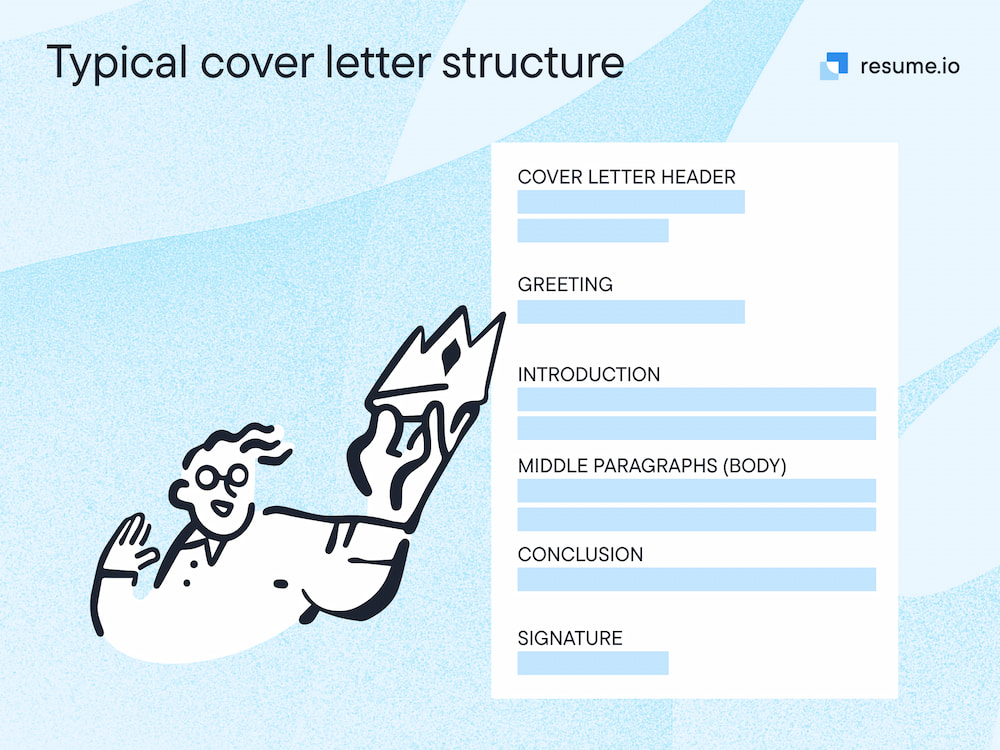
The basic outline of a cover letter is an ordered list of the sections every letter needs, from your contact details at the top to your signature at the bottom.
It gives you a fill-in-the-blank structure, so you spend your energy on what to say rather than where to put it.
Here is the at-a-glance framework that fits almost any role:
- Header: Your name and contact information
- Date: The day you send the letter
- Recipient details: The hiring manager's name, title, and company address
- Greeting: A direct salutation, ideally by name
- Introduction: Who you are and the role you want
- Body paragraphs: The proof that you suit the job
- Closing: A confident call to action
- Sign-off: A professional closing and your name
Think of the outline as the skeleton and your wording as everything built on top.
Once the order is set, you are no longer wondering what comes next.
You are filling defined sections one at a time, which is faster and far less stressful.
This same structure underpins any format you choose, whether you submit by email or through an online portal, and it holds true across the tips that make a cover letter work.
What are the 7 parts of a cover letter?
The seven parts of a cover letter are the header, the date, the recipient's details, the greeting, the introduction, the body, and the closing with your sign-off.
Each part has one job, and the table below shows what that job is so you know exactly what to write in each section.
| Part | What it does | Quick guidance |
|---|---|---|
| Header | Identifies you and how to reach you | Match the style to your resume header for a consistent pair |
| Date | Records when you applied | Use the month, day, and year you actually send it |
| Recipient details | Shows the letter is targeted | Add the hiring manager's name and title where you can find them |
| Greeting | Opens the conversation | Address a person by name, or use "Dear Hiring Team" as a fallback |
| Introduction | States who you are and the role | Lead with your strongest reason to keep reading |
| Body | Proves you fit the job | Connect your experience to the employer's needs with evidence |
| Closing and sign-off | Prompts the next step | Ask for an interview, thank the reader, and sign professionally |
The counting can vary, since some guides fold the date and recipient details into the header, or treat the closing and sign-off as separate parts.
The labels matter less than the sequence.
As long as every section is present and in order, your letter will read the way a hiring manager expects.

How do you outline a cover letter step by step?
Outlining a cover letter step by step means setting up the structure first, then mapping the right content into each section before you write full sentences.
Follow these five steps to build an outline you can reuse for every application.
- Set up the sections: List the parts in order, leaving space under each one to add notes.
- Pull keywords from the job description: Note the skills and requirements the employer repeats, since these guide what your body paragraphs cover.
- Map your evidence to the body: Under the body section, jot the achievements and skills that match those requirements, with a number or result beside each where possible.
- Draft your hook: Write a one-line note for the introduction that names the role and your single strongest selling point.
- Plan the close: Decide on your call to action, such as requesting an interview, so the ending does not trail off.
The advantage of building the structure before the prose is that you catch gaps early.
If you reach the body section and cannot list two relevant achievements, that is a signal to rethink your angle before you have written a single paragraph.
A common mistake is jumping straight into the introduction, then realizing partway down that your best material has nowhere to go.
What does a cover letter outline example look like?
A cover letter outline example shows the structure filled with placeholder prompts, so you can see what each section should contain before you adapt it to your own role.
The template below is the kind you can copy once and reuse for every application.
[Your name] [Phone] | [Email] | [City, State]
[Month Day, Year]
[Hiring manager's name] [Title, Company]
Dear [Hiring manager's name],
Introduction: Name the role, say where you found it, and lead with your strongest reason to be considered.
Body paragraph 1: Connect one key requirement from the job description to a specific achievement, with a number or result.
Body paragraph 2: Add a second relevant strength or skill, again backed by evidence rather than a claim.
Closing: Request an interview, thank the reader for their time, and point to your attached resume.
Sincerely, [Your name]
You can adapt this to almost any job by changing the evidence in the body, not the order of the sections.
What should go in each section of a cover letter outline?
The sections that carry the most weight are the introduction and the body, so those deserve the most thought, while the header, greeting, closing, and sign-off are largely about getting the format right.
Knowing what belongs where stops you from repeating your resume or padding the letter.
Your header carries your name, phone number, email, and city, and works best when it visually matches your resume.
The cover letter header gives you room for design choices as long as the core contact details are present.
Your greeting should name a person wherever you can find one, because a specific address signals genuine effort.
The introduction earns the most attention.
In fact, 41% of hiring managers say the introduction is the most important part of a cover letter (Resume.io Cover Letter Statistics, 2025), which is why a good opening leads with your strongest point rather than a slow warm-up.
Name the role, say where you found it, and get to your best selling point quickly.
Your body paragraphs are where you prove you suit the job.
This matters more than many applicants realize, because 35% of hiring managers disregard cover letters that do not mention a candidate's skills (Resume.io Cover Letter Statistics, 2025).
Rather than restating your resume, link specific experience to what the employer needs:
"In five years as an administrative assistant, I learned to handle 80 to 100 individual tasks a day without letting anything slip, and I run a productivity blog with 5,500 subscribers to stay current with the field."
Your closing then asks for the interview and thanks the reader, and your sign-off uses a standard phrase such as "Sincerely" above your name.
Why is a cover letter outline worth the extra step?
A cover letter outline is worth it because it produces a complete, targeted letter faster, and the letter itself carries real weight in hiring decisions.
An outline removes the two things that slow people down most: deciding what to include, and deciding what order to put it in.
The payoff is not only speed.
A strong cover letter genuinely influences whether you reach the interview stage.
Resume.io's research suggests that 87% of employers consider cover letters when deciding which candidates to invite for interviews (Resume.io Cover Letter Statistics, 2025).
A letter that is complete and well-ordered gives you a fairer shot at that consideration than one written in a hurry.
There is also a quality argument.
As the University of Pennsylvania's career services team explains, a cover letter lets you create a narrative that shows the path you have taken and why this role is the next step, something a resume cannot do on its own (Penn Career Services).
A clear structure protects that narrative, letting you focus on telling your story instead of arranging it.

Key takeaways
- A cover letter outline maps every section in order before you write, turning a blank page into a fill-in-the-blank structure.
- The seven core parts each have one job, so the outline tells you exactly what to put in every section and prevents you from repeating your resume.
- Building the structure before writing helps you catch weak spots early, such as a body section with no relevant achievements to show.
- The introduction does the heaviest lifting, with a large proportion of hirers agreeing it is the most important part of a cover letter application.
FAQs
A few questions come up often once people start building their outline.
Here are clear answers to the two most frequent ones.
What is the outline of a cover letter?
The outline of a cover letter is the ordered set of sections the letter contains, running from your header and contact information through to your closing and sign-off.
It works as a reusable template, letting you slot tailored content into a fixed structure for every job you apply to, so no section gets forgotten.
What words impress employers the most?
Employers are most impressed by concrete, results-focused words rather than generic praise.
Strong action verbs such as "led," "increased," "built," and "delivered," paired with specific numbers, prove what you achieved instead of just claiming it.
Skip overused fillers like "hardworking" and "team player," and show those qualities through evidence in your body paragraphs instead.