



When people picture a Fortune 500 CEO, they often picture a Harvard-educated MBA who climbed the corporate ladder through finance before taking the top job in their forties.
However, the reality looks very different.
We analyzed the backgrounds of Fortune 500 CEOs to uncover surprising patterns behind America’s biggest business leaders, from their birthdays and education to the career paths that eventually led them to the corner office of some of America’s most successful companies.
While no single path guarantees the corner office, the data reveals which assumptions about getting there hold up, and which are myths.
Key findings:
- Cancer is the most common zodiac sign among Fortune 500 CEOs, while Aries ranks among the least common.
- Women lead just 11.2% of Fortune 500 companies, but are just as likely as men to reach the role in their early fifties.
- Over half of CEOs don’t have an MBA.
- Nearly half of CEOs studied engineering or computer science, more than business, finance and economics combined.
- Four in five Fortune 500 CEOs were promoted internally.
- The most common route to CEO is through the Chief Operating Officer role, not Chief Financial Officer.
The Zodiac Signs of the Boardroom: Cancers Run Corporate America
Of the 138 Fortune 500 CEOs whose birth dates could be confirmed, Cancer came out on top as the most common zodiac sign, accounting for 11.5% of CEOs.
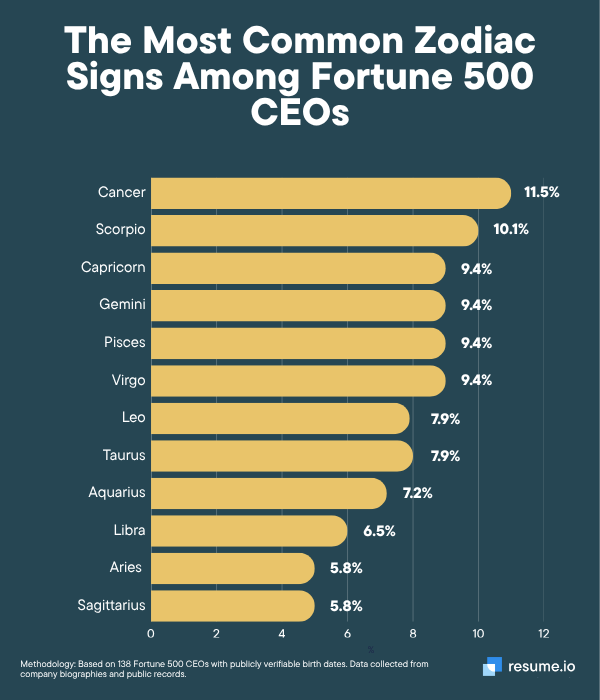
Scorpios followed closely behind at 10.1%, meaning water signs occupy the top two spots.
Meanwhile, Aries which is often described in astrology as the ultimately natural born leader, ranked among the least common signs in the Fortune 500. Aries tied with Libra and Sagittarius as the rarest zodiac signs among CEOs, with each accounting for just 5.8% of leaders.
The findings highlight a contrast between astrology stereotypes and real-world outcomes. While Aries is frequently associated with leadership, drive and competitiveness, it appears surprisingly uncommon among America’s largest companies.
Of course, zodiac signs don’t determine career success. Education, experience, opportunity and years of professional development all play a far greater role than the month you were born. But for astrology enthusiasts, it’s an entertaining twist that Cancer—not Aries—dominates the Fortune 500.
The Birth Months Most Likely to Produce CEOs
Birth month tells another interesting story.
Among the 186 Fortune 500 CEOs whose birth months are publicly available, three months tie for corner-office births: May, July and November, each accounting for 9.7% of CEOs.
The more striking pattern can be seen at the other end of the calendar. Just 4.8% of Fortune 500 CEOs were born in April, barely half of what you would expect if the birthdays were to be spread evenly across the whole year. December babies fare slightly better at 5.9%.
The underrepresentation of December is a pattern researchers have observed before. Children born late in the school-year cutoff are often the youngest in their class, and some studies suggest those early years of playing catch-up can echo throughout a career. The corner office, it seems, may carry a faint reflection of the classroom.
Once again, although birth month has no proven impact on career achievement, these patterns continue to fascinate researchers and the public alike, often sparking debate around seasonality, education cut-off dates and cultural factors.
Women Lead Just One in Ten Fortune 500 Companies
Beyond birthdays, the data also reveals how far corporate leadership still has to go in terms of gender representation. Of the 500 CEOs leading America's biggest companies, just 56, or 11.2%, are women.
That imbalance is stark, but the detail beneath it tells a more interesting story. Ten women lead companies in the top 100, headed by Gail Boudreaux of Elevance Health (#18), Sarah London of Centene (#19), Mary Barra of General Motors (#23), and Jane Fraser of Citigroup (#24). Women CEOs are not clustered in stereotypically "consumer" industries; they lead insurers, banks, chemical companies, and industrial machinery firms.
Two further patterns stand out in the data:
- Women reach the CEO's chair at essentially the same age as men (52.7 vs 51.7 on average)
- Women CEOs are even more likely than men to have been promoted from within: 86% rose through their own company, compared with 79% of men
These findings suggest that while women remain significantly underrepresented in Fortune 500 leadership, those who do reach the top often do so after building long careers within a single organization.
What Do Fortune 500 CEOs Study?
Among the 214 CEOs whose education is publicly documented, one university towers over the rest. Harvard educated 27 current Fortune 500 CEOs, counting undergraduate and postgraduate degrees, more than double its nearest rival. The University of Pennsylvania and its Wharton School follow with 11, then Northwestern and its Kellogg School (10), Cornell (9), and Columbia (8).
While elite universities dominate the top of the rankings, the wider dataset tells a more varied story. Fortune 500 CEOs also graduated from institutions including Texas A&M University, Syracuse University, Iowa State University, Kettering University, Manipal University and ITT Technical Institute, showing there is no single educational path to the C-suite.
The bigger surprise is what CEOs studied. Among those with a documented degree subject, 46% studied engineering or computer science, more than business (13%), accounting and finance (11%), and economics (8%) combined. These findings challenge the popular perception that finance is the default route into executive leadership. Instead, today’s Fortune 500 is disproportionately led by executives with engineering and technical backgrounds.
As for the MBA, despite the perception being that it is a standard route into executive leadership, the data revealed only 46% of CEOs with verified education hold one. Meaning that the majority of Fortune 500 chiefs reached the top without it.
The Career Path to the Corner Office
We traced the role each CEO held immediately before getting the top job, across 307 documented career paths.
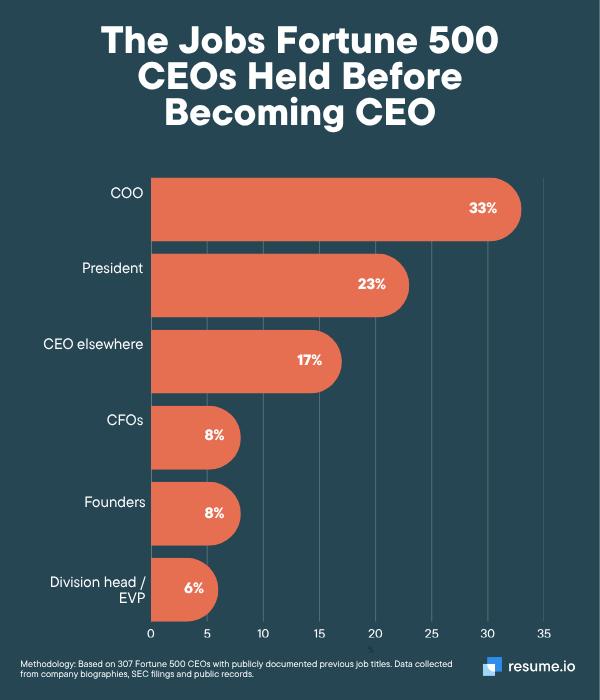
The most common stepping stone to CEO, by a wide margin, is Chief Operating Officer. One in three (33%) Fortune 500 CEOs was COO or operations chief immediately before promotion. The second most common title was found to be President with another 23% of CEOs holding the position, often the same job by another name.
The data found the ever-popular CFO-to-CEO pipeline to be rarer than it's made out with only 8% of CEOs holding the title prior:
- COO / Operations chief: 33%
- President: 23%
- CEO of another company: 17%
- CFO: 8%
- Founder: 8%
- Division head / EVP: 6%
Most striking of all, 80% of Fortune 500 CEOs were promoted within their own company, while 20% were hired in externally. In an era that celebrates job-hopping, our research reveals that workers are four times more likely to reach the CEO’s office by climbing up the ranks inside one organization rather than being recruited into it.
It Takes More Than Three Decades to Reach the Top
For most executives, the road to the CEO’s office is measured in decades rather than years. The research found the average age for getting the top spot being 52 years old or 53 years old excluding founders. Assuming that the average age to start a career is 22 in the US, that’s roughly 31 years of work before taking over the corner office.
The data also highlights just how unusual rapid success really is. Airbnb’s Brian Chesky became CEO at just 27 years old, but as the company’s founder, he appointed himself. In fact, founders dominate the fast track: of the 14 CEOs in the dataset who became chief executive before turning 40, 10 founded the companies they now lead.
Among non-founders, early promotions are exceptionally rare. Michael Rapino became CEO of Live Nation at 38, while Robert Eddy took over BJ’s Wholesale Club at just 33.
The findings reinforce that, for most professionals, becoming a Fortune 500 CEO is a marathon rather than a sprint. The typical chief executive spends three decades gaining experience, taking on leadership roles and working their way through increasingly senior positions before reaching the corner office.
Conclusion
From astrology to education, our research finds that there is no single blueprint for becoming a Fortune 500 CEO.
The data shows that today’s corporate leaders come from a wide range of backgrounds, universities and industries. While Harvard graduates and engineers appear more frequently than average, most CEOs don’t have an MBA, four in five rise through the ranks of the companies they eventually lead, and the typical executive spends more than three decades building a career before reaching the corner office.
If there’s one clear takeaway, it’s that becoming a CEO is far less about shortcuts or stereotypes than persistence. The route to the top is rarely quick and almost never follows the path people expect.
Methodology
We analyzed the chief executives of the 2026 Fortune 500, verified in post as of July 2026 using company announcements, SEC filings, and public records. Because not all executive data is publicly disclosed, sample sizes vary by finding: birth dates were verifiable for 186 of 500 CEOs (zodiac signs for 138), education for 214 (degree subjects for 129, MBA status for 203), career-path data for 307 to 319 depending on the metric, and gender for all 500. Zodiac and birth-month findings describe the observed distribution among current CEOs and imply no causal relationship. Education findings reflect CEOs whose academic backgrounds are publicly documented. This data analysis was completed in July 2026.


