



What is a resume personal statement?
A resume personal statement expresses who you are, where you’ve been, and sometimes where you plan to go next right at the top of your resume.
Everyone has different circumstances, so the personal statement helps to orient a potential future boss in terms of what they are about to read in the resume. Think about what you would like to share that matters to you. This space is particularly useful if you are changing industries, coming back in to the employment market or looking for a promotion. Your shop window starts here. The personal statement may be the only thing than an employer reads.
The resume personal statement hooks in a reader, influencing them to read more. So, how do you write a resume personal statement that is both natural and grabs an employer’s attention? Offer them a brief insight into who you are and why you would be a fantastic hire. So what do you write in a personal statement for a job?
This guide will cover:
- The basic formatting of a personal statement: How to tailor your personal statement to give you a competitive advantage
- Personal statement examples you should (and shouldn’t) use
- Practical steps for getting started on your resume personal statement
The personal statement format
The personal statement is a short paragraph that sits right below your contact information at the top of a resume. It sums up your experience, goals and skills with confidence. Think of your resume’s personal statement like an extended tagline for your career. A resume personal statement should include:
- Between 50 and 200 words in 3 - 4 sentences
- Your title or function, for example “Junior developer” or “Passionate hospitality manager”
- An opening hook
- Soft skills and hard skills
- Impressive facts and stats
- Your short and/or long-term goals
- Job-specific slant for the position you’re applying to
This may seem like a lot to cram into 200 words but perfecting your elevator pitch shows that you have a firm grasp of why your experience, goals, and skills make you the perfect fit for the job. Go all out to make this as fitting for each role as possible. Too often candidates come up with what they see as the perfect introduction to them and forget about how a hiring manager for each specific role might read it. Be flexible with the personal statement. It might not present the very best version of you - it should present the best version of you for this particular role.
This brief introduction is only a short piece of text, it is not disruptive and in many cases even serves as a welcome addition to what is otherwise a dry and impersonal document. It should be clear to you by now how we feel about the personal statement: Include it, especially because it allows you that bit of creativity that may make all the difference. Adopt a conversational tone and consider using the first person for these few lines. Third person (past tense) is standard for resumes, but if you want to go personal, this is where to do it.
How do I start my personal statement? How do you not start a personal statement? Even with a personal statement of 3-4 lines, sometimes the first sentence is the hardest. Even the first few words can have a disproportionate effect on how your personal statement is viewed. Your starting "hook" should make your fit with the role clear and specific. Use an example that is as unique to you as possible - you have to make your future employer sit up and pay attention. The first word of your personal statement should never be "I" - a great resume explores the potential of a common partnership and should not be a uni-directional monologue.
Align your resume’s personal statement with the job description
The hiring manager delicately chose every word in their job description. Gather clues from its tone, which skills they highlight, and any hints that point toward their dream employee. One of the top resume tips from HR managers is to include relevant keywords specific to the job posting itself as well as the actual wording of the job title.
What would this job description look like in 3 - 4 sentences? What keywords, skills, and tone would the job description have?
While still sticking to the facts about who you are and your experiences, your resume personal statement should highlight as many similarities with the job description as possible. When the hiring manager reads the first few sentences in your resume, they feel like you are exactly the person they were describing when they wrote the job description.
Position of the personal statement
Recruiters still prefer to see a candidate's personal details at the top (or running along a column on either side) of the resumes that cross their desk. This allows them to quickly search through the resumes that Applicant Tracking Systems have sorted into their virtual “yes” pile. You do not want your (relatively modern) personal statement to get in the way of this tradition.
The best place to put your statement is after your personal details (if they are at the top) and before your employment history section. Remember that the length of your resume is important. If you have already been very selective and cannot possibly leave out any more information and if adding your personal statement means your resume spills over onto a third page, you may consider not including your statement for the position in question. This ensures you comply with the unwritten rule that a resume should not be longer than two pages.
What is a good personal statement length? 200 words is the maximum suggested length, but if you go with one powerful sentence that you want the hiring manager to remember for the rest of the interview process, then why not? Less is more, but you have to be confident in your application to go with this option.
Plan to write your resume personal statement last
Instead of getting stuck at the beginning trying to write the perfect statement, skip this section and jump right into your employment history first. Once you’ve added your relevant work experiences, take a look at your keywords, phrases and skills from your past positions.
Your complete work history and the job description for the job you want are the foundations for your personal statement. By writing your resume personal statement last, it should be easier to get started once you have the right inspiration.
It might be the case that you leave a certain number of lines for the personal statement on your resume and write an individual statement for each role. You will often have a public version of your resume that is accessible on job boards (etc), so there should still be an "ideal" personal statement version.
How do I write a resume from scratch? While it is good advice to write the resume personal statement after your have written the resume itself (giving your brain a chance to ponder your true highlights), starting writing a resume is a mammoth task in itself. There are many useful pieces of advice when sitting down to write a resume, but for me, the key is to think about the reflecting the combination of what you are good at, what you enjoy and how those things will contribute to the direction of your career. For sure, be honest about your experience, but there has to be a creative flavour of ensuring that your past adequately reflects where you want to go.
Check out resume personal statement examples
Before you dive into writing, get a sense for different rhythms and layouts by checking these resume personal statement examples. How do you write a good personal statement?
Let's start with the basics. Since every person is unique, all personal statements should be unique too. You should, therefore, resist the urge to (largely) copy someone else's existing statement. This is the only spot on your resume to let your voice be heard, so try to write something that would prompt a friend to exclaim, “That sounds like something you’d say!” while, of course, keeping it professional.
Example. Innovative Executive Assistant with 10+ years of experience with global financial firm assisting a team of three C-Level directors. Expertly coordinate travel, manage large-scale expense reports, and streamline communication and calendars across departments..Seeking an Executive Assistant role with the Resume.io team to expand my office management career and thrive in an environment that requires independent problem-solving skills and focus under short deadlines.
The example above does the following things:
- States their title in the first sentence
- Includes specifics such as team size and duties
- Succinctly sums up major responsibilities and skills
- Highlights hard skills—experience arranging travel and expense reports—as well as soft skills—grace under pressure, attention to detail and communication.
- Specifically tailors the final statement with the company and/or job description
Here are a few more resume personal statement examples:
Experienced Digital Marketing Manager with five years of expertise in heading up a global firm. Increased inbound leads by 500% and raised online sales from 100,000 annually to over 2 million in a three-year period. Looking to grow career by applying skills to the Resume.io marketing team.
Straight to the point and accomplishment focused, without the use of “I”. Now let’s look at a less effective example:
I have worked as a Digital Marketing Manager for five years. During this time I have been an important and hard-working member of the team and showed my ability to work under pressure to deliver on company targets. I am looking to bring my skills to a new role in digital marketing.
Generic and ignores accomplishments. Also, too many uses of “I” in a passive voice.
Next is an example of a personal statement that focuses more on career objectives. A career objective can be used as a way to get across your skills and experience, without the personal bit. It’s a good option if you’re an entry-level candidate or college graduate without a lot of experience in the industry you’re applying for. The idea is, because you don’t have the relevant experience to talk about, you pull skills and experience from other areas of your resume so you can show you have what it takes.
Keep your career objective brief — 2-3 sentences max — following the same rules as the personal statement.
Content writer with three years' experience in a large e-commerce company. Delivered content that grew brand social presence to over 700,000 across three channels and improved email open rates by 48%. Looking to further career by joining the Resume.io as an SEO Executive.
See how it uses transferable skills? Combining these with numbers makes them all the more impressive.
And a less effective resume personal statement example:
I am a content writer looking to secure a role as an SEO Executive. While I have no experience in this field and am a dedicated individual and a keen learner. My enjoyment of how search engines work will help me excel in your company.
There’s not enough here to capture attention and it doesn’t sell transferable skills. Whichever type of opening statement you go for, if you have numbers to show, make them count.
Writing your personal profile resume
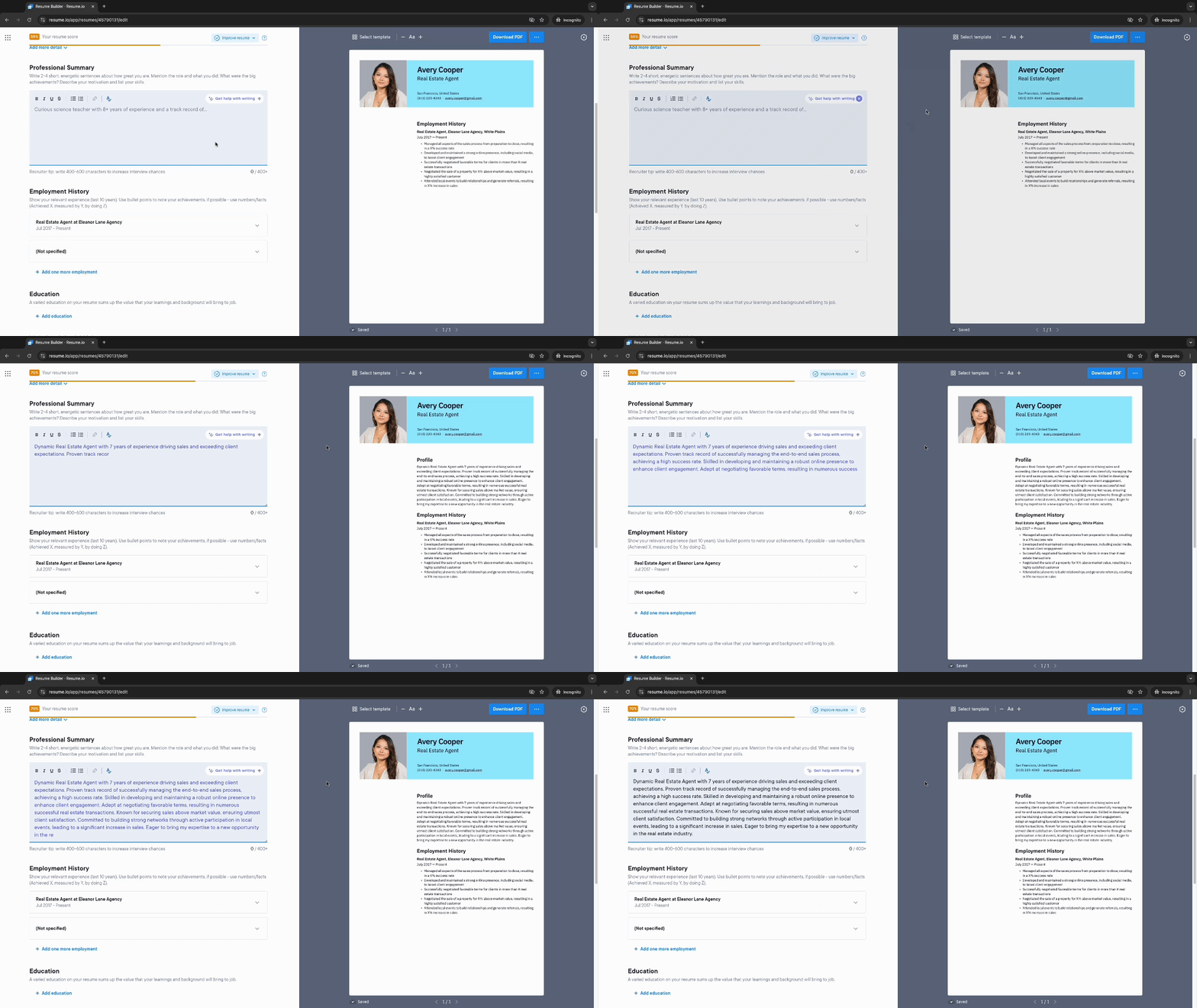
Always write the first draft of a personal profile resume without editing. Don’t worry about length or word choice in the first pass. Brag about yourself, be proud of your accomplishments, and add in all of your most impressive stats.
Some of the best writing happens without editing too soon, so don’t worry about sounding over the top or egotistical, that’s what editing your personal profile resume is for. If the goal is to get 3 - 4 perfect sentences, it’s likely your first draft will be closer to 6 - 8, maybe even longer. Then consider which parts are closest to helping you get the job and cull the rest. It might seem brutal, but brevity is critical at the top of your personal profile.
Polish your personal statement and experiment
Once you’ve narrowed your focus, use the following questions to help you review your work and edit your statement:
Is my first sentence clear and concise? The opening line should state your position and use strong, enthusiastic language to hook in the reader. It often includes years of experience as well.
Is it direct opposed to passive? A strong sense of self comes through in a personal statement. Instead of sentences that begin with “I believe I am…” or “I enjoy…” be bold. Get right to the point and take ownership of your skills.
Does it include objective information? For this one, try to get inside the hiring manager’s mind. If you were filling this role, what boxes would you need to check off? The second and third sentence often include specific skills, facts or figures to support this need.
Does it read naturally? Even with all these specifics, the statement should still be easy to understand and have a natural rhythm when read aloud. Cut out any jargon that acts as filler or that changes your tone. Formality may vary from company to company, but personal statements should always reflect the type of employee or person you are.
What are three tips for writing a personal statement?
- Make sure that your personality comes across in the writing.
- Quantify any accomplishments and include financials where possible.
- If you are at a moment of career change, don't fail to mention your goals.
Common mistakes in personal statements
When writing your personal statement, beware of platitudes. These are clichéd expressions that have become meaningless from overuse. They induce recruiters to roll their eyes and move on to the next candidate. Think of such terms as “an administrative jack-of-all-trades” or “a cog in the wheel’ and being ready for a “new challenge.” Definitely avoid this list of human resources’ most hated resume phrases.
Try to be original in your choice of words and ask a friend or family member to take a critical look at your personal statement when you are done. By the way, you should always have someone proofread your entire resume when you think you are ready to send it.
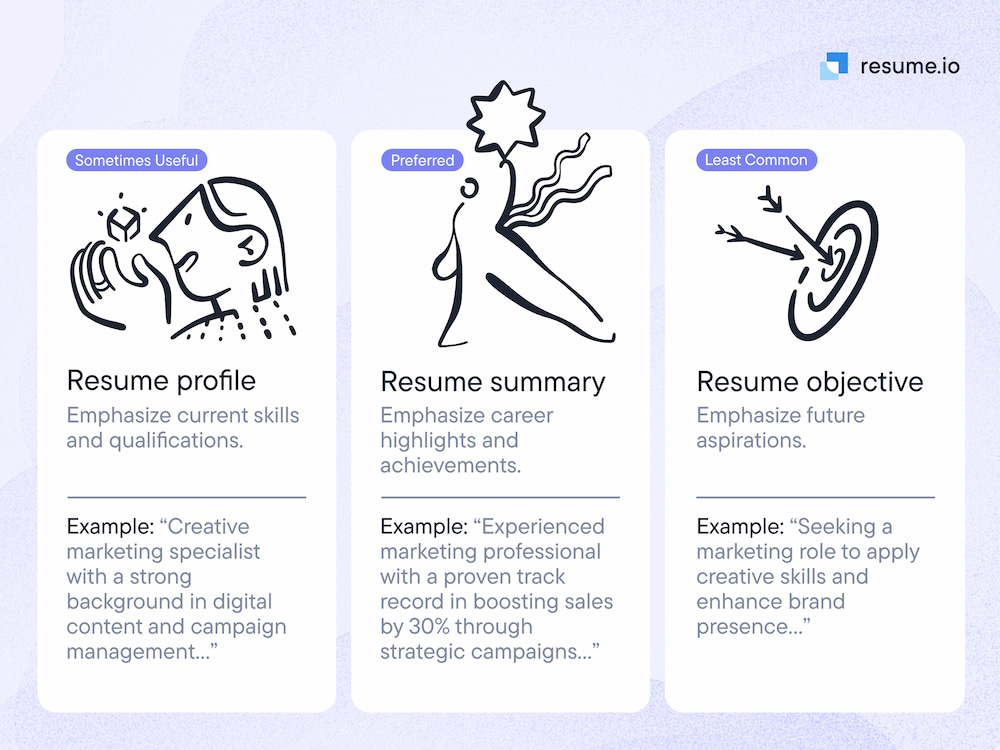
Some people call their personal statements " resume objectives." This is something else entirely. A resume objective is required when a candidate needs to project their hopes for their next role that differe from their previous experience a little. This objective can then be used to outline the motivations behind a career change and is also common with early-career professionals.
Does a personal statement need a title? Some resume templates might call the opening statement a summary and others may exclude a description entirely. Either option is fine as employers are conditioned to expect a few lines at the to of a resume to serve as a headline for your job application.
What do employers expect from your resume opening statement?
Sometimes it is useful to consider job seeking activity from the point of view of the end hiring managers. External recruiters are important people to impress, but it is the employers that will be making the ultimate hiring decision. They will be reading lots of resumes, so what would they want to read in your resume opening statement?
- They will want the resume opening statement to be written for them. When you are on the hunt for a new member of your professional family, an intensely personal connection is vital from the first lines.
- They will expect a quantifiable context to your resume opening statement. Impressive words come easily when you really need a job, but backing them up with numbers to demonstrate their scale is less simple.
- They will expect to be impressed. If you cannot impress a specific employer for a specific role with the first lines of your resume, then the role is almost certainly not for you. Nothing to shout about? Move on.
Key takeaways
Think of your CV personal statement as the first 2 minutes of an interview—whether on the phone or in person. The HR manager asks you to “tell me a little about yourself,” and you have a quick minute to set the tone for the rest of the conversation. Similarly, the CV personal statement should include:
- A natural, yet professional CV tone that reflects your personality
- The top reasons your experience makes you a unique fit for this position
- Why this role aligns with your career plans
- Facts and data on your CV that back up your earlier points
Crafting a personal statement for each role will cause some serious thought. What is your essential fit for the role that will make a hiring manager sit up and think "wow, I need to have them on my team?" What would you want to read if you were in their shoes. You will definitely have lots to say, but keep it simple and powerful.
One more good CV statement example:
Expert SEO copywriter with a decade of B2C and B2B experience across three industries. Versatile in writing social, website and long-form copy to convey each brand’s unique tone and message. I cultivated 15 new clients in two years and grew readership by over 200%. I am now seeking to expand my editing and content creation expertise in a Marketing Manager position.
Once you’ve mastered writing your CV personal statement, this clear sense of who you are and what you want will prepare you to pitch yourself during interviews.


