

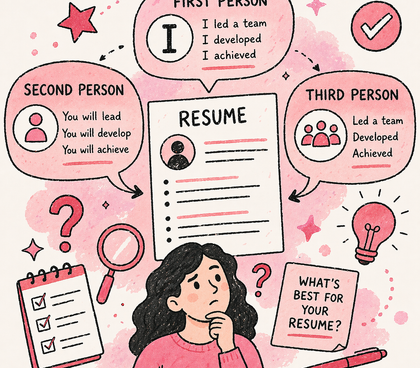
Most resumes follow a specific writing style that avoids personal pronouns, but the reasoning is not always clear.
Understanding how first-person language works in resumes helps you write clearer, professional bullet points that recruiters can scan quickly.
Should you use first person on a resume?
No, you should not use first-person pronouns like “I,” “me,” or “my” in a resume.
Instead, use first-person implied writing by starting sentences with action verbs, which keeps your resume concise, professional, and easier for recruiters and applicant tracking systems to read.
Is first-person okay in a resume?
First-person is acceptable in resumes only in its implied form, meaning you do not include pronouns like “I” or “my.”
This is the standard format used across industries because it helps writing say concise and focused on actions and results rather than the subject.
Recruiters expect resumes to follow a consistent, streamlined style.
Since every bullet point already refers to you, repeating “I” becomes unnecessary and wastes space.
Instead, starting with strong action verbs makes your experience better to scan and more impactful.
Using full first-person (“I managed,” “I created”) can make your resume feel less polished and slightly informal.
While it is not always a strict rejection factor, it can weaken the overall impression compared to a clean, action-led format.
Should I avoid using “I” in my resume?
Yes, you should avoid using “I” in your resume.
Modern resume writing uses implied first person, where the subject is understood but not written.
This keeps your writing concise and removes repetition.
For example:
- Instead of: “I managed a team of five”
- Use: “Managed a team of five”
This small shift makes your resume feel more competent and aligned with expectations.

What are the best practices for pronoun usage in resumes?
The best practice for pronoun usage in resumes is to avoid all personal pronouns and use implied first person instead.
This means writing in a direct, action-focused style without “I,” “me,” or “my.”
It keeps your resume relevant, qualified, and aligned with how recruiters expect to read experience.
Pronoun usage comparison (what to use and avoid)
| Writing style | Example | Should you use it? | Why |
|---|---|---|---|
| First person (explicit) | “I managed a team of 10” | ❌ Avoid | Adds unnecessary words and feels less professional |
| First person (implied) | “Managed a team of 10” | ✅ Recommended | Concise, results-focused, and recruiter-friendly |
| Second person | “You will manage projects” | ❌ Avoid | Not appropriate for resumes |
| Third person | “He managed a team of 10” | ❌ Avoid | Feels detached and unnatural |
Best practices to follow
- Start bullet points with strong action verbs (managed, developed, led)
- Remove pronouns in all sections, including your summary
- Focus on results, not narration
- Use consistent structure across all roles
- Keep wording short and direct for simple resume browsing
This format works because hirers already know your resume is about you.
Removing pronouns avoids repetition and makes each line easier to read quickly.
It is also easier for applicant tracking systems to parse because it prioritizes clear keywords and actions.

How do you write a resume in first-person implied?
To write a resume in first-person implied, remove pronouns like “I” and start each bullet point with a strong action verb.
Focus on what you did, how you did it, and the result.
This creates clear, concise statements that highlight your impact without irrelevant wording.
1. Start with an action verb
Use verbs like managed, developed, led, or improved to begin each bullet point.
This immediately shows what you contributed and keeps your writing direct.
2. Add what you did
Describe your responsibility or task clearly so the reader understands your role without needing extra context.
3. Include measurable results where possible
Use numbers, percentages, or outcomes to show impact and make your experience more credible.
4. Keep wording concise
Remove filler words and avoid full sentences where possible to improve readability and scanning speed.
Before submitting your resume, examine each bullet point to ensure no pronouns are included and each line starts with an action verb.
Examples
- ❌ “I managed a team of five employees and improved performance.”
- ✅ “Managed a team of five employees, improving performance by 20%.”
- ❌ “I was responsible for customer service and handling complaints.”
- ✅ “Handled customer service inquiries and resolved complaints, improving satisfaction scores.”
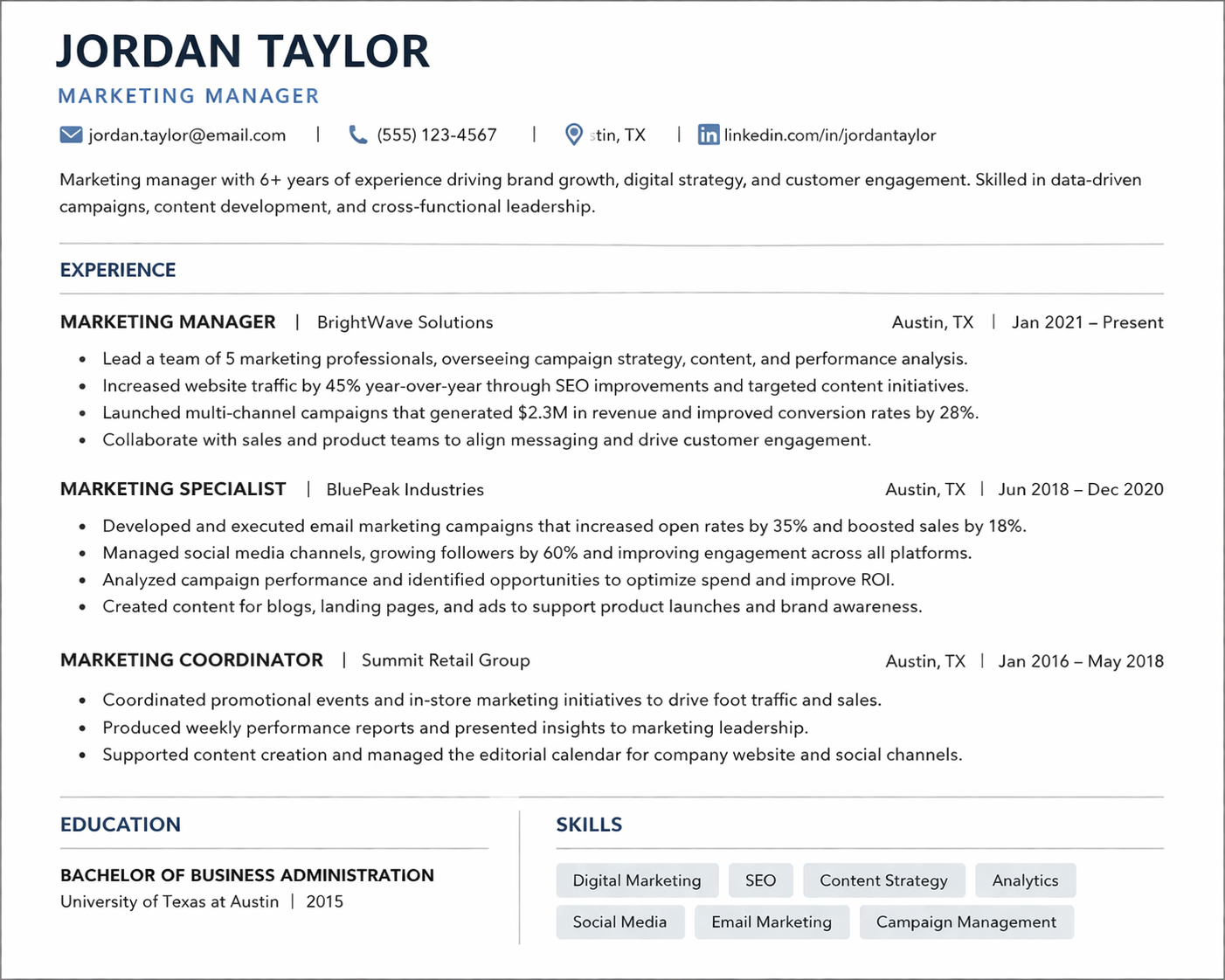
Recruiters scan resumes quickly, so this format helps them spot your impact faster.
They look for action, results, and relevance, not full sentences or personal narrative.
Writing in this format helps your experience stand out quickly and makes it simpler to tailor your resume for each role.
Resume builders like Resume.io can help you format bullet points in this style, so your experience stays consistent across sections.
When can you use pronouns in a resume?
In most cases, you should not use pronouns in a resume.
However, they may appear naturally in limited sections like a short summary or when writing informal application materials.
Even then, implied first person is still preferred to maintain consistency and a professional tone.
Where pronouns might appear (and what to do instead)
-
Professional summary
You may be tempted to write full sentences like “I am a marketing manager with five years of experience.”
→ Better: “Marketing manager with five years of experience…” -
Personal statements or career change explanations
In rare cases, such as explaining a transition, a full sentence may feel more natural.
→ Still aim to remove pronouns where possible. -
Cover letters (not resumes)
Pronouns are completely appropriate in cover letters, where a more conversational tone is expected.
The key is consistency.
Mixing styles, such as using “I” in one section and removing it in another, can make your resume feel uneven.
Keeping everything in implied first person creates a cleaner, sharper document that aligns with hirer expectations.
What does a first-person resume look like? (examples)
A first-person resume uses implied voice, meaning it removes pronouns and starts each line with an action verb.
This creates short, direct bullet points that highlight responsibilities and results.
The structure is consistent across sections, making it more feasible for hirers to scan and quickly understand your experience.
Example: Experience section (first-person implied)
Sales representative | Markham Wholesaler Group
- Managed relationships with 10+ retail clients, facilitating product returns and purchases
- Monitored customer feedback and logged insights into internal systems
- Reviewed client accounts monthly, identifying up to $50,000 in outstanding balances
- Negotiated pricing and discounts, contributing to 95%+ customer retention
Example: before vs after (improving first-person writing)
| Before (incorrect) | After (recommended) |
|---|---|
| I managed a team of five sales associates | Managed a team of five sales associates |
| I was responsible for handling customer complaints | Resolved customer complaints and improved satisfaction scores |
| I created marketing campaigns for new products | Developed marketing campaigns for new products |
These examples show how removing pronouns immediately improves clarity and flow.
Each bullet point becomes more focused on action and outcomes, which is exactly what those hiring look for during quick resume skims.
Common mistakes to avoid when using first person in a resume
The most common mistake is using full first-person pronouns like “I” instead of implied voice.
Other issues include mixing writing styles, using complete sentences instead of bullet points, and focusing on duties rather than results.
Avoiding these mistakes keeps your resume consistent, streamlined, and aligned with recruiter expectations.
Common mistakes and how to fix them
| Mistake | Example | Fix |
|---|---|---|
| Using “I” in bullet points | I managed a team of five | Remove pronoun → Managed a team of five |
| Mixing styles | Managed projects… then I created reports | Keep consistent implied voice throughout |
| Writing full sentences | I was responsible for overseeing operations | Use concise phrasing → Oversaw operations |
| Focusing on tasks only | Managed customer service | Add impact → Managed customer service, improving satisfaction by 15% |
| Using weak verbs | Helped with marketing campaigns | Use strong verbs → Developed marketing campaigns |
Small inconsistencies can make your resume harder to read and less professional overall.
Recruiters are used to a clean, action-led format, so even minor deviations can stand out.
Keeping your writing consistent and results-focused helps maintain clarity and strengthens your overall presentation.
Key takeaways
- Do not use “I” or other pronouns in your resume. Use implied first person by starting bullet points with action verbs.
- Maintain concise writing and results-focused so it can be quickly skimmed.
- Stay consistent throughout your resume. Mixing styles or full sentences can make your application feel less professional.
FAQs
Quick answers to common questions about pronouns and writing style in resumes.
What to say instead of "I" in a resume?
Instead of using “I,” start each bullet point with a strong action verb like managed, developed, or led.
This removes unnecessary words and keeps your writing focused on your actions and results.
It also makes your resume easier for recruiters to scan quickly.
Is third person best on a resume?
No, third person is not recommended for resumes because it sounds formal and detached.
Writing in third person can make it seem like someone else is describing your experience.
Implied first person is the preferred style because it is direct, lean, and widely expected by hirers.
What is the 1-2-3 rule in pronouns?
The 1-2-3 rule refers to first-, second-, and third-person pronouns used in general writing, such as “I,” “you,” and “they.”
In resumes, these are typically avoided to keep content concise and professional.
This is separate from gender pronouns like “she/her” or “they/them,” which may appear in your contact details.