



Breaking into the workforce has never been more complex for early-career professionals and graduates in the U.S. From navigating rising living costs to balancing career progression with well-being, today’s junior employees are entering a job market that looks very different from even a few years ago.
While salary and job security remain top priorities, factors like company culture, leadership transparency, and diversity and inclusion are playing an increasingly important role in shaping how young professionals experience their first roles, but which companies do it the best?
To understand where junior employees are thriving, and where they’re struggling, resume.io analyzed 12,870 Glassdoor reviews from junior workers in leading U.S. companies to uncover the best and worst workplaces for early-career talent in 2026. By examining key factors such as career opportunities, compensation, work-life balance, and leadership, this study reveals which employers are setting the standard for junior job satisfaction, and which are falling short.
From industry giants to household names, the findings highlight a clear trend: the companies that invest in inclusive cultures and meaningful growth opportunities are the ones with the happiest junior employee cohort.
Key findings
- Google (4.44 out of 5) tops the rankings for junior employee satisfaction in 2026, leading in five out of six individual categories.
- Walmart (3.41) has the lowest overall junior satisfaction score across all 42 companies analyzed.
- Six out of ten of the top-ranked companies score highest in diversity and inclusion, making it the strongest predictor of overall junior satisfaction.
- Senior leadership is the lowest-scoring category in the entire study. Google leads with 4.26, but second place (Dell Technologies) drops off to 3.94.
The 10 best companies for junior employees in 2026
These ten companies received the highest overall satisfaction scores from junior employees across thousands of Glassdoor reviews, and in several cases, the margins aren’t close.
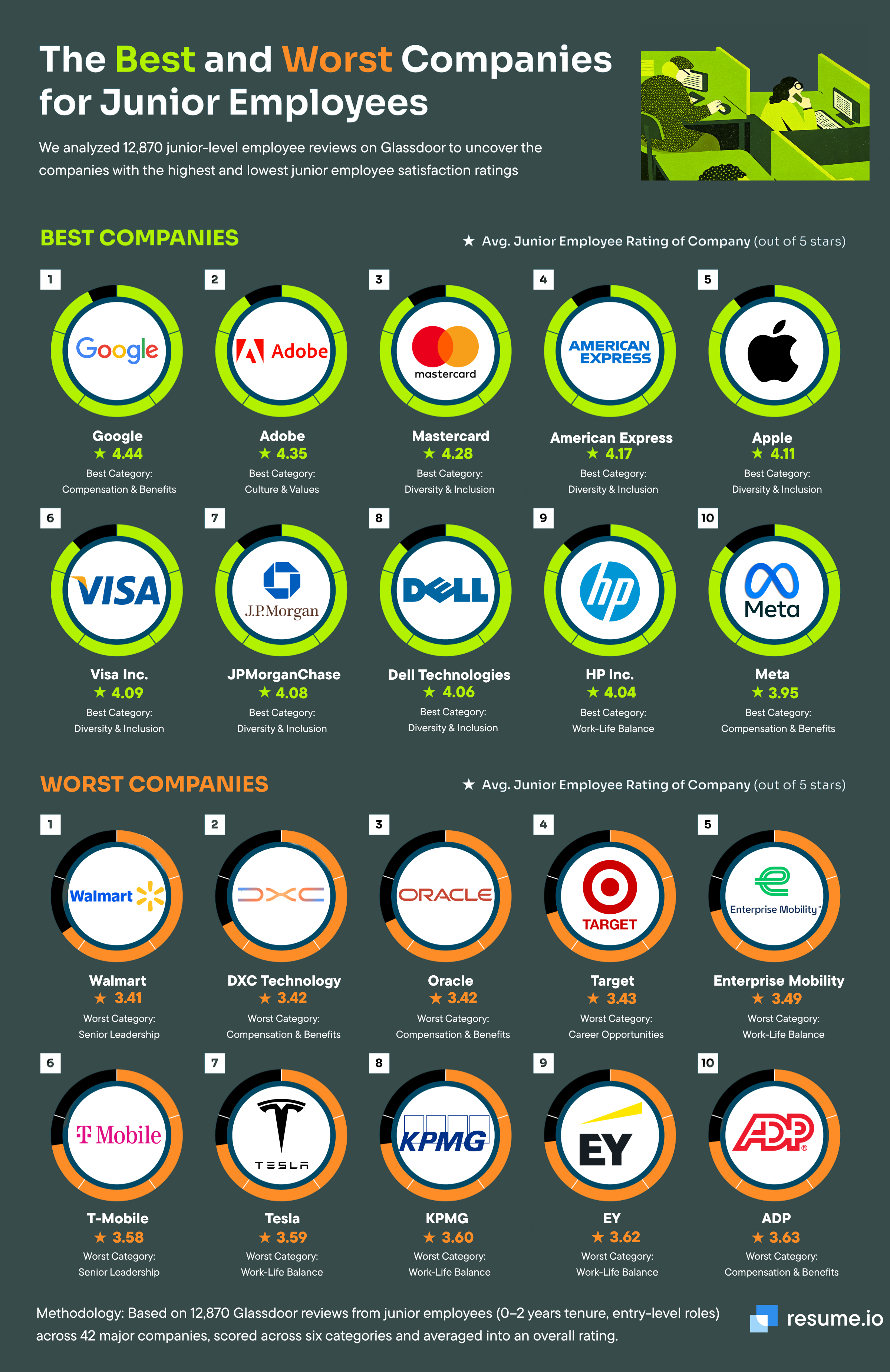
Google outshines all other employers in the research with an overall rating of 4.44. It’s also the only company to rank first in five of six categories according to junior employees: career opportunities (4.41), compensation and benefits (4.53), culture and values (4.49), work-life balance (4.35), and diversity and inclusion (4.46). Its senior leadership score (4.26) is also the highest of any company reviewed. Highlighting that for junior employees in 2026, Google continues to set the benchmark.
Adobe takes second place with a 4.35 overall rating, performing especially well in culture and values (4.46) and compensation and benefits (4.29). Making it clear that junior employees at Adobe feel supported by the working environment, not just the pay.
Mastercard rounds off the top three at 4.28, with its strongest score in diversity and inclusion (4.34). It also scores consistently well across culture and values (4.22) and compensation (4.07), suggesting a well-rounded experience for early-career hires.
The data revealed a striking pattern in the top 10: six out of ten companies score highest in diversity and inclusion. Suggesting that the employers doing the most to create inclusive environments are also the ones where junior employees are happiest overall. Early-career workers often enter companies with less institutional power, making an inclusive culture even more important to their experience.
The 10 worst companies for junior employees in 2026
These companies received the lowest overall ratings from junior employees. While a low ranking doesn’t mean every experience is negative, across hundreds of reviews, these employers consistently underperform.
Walmart sits at the bottom with a 3.41 rating. Its weakest area is senior leadership, which suggests junior employees feel distant from decision-makers or unsupported by management.
DXC Technology and Oracle tie for the second-worst score at 3.42, both scoring the lowest in compensation and benefits. For junior employees at these companies, pay and perks don’t match expectations, which is a significant issue when you’re early in your career and financial stability matters most. DXC’s position near the bottom is not new. The company ranked last in resume.io’s 2024 junior satisfaction study with a score of just 3.28, and while it has nudged up slightly to 3.42, it remains one of the poorest-rated employers for early-career workers.
Target ranks third-worst at 3.43, with career opportunities as its weakest category. This is a red flag for any entry-level worker: if the path forward isn’t clear, early motivation can fade fast.
Two themes dominate the bottom 10. Work-life balance is the weakest category for four companies (Enterprise Mobility, Tesla, KPMG, and EY), signalling that junior employees feel overworked or unable to maintain healthy boundaries. Compensation is the biggest issue at three companies (DXC Technology, Oracle, and ADP), while senior leadership drags down scores at Walmart and T-Mobile.
Best company for each category:
Beyond the overall rankings, we also broke the data down by category to reveal which companies lead in specific areas that matter to junior employees.
Career opportunities
Google tops this category with a 4.41 rating, followed by Adobe (4.18) and Enterprise Mobility (4.12). Interestingly, Enterprise Mobility appears here despite ranking in the bottom 10 overall, suggesting it offers strong growth paths even if other areas need work. JPMorganChase (4.09) and Dell Technologies (4.06) round out the top five.
Compensation and benefits
Google again leads (4.53), with AT&T (4.30) making a notable appearance in second place. Adobe (4.29), Apple (4.19), and Visa (4.12) follow. The gap between Google and the rest is significant, with its compensation score being 0.23 points higher than the next company and the widest lead in any category.
Culture and values
Google (4.49) and Adobe (4.46) are nearly tied at the top, with American Express (4.36), Dell Technologies (4.31), and Mastercard (4.22) following closely. Strong culture scores tend to correlate with strong diversity and inclusion scores, suggesting these values are connected in practice, not just in policy.
Work-life balance
Google leads again (4.35), but American Express (4.34) is right behind, closer than in any other category. Dell Technologies (4.32) and HP Inc. (4.31) also score well. This category shows the most compressed range among top performers, meaning several companies are doing roughly equally well at supporting junior employees’ boundaries and flexibility.
Senior leadership
This is the lowest-scoring category overall. Google’s 4.26 leads, but the second-place score (Dell Technologies, 3.94) drops off sharply. This gap suggests that even at companies rated well overall, junior employees often feel disconnected from senior leaders. It’s the hardest area for companies to get right and the one where juniors have the least influence.
Diversity and inclusion
Google (4.46), Apple (4.45), Enterprise Mobility (4.45), and Adobe (4.45) are clustered at the top, all tied for first place. This is the strongest-performing category overall, with even mid-ranked companies scoring above 4.0. Highlighting that, according to junior staff, many large employers have made meaningful progress on D&I.
The best and worst tech companies for junior job satisfaction in 2026
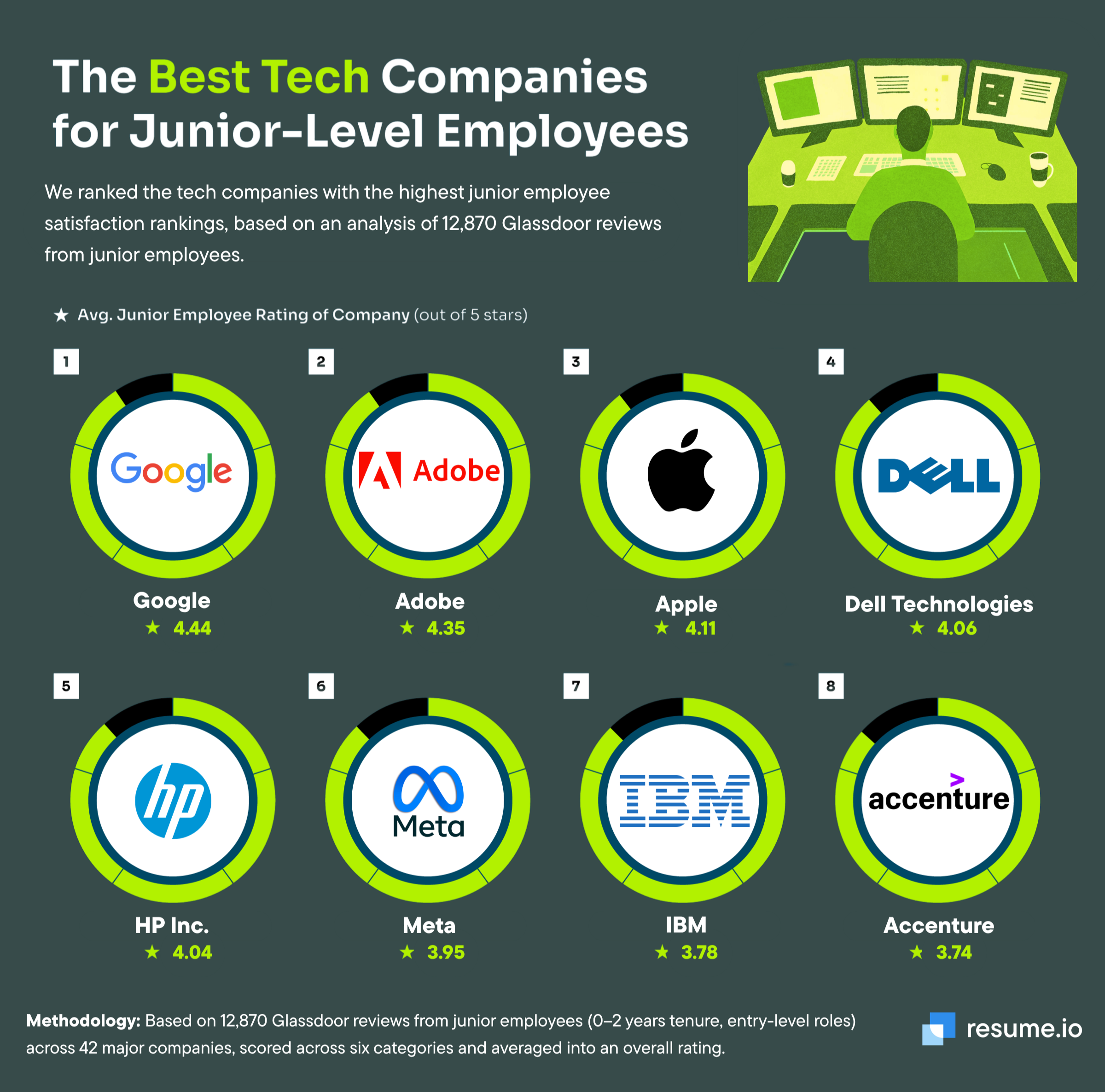
The tech sector has been and remains one of the most sought-after sectors for early-career workers, but junior satisfaction varies significantly depending on where you land. Across the 14 major tech companies analyzed in this study, Google, Adobe, and Apple lead the way, while Oracle, DXC Technology, and Tesla rank as the worst-rated companies for junior employees.
Google also takes the lead in the tech company rankings with an overall junior satisfaction score of 4.44, the highest of any company in the study. Followed by Adobe in second place with an overall score of 4.35, and Apple rounds off the top three at 4.11.
At the other end of the spectrum, Oracle and DXC Technology both score 3.42, making them the lowest rated of the companies in the tech sector. DXC’s compensation score of 2.83 is the weakest pay rating of any tech company in the study, a damaging finding for a sector that has always been renowned for strong salaries and benefits. Tesla takes the runner-up position with an overall score of 3.59, and Amazon rounds off the top three with an overall score of 3.63.
How AI is reshaping junior roles
These rankings come at a time when the entry-level job market is under real pressure. The rapid integration of AI into workplaces has accelerated a shift that was already underway: routine tasks that once formed the backbone of junior roles are being automated, and an increasing number of employers are reducing the number of entry-level positions as a result.
But the data here tells a more nuanced story. The companies at the top of this list aren’t just surviving the AI transition; they’re investing in junior talent through strong compensation, inclusive cultures, and clear career paths. Google, Adobe, and Mastercard aren’t cutting entry-level roles; they’re making them better.
The companies at the bottom, in contrast, show what happens when investment in early-career employees lags. Poor leadership scores, weak compensation, and limited career opportunities create environments where junior employees feel like an afterthought, and that’s a problem that AI alone didn’t cause.
The gap between the best and worst employers in this study isn’t just a number. It reflects a fundamental difference in how companies view job seekers at the start of their careers, as an investment to be developed, or a cost to be managed. For anyone choosing where to begin their working life in 2026, that decision is worth making before you accept the offer.
Wherever you choose to start your career, putting your best foot forward starts with a strong resume. Resume templates can be found on our website to help you stand out from the crowd, whichever role you’re applying for.
Methodology:
We analyzed 12,870 junior-level employee reviews from 42 major companies on Glassdoor.
A total of 90,971 reviews from 52 companies were filtered by two-criteria to include only those from employees who self-identified as being in entry-level or junior positions through entry-level job title keywords and had 0–2 years of tenure at the company. The Keywords included were: junior, graduate, intern, trainee, apprentice, entry-level, associate, analyst, coordinator, assistant, co-op, new grad, and early career.
Each company was scored across six categories: career opportunities, compensation and benefits, culture and values, work-life balance, senior leadership, and diversity and inclusion. The overall rating is the average across all six categories. Only companies with a minimum of 100 qualifying reviews were included in the final rankings to ensure statistical reliability.
This data analysis was completed in April 2026.


