

From job seekers faking symptoms to attend interviews to burned-out employees disguising mental exhaustion as the flu, sick days have evolved far beyond their original purpose.
What we did
We at resume.io surveyed 1,000 full-time U.S. workers to uncover the truth about sick days in America: why workers really take them, what lies they tell, and how guilt and workplace culture create a cycle that damages both health and productivity.
The survey explored how many sick days employees took in the past six months, the real reasons behind those absences, and whether they felt compelled to lie to their employers.
How and why do employees take sick days?
56% of U.S. workers took at least one sick day in the past six months, while 44% didn't take a single day off. While genuine illness still plays a role, many workers use sick days to cope with demands that fall outside traditional PTO.
On-site workers took sick days at 58.46%, while remote workers took fewer at 38.14%. But remote workers aren't healthier either. 32.99% work from home while sick instead of taking official sick days, and 26.12% work through illness at home. Remote work hasn't eliminated sick days; it's made them invisible.
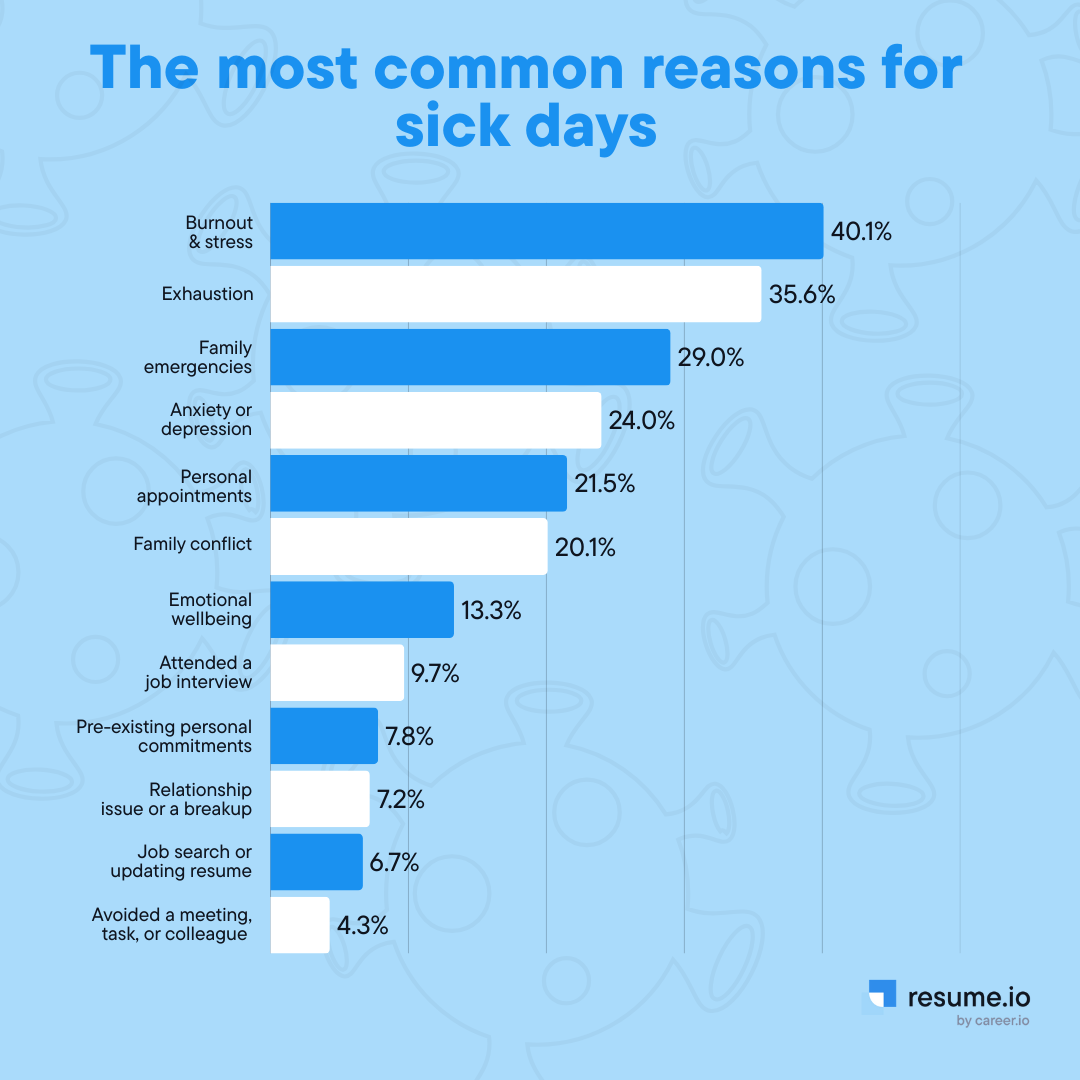
Nearly 1 in 10 workers (9.7%) have faked sick to attend job interviews, while 6.7% used the time for job applications. The sick day has become a covert career tool. Meanwhile, 7.2% called in sick after romantic breakups; the "heartbreak sick day" is real. Another 7.8% took time off for plans they simply didn't want to cancel, treating sick leave as unauthorized personal time.
Only 14.4% are honest with their manager about sick leave
A profound 40.1% of workers have called in sick due to burnout, stress, or mental exhaustion, the single most common cause of sick day usage. Yet, regardless of mental health being the primary driver of absenteeism, workers feel forced to hide it. Only 14.5% were completely honest with their employers about the real reason.
Leading at 23.5%, the "not feeling well" tactic is vague enough to avoid follow-up questions while sounding credible enough to pass inspection. Stomach bugs rank high (16.6%) because they're uncomfortable to question and impossible to prove. Only 16.7% said they've never taken a sick day for non-illness reasons, meaning 83.3% have lied or covered up the truth about why they were absent.
15% of workers "soft launch" their sick days the day before
Taking a sick day requires planning. 14.4% mention feeling "a bit off" the day before to set up their excuse, while 17.6% carefully time their message for early morning to seem more genuine. 14.8% practice what they'll say to their manager, 10.4% use fake coughs or tired voices, and 9.9% provide specific symptoms to boost credibility. Only 42% skip the performance entirely, claiming they are sick and need to rest properly.
Guilt is driving workers to work while sick
Even when employees finally take a sick day, they are unable to fully disconnect. 16.3% of remote and hybrid workers check work emails while on sick leave, and 9.8% respond to emails or join calls while supposed to be resting.
The guilt follows them home, or rather, it never leaves, because for many, home is the workplace.
How many Americans work while being sick?
Over a third of American workers (36.5%) have dragged themselves to work while genuinely ill because they cannot afford to lose their pay. The statistics paint a clear picture of a workforce torn between health and financial survival. However, studies consistently show that "presenteeism" (working while sick) costs employers far more than absenteeism, yet the system punishes rest and rewards suffering.
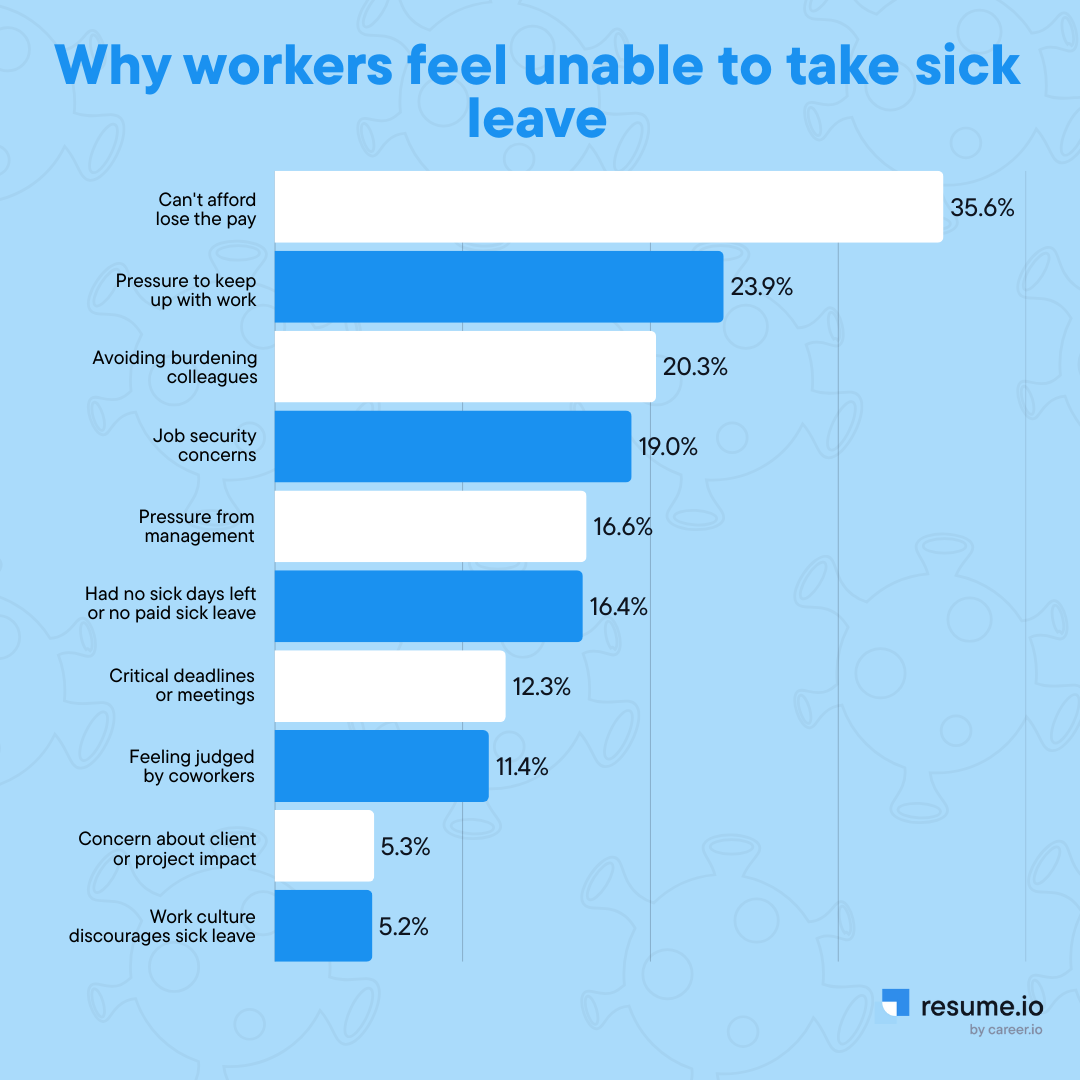
Nearly one in every four employees (23.9%) dragged themselves to work, afraid of falling behind, while 20.3% couldn't bear the thought of burdening their team. Another 16.6% were directly pressured by their managers to show up sick, and 12.3% had deadlines or meetings that they simply could not miss. Peer pressure is also a factor: 11.4% were concerned about being judged by their colleagues.
The result? Only 18.2% of workers have never worked while genuinely ill, implying that more than four in five Americans have given up their health for a job.
Job insecurity drives 19% of workers to work while sick
In today's unpredictable job market, nearly one in five workers (19%) have forced themselves to work while genuinely sick because they feared being seen as unreliable or worried about their job security.
37.5% of all workers do not receive sick days in addition to their standard PTO, making every illness an impossible choice: recover properly or save precious vacation time.
Remote workers get 30% less sick days than on-site employees
Remote work was intended to make life easier, but it has given employers an excuse to reduce sick leave.
59.5% of fully remote workers receive no sick days beyond standard PTO, compared to just 30.4% of on-site workers, nearly double the rate. The reasoning is straightforward: if you work from home, employers assume you can "rest" between emails.
Except that's not true. 33% of remote workers admitted to working from home while ill rather than taking an official sick day, and another 12.4% admitted to working despite being too ill to function normally.
Among those who do receive dedicated sick leave, only 11% of remote workers get 5-10 days versus 19.3% of on-site employees, and only 4.8% receive more than 10 days versus 15.2% on-site. Remote work hasn't eliminated sick days, it's made them invisible while cutting the safety net.
What causes workers to take mental-health sick leave?
When we asked workers what specifically led to their most recent mental health sick day, the responses revealed systemic workplace problems and emotional exhaustion at every level.
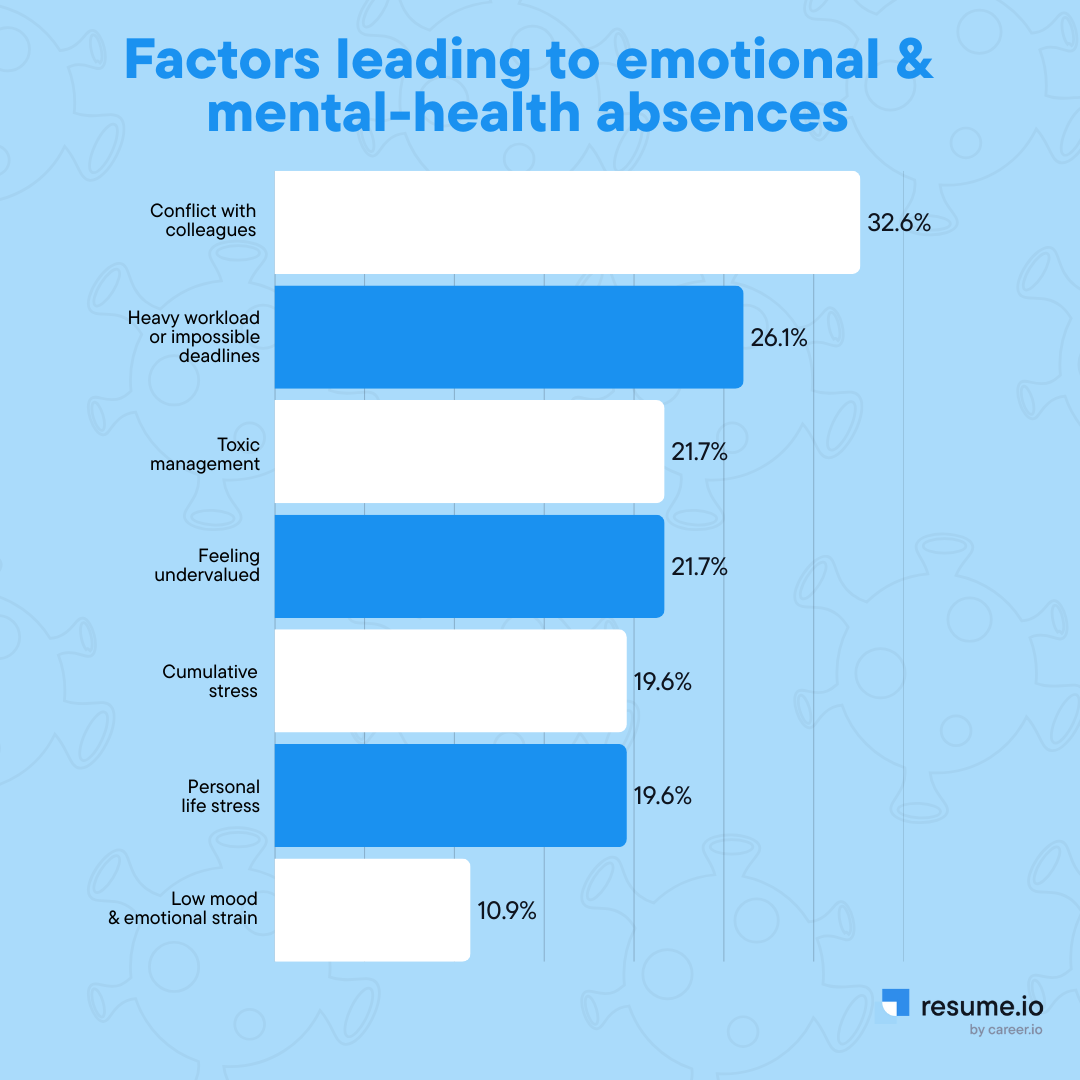
Nearly one-third (32.6%) highlight conflict with colleagues as the breaking point, as personal conflict drives more mental health absences than any other factor. Heavy workload comes in at 26.1%, followed by toxic managers and feeling undervalued at 21.7%.
Interestingly, 19.6% of respondents describe cumulative stress without a single incident. They just run into a wall. Another 19.6% mention stress in their personal lives, indicating how pressures at work and at home contribute to one another.
The most alarming statistic is that 10.9% of people woke up without a specific trigger and were unable to face their jobs, which is an indication of deeper burnout showing up as unplanned collapse.
Gen Z's honesty about burnout outpaces older generations
However, Gen Z's redefinition of sick days goes beyond mental health. A notable 16.2% have taken sick days to attend job interviews, nearly doubling the 9.7% workforce average. Another 12.8% used sick time to look for work or complete applications.
On the other hand, Millennials are overwhelmed by guilt, with 27.8% feeling anxious or stressed about requesting sick leave. The highest rate of any other generation.
What causes every generation to take mental health sick days?
Breaking points are clearly visible across generations. Gen Z blames people: 53.8% cite colleague conflict (nearly twice as many as previous generations), and 38.5% blame toxic managers. They name exactly who's burning them out.
Millennials mention workload (28.6%), but 14.3% simply wake up unable to function, working until they break without knowing why.
Gen X experiences structural fear, with 29% report an unsustainable workload, while 16.1% are concerned about job security. They've survived layoffs and dealt with stress until cumulative pressure (19.4%) forces them to quit.
Men are more likely to call in sick because of heartbreak
6.3% of women took sick days following a romantic breakup, while 8.3% of men did the same. As a result, men may be more likely to deal with emotional distress in private, using sick days as a socially acceptable coping strategy.
The patterns indicate that men use sick days more strategically for job searches, emotional recovery disguised as physical illness, and strategic career moves. Women are more likely to take sick days when truly necessary and communicate openly about their absence.
Is it time to make a career change?
16.2% of workers use sick days to attend job interviews -- but searching for a new role doesn't have to mean faking it. resume.io gives you the tools to job hunt smarter, with professional resume templates, cover letter builders, and career resources that help you showcase your skills, impress employers, and land interviews faster, without ever taking a sick day.
Methodology
We surveyed 1,000 employed Americans aged 18+ across all 50 states and work settings (remote, hybrid, and on-site) in January 2026. Respondents were asked about sick day usage in the past six months.


