



A bad resume is one that is unclear or hard to scan, making it difficult for employers to quickly understand your value.
Reviewing real examples helps you identify these issues and fix them before applying.
What does a bad resume look like?
A bad resume is usually unclear, overly generic, or difficult to read, making it hard for hiring managers to quickly understand your experience and value.
Most are not obviously terrible, they look acceptable at first glance but fail to show results, relevance, or structure when reviewed closely.
Here’s an example of a bad resume:
Bad resume example
John Doe
1234 Elm Street
Anytown, USA 12345
john.doe@email.com | (123) 456-7890
linkedin.com/in/johndoe
Objective
A results-driven professional with a provn track record in diverse roles seeking to leverage my skills and experience to contribute to your esteemed organization. Looking for a dynamic role where I can make an impact and dive succcess.
Experience
Various Positions
Various Companies
January 2010 – Present
- Played a role in different types of tasks and projects
- Handled several responsibilities and duties across multiple sectors
- Worked on various initiatives that helped in some areas of business
- Assisted in many activities and contributed to overall productivity
Job Title
Company Name
June 2005 – December 2009
- Managed a range of daily activities and operational duties
- Coordinated with teams and worked on several assignments
- Participated in various company projects and programs
Education
Bachelor of Arts in General Studies
University Name
Skills
Teamwork and Collaboration
Problem-Solving
Communication Skills
Why this resume doesn’t work
- Too vague: Phrases like “played a role” and “handled responsibilities” don’t explain what was actually achieved
- No measurable results: There are no numbers or outcomes to show impact
- Generic summary: The objective uses clichés and doesn’t reflect a specific role
- Lack of structure: Repetitive bullet points and unclear progression make it hard to follow
- Errors and credibility issues: Spelling mistakes and low-detail education weaken trust
What a recruiter sees
A resume like this is difficult to assess quickly.
The lack of clear achievements, structure, and focus makes it hard to understand what the candidate actually does well or what roles they are suited for.
Quick takeaway
The most common bad resume examples include vague bullet points, generic summaries, poor formatting, and untailored content.
These issues make it difficult for employers to quickly understand your value.
Improved version of the same resume
John Doe
Anytown, USA
john.doe@email.com | (123) 456-7890
linkedin.com/in/johndoe
Professional summary
Retail manager with 10+ years of experience driving sales growth and improving store operations. Proven track record of increasing revenue, reducing inventory loss, and leading high-performing teams in fast-paced retail environments.
Experience
Retail Manager
Family Store | February 2022 – Present
- Increased weekly sales by 18% within six months by reorganizing product placement and launching targeted promotions
- Managed and trained a team of 8 staff, improving employee retention and performance
- Reduced inventory loss by 12% by implementing a new stock tracking system
- Resolved customer issues, maintaining a 95% satisfaction rating
Sales Associate
Retail Store Inc. | January 2018 – January 2022
- Assisted 50+ customers daily, contributing to consistent achievement of monthly sales targets
- Supported in-store marketing campaigns that increased foot traffic and engagement
- Maintained inventory accuracy and supported stock management processes
Education
Bachelor of Arts in General Studies
University Name
Skills
- Team leadership
- Inventory management
- Customer service
- Sales strategy
- Staff training
Why this version works better
- Clear job focus: The role is defined (retail), not vague “various positions”
- Specific achievements: Metrics show impact instead of generic duties
- Structured experience: Each role is distinct and easy to scan
- Professional tone: No clichés or unclear language
- Relevant skills: Focused and aligned with the role
What makes a bad resume vs a good resume?
A good resume is clear, structured, and focused on measurable results, while a bad resume is often general and difficult to scan.
The difference usually comes down to how well your experience is presented and how easily a recruiter can understand your value within a few seconds.
Good vs bad resume examples
| Feature | Good resume example | Bad resume example |
|---|---|---|
| Summary | “Retail manager with 10+ years of experience increasing sales and leading teams” | “Looking for a challenging role where I can grow and use my skills” |
| Experience | “Increased weekly sales by 18% within six months through targeted promotions” | “Responsible for sales and helping customers” |
| Language | Uses action verbs like “led,” “improved,” “reduced” | Uses general phrases like “helped with,” “worked on,” “responsible for” |
| Achievements | Includes metrics and outcomes (percentages, revenue, results) | Lists duties with no measurable impact |
| Formatting | Clean layout, clear sections, consistent structure | Cluttered, inconsistent, hard to scan |
| Relevance | Tailored to the job with relevant skills and keywords | Generic, one-size-fits-all content |
| Length | 1-2 pages, focused on relevant experience | Too long or filled with unnecessary details |
| Skills | Specific and supported by examples in experience | List with no context (“team player,” “hard worker”) |
| Contact details | Professional email and clear contact info | Unprofessional email or missing information |
A good resume shows what you achieved and why it matters, while a bad resume simply lists what you were responsible for.
If your resume feels generic or task-focused, it likely needs more specificity, structure, and relevance.
What are the most common bad resume examples?
Most bad resumes are not obviously wrong.
They usually include small issues that make your experience harder to understand or less convincing.
If you recognize any of the signs below, your resume needs improvement.
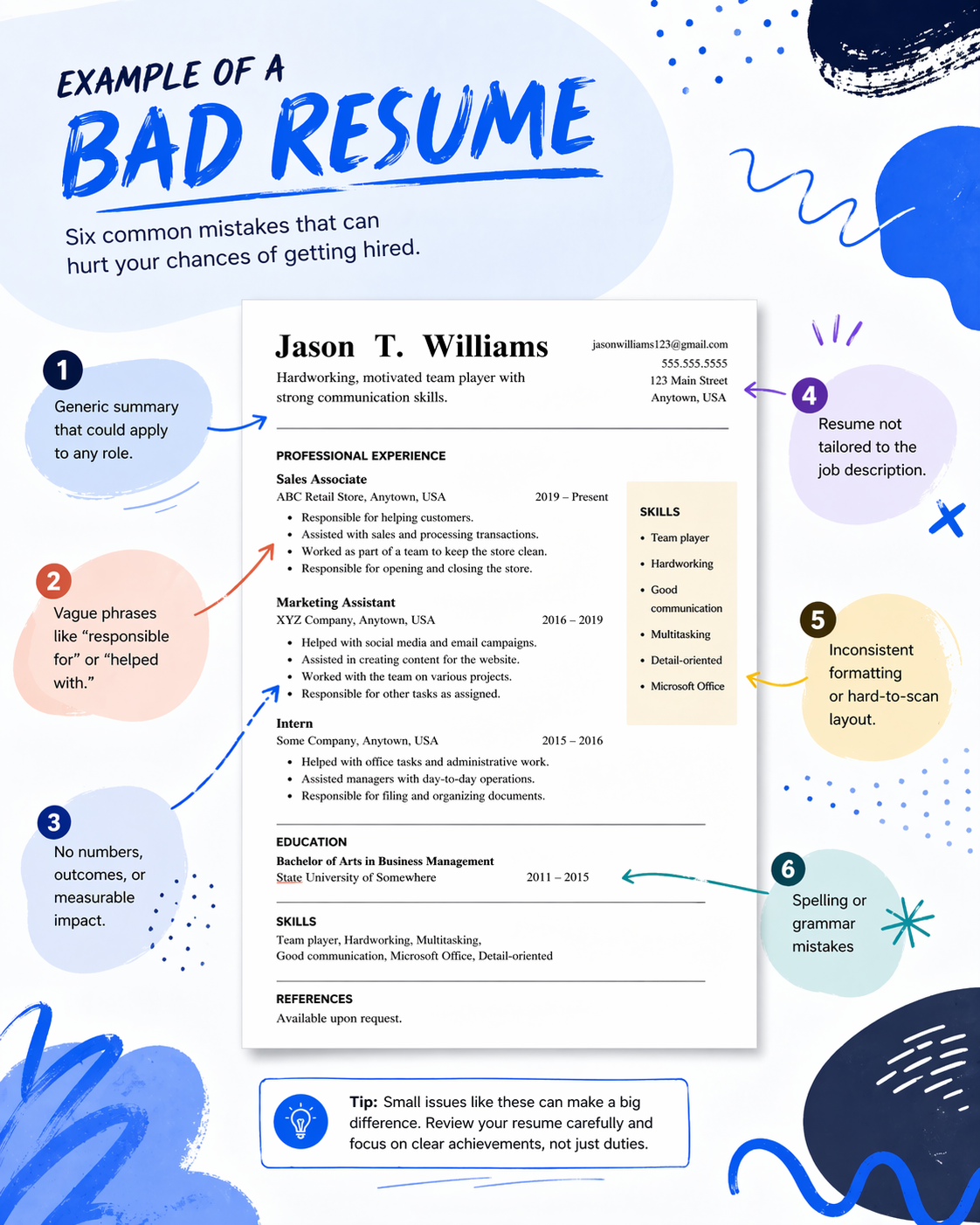
- Bullet points that list tasks instead of results
- Vague phrases like “responsible for” or “helped with”
- No numbers, outcomes, or measurable impact
- Inconsistent formatting or hard-to-scan layout
- Generic summary that could apply to any role
- Resume not tailored to the job description
- Too much irrelevant or outdated information
- Overuse of buzzwords like “team player” or “hardworking”
- Spelling or grammar mistakes
- Unprofessional email address or missing contact details
If you notice several of these issues, review our full guide to resume mistakes for a deeper breakdown and step-by-step fixes.
Key takeaways
- A bad resume is often vague, generic, or hard to scan, which makes it easy for hiring managers to overlook
- Common issues include listing duties instead of achievements, missing metrics, poor formatting, and lack of tailoring
- A strong resume is clear, structured, and focused on results that show your impact
- Small details like grammar, formatting, and contact information can affect how professional your resume appears
- Reviewing and fixing these issues before applying can significantly improve your chances of getting an interview

FAQs for bad resumes
Quick answers to common questions about bad resumes and what to avoid.
What is considered a bad resume?
A bad resume is one that is unclear, generic, or difficult to read, making it hard for employers to quickly understand your qualifications.
It often focuses on duties instead of achievements, lacks measurable results, and is not tailored to the job.
These issues reduce your chances of getting noticed, even if you have relevant experience.
What are red flags on resumes?
Common red flags include typos, inconsistent formatting, vague job descriptions, and unexplained gaps in employment.
Hiring managers also notice when resumes are overly generic or include irrelevant information.
These signals can suggest a lack of attention to detail or effort.
What looks unprofessional on a resume?
Unprofessional elements include casual language, unverified claims, poor formatting, and the use of overly decorative designs.
An unprofessional email address or inconsistent structure can also weaken your credibility.
A resume should always present your experience clearly and professionally.
What should never go on a resume?
You should avoid including personal details such as age, marital status, or social security number, as well as irrelevant or outdated experience.
False information, exaggerations, or inappropriate content should never be included.
Keeping your resume focused on relevant, accurate, and professional information is essential.


