



A CAR method resume replaces lists of job duties with bullet points built from three parts: the challenge you faced, the action you took, and the result you produced.
Resume.io recommends it because it gives a hiring manager evidence of impact rather than a description of your workload.
What is the CAR resume format?
The CAR resume format is a way of writing work experience bullet points in three parts: the challenge you faced, the action you took, and the result that followed.
CAR stands for challenge, action, result, and the finished bullet reads as one ordinary sentence.
- Challenge: The problem, gap, or goal in front of you
- Action: What you personally did about it, including the tools, methods, or decisions you used
- Result: What changed because of your action, expressed as a number wherever one exists
The format exists because a hiring manager cannot verify a claim about your qualities.
A description of something that actually happened is the only thing they can assess, which is why the challenge action result sequence puts the happening first and leaves the conclusion to the reader.
Amanda Augustine, CPRW, CPCC, Resume.io’s resident career expert, draws the distinction directly:
“Anyone can state on their resume that they’re a great salesperson or adept at project management; however, it’s the candidate whose resume explains how they’ve consistently met or exceeded their sales quota, or completed multiple projects on time and on budget, who will impress employers.”
CAR governs your sentences rather than your layout, so it sits inside whichever resume format you already use.
A chronological resume and a skills-based resume both improve when the bullets underneath carry outcomes, and the skills you list elsewhere become easier to believe once your experience section demonstrates them.
How do you write a CAR resume bullet?
Writing a CAR method resume bullet takes four passes over one accomplishment.
You name the problem, name what you did, attach the outcome, then compress all three into one or two lines that lead with a strong verb.
The labels are a drafting aid and come off before the bullet goes on the page.
- Name the challenge: Pick one accomplishment and finish this sentence: before I got involved, the situation was ___. Slow, manual, inaccurate, understaffed, and over budget are all valid starting points.
- Name your action: Write what you did, not what the team did. Include the specific system, method, or decision, because that detail is what separates your contribution from your job title.
- Attach the result: Answer the question “and then what happened”, using a figure if you have one.
- Compress into one bullet: Open with an action verb, fold the challenge into a short clause, and close on the outcome.
Step two is where most bullets go soft. Writers reach for the quality, such as collaborated or communicated effectively, instead of the thing they actually handled.
Our analysis of hiring outcomes points the same way: 20.1% of resumes listing at least one technical or analytical skill led to a hire, compared with 14.2% of resumes listing only soft skills (Resume.io, Resume Skills That Get You Hired, 2026).
Naming the tool or method inside your action step applies that finding at the level of a single line.
Two lines is the practical ceiling for any one bullet, because a result that arrives on line three has usually stopped being read.
Length is easier to judge once a bullet sits in a real layout rather than a blank document, which is one reason people draft these in a resume builder online and watch the page fill up.
The same constraint drives the question of whether a resume should be one page: every line you spend on a duty is a line you cannot spend on an outcome.
What are some CAR format resume examples?
Strong CAR format resume examples read as ordinary achievement bullets.
The challenge sits in a short clause, the action carries the verb, and the result closes with a figure.
Set a duty-based bullet beside its CAR counterpart and the difference shows up as evidence rather than extra words.
| Duty-based bullet | CAR method bullet |
|---|---|
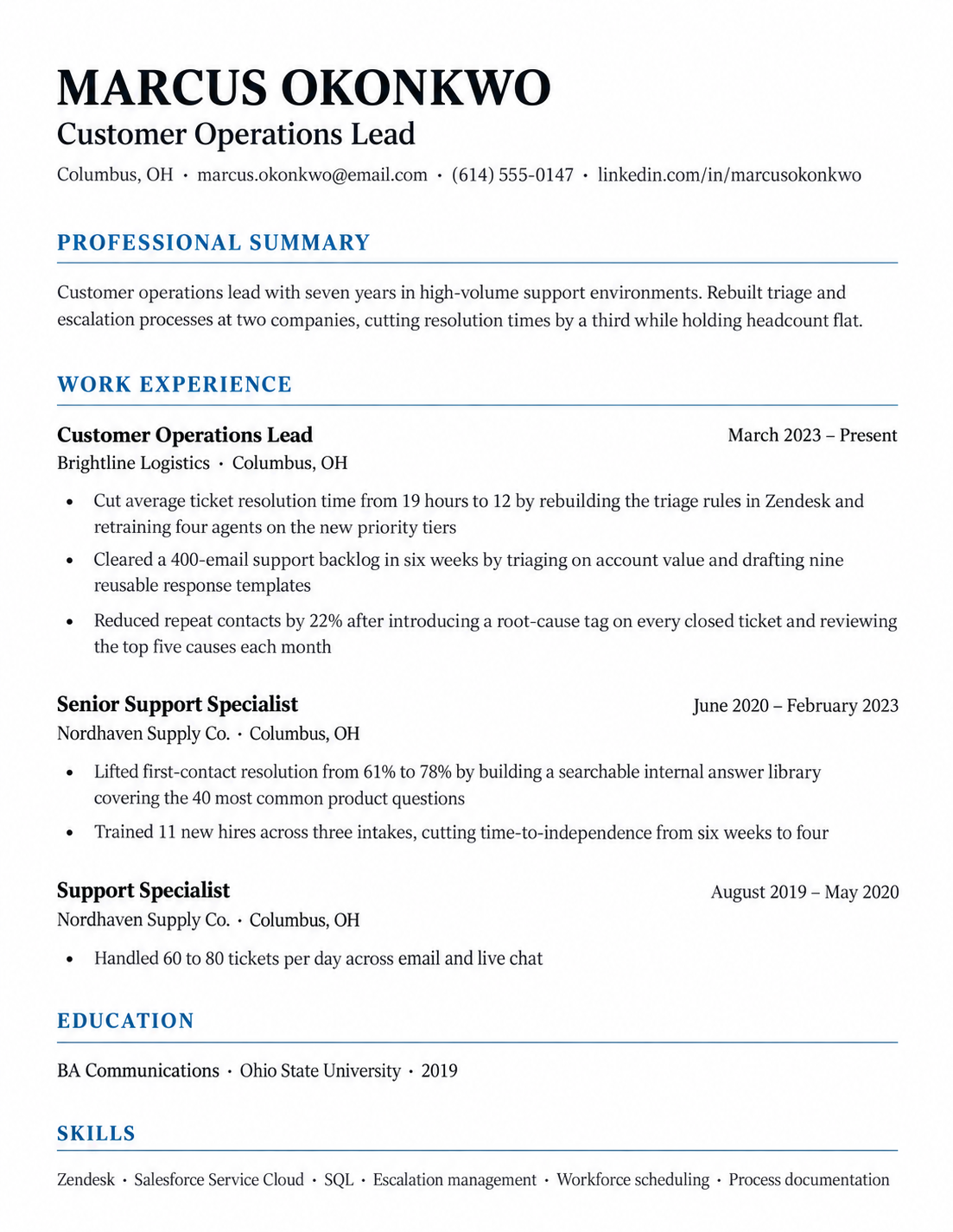
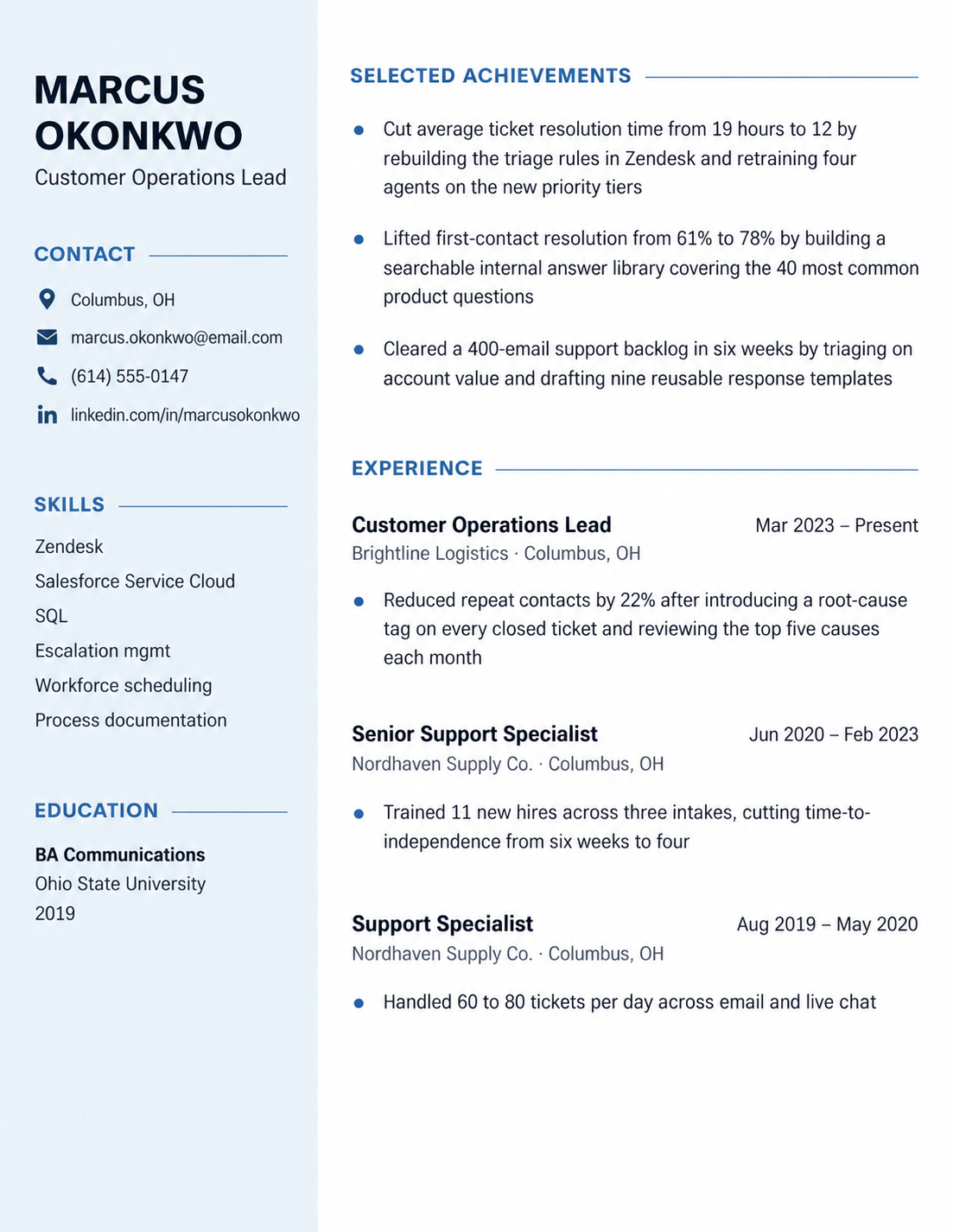
| Responsible for answering customer support tickets. | Cut average ticket resolution time from 19 hours to 12 by rebuilding the triage rules in Zendesk and retraining four agents on the new priority tiers. |
| Handled stock counts and warehouse organization. | Reduced monthly stock discrepancies by 30% after replacing a paper count sheet with a barcode scanning process across two shifts. |
| Provided patient care on a busy ward. | Lowered medication handover errors on a 32-bed ward by introducing a two-nurse verification step at shift change, adopted hospital-wide within six months. |
Broken into its parts, the warehouse example runs from a challenge of recurring stock discrepancies, through an action of replacing a manual count sheet with barcode scanning across two shifts, to a result of a 30% monthly reduction.
The common mistake from here is converting every line, because a role with eight bullets does not need eight outcomes and a page of consecutive achievements flattens out until none of them stand out.
Three to four for your most recent role dropping to one or two for older positions keeps the strongest material visible, and which outcomes survive that cut depends on the job in front of you, since a targeted resume keeps only the achievements that match the posting.
Example 1
Example 2
Does the C in CAR stand for challenge or context?
Challenge and context are both in use, and university career centers do not agree on which is correct.
We recommend challenge for resume writing, because it forces a before-and-after that a reader can measure.
Context describes only a setting, and a setting on its own gives nobody anything to weigh.
- Walden University’s career services teaches CAR as challenge, action, result, framing the C as a problem you identified and addressed.
- Boston University’s resume guide teaches the same acronym as context, action, result, framing the C as the setting a reader needs to follow the bullet.
- The University of Arizona skips CAR altogether and teaches APR, built from action, project or problem, and result.
The split matters less than most people assume, and our position is that you should default to challenge and keep context in reserve.
Reserve it for the narrow case where nothing was broken: compliance work, scheduled maintenance, or any role where the job was to hold a standard rather than improve one.
In those roles scale does the work that a challenge clause would do elsewhere, so a bullet opening with “across 14 sites” is already giving the reader something to measure.
The XYZ resume format resolves the same ambiguity by fixing the sequence into a sentence template instead of naming three parts, and a functional resume leans on the context reading more heavily than most, since it groups achievements by capability rather than by role.
CAR method vs STAR method: Which should you use on a resume?
Use CAR on a resume and STAR in interviews.
The CAR method resume format drops the separate task step, which keeps each bullet to one or two lines.
STAR splits situation and task, which suits a spoken answer where you have time to set the scene.
| CAR | STAR | |
|---|---|---|
| Parts | Challenge, action, result | Situation, task, action, result |
| Best suited to | Written bullet points | Spoken answers |
| Typical length | One to two lines | 60 to 90 seconds |
| What it emphasizes | The problem and the outcome | The sequence of events |
One accomplishment supplies both versions.
Take a support lead who inherited a backlog of 400 unanswered emails.
On the resume, the CAR version runs: “Cleared a 400-email support backlog in six weeks by triaging on account value and drafting nine reusable response templates.”
In an interview, the same material expands into STAR by splitting that opening clause in two.
The situation is the backlog and the three-day response times customers were complaining about.
The task is the one you were given, which was to clear it without hiring.
The action and result then follow unchanged.
Writing the resume first therefore does double duty, because your interview stories are already chosen and already quantified before anyone asks for them.
Preparing the STAR method version afterwards is an expansion job rather than a blank page.
What if you do not have numbers for the result?
Write the result without a figure rather than dropping the result.
A CAR bullet still works when the outcome is a change in state, such as a process that now runs without escalation or a policy that other teams adopted.
Invented numbers fail the first interview question about them.
Before settling for a qualitative result, check four places where a number usually hides:
- Frequency: How often did the thing happen before, and how often now
- Volume: How many people, accounts, cases, or units were involved
- Scope: How many sites, teams, systems, or shifts your change reached
- Time: How long the task used to take, and how long it took afterwards
Scope and volume are available in almost every role, including roles with no sales target and no budget attached.
A teacher knows the class size, a driver knows the route count, a support agent knows the weekly ticket volume, and a nurse knows the bed count.
None of those are performance metrics, and every one of them quantifies the bullet enough to make the result legible to a reader who has never met you.
Where no figure exists at all, name the durable change instead: “Rewrote the onboarding checklist after three new hires missed the same compliance step, and the revised version is now used by both regional offices.”
That result is real, verifiable in an interview, and specific to you.
Key takeaways
- The CAR method turns a job duty into evidence by naming the problem, your action, and what changed as a result.
- Naming the specific system or method you used carries more weight with employers than naming a personal quality.
- Three to four CAR bullets on your most recent role beats converting every line, because consecutive achievements flatten each other out.
- CAR belongs on the resume and STAR belongs in the interview, and the same accomplishment supplies both.
- A result without a number is still a result, as long as the change you describe is specific and verifiable.
Frequently asked questions
A few questions come up repeatedly once people start rewriting their bullets.
Is the CAR method the same as the STAR method?
No. STAR adds a separate task step between the situation and the action, which makes it longer and better suited to spoken interview answers.
CAR compresses the same material into one or two written lines, which is why it fits a resume bullet.
Should you label challenge, action, and result on your resume?
No. The labels are a drafting aid used while you work out the three parts, and they come off before the bullet goes on the page.
A finished CAR bullet reads as a single sentence with no visible structure.
Can you use the CAR method with no work experience?
Yes, you can make a CAR resume without experience.
Coursework, volunteering, part-time jobs, and student organizations all contain problems you solved and outcomes you produced.


