

What we did
To get an idea of how workers feel about the time lost to commuting, we surveyed 3,017 employees and asked them a simple question: how much of your yearly salary would you give up to skip your commute entirely? We did not count the money they would save on gas and wear and tear - just the pure value of getting that time back. Turns out, workers would be willing to give up $3,252 of their annual salary to avoid a strenuous commute to work.
The answers add up to more than a list of roads people despise. They show where commuting takes the biggest emotional toll, how mid-sized cities can be every bit as punishing as the country's traffic giants, and why employers might want to start treating travel time as part of what they're really paying for.
Here is what we found from the data:
Key Findings
Rhode Island is Tiny, But Its Commute is Brutal
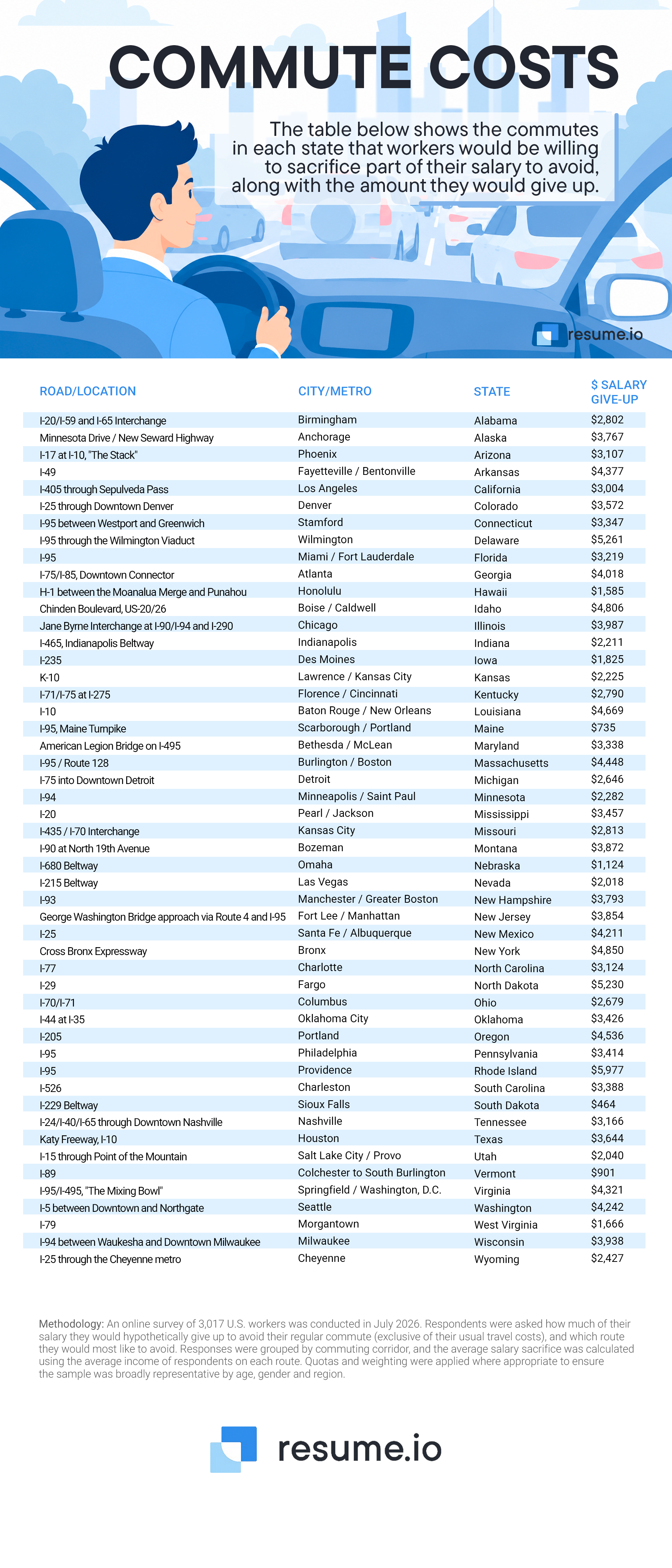
Providence took both of the top two spots. Drivers on the Route 6/10 Interchange said they would hand over $6,116 a year to avoid it, and those on I-95 would give up $5,977. The state's overall figure - 11% of salary - was the highest anywhere in the survey. The lesson isn't that Rhode Island has a lot of roads. It's that everyone leans on the same few routes. In a small state, a bottleneck doesn't need to run for 50 miles to wreck your day.
Over Half the Worst 20 Routes Sit In Just Four Northeastern States
Rhode Island, Delaware, New York and Massachusetts account for 11 of the top 20. New York brings the Cross Bronx Expressway, the Brooklyn-Queens Expressway and the Long Island Expressway; Massachusetts slots three Boston routes in between 13th and 20th. Dense offices, roads laid out a century ago and few good alternatives all push people toward one conclusion: they would rather not make the trip at all.
Big Cities Do Not Dominate the Rankings
Fargo's I-29 came in fourth nationally - ahead of anything in New York, Boston, LA, Chicago or Atlanta. Chinden Boulevard in the Boise-Caldwell area landed ninth, and Bismarck's US-83 came 14th. A road doesn't need millions of daily drivers to feel unbearable - fast growth, tight capacity and no real alternative will do it. Ironically, many of these bottlenecks exist because so many workers are relocating to smaller metros in search of a better quality of life.
A Few Cities Are Consistent From Road to Road
Chicago's Kennedy, Dan Ryan, Jane Byrne Interchange and Eisenhower all clustered between $3,895 and $4,022. Montana's three routes were tighter still, from $3,869 to $3,872. That kind of consistency hints that people aren't really rating individual roads – they are rating what it feels like to drive anywhere in their state.
Escaping the Worst Commute is Worth Over 1,200% More in Some Cities Than Others
Providence drivers on the Route 6/10 Interchange valued escape at $6,116 a year. Drivers on the I-229 Beltway in Sioux Falls put it at $464 - the top figure is more than 13 times the bottom. In some places, staying off the road is a minor convenience. In others, it's worth a serious annual raise.
No Escape: Why Bridge and Tunnel Routes Rank Highest
The George Washington Bridge and Lincoln Tunnel approaches, the American Legion Bridge, the Lake Pontchartrain Causeway and the SR-520 Floating Bridge all rank high. They share one characteristic: once traffic backs up near a crossing, there's nowhere to go. A jam on a regular street lets you cut down a side road. A jam on the approach to a bridge just becomes your commute.
Rural States Where Escaping the Commute is Worth Under $1,300
The final eight routes are all in Nebraska, Vermont, Maine or South Dakota. Maine's three run from $723 to $735, Vermont's are tied at $901, Omaha's fall between $1,100 and $1,253. It's not that people there love every drive — it's that skipping it just isn't worth much compared to Providence, Wilmington or Fargo.
Final Thoughts
The numbers in this survey put a price on something job seekers already know instinctively: the commute is part of a worker’s compensation. Every unpredictable morning on the interchange and every hour lost in the approach to a bridge quietly discounts the salary workers take home. As our data shows, workers in some cities would give up thousands of dollars a year just to make that road disappear.
However, for workers who would hand over $6,000 a year to skip the drive, that's a strong sign it's worth hunting for a remote or closer-to-home role instead. Our remote job guide is a good place to start, and when you find the right opening, our resume builder will get an application ready in minutes — no interchange required.
Methodology
An online survey of 3,017 U.S. workers was conducted in July 2026. Respondents were asked how much of their salary they would hypothetically give up to avoid their regular commute (exclusive of their usual travel costs), and which route they would most like to avoid. Responses were grouped by commuting corridor, and the average salary sacrifice was calculated using the average income of respondents on each route. Quotas and weighting were applied where appropriate to ensure the sample was broadly representative by age, gender and region.