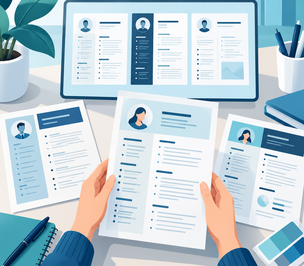



What is AI hiring bias?
AI hiring bias happens when an automated recruiting tool systematically disadvantages candidates based on characteristics like race, gender, age, or disability.
These systems learn from past hiring data, so they often repeat the same patterns that data contains.
The result is qualified people being filtered out before a human ever sees their application.
If you have applied for a job recently, there is a strong chance an algorithm screened you first.
That feels unsettling, and the concern is reasonable.
The good news is that understanding how this bias works puts you in a far stronger position, both to spot it and to respond to it.
This page walks through what AI hiring bias is, the documented cases, what current research shows, where the law stands, and the practical steps you can take.
What are some real examples of AI hiring bias?
The clearest examples of AI hiring bias come from major employers and vendors whose tools were found to disadvantage specific groups.
These are not hypothetical risks.
They are documented cases that reached newsrooms, regulators, and courts, and together they show that bias can appear at every stage of automated hiring.
A few of the most widely reported cases stand out:
| Case | What the tool did | Group affected |
|---|---|---|
| Amazon recruiting tool | Trained on a decade of mostly male resumes, it downgraded applications that included the word "women's" and favored male-coded language | Women |
| iTutorGroup | Screening software was set to auto-reject women over 55 and men over 60. The company settled with the EEOC for 365,000 dollars | Older applicants |
| HireVue video interviews | Faced scrutiny over scoring that journalists found could be swayed by accent, background, and appearance rather than answers | Non-native speakers, candidates with disabilities |
| Workday screening tools | A federal court allowed a discrimination case to proceed and treated the vendor's tools as an agent of the employer | Applicants by race, age, and disability |
What ties these cases together is that none of the tools were designed to discriminate.
The bias entered through the data and the design, which is exactly why it is so easy to miss.
A system can look neutral on the surface while quietly repeating decisions that would be unlawful if a person made them openly.
How does AI bias enter the hiring process?
AI bias enters the hiring process at the points where a system learns from flawed data or judges candidates on signals that have nothing to do with the job.
It rarely shows up as one obvious moment.
Instead, it builds up across several steps, each of which can tilt an outcome before a recruiter gets involved.
The most common entry points are these:
- Flawed training data: The tool learns what a "good" candidate looks like from past hires. If those hires skewed toward one group, the model learns to prefer that group.
- Proxy variables: The system uses stand-ins like zip code or employment gaps that correlate with race or gender, penalizing people for things unrelated to ability.
- Video and speech analysis: Tools that score tone, word choice, or facial expression can misread accents, neurodivergent communication, or disability.
- Automation bias: Even with a human in the loop, reviewers tend to trust and copy the algorithm's recommendation rather than question it.
The last point deserves attention because it undermines the most common safeguard.
Many employers assume a human reviewer will catch a biased recommendation.
In practice, when a system looks authoritative, people often defer to it.
A resume gap is a good illustration of the proxy problem too.
Someone who took time out to raise a child or recover from illness is not less capable, yet a model trained to treat gaps as a negative will quietly mark them down.
Recognizing these mechanisms is the first step toward writing applications that give algorithms fewer reasons to misjudge you.
What are the latest research findings on AI bias in employment practices?
The latest research shows that AI hiring bias is widespread, measurable at scale, and more complex than early studies suggested.
The field has moved from asking whether individual tools are biased to examining how the entire hiring system, including the people in it, produces biased outcomes.
Several large studies published recently make the picture much clearer.
The most significant findings include these:
- A Stanford study followed 3.4 million people submitting 4 million applications and found that 26% of Black applicants and 15% of Asian applicants applied to roles where the AI discriminated against their group. Under equal treatment, 40,000 more of their applications would have advanced (Stanford HAI, 2026).
- The same research found that around 90% of US employers now use AI screening tools, and most rely on the same few vendors, meaning one biased model can shut a person out of many jobs at once.
- A University of Washington study found that AI resume screeners favored white-associated names 85% of the time and male-associated names 52% of the time, and that people reviewing alongside a biased tool tended to mirror its preferences rather than correct them (University of Washington, 2024).
Researchers increasingly agree that bias audits need to be ongoing rather than one-time checks, and that human oversight alone does not reliably prevent discrimination.
There is also a growing view that "fair-looking" systems are not always fair.
Some score well on bias tests simply because they rely on crude keyword matching, which researchers have called an illusion of neutrality.
For job seekers, the practical takeaway is that these tools are now a standard part of hiring, so preparing for them is sensible rather than paranoid.
How do hiring algorithms contribute to gender inequality?
Hiring algorithms contribute to gender inequality when they learn from workforces that were already male-dominated and then treat male candidates as the template for success.
Because the model copies historical patterns, it can quietly penalize women even when no one intends that outcome.
This is one of the most consistently documented forms of AI hiring bias.
It tends to work in two ways.
First, a tool trained on mostly male hires may downgrade signals associated with women, which is what happened with the Amazon recruiting tool that penalized the word "women's."
Second, models can absorb occupational stereotypes, linking men to technical or leadership roles and women to support roles, which shapes how candidates are ranked.
Caregiving gaps add another layer, since women disproportionately take career breaks and many systems read gaps as a negative.
The lesson is not that women should hide their experience, but that understanding these tendencies helps you frame your achievements in clear, results-focused terms that are harder for a model to overlook.
Is AI hiring bias illegal?
In the United States, yes, discrimination caused by an AI hiring tool can be illegal, and the employer is responsible even when a third-party vendor built the tool.
Existing civil rights laws apply to automated decisions just as they apply to human ones.
Using an algorithm does not transfer or remove that legal responsibility.
This is information rather than legal advice, and anyone who believes they have faced discrimination should consider speaking with a qualified employment attorney.
Several established laws cover AI-driven hiring:
- Title VII of the Civil Rights Act: Prohibits discrimination based on race, color, religion, sex, and national origin.
- The Americans with Disabilities Act: Protects candidates whose disabilities may be disadvantaged by automated assessments.
- The Age Discrimination in Employment Act: Covers applicants 40 and older, the protection at issue in the iTutorGroup settlement.
Enforcement is becoming more active.
The Equal Employment Opportunity Commission settled its first AI hiring discrimination case against iTutorGroup, and the closely watched Mobley vs Workday case has tested whether a vendor's screening tools can be treated as an agent of the employer.
Some jurisdictions have gone further, with New York City now requiring annual bias audits for automated employment decision tools.
For candidates, the key point is that protections exist and regulators are paying attention, so a biased outcome is not something you simply have to accept.
How can job seekers protect themselves from AI hiring bias?
You cannot control how an employer's algorithm works, but you can make your application clearer, harder to misread, and easier for both software and people to evaluate fairly.
The goal is to reduce the number of signals a biased system could use against you while keeping your application authentic.
Small, deliberate choices make a real difference.
These steps give you the most leverage:
- Use clear, standard formatting: Avoid graphics, columns, and unusual fonts that screening tools can misread, and keep your resume structure simple.
- Mirror the job description's language: Use the same plain terms for skills and responsibilities so keyword-based systems recognize your fit.
- Quantify your achievements: Concrete, results-focused statements are harder for a model to overlook than vague descriptions.
- Explain gaps briefly and plainly: A short, factual note on a career break gives both software and reviewers context rather than leaving a gap to be misread.
- Request accommodations when needed: If a video or game-based assessment could disadvantage you, you can ask the employer for an alternative.
A growing number of automated interviews are being used by hiring departments, with around 43% of large companies now using artificial intelligence to interview candidates (Resume.io Interview Statistics, 2025), meaning how you present matters as much as what a tool measures.
The strongest version of a job application is one that reads as genuinely yours, written in clear language, and structured so that no system has an easy excuse to set it aside.
None of this guarantees a fair outcome, but it tilts the odds back in your favor.
Key takeaways
- AI hiring bias is rarely deliberate. It usually comes from tools copying patterns in old hiring data and judging people on signals unrelated to the job.
- Bias can enter at every stage, from resume screening to video interviews, which is why a tool can look neutral while still producing unfair outcomes.
- Independent research now shows the problem is widespread rather than occasional, and that a human reviewer does not reliably catch what a biased system recommends.
- In the United States, employers stay legally responsible for discriminatory AI hiring outcomes, even when an outside vendor built the tool.
- You have more control than it feels like. Clear formatting, job-matched language, quantified results, and requesting accommodations all reduce your exposure to a biased screen.

Frequently asked questions
Here are quick answers to some of the most common questions about AI hiring bias.
Can AI interview analysis help in reducing hiring bias?
Sometimes, but not reliably on its own.
AI interview analysis can reduce bias by applying the same structured questions and criteria to every candidate, which limits some forms of human inconsistency.
However, the same tools can introduce new bias if they score accents, expressions, or speech patterns, so they help only when carefully designed, tested, and overseen by people.
Preparing as you would for any job interview remains the most useful thing within your control.
Can you tell if AI rejected your job application?
Usually no, because most employers do not disclose exactly how applications are screened.
Some jurisdictions, such as New York City, require notice when automated decision tools are used, and a few employers volunteer it.
If you are unsure, you can ask the employer directly whether automated screening is part of their process.
Does using AI to write my resume increase bias against me?
Yes, it can. Many hiring managers and some screening tools respond negatively to applications that read as machine-written, treating them as a sign of low effort or low authenticity.
Using AI for ideas or structure is fine, but the finished resume should sound genuinely like you and reflect your real experience.