


To calm your nerves before an interview, prepare thoroughly, use slow exhale-focused breathing, and reframe the situation as a two-way conversation rather than a test.
A little nervousness is normal and even helpful.
The goal is not to erase it, but to keep it at a level where you can think clearly and speak well.
What are the most effective ways to calm nerves before a job interview?
The most effective ways to calm nerves before a job interview combine preparation with physical regulation.
Rehearse your answers out loud, plan the logistics in advance, rest and eat well, move your body to release tension, breathe slowly, and reframe the interview as a conversation.
Together these lower both the mental and the physical sides of nervousness.
- Rehearse out loud, do not memorize: Practice a strong answer to "Tell me about yourself" and run through your elevator pitch using bullet points rather than a script. Speaking at full volume gets you used to the sound of your own voice, so the real conversation is less of a shock.
- Plan the logistics the night before: Lay out your outfit, map your route or test your video link, and have everything you need to bring ready. Removing last-minute surprises removes a large source of stress.
- Rest and eat before you go: A good night of sleep and a balanced meal steady your energy and reduce the physical symptoms of anxiety. Limiting extra caffeine helps if you are prone to jitters.
- Move your body first: A brisk walk or light stretching burns off nervous energy and clears your head before you sit down.
- Breathe with a longer exhale: Slow breathing where the out-breath is longer than the in-breath calms your body quickly, and five minutes of this exhale-focused pattern, called cyclic sighing, eased anxiety more than box breathing or mindfulness in one study (Stanford Medicine, 2023).
- Reframe it as a conversation: Remember you are also there to judge whether the role suits you.
The more you prepare, the fewer things feel unknown, and uncertainty is what fuels most interview nerves.
Practicing common questions, including your strengths and weaknesses, turns a high-pressure test into a discussion you have already had once in private.
Are there any quick tips to manage interview stress and stay calm?
Yes. When time is short, a few fast tactics can settle interview stress in minutes.
Do a quick brain dump of your worries, take a few slow breaths, give yourself a short pep talk, sip some water, and loosen your shoulders and jaw.
Each one either calms your body or clears your head without much effort.
Pick based on what your nerves feel like in the moment: physical symptoms call for the body-based tactics, while a racing mind calls for the mental ones.
| Quick tactic | Why it works | Time it takes |
|---|---|---|
| Brain dump | Empties racing thoughts onto paper so your mind stops looping | 1 minute |
| A few slow breaths | Quickly slows a racing heart rate | 1 minute |
| Pep talk | Positive self-talk out loud shifts focus from fear to capability | 1 minute |
| Sip of water | Eases a dry, shaky voice and gives your hands something to do | Seconds |
| Loosen shoulders and jaw | Releases the physical tension that feeds the feeling of panic | Seconds |
These are situational resets rather than a full routine, so they work best on top of solid preparation.
Keep two or three that suit you within reach, so you always have something reliable when nerves spike unexpectedly.
What should you do 5 minutes before an interview?
In the five minutes before an interview, focus on resetting your body and mind rather than cramming new information.
Take a few slow breaths, glance at your key points once, sit or stand tall, and remind yourself this is a conversation.
Arrive or log in a few minutes early so you are not rushing at the last second.
- Reset your breathing: Two or three rounds of slow breaths with a long exhale to lower your heart rate.
- Glance at your notes once: A final look at your three main talking points, then put them away.
- Fix your posture: Sit up or stand tall for a moment to signal to your body that the situation is safe.
- Reframe in one line: Tell yourself something simple and true, such as "I am ready to have this conversation."
- Be early and settled: Log in or arrive five to ten minutes early so the start feels calm, not frantic.
Cramming in the final minutes tends to raise anxiety rather than lower it.
Trust the preparation you have already done and use this window to steady yourself instead.
How do you stay calm during an interview?
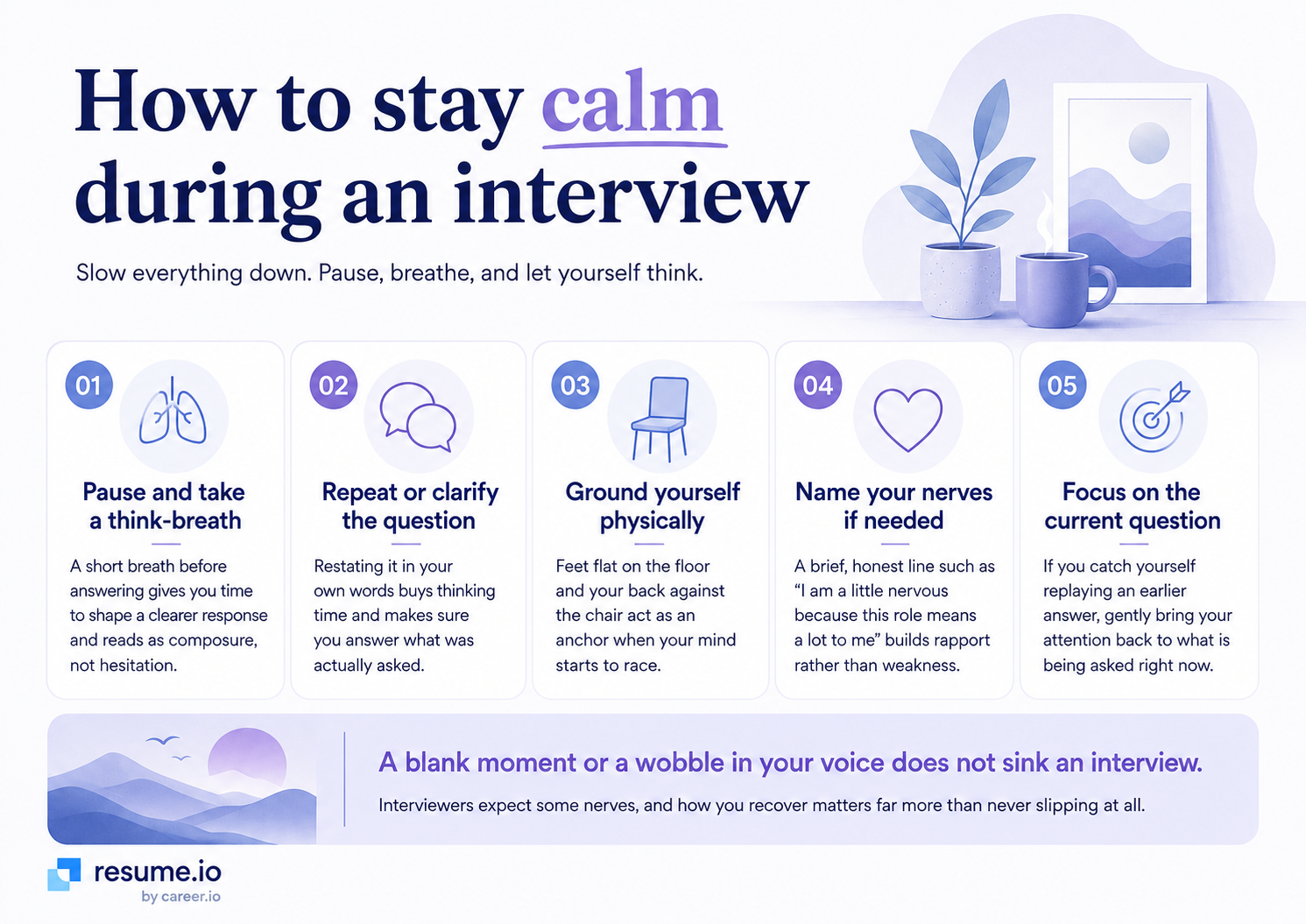
To stay calm during an interview, slow everything down.
Pause before you answer, breathe, and let short silences happen instead of rushing to fill them.
If your mind goes blank, repeat the question back to buy yourself a moment.
If your voice shakes, naming your nerves honestly often relaxes both you and the interviewer.
- Pause and take a think-breath: A short breath before answering gives you time to shape a clearer response and reads as composure, not hesitation.
- Repeat or clarify the question: Restating it in your own words buys thinking time and makes sure you answer what was actually asked.
- Ground yourself physically: Feet flat on the floor and your back against the chair act as an anchor when your mind starts to race.
- Name your nerves if needed: A brief, honest line such as "I am a little nervous because this role means a lot to me" builds rapport rather than weakness.
- Focus on the current question: If you catch yourself replaying an earlier answer, gently bring your attention back to what is being asked right now.
A blank moment or a wobble in your voice does not sink an interview.
Interviewers expect some nerves, and how you recover matters far more than never slipping at all.
How can I stay relaxed and confident during an interview?
Confidence during an interview comes mostly from your body and your pace, not from having flawless answers.
Sit upright and lean in slightly, hold comfortable eye contact, keep your hands open and visible, and slow your speaking pace by about ten percent.
These signals settle your nerves and make you read as calm and assured.
- Posture: Sitting upright and leaning in slightly shows engagement and keeps your breathing steady.
- Eye contact: Comfortable eye contact, or looking at the camera on video, builds connection.
- Open hands: Visible, relaxed hands stop fidgeting and read as openness.
- Slower pace: Fast talking signals nerves, so easing off slightly makes you sound more assured and gives you time to think.
- A genuine smile: Smiling releases tension and makes you appear more approachable.
Confidence is partly a loop.
When your body acts calm, your mind tends to follow, which then makes the calm body language easier to hold.
You do not need to feel fully confident to begin, because acting the part first is often what brings the feeling.
What can you do to calm nerves for a Zoom interview?
For a Zoom interview, control your environment in advance so technology is one less thing to worry about.
Test your camera, microphone, and link beforehand, position the webcam at eye level, and sit facing a window or light so you are clearly visible.
A settled setup lets you focus on the conversation instead of the screen.
- Test your tech early: Check your connection, camera, and audio well before the start time.
- Camera at eye level: This creates a natural, level eye line with the interviewer.
- Face the light: Sit facing a window or lamp so you are well lit.
- Silence notifications: Close email and chat apps so pings do not break your focus.
- Keep notes nearby but off-screen: A few bullet points just beside the camera can steady you without pulling your eyes away.
How do you overcome interview anxiety?
To overcome interview anxiety, treat the nerves as energy to channel rather than a problem to erase.
Shift your mindset from performing under judgment to exploring a genuine fit, and prepare enough that fewer things feel unknown.
For most people, anxiety shrinks as preparation grows and as each interview makes the next one feel more familiar.
Two mindset shifts help most:
- Relabel the feeling: Anxiety and excitement produce almost identical physical signals, so it is easier to move between them than to force yourself to feel calm. People who told themselves "I am excited" performed better in high-pressure tasks than those who tried to calm down (American Psychological Association, 2013).
- Prepare until less feels unknown: Rehearsed answers and solid company research leave little room for panic. This is reflected in what job seekers fear most: 44% of job seekers say they would feel more nervous skipping interview practice than skipping company research (Resume.io, Interview Hacking Survey, 2025).
If your anxiety is intense, happens before every interview, or stops you attending altogether, it is worth taking seriously.
Support from a healthcare or mental health professional can make a real difference.
Key takeaways
- Some nervousness before an interview is normal and can sharpen your focus, so the aim is to manage it, not remove it.
- Preparation is the strongest calming tool: rehearse out loud, plan logistics the night before, and know your key stories.
- Exhale-focused breathing, where the out-breath is longer than the in-breath, calms your body faster than shallow breathing.
- Reframing nerves as excitement, and the interview as a two-way conversation, lowers pressure and improves performance.
- In the final five minutes, reset your breathing and posture rather than cramming new information.
Frequently asked questions
Here are answers to a few common questions about interview nerves.
Why is my anxiety preventing me from going to job interviews?
Strong anticipatory anxiety can trigger avoidance, where skipping the interview brings quick relief and makes avoiding the next one more likely.
This pattern is common and treatable.
If interview anxiety regularly stops you from attending, a healthcare or mental health professional can help, often using approaches such as cognitive behavioral therapy.
What is the 10 second rule in an interview?
The 10-second rule is the idea that you can take up to around ten seconds of silence to think before you answer a question.
A short, deliberate pause reads as composure rather than being unprepared, and it gives you time to shape a clearer answer.
The silence almost always feels longer to you than it does to the interviewer.
Is it normal to be nervous before an interview?
Yes. Nearly everyone feels some nerves before an interview, including experienced professionals, because it is a situation you care about.
A moderate level of nervousness can even improve your focus and energy.
It becomes worth addressing only when it is severe enough to disrupt your thinking or stop you attending.


