
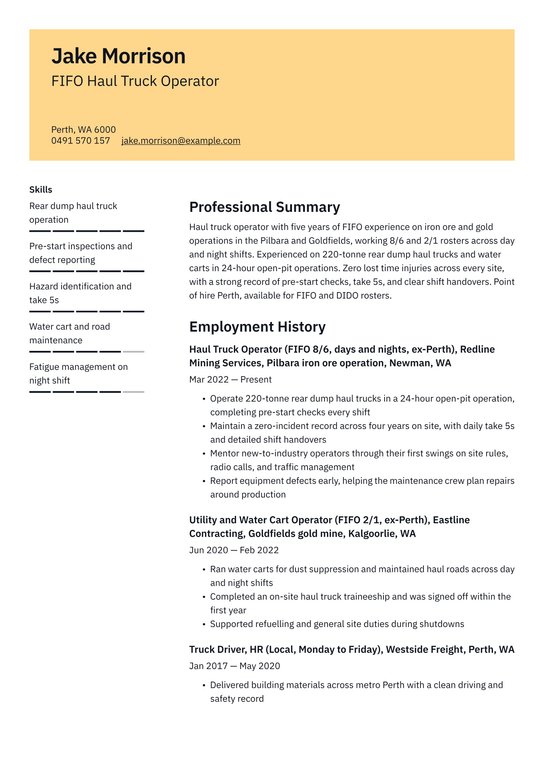
Haul truck operator with five years of FIFO experience on iron ore and gold operations in the Pilbara and Goldfields, working 8/6 and 2/1 rosters across day and night shifts. Experienced on 220-tonne rear dump haul trucks and water carts in 24-hour open-pit operations. Zero lost time injuries across every site, with a strong record of pre-start checks, take 5s, and clear shift handovers. Point of hire Perth, available for FIFO and DIDO rosters.
03/2022 - present, Haul Truck Operator (FIFO 8/6, days and nights, ex-Perth), Redline Mining Services, Pilbara iron ore operation, Newman, WA
- Operate 220-tonne rear dump haul trucks in a 24-hour open-pit operation, completing pre-start checks every shift
- Maintain a zero-incident record across four years on site, with daily take 5s and detailed shift handovers
- Mentor new-to-industry operators through their first swings on site rules, radio calls, and traffic management
- Report equipment defects early, helping the maintenance crew plan repairs around production
06/2020 - 02/2022, Utility and Water Cart Operator (FIFO 2/1, ex-Perth), Eastline Contracting, Goldfields gold mine, Kalgoorlie, WA
- Ran water carts for dust suppression and maintained haul roads across day and night shifts
- Completed an on-site haul truck traineeship and was signed off within the first year
- Supported refuelling and general site duties during shutdowns
01/2017 - 05/2020, Truck Driver, HR (Local, Monday to Friday), Westside Freight, Perth, WA
- Delivered building materials across metro Perth with a clean driving and safety record
07/2020 - 11/2021, Certificate III in Surface Extraction Operations, Goldfields Mining Training, Kalgoorlie, WA
- Completed as an on-site traineeship alongside FIFO work at a Goldfields gold mine
- Covered haul truck operation, water cart operation, and safe work practices in open-pit mining
- Rear dump haul truck operation
- Pre-start inspections and defect reporting
- Hazard identification and take 5s
- Water cart and road maintenance
- Fatigue management on night shift
Fly-in fly-out (FIFO) jobs draw thousands of applicants, and recruiters scan every FIFO resume for the same few things: current tickets, roster experience, and proof you can work safely on a remote site. The two resume examples below cover the most common routes onto site, a resume for a haul truck operator and a resume for a camp chef, each set out the way Australian employers read them. Adapt the layout that fits your background, or build yours with our online resume writer.
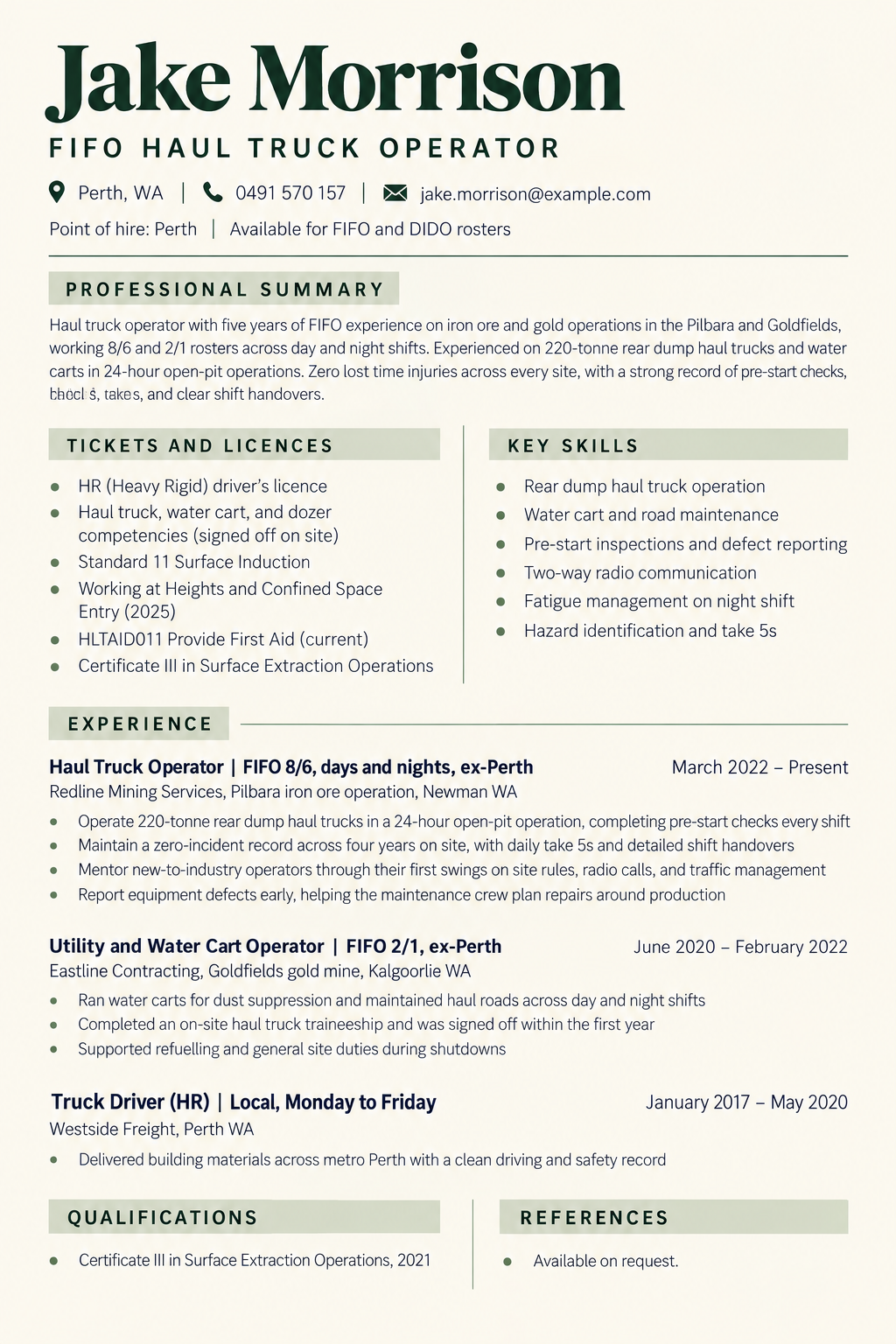
FIFO haul truck operator resume example
This haul truck operator example shows an experienced FIFO worker, with the roster, location, and commodity on every role and the tickets straight after the summary.
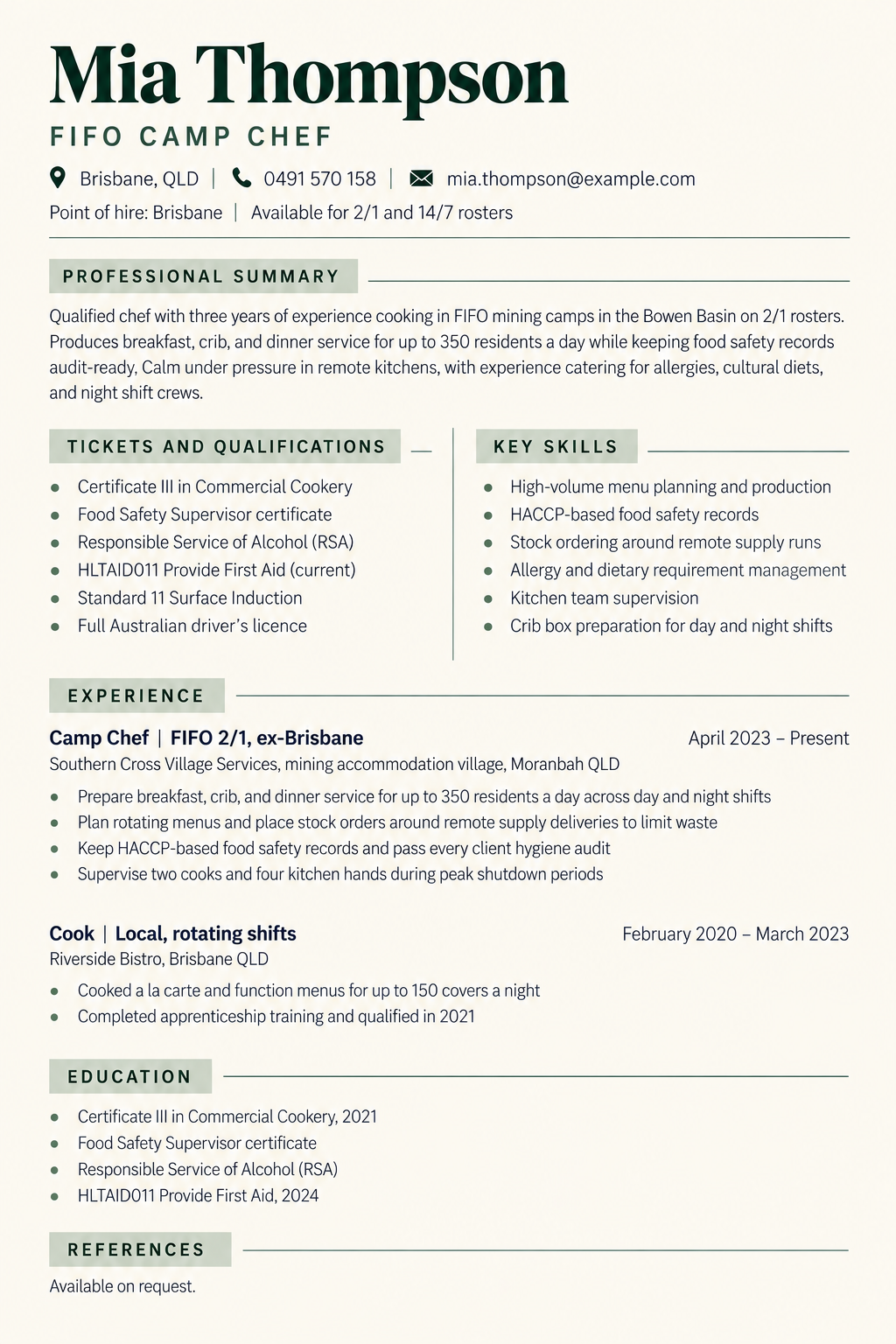
FIFO camp chef resume example
This camp chef example shows the hospitality side of FIFO work, where volume, food safety, and reliability on a long roster matter most.
“Crib” is the mining word for a meal break, and camp kitchens pack crib boxes for crews to take on shift.
What qualifications and resume tips are best for landing FIFO roles?
The best qualifications for FIFO roles are the tickets each job ad names, such as a Standard 11 induction for Queensland coal mines, an HR truck licence, Working at Heights, or a Certificate III in Commercial Cookery for camp chefs.
You should list every current ticket on page one of your FIFO resume and keeping it to two pages.
No single list covers every FIFO job, because requirements change by state, mine type, and role.
Queensland’s Recognised Standard 11 sets the induction training for coal mine workers in that state but Western Australia works differently.
Under the WHS (Mines) Regulations 2022, the mine operator must induct each new worker, so WA employers usually induct you after you are hired.
| Ticket | Who usually asks for it | How to list it |
|---|---|---|
| Standard 11 induction | Queensland coal mine workers | “Standard 11 Surface Induction” plus the year |
| Site induction | Every new worker on WA mine sites, delivered by the operator | Leave off until completed, then name the site |
| HR (Heavy Rigid) or HC (Heavy Combination) licence | Haul truck, water cart, and service truck roles | The licence class |
| High Risk Work Licence | Stores, logistics, and maintenance support | The class code, such as LF for forklift |
| Working at Heights, Confined Space | Maintenance, shutdown, and trade assistant roles | The completion year |
| First Aid (HLTAID011) | Many site and camp roles | “Current” or the expiry year |
| Certificate III in Commercial Cookery, Food Safety Supervisor | Camp chefs and cooks | The qualification name and year |
Write each ticket as it appears on the certificate, with the class or code where one exists.
Clear certifications let a recruiter check eligibility in seconds, so remove tickets unrelated to the role, because a long list hides the ones the employer is screening for.
How should I apply for FIFO roles and what should I highlight on my resume?
Apply for FIFO roles through three routes at once: directly with mining companies and contractors, through labour hire agencies, and through camp and village operators for hospitality jobs.
On your FIFO resume, highlight your tickets, roster experience, safety record, and point of hire, which is the city you can fly out from.
- Apply directly: Mining companies and contractors list roles on their careers pages and SEEK. Some, such as Mount Isa Mines, take expressions of interest for entry-level operators.
- Register with labour hire: Agencies place workers across several operations, including shutdowns and short contracts.
- Approach camp operators: Kitchen, cleaning, and village roles are usually run by accommodation contractors rather than the mine itself.
- Tailor every application: Build a targeted resume for each ad, using its exact role title and the tickets it names.
Recruiters scan for the same core details, whatever the role:
- Tickets and licences: The first proof you are site-ready.
- Roster history: The rosters you have worked, showing you can handle time away.
- Safety record: Incident-free time and pre-start checks, plus take 5s, a quick five-step hazard check done before each task.
- Point of hire: The airport you fly from, since many roles only fly from set cities.
- Volume and standards for camp roles: Residents served per day and food safety audits passed.
Point of hire can decide whether you are even considered.
One recent Mount Isa listing on Indeed preferred local candidates but offered FIFO from Brisbane, Townsville, or Cairns.
A line reading “Point of hire: Brisbane” answers that question before the recruiter asks it.
How do you show rosters and site experience on a FIFO resume?
Show rosters on a FIFO resume by adding the roster pattern, shift type, and point of hire to the title line of each role, then naming the site, region, and commodity under it.
A recruiter can see at a glance that you have already completed real swings and know what a FIFO roster demands.
Neither of the top-ranking FIFO resume examples we reviewed for this page shows a roster on its work history lines.
Adding one to each job title line turns your work history into proof of FIFO readiness.
A swing is one stint on site, so two years of 2/1 rosters tells a recruiter you have completed many of them.
Before:
Utility and Water Cart Operator
Mining company, WA | 2020 to 2022
After:
Utility and Water Cart Operator | FIFO 2/1, ex-Perth
Eastline Contracting, Goldfields gold mine, Kalgoorlie WA | June 2020 to February 2022
The second version adds the roster, the commodity, the region, and where you fly from.
Rosters are written as time on site, then time at home:
| Roster | What it means |
|---|---|
| 8/6 | Eight days on site, six days at home |
| 2/1 | Two weeks on site, one week at home |
| 14/7 | Fourteen days on site, seven days at home |
| 4/3 | Four days on, three days off |
List non-FIFO shift work as well, such as rotating nights or 12-hour shifts.
Recruiters read that as evidence you can manage fatigue, even if you have never flown to site.
How do you write a FIFO resume with no mining experience?
Write a FIFO resume with no mining experience by translating your current work into site language and leading with any tickets you already hold.
Construction, warehousing, transport, hospitality, and cleaning all transfer well, and camp roles such as kitchen hand or village cleaner are a common way for newcomers to get onto site.
Entry-level hiring is real but crowded and on Reddit’s r/mining, experienced workers tell newcomers that thousands of people apply for entry roles.
They suggest searching for “new to industry” or “greenskin” jobs, or starting with camp operators.
A strong resume with no experience in your target industry focuses on what already transfers:
- Construction and labouring: Site safety, small plant, and physical work outdoors.
- Warehousing and logistics: Forklifts, stock control, set procedures, and shift work.
- Hospitality and cleaning: Long shifts, food safety, and housekeeping standards for camp roles.
- Driving and transport: Heavy vehicle licences, fatigue management, and vehicle checks.
Here is how a warehouse bullet can be rewritten for a FIFO resume:
Before:
- Drove forklifts in a warehouse
After:
- Operated counterbalance forklifts on 12-hour rotating shifts, completing pre-start checks and following traffic management plans with no incidents in three years
The rewrite uses words a mine site recognises: pre-starts, traffic management, and shift length.
Hospitality work translates the same way once it is framed around meals served per day, food safety audits passed, and long rostered shifts.
What mistakes should you avoid on a FIFO resume?
The most common FIFO resume mistakes are using AI-written text without making it your own, burying or omitting tickets, leaving out rosters and point of hire, listing tickets the role does not need, and sending a resume with typos.
Each one makes a recruiter’s quick screen harder, and some lead straight to the reject pile.
- AI-written resumes: 49% of US hiring managers automatically dismiss AI-generated resumes (Resume.io, Resume Rejections Survey, 2024). Amanda Augustine, CPRW, CPCC, career expert at Resume.io, says “authenticity in job applications is more valued than perfection,” adding that “employers are looking for genuine candidates, not just flawless prose.”
- Buried tickets: Licences at the bottom of page two may never be seen. Move them under your summary.
- Expired tickets: Add the year or “current” so the employer knows what is still valid.
- No roster or point of hire: Without them, a recruiter cannot tell whether you have worked FIFO or where you would fly from.
- Unneeded tickets: Paying for courses the role does not ask for costs money and adds clutter, so check the ads you want first.
- Typos: Experienced workers on r/mining tell applicants plainly to use spell check, because errors suggest carelessness in a safety-first industry.
The AI survey was run with US hiring managers, but the lesson carries to Australian site jobs.
Use AI to tidy your wording if it helps, then rewrite each line so it describes your own sites, machines, and rosters.
Keep the layout simple and ATS-friendly, since an applicant tracking system may screen your FIFO resume before a person reads it.
Key tips
- List every current ticket straight after your summary, with its class, code, or year.
- Add the roster, shift type, and point of hire to the title line of each role.
- Name the site, region, and commodity under each job, such as iron ore in the Pilbara.
- Translate non-mining experience into site language, such as traffic management and hazard checks.
- Write your own wording rather than pasting AI text, and start from one of our resume templates to save time on layout.
FAQs
Here are short answers to three common questions about FIFO resumes.
How long should a FIFO resume be?
Two pages suits most FIFO resumes. A two-page resume gives room for tickets, roster history, and experience, with your summary and tickets on the first page.
Applicants new to the industry can often fit everything on one page, but more than three pages makes a recruiter’s quick scan harder.
Do you need tickets before applying for FIFO jobs in WA?
No, not for the site induction. Under the WHS (Mines) Regulations 2022, WA mine operators must induct each new worker, so the induction usually happens after you are hired.
Some roles still ask for role-specific tickets before you start, such as an HR licence for truck work, so check each job ad before paying for a course.
What does “greenskin” mean in FIFO jobs?
“Greenskin” is mining slang for someone new to the industry with no site experience.
Some job ads use it, or “new to industry”, to flag entry-level roles that include training.
Search both terms on job boards, and frame your FIFO resume around transferable skills and any tickets you already hold.