
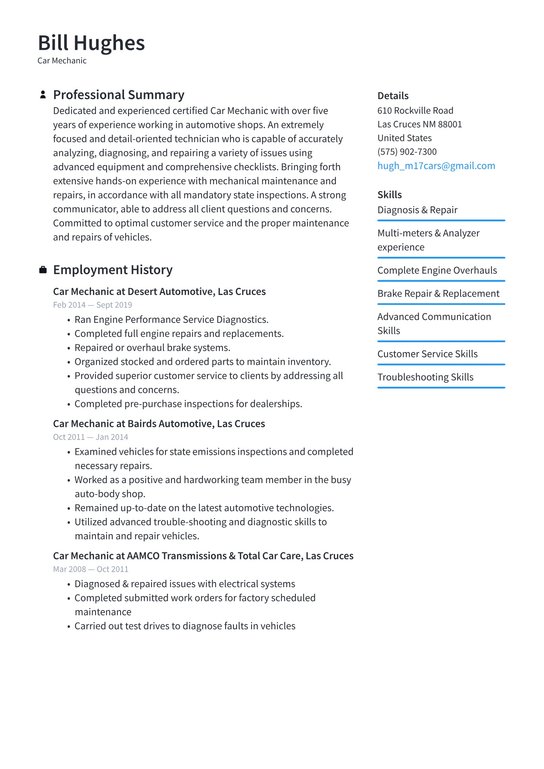
02/2014 - 09/2019, Car Mechanic, Desert Automotive, Las Cruces
- Ran Engine Performance Service Diagnostics.
- Completed full engine repairs and replacements.
- Repaired or overhaul brake systems.
- Organized stocked and ordered parts to maintain inventory.
- Provided superior customer service to clients by addressing all questions and concerns.
- Completed pre-purchase inspections for dealerships.
10/2011 - 01/2014, Car Mechanic, Bairds Automotive, Las Cruces
- Examined vehicles for state emissions inspections and completed necessary repairs.
- Worked as a positive and hardworking team member in the busy auto-body shop.
- Remained up-to-date on the latest automotive technologies.
- Utilized advanced trouble-shooting and diagnostic skills to maintain and repair vehicles.
03/2008 - 10/2011, Car Mechanic, AAMCO Transmissions & Total Car Care, Las Cruces
- Diagnosed & repaired issues with electrical systems
- Completed submitted work orders for factory scheduled maintenance
- Carried out test drives to diagnose faults in vehicles
08/2003 - present, Automotive Technology Certificate, Lincoln Technical Institute, Whitestone
09/1998 - 05/2002, High School Diploma, Astoria High School, Astoria
- Diagnosis & Repair
- Multi-meters & Analyzer experience
- Complete Engine Overhauls
- Brake Repair & Replacement
- Advanced Communication Skills
- Customer Service Skills
- Troubleshooting Skills
The Australian resume format is a reverse-chronological document of two to three pages, written in Australian English, with no photo or personal details and a clearly labelled key skills section. Whether you are applying locally or arriving from overseas, Resume.io helps you match the layout, length, and referee conventions Australian employers expect.
Related Resume Examples
College Student resume example

High School Student resume example

Government resume example
What is the Australian resume format?
The Australian resume format is a reverse-chronological summary of your career, usually two to three pages, led by your contact details and a short professional summary, then key skills, work experience, and education.
Australians use the words "resume" and "CV" interchangeably, so a job ad asking for either means this same document.
The standard section order Australian employers expect is:
- Contact details: Name, city and state, mobile number, and professional email
- Professional summary: Three to four lines matched to the role
- Key skills: A labelled list of the capabilities named in the job ad
- Professional experience: Roles in reverse-chronological order, most recent first
- Education and qualifications: Degrees, and vocational qualifications such as TAFE certificates
- Certifications and licences: Tickets and registrations relevant to the role
- Referees: Either named, or noted as available on request
The default is reverse-chronological, though other resume formats, such as a functional layout, can suit career changers with limited recent experience.
This structure covers the key parts of a resume anywhere, but the Australian version is more detailed than a US resume and shorter than an academic CV.
How long should an Australian resume be?
An Australian resume should be two to three pages for most experienced candidates.
That is longer than the strict US one-page standard and shorter than a multi-page academic CV.
The right length follows how much relevant experience you have; padding to reach a page count works against you, and anything past three pages should justify the extra space.
| Career stage | Recommended length |
|---|---|
| Students and recent graduates | 1 to 2 pages |
| Early to mid-career professionals | Around 2 pages |
| Senior, executive, and government roles | 2 to 3 pages, occasionally more |
A common myth, repeated on several career sites, is that Australian resumes should run to four or five pages but they should not.
Australian university careers services advise two to three pages for most applicants (RMIT University, 2024), and a longer document usually signals padding rather than seniority.
If you are converting a US one-page resume, you have room to add context and achievements; if you are trimming an academic CV, cut publications and dense detail down to a focused two-page resume.
The test is relevance: every line should help an Australian employer see why you fit this role.
Should you put referees on an Australian resume?
Yes, referees are far more expected on an Australian resume than on a US or UK one, where they are usually left off entirely.
A referees section is a distinctive Australian convention, and how you handle it is a genuine choice rather than a fixed rule.
Two approaches are both accepted, and the right one depends on the role and how much space you have.
| Approach | When it works best |
|---|---|
| Name two to three referees directly (name, title, organisation, phone, email) | Senior, government, education, and healthcare roles, where employers expect named contacts and "available on request" can read as evasive |
| Write "Referees available on request" and keep a matching list ready | Earlier-career applications, competitive space on the page, or when you want to protect referees' contact details until you are shortlisted |
Whichever you choose, three things do not change.
Ask each referee for permission first, because Australian employers often check references before making a formal offer.
Choose people who can speak to your work, usually a recent manager or supervisor.
Always have a formatted reference list ready to send the moment it is requested.
How do Australian resumes differ from US and UK resumes?
Australian resumes sit between the US and UK conventions: more detailed and slightly longer than a US resume, less formal than a UK CV, and distinctive in expecting referees and Australian spelling.
If you are adapting an international resume or moving between markets, for example from the Canadian resume format, these are the differences that matter most.
| Feature | Australia | United States | United Kingdom |
|---|---|---|---|
| Typical length | 2 to 3 pages | 1 page for most | 2 pages |
| Photo | No | No | No |
| Referees | Named or "available on request" | Omitted | Usually omitted |
| Spelling | Australian (organise, colour) | American (organize, color) | British (organise, colour) |
| Date format | DD/MM/YYYY, or Month Year for roles | MM/DD/YYYY | DD/MM/YYYY |
| Paper size | A4 | US Letter | A4 |
| Terminology | "Resume" and "CV" interchangeable | "Resume" standard | "CV" standard |
The practical takeaway for anyone moving to Australia is to resist two extremes.
Do not submit a bare one-page US resume, which reads as thin to Australian recruiters, and do not send a ten-page academic CV, which reads as unfocused.
The Australian format rewards detail that is relevant and quantified, presented in a scannable layout.
What to include in an Australian resume, section by section
Each section of an Australian resume should prove your fit for the role.
Here is how to write a resume for the Australian market, section by section, with adaptable examples to localise for your industry and city.
1. Contact details
List your full name, city and state, a mobile number, and a professional email address in your resume header.
You do not need your full street address; a city and state such as Sydney, NSW is enough, and a hyperlinked LinkedIn profile is worth adding.
If you are applying from overseas or relocating, add your work rights on the same line so recruiters can screen eligibility straight away.
Jordan Nguyen
Operations Coordinator
Sydney, NSW | +61 4XX XXX XXX | jordan.nguyen@email.com | LinkedIn
Australian permanent resident with full working rights
2. Professional summary
Open with a three to four line summary that matches the role, naming your job title, years of experience, and your strongest quantified result.
Avoid broad adjectives and lead with evidence.
Operations coordinator with over six years of experience across logistics and healthcare administration in New South Wales. Managed a state-wide supplier network and cut fulfilment delays by 22% in twelve months. Skilled in scheduling, vendor management, and process improvement.
3. Key skills
Give key skills their own labelled section near the top, because Australian recruiters and search tools scan it first.
Skills-first screening is now common: 41% of US employers look for a skills section first when reviewing a resume (Resume.io, Resume Statistics, 2025), and Australian recruiters increasingly search resumes the same way, so a named block of six to ten role-relevant skills belongs high on the page.
Balance practical technical skills with interpersonal ones, and mirror the wording of the job ad.
- Supplier and vendor management
- Rostering and scheduling
- Process improvement
- Budget tracking
- Stakeholder communication
4. Work experience
On an Australian resume, list roles in reverse-chronological order with your job title, employer, city and state, and dates in Month Year format.
Under each role, use bullet points that lead with a verb and show achievements rather than duties, quantified wherever possible.
Keep the focus on roughly the last ten to fifteen years and group anything older under a brief earlier-career heading.
Operations Coordinator, BrightPath Logistics, Sydney NSW
March 2021 to Present
- Coordinated a supplier network across five states, reducing fulfilment delays by 22%.
- Managed a $480,000 annual operations budget across three sites.
- Introduced a scheduling process that lifted on-time delivery from 84% to 96%.
5. Education, qualifications, and licences
List your highest qualification first, with the degree or certificate, institution, and year.
Include vocational qualifications such as TAFE certificates, and add any licences or tickets the role requires, for example a White Card for construction or a current Working with Children Check.
Once you have a tertiary qualification or several years of experience, you can leave secondary school details off.
Should you include a photo or personal details?
No. An Australian resume should not include a photo, date of birth, marital status, nationality, or religion.
Australian anti-discrimination laws mean employers generally do not want this information, and including it can create legal risk for them and work against you.
A photo also wastes space that a recruiter would rather see filled with evidence of your skills.
Leave the following off an Australian resume:
- Photograph
- Date of birth or age
- Marital or family status
- Religion or political affiliation
- Passport or identity numbers
Keep the focus on what you have done and what you can do.
The only personal detail worth adding, and only for newcomers, is your work rights, which belong on the contact line rather than in a separate personal section.
Everything else on the page should speak to your suitability for the role.
Key selection criteria for government and public-sector roles
Government and many public-sector roles in Australia ask you to address key selection criteria, which is a separate document or section from your resume.
Each criterion asks you to prove a capability with a specific example, and the clearest way to answer is the STAR method: Situation, Task, Action, Result.
- Situation: Set the context briefly
- Task: Explain what you were responsible for
- Action: Describe what you did, focusing on your own contribution
- Result: State the outcome, quantified where possible
For a criterion such as "demonstrated ability to manage competing priorities," you would name a real situation, the deadline pressure you faced, the actions you took to reschedule and delegate, and the measurable result.
Australian public-sector recruitment weights these responses heavily, so treat each criterion as its own short, evidence-led answer rather than repeating your resume.
Private-sector roles rarely ask for selection criteria, so only prepare them when the job ad requests them.
Australian resume example (text version)
Here is a complete text-only Australian resume you can adapt.
It follows the standard section order, uses Australian spelling and Month Year dates, and keeps referees available on request.
Jordan Nguyen
Operations Coordinator
Sydney, NSW | +61 4XX XXX XXX | jordan.nguyen@email.com | LinkedIn
Australian permanent resident with full working rights
Professional summary
Operations coordinator with over six years of experience across logistics and healthcare administration in New South Wales. Managed a state-wide supplier network and cut fulfilment delays by 22% in twelve months. Skilled in scheduling, vendor management, and process improvement.
Key skills
Supplier and vendor management • Rostering and scheduling • Process improvement • Budget tracking • Stakeholder communication • Reporting
Professional experience
Operations Coordinator, BrightPath Logistics, Sydney NSW
March 2021 to Present
- Coordinated a supplier network across five states, reducing fulfilment delays by 22%.
- Managed a $480,000 annual operations budget across three sites.
- Introduced a scheduling process that lifted on-time delivery from 84% to 96%.
Administration Officer, Northside Health, Newcastle NSW
January 2019 to February 2021
- Scheduled rosters for a 40-person clinical team across rotating shifts.
- Streamlined supplier invoicing, reducing processing time by 30%.
Education and qualifications
Bachelor of Business (Logistics and Supply Chain), University of Technology Sydney, 2018
Certificate IV in Business Administration, TAFE NSW, 2016
Licences
Current NSW driver licence
Referees
Available on request
Formatting and ATS in Australia
Australian resumes should use a single-column layout on A4 paper, with a standard font such as Calibri or Arial at around 11 point and margins of about 2.5cm.
Many Australian employers, especially larger ones, run applicant tracking systems such as Workday and PageUp, and these systems struggle with graphics, text boxes, and multi-column designs.
A simple layout protects your content and keeps it readable for the person on the other end.
A quick formatting checklist for Australia:
- Use A4 (210mm x 297mm), not US Letter
- Keep to a single column with clear, standard headings
- Save as PDF unless the job ad asks for a Word document
- Use Month Year for role dates to avoid DD/MM versus MM/DD confusion
- Include the +61 country code if you are applying from overseas
Expert tip: Recruiters move fast on the first pass. 24% of US hiring managers spend under 30 seconds on a resume (Resume.io, Resume Statistics, 2025), and Australian recruiters screen just as quickly, so put your strongest, most relevant information in the top third of page one where it will actually be seen.
Australian job market and outlook
Australia's job market in 2026 is steady but more selective than during the post-pandemic hiring peak.
Unemployment sat at 4.4% in May 2026, with around 330,000 job vacancies nationally and roughly 15.2 million people employed (Australian Bureau of Statistics, 2026).
Vacancies are about 30% below their 2022 high, which means employers are pickier and hiring timelines are longer.
A tighter market rewards the fundamentals covered above:
- Tailor each application to the specific job ad and its keywords
- Lead with quantified achievements rather than duties
- Keep formatting clean so it clears ATS screening
The practical implication is that a generic resume is less likely to land now than it was two years ago, so the time you spend tailoring and tightening pays off directly in interviews.
How to choose a resume builder in Australia
The right resume builder for the Australian market produces an ATS-safe layout, supports Australian spelling and A4 sizing, and gives you room for the two to three page length local employers expect.
Not every international tool handles these defaults, so it is worth checking a few things before you commit.
When choosing a resume builder in Australia, look for:
- A4 page sizing and single-column, ATS-friendly templates
- Editable Australian English throughout
- Space for a key skills section and a referees section
- Export to both PDF and Word
Resume.io offers field-tested templates that meet these Australian conventions, and you can browse resume examples across hundreds of roles or start from a template and adapt it to your industry.
Whichever tool you use, the format matters more than the branding: a clear, tailored, correctly localised resume is what earns the interview.
Key takeaways
- The Australian resume format is reverse-chronological, two to three pages, and written in Australian English with no photo.
- Referees are more expected in Australia than in the US or UK; name them for senior and government roles, or note them as available on request and keep a list ready.
- Give key skills their own labelled section near the top, and mirror the wording of the job ad.
- State your work rights near your contact details if you are applying from overseas.
- Use a single-column A4 layout so your resume clears applicant tracking systems.
Frequently asked questions
A few common questions about the Australian resume format, answered directly.
Do Australian resumes need a photo?
No. Australian resumes should not include a photo, and adding one can count against you under anti-discrimination norms.
Focus the space on your skills, experience, and qualifications instead, and keep any professional photo to your LinkedIn profile.
How many pages should an Australian resume be?
Two to three pages is standard for most experienced candidates.
Recent graduates can use one to two pages, while senior, executive, and government applications may run to three.
Length should follow relevant content rather than a target page count.
Do you put referees on an Australian resume?
You can, and it is more common in Australia than in the US or UK.
Either name two to three referees with their contact details, which is expected for senior and government roles, or write "Referees available on request" and keep a matching list ready.
Always ask your referees for permission first.