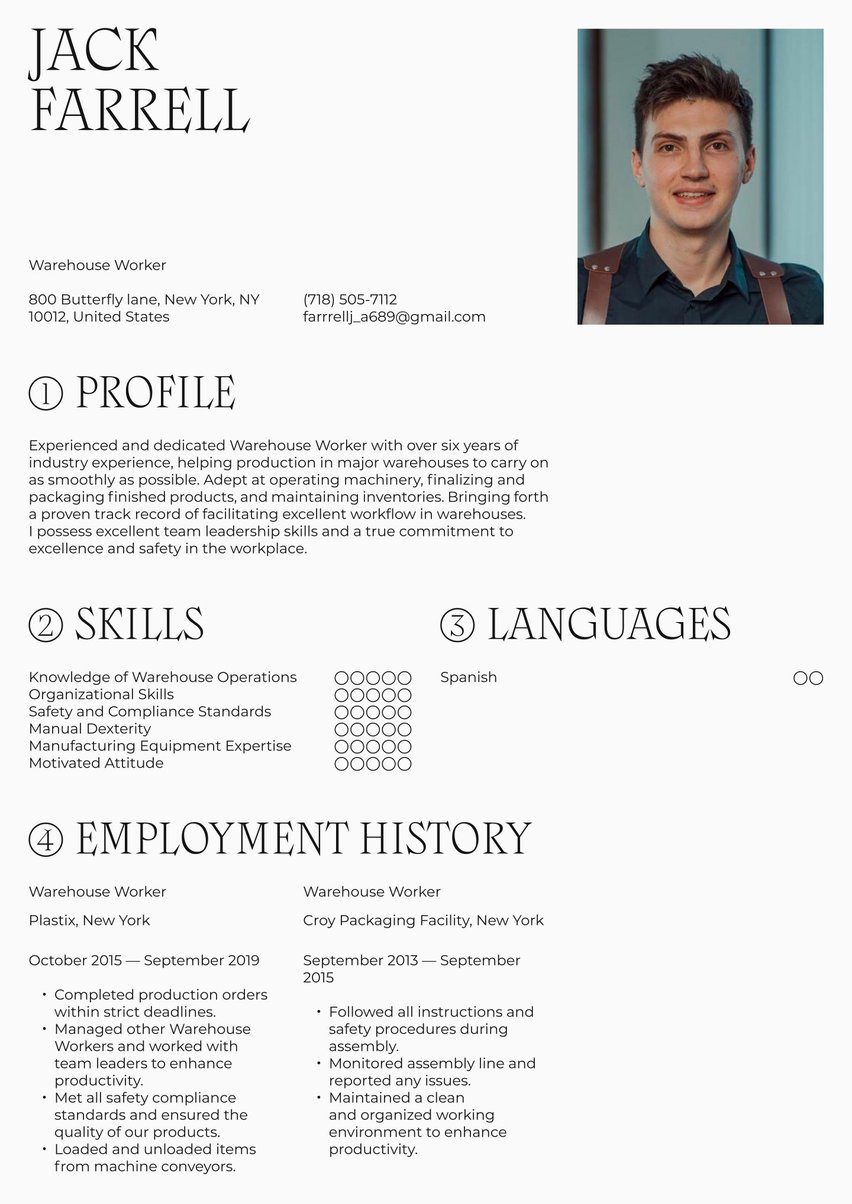

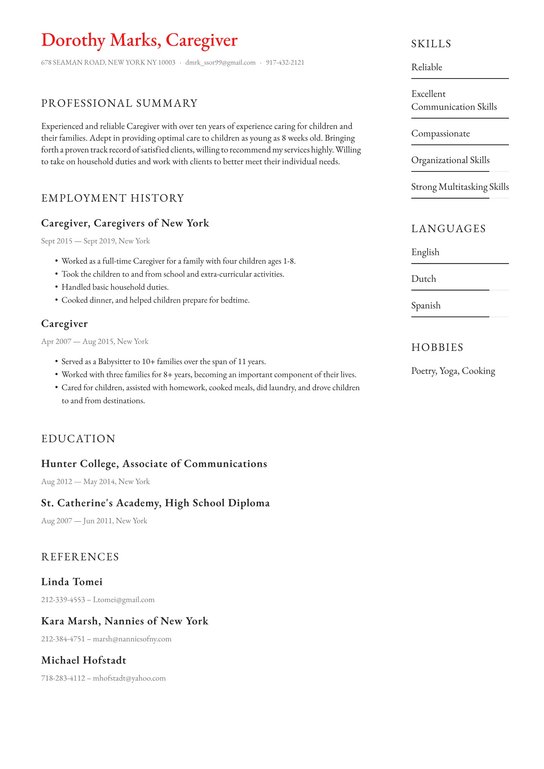
09/2015 - 09/2019, Caregiver, Caregivers of New York, New York
- Worked as a full-time Caregiver for a family with four children ages 1-8.
- Took the children to and from school and extra-curricular activities.
- Handled basic household duties.
- Cooked dinner, and helped children prepare for bedtime.
04/2007 - 08/2015, Caregiver, , New York
- Served as a Babysitter to 10+ families over the span of 11 years.
- Worked with three families for 8+ years, becoming an important component of their lives.
- Cared for children, assisted with homework, cooked meals, did laundry, and drove children to and from destinations.
08/2012 - 05/2014, Associate of Communications, Hunter College, New York
08/2007 - 06/2011, High School Diploma, St. Catherine's Academy, New York
- English
- Dutch
- Spanish
- Reliable
- Excellent Communication Skills
- Compassionate
- Organizational Skills
- Strong Multitasking Skills
A strong PSW resume in Canada leads with your Personal Support Worker certificate, your safety certifications with expiry dates, and the care settings and patient populations you have supported. This Resume.io example shows how to order those details so a hiring manager can screen you in within seconds, not scroll past you.
Related Resume Examples
Caregiver resume example

Configured for compassionate care, this template highlights your nurturing qualities essential for Home Health Caregiver roles. The soothing color palette and clear structure enhance communication of your core competencies, ensuring a warm connection with potential employers.
Healthcare resume example
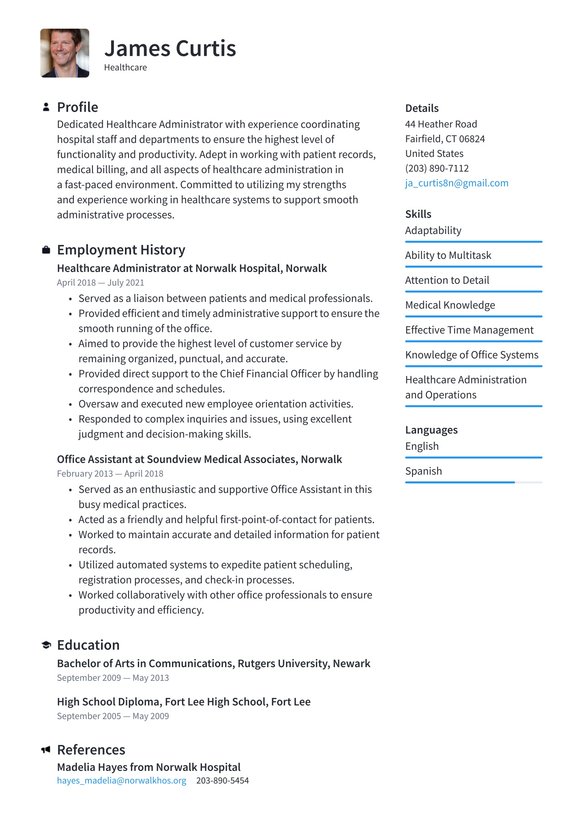
Customized for healthcare professionals, this clean, organized layout highlights your multitasking and administrative skills in fast-paced environments. The structured design effortlessly showcases your expertise, ensuring you connect with healthcare employers seeking efficiency and dedication.
Demand is real, which is why the bar is high.
Healthcare made up 14.82% of all Canadian job ads (Resume.io, Industry Hiring Report, 2025), and the role, classified federally as NOC 33102, pays a median of $24.00 an hour in Ontario (Job Bank, 2024).
A clear, credential-first resume is what turns that demand into an interview.
PSW resume example for Canada
Maria Santos, PSW
Toronto, Ontario | (555) 012-3456 | maria.santos@email.com
Professional summary
Certified Personal Support Worker with three years of experience in long-term care and home care across the Greater Toronto Area. Skilled in dementia care, safe transfers, and personal care for high-needs residents. Committed to dignity, fall prevention, and clear reporting to nursing staff.
Certifications
- Personal Support Worker Certificate | Centennial College, 2022
- Standard First Aid and CPR-C (HCP) | Canadian Red Cross, expires 2027
- WHMIS 2015 | 2022
- Gentle Persuasive Approaches (GPA) | 2023
- Vulnerable Sector Check | current
Core skills
- Personal care: Bathing, grooming, toileting, and feeding for 8 to 10 residents per shift
- Mobility and safety: Mechanical lifts (Hoyer, sit-to-stand), gait belts, fall prevention
- Specialized care: Dementia and Alzheimer care, palliative support, continence care
- Documentation: PointClickCare, care plan charting, incident reporting
Professional experience
Personal Support Worker | Chartwell Retirement Residences | Toronto, ON | 2023 to present
- Provide daily personal care for 9 residents with dementia and mobility limitations in a 120-bed long-term care home
- Perform safe transfers using Hoyer and sit-to-stand lifts, maintaining a record of zero patient-handling injuries
- Chart vital signs and behavioural changes in PointClickCare and escalate concerns to the charge nurse
Personal Support Worker | SE Health (home care) | Toronto, ON | 2022 to 2023
- Delivered personal care and medication reminders to 6 to 8 community clients per day
- Prepared modified-texture meals for clients with dysphagia, following individual care plans
Education and clinical placement
Personal Support Worker Certificate | Centennial College | 2022
- Completed 300 hours of supervised placement in long-term care and community settings
How to write a resume for a PSW job
Write a PSW resume in the order a hiring manager reviews it: certificate first, safety certifications with dates next, then care settings, caseload, and the systems you have used.
Follow these steps in sequence, then expand each with detail from your own experience.
- List your PSW certificate with the institution and graduation year
- Add safety certifications with issuing body and expiry date
- Write a professional summary naming your experience, settings, and strengths
- Detail experience with caseload size, patient population, and facility type
- Group skills so an applicant tracking system can read them
- Start from a clean template that keeps sections in this order
The detail in step four is where most candidates lose ground.
Only 26% of candidates include measurable data on their resumes (Resume.io, Cover Letter Statistics, 2025), so numbers separate you fast.
Learning to quantify each bullet is the single highest-value edit you can make.
- Generic: Provided personal care to residents and assisted with daily activities.
- Better: Provided daily personal care for 9 residents with dementia in a 120-bed long-term care home, including safe transfers, hygiene support, and meal assistance.
The stronger version tells the employer your caseload, the population, the care types, and the environment.
That is the full picture a reviewer needs to move you forward.
What certification do you need on a PSW resume in Canada?
You need a Personal Support Worker certificate from a recognized program, plus current safety credentials.
The standard reference is the NACC program, which runs 700 hours aligned with the 2022 Ontario PSW training standard, combining 400 theory hours with 300 hours of supervised placement (NACC).
Federally, the role sits under NOC 33102, where employers usually require CPR and first aid.
List these certifications in a visible block near the top, each with its issuing body and expiry date:
- Personal Support Worker Certificate, with college name and year
- Standard First Aid and CPR-C, with expiry date
- WHMIS 2015
- Gentle Persuasive Approaches or PIECES, for dementia and responsive behaviours
- Vulnerable Sector Check
Two mistakes cost candidates here.
The first is labelling the credential as a generic "healthcare diploma" rather than "Personal Support Worker Certificate," when credential matching is literal and searches for the exact term.
The second is leaving off expiry dates, since an expired CPR date can end an application before the experience section is read.
What should a professional summary for a PSW include?
A PSW professional summary is two to three sentences naming your certification, years of experience, the care settings you have worked in, and your core strength.
It sits directly under your contact details and gives a hiring manager a reason to keep reading.
Write it for an experienced candidate with a track record to lead on.
A professional summary works best when it is concrete rather than aspirational, so compare these two openings:
- Vague: Compassionate caregiver looking for a rewarding PSW role
- Concrete: Certified PSW with three years in long-term care, skilled in dementia care, safe transfers, and PointClickCare charting
The concrete version names the credential, the environment, the skills, and a system in one line, which is exactly what a reviewer scans for first.
Keep the tone calm and factual, name the population you know best, and save fuller detail for your experience section rather than repeating it here.
What is a good objective for a PSW resume?
For most PSWs, an objective is the wrong choice, and a professional summary belongs in that space instead.
The one exception is a new graduate with no paid experience, where a single line can frame your certificate and placement before your work history begins.
Resident career expert Amanda Augustine, notes, the term "objective" has "practically become a dirty word," because it focuses on what you want rather than what you offer.
If you are that new graduate, keep the line to one sentence and make it about the employer:
- New-grad opener: PSW graduate with 300 placement hours in long-term care, ready to support residents with daily care and safe mobility...
The moment you have real PSW experience, replace this with a summary.
For most candidates the decision between an objective or a summary comes down to one question: do you have relevant experience to lead with yet?
If the honest answer is yes, lead with it.
What skills should a PSW have?
A PSW resume should show hard care skills and the soft skills that make care safe and humane.
Group them so both a person and a scanner can read them quickly, and name specific equipment and systems rather than generic traits like "hardworking."
Split your skills into clear categories:
- Personal care: Bathing, grooming, toileting, feeding, and continence care
- Mobility and safety: Mechanical lifts, gait belts, transfers, and fall prevention
- Specialized care: Dementia and palliative support, and modified-texture meals
- Documentation: PointClickCare, care plan charting, and incident reporting
- Soft skills: Patience, active listening, and clear communication with nurses
Naming a lift by type or an electronic record by name proves hands-on ability in a way an adjective never will.
The same logic drives the healthcare skills that carry weight in nursing support roles, where specificity beats volume every time.
What are the most in-demand PSW duties employers look for on resumes today?
Employers look for proof of hands-on competence in daily care, safe mobility, observation, and documentation.
Listing duties alone is not enough; show the population and the environment so each duty reads as demonstrated experience rather than a description lifted from a posting.
The duties that consistently earn attention are:
- Activities of daily living: Bathing, grooming, dressing, and feeding with dignity
- Safe transfers: Mechanical lifts, sit-to-stand devices, and repositioning
- Observation and reporting: Vitals, skin integrity, and behavioural changes
- Dementia support: Responsive behaviours managed with a person-centred approach
- Palliative and end-of-life care: Comfort measures and family support
The common mistake is describing a duty without context.
"Supported residents with dementia in a secure memory-care unit" proves far more than "provided dementia care," because it names the population and the environment you have actually worked in.
Anchor each duty to a real setting from your own history.
How can I tailor my PSW resume to highlight patient care and safety effectively?
Tailor your resume by mirroring the posting's language and moving its priorities to the top.
If a home emphasizes dementia care and safe transfers, those belong in your summary and your first experience bullets, not buried at the bottom.
Read the posting twice, then reorder to match.
Two moves make the biggest difference:
- Match the job title exactly. If the posting says Personal Support Worker, use that, not Caregiver or Health Care Aide.
- Name the systems and keywords the posting uses, such as PointClickCare, WHMIS, or palliative care.
Safety is a theme you can carry through the whole document.
A bullet such as "maintained zero patient-handling injuries across two years" signals safe practice more convincingly than any skills-list entry, because it pairs the claim with a result.
Keep the language factual and specific, and let your record make the case.
Frequently asked questions
These are the questions PSW candidates ask most often once the resume itself is drafted.
Do you need Canadian experience to get a PSW job?
No. Many long-term care and home care employers hire new PSW graduates directly.
Highlight transferable caregiving experience from any country, your PSW certificate, and any Canadian placement or volunteer hours.
Canadian clinical placement often carries the same weight as early paid experience.
How long should a PSW resume be?
One to two pages. A new graduate can usually fit everything on one page, while an experienced PSW may need two to cover multiple settings and certifications.
Keep it concise and relevant, and never pad a resume to reach a second page.
Should you list PointClickCare on your resume?
Yes. PointClickCare is widely used for charting across Ontario long-term care, so naming it directly is one of the highest-value entries on a PSW resume.
If you have used any electronic health record, name it exactly rather than describing it generically.
Can I use an AI resume builder for my PSW application?
Yes, an AI resume builder can help you structure and format a PSW resume quickly, which is useful for keeping certifications, skills, and experience in the order employers screen for.
Verify every detail yourself before you apply, since a tool can generalize or miss specifics like your exact certificate name, CPR expiry date, and caseload numbers, all of which a healthcare employer will check.
Keep the wording true to your own placements and care settings rather than leaving generic phrasing in place.