


Getting your cover letter length right is one of the simplest ways to make a stronger first impression.
Here is what the standard looks like, when the rules shift, and how to judge the right length for your situation.
How long should a cover letter be?
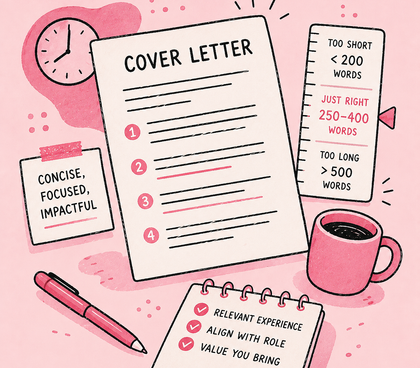
A cover letter should be one page or less, typically between 250 and 400 words.
That works out to three or four short paragraphs.
A well-structured cover letter has a measurable effect on your chances: research shows that including one makes you 1.9 times more likely to land an interview.
Recruiters spend very little time on initial screening, so a concise letter that reaches its point quickly will always land better than a longer one that buries your most compelling material.
Three to four paragraphs is the structure that works for most applications:
- An opening that names the role and gives a clear reason you want it.
- One or two paragraphs connecting your most relevant experience to what the employer needs.
- A short, confident closing with a natural call to action.
Staying within this range also signals something useful: that you can communicate clearly and choose what matters.
Those are qualities most employers are actively looking for.
What are the common word counts for effective cover letters?
Most effective cover letters land between 250 and 400 words, with 300 being a dependable target for the majority of applications.
Entry-level candidates often write closer to 200-250 words, while mid-level professionals tend to sit in the 300-400 range where there is room to bring in a concrete result.
Going above 500 words is where cover letters lose their impact, not because the extra content is necessarily weak, but because a reader's attention rarely reaches it.
Vague phrases like "I am a highly motivated team player" take up space without saying anything useful, so every sentence needs to justify its presence.

Is two pages appropriate for a cover letter?
For the vast majority of applications, no.
A two-page cover letter is rarely appropriate and, in most cases, works against you.
A letter that runs to a second page tends to signal a lack of editing judgment rather than impressive depth.
There are a small number of situations where a longer letter is genuinely warranted:
- Academic or research positions: Faculty applications, fellowship proposals, and research roles often require a more detailed account of your work, methodology, and scholarly interests. Two pages can be justified here.
- Senior executive roles: Candidates with decades of experience applying for director or C-suite positions may have a case for extending slightly beyond one page, provided every paragraph pulls its weight.
- Roles with specific instructions: If the job posting sets a word limit or asks you to answer particular questions, follow those instructions. They take precedence over general guidance.
Outside these situations, one page is the standard.
If you are struggling to fit everything in, that is usually a sign there is too much included rather than too little space.
How does the length of a cover letter vary between electronic and paper versions?
The format in which you send your cover letter should shape how long it is, because the same word count does not translate the same way across different submission types.
- Email body cover letters should be shorter, closer to 150-200 words. A letter in the body of an email competes with everything else in the reader's inbox, so keeping it tight gives your key points the best chance of being read. One direct paragraph on your fit, bookended by a brief opening and a clean closing line, is all you need.
- Attached cover letters give you slightly more room and are where the standard 250-400 word guidance applies. Whether the file is a PDF or a Word document, it will be opened deliberately, which means the reader is already engaged.
- Online application portals sometimes have character or word limits built in. Always check before you write, because working within a set limit from the start is far easier than compressing an over-length letter at the last minute.
What does not change across any of these formats is the need for clear structure and breathing room on the page.
The cover letter format, font choices, and spacing you use all contribute to a letter that feels considered and is easy to read.
How does experience level affect how long your cover letter should be?
Your experience level shapes how much you genuinely have to say, and that should guide how long your letter runs.
- Early-career candidates often pad a letter to seem more substantial, but a tight 200-250 word letter that speaks clearly to your enthusiasm and what you bring to the team will outperform a longer one full of filler every time. Hiring managers understand a recent graduate has a shorter track record; what they are looking for is evidence of thinking, not volume.
- Mid-career professionals typically have enough experience to fill 300-400 words without effort. The challenge is selection: choose the experience that speaks most directly to the role, develop it with a concrete detail or result, and move on. One well-chosen example leaves a clearer impression than a broader summary.
- Senior candidates face the greatest risk of writing too much. The discipline of staying close to one page, even with 20 years of experience behind you, demonstrates the clarity and prioritization that senior roles require. If your letter is running long, ask which paragraphs would survive if the reader only read two, then keep those.
What happens when your cover letter is too long or too short?
A cover letter that is too long dilutes its own impact, and when everything is included nothing stands out.
One that is too short risks coming across as low-effort or generic, giving the reader no reason to stay with your application.
Precision is the goal, not brevity for its own sake, and there is a real difference between a well-crafted 220-word letter built around a particular role and a thin one.
For most applications, the right length is whatever says what needs to be said without going further.
Key takeaways
- A cover letter should be one page or less, typically 250 to 400 words across three to four short paragraphs.
- 300 words is a reliable target for most applications, with entry-level candidates sitting closer to 200-250 and mid-level professionals in the 300-400 range.
- Two pages is rarely appropriate outside of academic, research, or senior executive roles.
- Email cover letters should be shorter than attached ones, closer to 150-200 words, as they compete for attention in a busy inbox.
- The format you use (email body, attachment, or online portal) should directly influence your word count.
- Your experience level is one of the strongest guides to length: write as much as you genuinely have to say, and no more.
- Too long dilutes your impact; too short signals low effort. Precision, not brevity, is the goal.

FAQs
Length is one of the most searched cover letter questions.
Here are the answers that come up most often.
What is the ideal length of a cover letter?
The ideal cover letter length is one page or less, typically 250 to 400 words, structured across three to four short paragraphs.
This gives you enough room to introduce yourself, connect your experience to the role, and close with confidence, without losing the reader's attention.
Is a 500-word cover letter too long?
For most applications, yes.
A letter of this length sits at the outer limit of what hiring managers tend to read in full, and anything beyond 400 words risks losing their attention before you reach your most relevant points.
Review each paragraph and ask whether it adds something concrete.
If it does not, cut it.
Does cover letter length matter for email applications?
Yes, and email cover letters should be shorter than attached ones.
When your letter appears in the body of an email, aim for 150 to 200 words, make your fit clear in one direct paragraph, and close cleanly.
Your resume carries the detail; the email just needs to earn the click to open it.


