


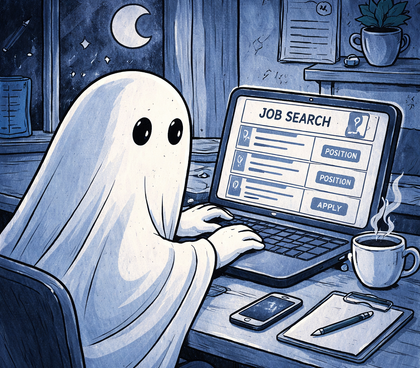
If you’ve applied to jobs and never heard back, you’re not alone.
Some listings stay open even when companies aren’t actively hiring, which can make the job search feel confusing and time-consuming.
What are ghost jobs?
Ghost jobs are job postings for roles that companies are not actively trying to fill, even though they appear open.
These listings, sometimes called phantom jobs, may represent positions that are already filled, paused, or only used to collect applications for future hiring needs.
They are usually posted by legitimate employers, not scammers.
Common types of ghost jobs
Ghost jobs are not all the same.
In practice, they usually fall into a few patterns:
- Evergreen roles: Listings that stay open long-term so companies can build a pipeline of candidates.
- Outdated postings: Jobs that have already been filled but were never removed from job boards.
- Market testing roles: Positions posted to understand candidate availability, skills, or salary expectations.
- Internal or pre-filled roles: Jobs posted publicly even though an internal candidate is already being considered.
Ghost jobs vs job scams
It is important to distinguish ghost jobs from job scams.
Ghost jobs are typically posted by real companies advertising real types of roles, but without active hiring intent.
Job scams, on the other hand, are designed to deceive applicants and may involve fake companies, requests for personal information, or payment.
Why do companies post ghost jobs?
Companies post ghost jobs for a mix of practical and strategic reasons, even when they do not plan to hire immediately.
In most cases, the goal is to prepare for future hiring, gather market data, or maintain the appearance of growth rather than fill an active role.
Common reasons companies post ghost jobs
| Reason | What it looks like in practice |
|---|---|
| Building a talent pipeline | Companies collect resumes so they have candidates ready when a role opens later |
| Preparing for future hiring | Roles are posted ahead of budget approval or business growth |
| Testing the job market | Employers assess skills, availability, and salary expectations without committing to hire |
| Keeping listings active after hiring | Job postings stay live even after someone has been hired |
| Evaluating internal candidates | A role is posted publicly even though an internal hire is likely |
| Signaling company growth | Listings create the impression that the company is expanding or hiring actively |
Some companies also keep roles open to attract strong candidates who might be worth hiring, even if there is no immediate need.
In other cases, postings remain live simply due to slow updates across job boards.
Why are there so many ghost jobs right now?
There are more ghost jobs right now because hiring has become slower and less predictable, while companies still want to stay visible and prepared for future roles.
Many employers are posting jobs without immediate intent to hire due to budget uncertainty, internal approvals, and a desire to build candidate pipelines in advance.
Several broader shifts in the job market have made ghost jobs more common:
- Slower hiring processes: Companies take longer to approve roles, so listings may go live before hiring is confirmed.
- Economic uncertainty: Employers stay cautious about headcount but continue collecting candidates in case conditions improve.
- Always-on recruiting strategies: Some companies keep roles open continuously to avoid starting from scratch when a need arises.
- Increased use of job boards and automation: Listings can stay active or reappear across platforms even after roles are paused or filled.
- Higher competition for jobs: More applicants are applying broadly, which makes it harder to tell which roles are genuinely active.
For job seekers, this creates a disconnect between what looks like a strong job market and what actually results in interviews or offers.
It is one reason many people feel like they are applying to dozens of roles without seeing progress.
How do ghost jobs affect the job market and job seekers?
Ghost jobs can make the job market look more active than it really is, which leads to confusion, wasted effort, and slower progress for job seekers.
They also affect how companies are perceived, since repeated non-responses or unclear hiring signals can reduce trust in job postings and employer credibility.
Impact on job seekers
- Wasted time and effort: Candidates may spend hours tailoring resumes and writing applications for roles that are not actively hiring. This time could be better spent focusing on verified opportunities or preparing for interviews.
- Application fatigue: Repeated lack of response can make the job search feel discouraging, even when effort is high. Over time, this can reduce motivation and lead to lower-quality applications.
- Difficulty prioritizing applications: It becomes harder to tell which roles are worth focusing on, leading to less efficient job search strategies. Job seekers may apply broadly instead of targeting roles where they have a stronger chance.
- Reduced trust in job listings: Job seekers may become more skeptical of postings, especially if roles stay open for long periods. This can make it harder to engage confidently with new opportunities.
Impact on the job market
- Inflated job availability data: Open roles may not reflect real hiring demand, making the market seem stronger than it is. This can create unrealistic expectations about how quickly candidates should find work.
- Slower hiring signals: It becomes harder to understand which companies are actively hiring versus preparing for future needs. As a result, job seekers may struggle to identify where to focus their efforts.
- Reputation risk for employers: Companies that frequently post inactive roles may struggle to attract strong candidates over time. This can weaken their employer brand and reduce the quality of future applicants.
In practice, ghost jobs often push job seekers to rely less on mass applications and more on targeted applications, networking, and direct outreach to employers.
How can you spot ghost jobs?
You can spot ghost jobs by looking for patterns that suggest a role is not actively being filled, such as outdated postings, vague descriptions, or repeated listings.
While no single sign guarantees a job is a ghost posting, combining several signals can help you decide whether it is worth applying.
Common signs of a ghost job
Here are the most common indications that a job posting is "phantom":
| Sign of ghost job | What it usually means | What you should do |
|---|---|---|
| The job has been posted for a long time (30+ days) | The company may have already filled the role or paused hiring | Prioritize newer listings where hiring is more likely active |
| The same role is repeatedly reposted | The company may be building a candidate pipeline rather than hiring immediately | Check if the role appears consistently over time before applying |
| The description is vague or generic | The posting may be used to collect resumes for multiple future roles | Look for clear responsibilities, team details, and hiring context |
| The job is not listed on the company website | It may be outdated or pulled from another source | Always verify the role on the company’s official careers page |
| There is no clear hiring timeline | The company may not have approval or urgency to fill the role | Ask about timelines if you speak to a recruiter |
| You receive little or no response after applying | The role may not be actively monitored or prioritized | Follow up once, then focus your energy elsewhere |
Practical tip for avoiding ghost jobs
Before spending time tailoring your resume, take a moment to check when the job was posted, whether it appears on the company’s site, and how specific the description is.
This quick check can help you focus on roles that are more likely to lead to interviews.
Are ghost jobs illegal?
Ghost jobs are generally not illegal, but they can raise ethical concerns and, in some cases, legal risks if they mislead candidates.
Most ghost job postings come from legitimate companies and fall into a gray area where the role exists in theory but is not actively being filled.
In the United States, there is no specific law that bans posting a job without immediate hiring intent.
However, if a company uses misleading listings to collect personal data, discriminate against candidates, or falsely advertise opportunities, it could violate employment or advertising laws.
It is also important to distinguish ghost jobs from scams.
While ghost jobs may waste time or create confusion, scams are designed to exploit applicants and may involve fake companies, requests for money, or misuse of personal information.
For job seekers, the key takeaway is that ghost jobs are usually a hiring practice issue rather than a legal violation, but they still require careful evaluation before applying.
What percentage of job postings are ghost jobs?
Estimates vary, but research from Forbes suggests that up to 30 percent of job postings do not result in a hire, meaning a significant portion may function as ghost jobs.
This does not mean every one of these listings is intentionally misleading, but it highlights how common non-active roles can be.
For job seekers, it reinforces the need to focus on recent, well-defined postings that show clear hiring intent.
What are the common signs of fake recruitment agencies?
Fake recruitment agencies often show clear warning signs, such as asking for upfront fees, using generic communication, or avoiding verifiable company details.
Unlike ghost jobs, these are designed to deceive applicants and may involve misuse of personal information.
Be cautious if a recruiter contacts you without a clear job description, uses a free email address, or pressures you to act quickly.
You should also verify the agency’s website, reviews, and business registration before engaging further.
If something feels unclear or rushed, it is best to step back and avoid sharing sensitive information.
Key takeaways
- Ghost jobs are listings that companies are not actively trying to fill, even though they appear open.
- They are usually posted by real employers, not scammers, but can still waste time and effort.
- Common signs include long posting dates, repeated listings, and vague job descriptions.
- Not all unfilled roles are intentional, but many reflect slower hiring or pipeline building.
- Focus on recent, specific postings and verify roles before spending time applying.

FAQs
Quick answers to common questions about ghost jobs and how they affect your job search.
Why are there so many ghost jobs right now?
There are more ghost jobs because hiring has become slower and more uncertain, while companies still want to stay visible and prepared for future roles.
Many employers post listings before roles are fully approved or keep them open to build candidate pipelines.
Increased use of job boards and automation also means outdated listings stay active longer.
How common are ghost jobs?
Ghost jobs are fairly common, with some estimates suggesting that almost a third of job postings do not lead to a hire.
Not all of these are intentional, but many reflect roles that are paused, already filled, or not actively hiring.
This means job seekers need to be more selective when deciding where to apply.
What are the red flags of ghost jobs?
Yes, there are several common red flags, including listings that stay open for a long time, repeated reposting of the same role, and vague job descriptions.
Jobs that are not listed on the company’s website or lack a clear hiring timeline can also be warning signs.
Looking for these patterns can help you avoid wasting time on inactive roles.
Is applying to ghost jobs a threat to my personal data?
No, most ghost jobs are posted by legitimate companies and do not pose a direct risk to your personal data.
However, you should still be cautious and make sure the job and company are real before applying.
If a listing asks for sensitive information or payment, it is more likely to be a scam than a ghost job.


