



To get a promotion, prove you already operate at the level above your current role, then make that case directly to the person who decides.
Document your results, learn how your company chooses who advances, pick your moment, and raise it in a dedicated conversation with your manager.
Promotions rarely arrive by waiting quietly.
How do you get a promotion?
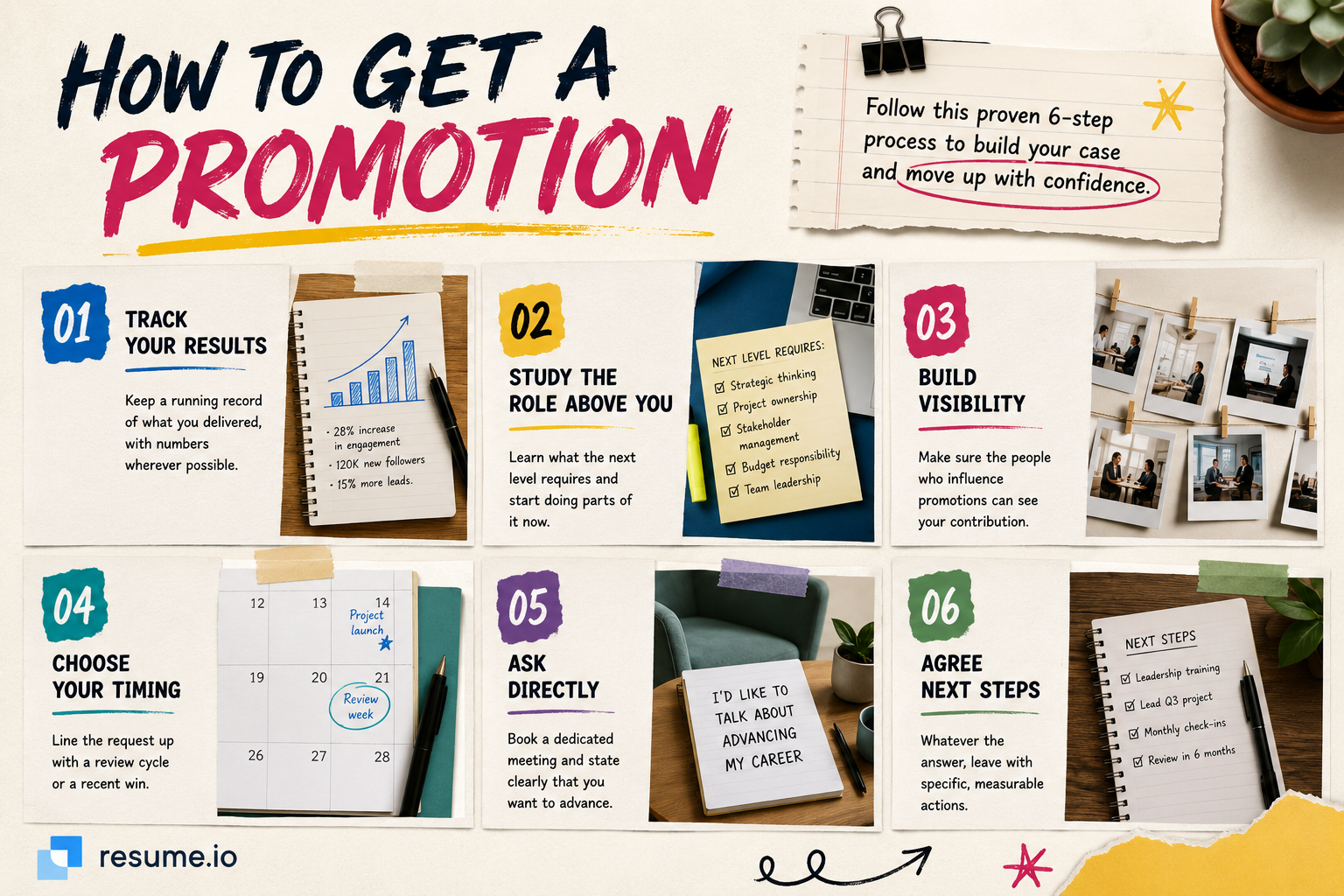
You get a promotion by building a documented case for your value, showing you can handle the role above your own, and raising the conversation with your manager at the right moment.
The process is deliberate rather than passive, and it usually unfolds over several months rather than in a single meeting.
Here is the sequence most successful promotions follow:
- Track your results: Keep a running record of what you delivered, with numbers wherever possible.
- Study the role above you: Learn what the next level requires and start doing parts of it now.
- Build visibility: Make sure the people who influence promotions can see your contribution.
- Choose your timing: Line the request up with a review cycle or a recent win.
- Ask directly: Book a dedicated meeting and state clearly that you want to advance.
- Agree next steps: Whatever the answer, leave with specific, measurable actions.
Consider an analyst who spends two quarters quietly taking on a team lead's planning work before ever mentioning advancement.
By the time the conversation happens, the promotion simply names what she already does.
Each step builds on the one before it, which is why a promotion is easier to earn than to demand, and the strongest candidates treat advancement as one part of how they grow their career.
What makes an employee promotable?
An employee becomes promotable by delivering consistently in their current role while showing they can already carry the responsibilities of the next one.
Managers look for reliability, sound judgment, and a habit of solving problems rather than only raising them.
Promotability shows in behavior over time, rather than in a single review.
The traits that mark someone as ready to move up stay fairly consistent across roles and industries:
- Ownership: You follow problems through to a solution instead of escalating them
- Judgment: Your decisions hold up, so leaders trust you with more
- Impact: Your work connects to results the business actually cares about
- Influence: You bring colleagues with you instead of working in isolation
The most common mistake is confusing effort with readiness.
Long hours or being well liked is not the same as operating at the next level, and managers rarely promote on goodwill alone.
Focus instead on demonstrating the leadership skills and skills the higher role demands, so the step up looks like a formality that confirms what you already do.
How do companies decide who to promote?
Companies decide who to promote based on business need, available budget, and clear evidence that a candidate already performs at the higher level.
A manager normally has to argue your case to their own leadership and to human resources, so it has to be simple enough to repeat without you in the room.
In practice, the factors that carry the most weight are:
- Performance: A track record of results at your current level
- Sponsorship: A senior colleague willing to advocate for you
- Headcount: An open role or the budget to promote into it
Sponsorship often matters as much as output, because the person who argues for you in a meeting you do not attend can decide the result.
It also helps to be honest about the parts of the process that are not purely meritocratic.
45% of US workers say they have missed a job or promotion because of a colleague with family connections (Resume.io Nepotism at Work study, 2025).
Knowing that visibility and relationships shape outcomes changes how you prepare, so you make your results impossible to overlook and make sure the right people know your name before a decision is on the table.
How do you ask your boss for a promotion?
You ask your boss for a promotion by requesting a dedicated meeting, presenting a clear record of your impact, and stating plainly that you are ready for the next role.
Frame the request around the value you bring and how the move helps the team, rather than personal need or length of service.
Confidence and evidence carry the conversation.
Preparation is what separates a strong ask from an awkward one.
Before the meeting, gather your accomplishments with figures attached, name the title you want, and tie your case to goals your manager already answers for.
A promotion usually comes with a raise, so decide in advance whether you are discussing both together or in sequence.
A simple script keeps the conversation on track:
"Thank you for making the time. Over the past year I have led [project or responsibility] and delivered [specific result]. I have taken on work at the [target role] level, and I would like to formally discuss moving into that role. I have put together a short summary of my impact and how I plan to contribute in the new capacity."
Keep the tone collaborative and forward-looking.
If your company expects something formal, you can put the same case into a promotion request letter so there is a record your manager can share upward.
How long should you wait before asking for a promotion?
You should wait until you have a clear track record at your current level and a recent win to point to, which for most people falls between six and eighteen months in a role.
The right moment depends less on the calendar than on evidence, so once you consistently perform above your current job, you are ready to raise it.
Beyond your own readiness, the surrounding conditions matter.
Some moments make a manager far more receptive than others:
| Strong times to ask | Times to hold off |
|---|---|
| During or just before a performance review | During a hiring freeze or layoffs |
| Right after a visible win or completed project | When your team just missed a major target |
| When the team is growing or restructuring | When your manager is overloaded or in crisis |
People who time this well plant the seed early rather than spring the request as a surprise.
Raising your career growth goals in regular one-to-ones months ahead means the formal conversation confirms something your manager already expects, which makes a yes far more likely.
How often should you get promoted?
Expect to be promoted every one to three years early in your career, slowing to every two to five years at mid and senior levels where roles are broader and rungs are fewer.
These are rough guides rather than rules, and the pace shifts with industry, company size, and ambition.
Typical cadence looks roughly like this:
- Early career: A step up every one to two years as you build core skills
- Mid career: Every two to three years as your scope widens
- Senior level: Every three to five years, with fewer rungs and bigger jumps
Context helps set realistic expectations. Median employee tenure in the United States was 3.9 years in January 2024, the lowest level since 2002 (US Bureau of Labor Statistics, Employee Tenure, 2024).
People change employers more often than they once did, and moving rarely means starting over, since 35% of people who changed jobs in the past two years stayed in the same industry (Resume.io Resume Statistics, 2025).
If three to five years pass with strong performance and no promotion in sight, treat it as a signal to have a direct conversation about your path.
What should you do after the promotion conversation?
What you do after the promotion conversation depends on the outcome, and each likely answer has a clear next move.
A yes calls for confirming the details and recording the win.
A "not yet" or a firm no calls for a plan, and sometimes a decision about whether to stay.
Match your response to the answer you get:
- Yes: Confirm the details in writing, then update your resume to show the promotion and add the promotion on LinkedIn so your record reflects the new title.
- Not yet: Ask what you must demonstrate, agree measurable milestones, and set a follow-up date.
- No path: Treat a repeated no with no roadmap as information about the company, not about you.
Lack of advancement is one of the strongest reasons people leave, with 63% of workers who quit a job in 2021 citing a lack of opportunities for advancement as a reason (Pew Research Center, 2022).
A "not yet" that comes with specific gaps and a timeline is worth working toward.
When the answer is a repeated no with no path attached, give your current employer a fair chance to respond, then decide clearly whether staying or moving on serves your goals better.
Key takeaways
- A promotion is earned by performing at the next level first and then making a documented case for it, not by waiting to be noticed.
- Managers promote people whose value is easy to advocate for, so keep a running record of results with numbers attached.
- Timing works best during a review cycle or right after a visible win, and worst during freezes, layoffs, or team setbacks.
- Ask in a dedicated meeting with a clear script, name the role you want, and connect it to goals your manager already owns.
- Treat a "not yet" as a roadmap and a repeated no with no path as a signal that advancing may mean changing employers.
Frequently asked questions
Here are quick answers to the questions people ask most about getting promoted.
What is a promotion at work?
A promotion at work is a move into a more senior role with greater responsibility, usually with a higher salary and a new title.
It is a formal recognition that you are operating above your current level.
Promotions can be a step into management or a step up in scope within the same track.
Can you get promoted without asking?
Yes, it is possible, but it is less reliable than asking.
Some managers proactively advance strong performers, yet many are busy and will not act unless you make your interest and readiness clear.
Stating your goals directly gives your manager a reason to advocate for you.
How do you get promoted to manager?
You get promoted to manager by demonstrating leadership before you hold the title, such as mentoring colleagues, owning projects, and improving how the team works.
Make your interest in managing known, and ask what specific gaps you need to close.
Companies promote the people who already influence and support others, not only the strongest individual performers.


