


Social media jobs are paid roles that plan, create, publish, and analyze content for brands across platforms like TikTok, Instagram, and LinkedIn.
The field spans creative, strategic, and data-focused work, and most roles reward a strong portfolio and platform fluency more than any single degree, which makes it one of the more open fields to enter.
What jobs can I get in social media?
You can get social media jobs across five broad areas: content creation, community management, strategy and management, paid social advertising, and influencer marketing.
Each role sits somewhere between creative production and data analysis, so you can lean into strengths you already have rather than starting from zero.
| Role | What they do | Key tools |
|---|---|---|
| Social media manager | Set strategy, own the content calendar, track performance, and manage ad budgets | Analytics dashboards, Hootsuite, Sprout Social |
| Content creator | Script, film, and edit short-form video, shoot photos, and write captions | CapCut, Premiere Pro, Canva, Photoshop |
| Community manager | Reply to comments and messages, monitor sentiment, and grow a loyal audience | Native inboxes, social listening tools |
| Influencer marketing specialist | Find creators, negotiate partnerships, and track campaign return | Creator databases, reporting tools |
| Paid social specialist | Build and optimize ad campaigns, run A/B tests, and analyze conversions | Meta Ads Manager, TikTok Ads Manager |
| Social media coordinator | Schedule posts, support the team, and pull basic reports | Scheduling platforms, Canva |
The right entry point depends on how you like to work: content creation suits people who enjoy being on camera, while paid social and analytics reward those who prefer numbers.
Many social media manager jobs at smaller companies expect one person to cover several of these areas, which is often the fastest way to learn the whole field.
What are the essential skills for jobs in social media?
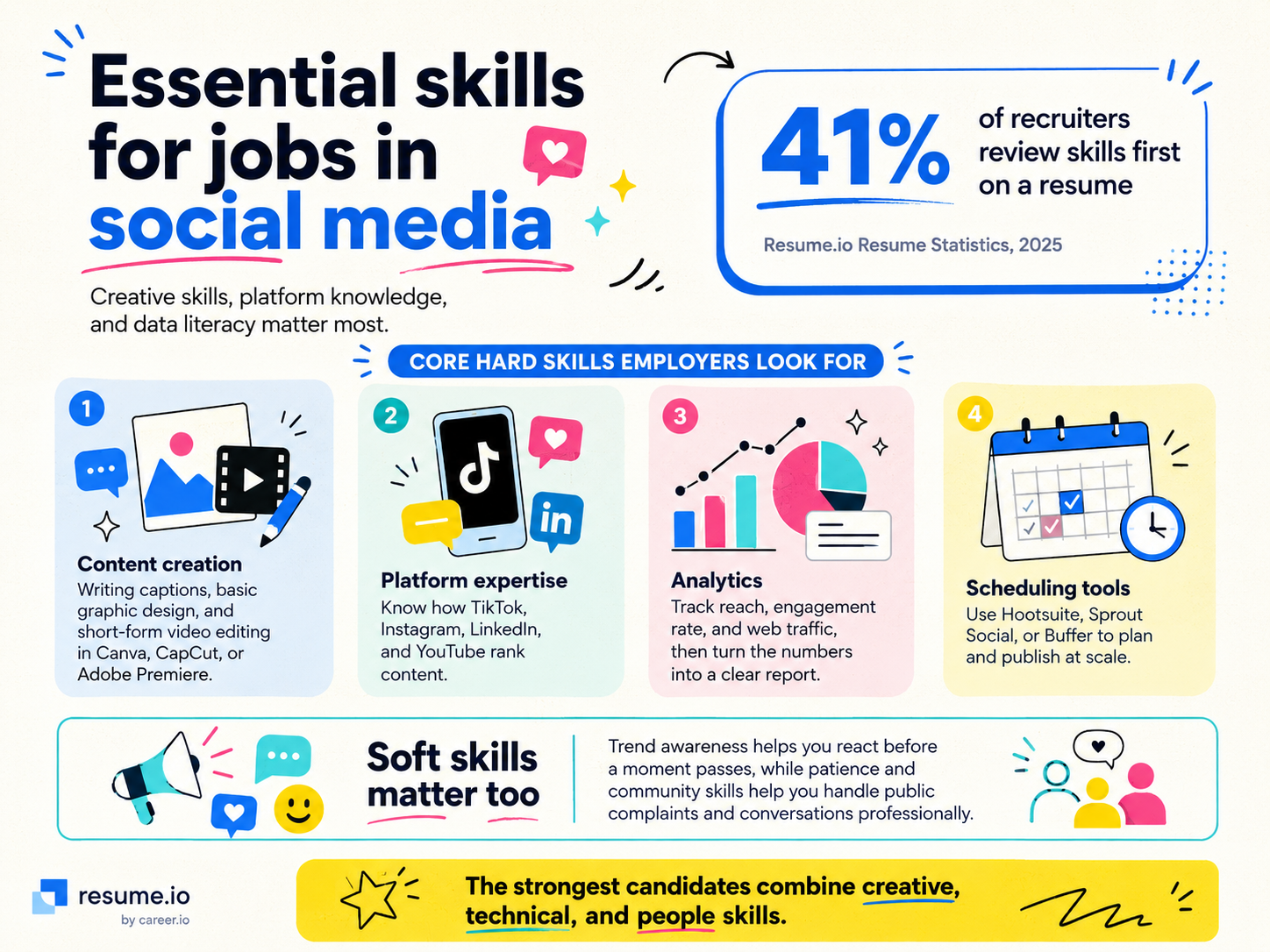
Social media jobs ask for a blend of creative skills, platform knowledge, and data literacy.
Employers want people who can produce content, understand how each platform's algorithm behaves, and prove results with numbers, a mix that matters more than a polished CV alone.
That emphasis is measurable, as 41% of recruiters review skills first on a resume (Resume.io Resume Statistics, 2025).
The core hard skills employers look for:
- Content creation: Writing captions, basic graphic design, and short-form video editing in Canva, CapCut, or Adobe Premiere.
- Platform expertise: A working knowledge of how TikTok, Instagram, LinkedIn, and YouTube rank content.
- Analytics: Tracking reach, engagement rate, and web traffic, then turning those numbers into a clear report.
- Scheduling tools: Comfort with Hootsuite, Sprout Social, or Buffer to plan and publish at scale.
The soft skills carry equal weight, from trend awareness that lets you react before a moment passes to the patience community work demands when handling public complaints.
Broader marketing skills and the technical skills behind analytics tools round out a candidate who is difficult to overlook.
What qualifications do I need for a social media job?
You do not strictly need a degree for a social media job, though a bachelor's degree in marketing, communications, or public relations is often preferred and can raise your starting salary.
What matters far more is proof that you can grow an audience and move real numbers.
Among job seekers, 72% of candidates believe skills matter more than education (Resume.io Resume Statistics, 2025), and social media hiring reflects that shift more than most fields.
The proof that tends to win interviews includes:
- A personal or client account showing follower growth over time.
- A documented campaign with before and after engagement figures.
- Fluency in the current content and skills employers name in their listings.
Entry-level roles typically expect one to three years of digital marketing experience and manager roles look for three to five, but both weigh demonstrated results heavily.
A common mistake is waiting until you feel fully qualified before applying, when a candidate with a live account and a few measurable wins often lands the interview over a more credentialed applicant who cannot show their work.
How much do social media jobs pay?
Social media jobs pay across a wide range, shaped by seniority, city, and whether the role is in-house, agency, or freelance.
Coordinator and specialist roles cluster between $45,000 and $55,000, managers and strategists earn more, and freelance rates commonly run from $20 to $75 or more per hour depending on niche and experience.
| Role | National average salary (Indeed, 2025) |
|---|---|
| Social media coordinator | $45,353 |
| Social media specialist | $53,255 |
| Community manager | $55,008 |
| Social media manager | $55,933 |
| Content manager | $63,669 |
| Social media strategist | $63,875 |
The ceiling sits well above those figures once you move into management.
Marketing managers, the level many social media careers eventually feed into, earned a median wage of $161,030 (U.S. Bureau of Labor Statistics, 2024).
That gap is why building toward strategy and management is one of the clearest routes to the highest-paying jobs in the discipline.
How can I start a career in social media?
You can start a career in social media by building proof of skill before you apply, then targeting the roles that match your strengths.
The field values evidence over credentials, so the fastest path pairs hands-on practice with a focused search.
Work through these steps in order:
- Research the roles: Map the five role types to decide whether you lean creative, strategic, or analytical.
- Pick a platform focus: Go deep on one or two platforms rather than spreading yourself thin.
- Learn the core tools: Build fluency in Canva, CapCut, and one scheduling tool such as Buffer or Hootsuite.
- Build a portfolio: Grow your own account or run a mock campaign for a brand you admire.
- Network on the platforms: Use LinkedIn to connect with practitioners and join the conversation.
- Apply and tailor: Adjust your resume for each listing and lead with measurable outcomes.
Progression from there follows a clear ladder, from coordinator to specialist to manager and eventually to lead or director.
Treating each early role as a place to gather portfolio-ready results is what shortens the climb and keeps your career moving.
Can you get an entry-level social media job with no experience?
Yes, you can get an entry-level social media job with no professional experience, because this field lets you manufacture proof on your own.
Hiring managers care whether you can grow and engage an audience, and you can demonstrate that without ever having held the title.
The route is to build evidence rather than wait for permission.
Three moves turn a thin history into credible experience:
- Create a mock campaign for a brand you love, with a redesigned feed and sample captions packaged as a case study.
- Volunteer to run social accounts for a local business, club, or nonprofit to generate real numbers.
- Add that freelance work and any projects to your application as genuine experience.
When you write your application, quantify everything you can, because a line such as "grew a club's Instagram from 200 to 1,400 followers in three months" carries more weight than a list of duties.
Learning to quantify results is the single biggest lever for a first-timer, and framing projects this way is the core of any strong resume with no experience.
What are the best platforms to find remote social media jobs?
The best platforms to find remote social media jobs fall into three groups: large professional networks, curated remote-first boards, and freelance marketplaces.
Each suits a different stage and working style, so where you look should match whether you want a salaried role or contract work.
| Platform | Best for |
|---|---|
| Corporate and salaried roles; filter by remote and set keyword alerts | |
| Indeed | High-volume entry to mid-level listings across the web |
| Remotive | Curated, remote-first companies with a marketing section |
| Wellfound | Startup and funded early-stage growth roles |
| FlexJobs | Hand-screened, scam-free remote and flexible listings |
| Upwork | Building a freelance roster and ongoing retainer clients |
| Fiverr | Packaging a specific skill, such as TikTok content, into a set service |
A practical safeguard applies everywhere: never pay for equipment or training as a condition of a remote role, since that is a reliable scam signal.
Deciding early whether you want a salaried position or freelance contracts saves time, because the platforms that serve each are largely different.
Industry trends shaping social media careers
Three shifts are reshaping social media careers right now, and understanding them makes you a stronger candidate.
Employers increasingly hire for the ability to work with change rather than for a fixed skill set, so signaling awareness of where the field is heading matters in interviews.
- The rise of AI: Companies want people who use AI to speed up copywriting and video editing without losing a human voice.
- Social search and SEO: Younger audiences increasingly search on TikTok and Instagram, so optimizing captions and video keywords is now a core skill.
- Social commerce: Shoppable feeds are growing fast, and roles that convert viewers into buyers are in high demand.
The outlook supports the move into this field.
Employment of advertising, promotions, and marketing managers is projected to grow 6% from 2024 to 2034, faster than the average for all occupations, with about 36,400 openings each year on average (U.S. Bureau of Labor Statistics, 2024).
Candidates who pair current tool fluency with these trends put themselves in the strongest position as the field expands.
Key takeaways
- Social media jobs cover five main areas: content creation, community management, strategy and management, paid social, and influencer marketing.
- A portfolio that shows audience growth and measurable results carries more weight in hiring than a degree does.
- Pay ranges from around $45,000 for coordinators to six figures for marketing leadership, with freelance rates of $20 to $75 or more per hour.
- You can enter with no experience by building a mock campaign, volunteering to run real accounts, and quantifying every result on your application.
- Remote roles are widely available on LinkedIn, Indeed, curated boards like Remotive and FlexJobs, and freelance marketplaces such as Upwork and Fiverr.

Frequently asked questions
Here are quick answers to the questions people most often ask about working in social media.
Are remote social media jobs well paid compared to in-office roles?
Yes, in most cases remote social media jobs pay on par with in-office roles, since pay is set by seniority, skill, and results rather than location.
Some fully remote positions at larger companies match or exceed local salaries, though very small businesses and short contracts can pay less.
Comparing the full package, including benefits, matters more than the remote label alone.
Which social media job pays the most?
Roles that combine strategy, budget ownership, and leadership pay the most, such as social media director and marketing manager positions that oversee wider teams.
Paid social specialists who manage large ad budgets also command higher salaries because their work ties directly to revenue.
Production-only roles tend to sit at the lower end of the range.
Do you need to be active on social media to get hired?
Yes, an active personal presence helps you get hired, because it shows employers you understand how content, engagement, and current trends actually work.
You do not need a huge following, but a well-run account or a documented project demonstrates the exact skills the job requires.