FAA-certified Commercial Pilot and Aviation Professional with 8+ years of experience in commercial airline operations and flight instruction. Expertise in flight operations, crew resource management, and aviation safety protocols. Demonstrated leadership skills with excellent communication abilities and a commitment to maintaining the highest standards of safety and professionalism. Seeking to leverage extensive aviation background to contribute to operational excellence within a leading airline or aviation organization.
06/2019 - present, First officer, Delta Air Lines, Atlanta
Operate Boeing 737 aircraft as second-in-command on domestic and international routes
Conduct comprehensive pre-flight inspections and performance calculations to ensure operational safety
Collaborate with Captain and cabin crew to maintain highest standards of safety and customer service
Monitor aircraft systems, weather conditions, and flight parameters during all phases of flight
Participate in CRM (Crew Resource Management) to optimize teamwork and decision-making in the cockpit
03/2017 - 05/2019, Flight Instructor, ATP Flight School , Jacksonville
Provided comprehensive flight training to students pursuing Private, Commercial, and Instrument ratings
Conducted ground school instruction on aviation theory, regulations, and aircraft systems
Evaluated student progress and provided detailed feedback to improve performance
Created customized training plans to address individual learning styles and challenges
08/2015 - 02/2017, Regional first officer, SkyWest Airlines, Chicago
Operated Embraer E175 aircraft on regional routes as part of the United Express network
Assisted Captain with flight planning, weight and balance calculations, and pre-flight procedures
Monitored aircraft systems and fuel consumption during flight
Maintained situational awareness and provided inputs for decision-making
- 01/2015, Bachelor of Science in Aeronautical Science, Embry-Riddle Aeronautical University , Daytona Beach
- Communication
- Adaptability
- Problem Solving
- Leadership
- Ability to Work Under Pressure
- present, FAA Commercial Pilot License,
- present, FAA Certified Flight Instructor,
- present, First Class Medical Certificate,
A well-crafted, targeted CV can significantly improve your chances of securing an interview and advancing your career. However, a vague or outdated CV may hold you back. To really take off, your aviation CV must present a clear and compelling summary of your skills, experience, and certifications—demonstrating your capabilities both in the air and on the ground.
Think of your aviation CV as the flight plan for your career—it needs to be precise, well-structured, and tailored to get you to your desired destination.
Guide for an aviation CV example
Build a CV that soars with resume.io. We have writing guides and CV examples for over 200 professions. With our easy-to-use CV builder, you can craft a professional aviation CV template in no time.
This step-by-step writing guide and corresponding aviation CV example will cover the following:
- How to write an aviation CV
- Choosing the best CV format for aviation professionals
- Listing your contact information
- How to write an impressive summary
- Adding your aviation experience
- Including your relevant skills and education
- Selecting the right CV design and layout
- A job outlook for the aviation market and what salary you can earn
How to write an aviation CV
Before you start writing your CV, you should know what information to include.
From aerospace engineers to airline pilots, every aviation CV template should have these sections:
- The CV header
- The CV summary (a.k.a. profile or personal statement)
- The employment history section
- The CV skills section
- The education section
Your CV is a marketing tool that you can use to sell your skills, experience, and achievements to prospective employers. Similar to a pre-flight checklist, it needs to be clear and tailored to the mission of landing a job.
Follow these tips to write an impressive aviation CV:
- Tailor your CV to the role. Review the job description and align your CV with the employer’s needs. Whether they’re recruiting pilots for route expansion or engineers for maintenance, show how your skills and experience directly support their goals.
- Focus on your results. Avoid listing routine duties. Instead, highlight your achievements—such as improved turnaround times, successful audits, or enhanced safety practices—to show the impact you’ve made in previous roles.
- Keep the design simple. Using flashy or over-the-top design elements could actually work against you. If your aviation CV is hard to read, the hiring manager may not bother.
- Include relevant keywords. Use industry-specific terms from the job posting to help your CV pass applicant tracking systems (ATS), such as “flight operations” or “aviation safety management.”
Make your CV ATS-friendly
Many employers rely on applicant tracking systems (ATS) to scan CVs for specific job-related keywords. By incorporating these key terms—such as skills, qualifications, and tools mentioned on the job description—you significantly improve the chances that your CV gets flagged as a match and moved forward to hiring managers.
For example, an aviation job advert may mention the following keywords:
- “Airport ramp agent”
- “Baggage and cargo handling”
- “Customer service”
- “Team-focused mindset”
Here’s how you could incorporate those keywords into your professional summary:
“Reliable airport ramp agent with 2+ years of experience managing busy ground operations. Skilled in aircraft turnaround, baggage and cargo handling, and operating ground support equipment. Recognised for team-focused mindset and delivering excellent customer service to support punctual departures.”
Choosing the right CV format for aviation
Your aviation CV should be clear, well-structured, and reflect the precision and professionalism expected in the industry.
For most aviation roles, a reverse chronological order is the preferred format. This layout presents your most recent position first, allowing recruiters to quickly assess your latest and most relevant experience. It’s also widely accepted by applicant tracking systems (ATS), making it an efficient choice for those with a steady employment history.
However, if you’re entering the aviation sector for the first time, returning after a career break, or making a career change, a different format may be more effective. A skills-based CV places emphasis on transferable skills rather than job history, which can be beneficial when moving into aviation from another industry.
Alternatively, a combination (or hybrid) CV integrates both your skills and employment history equally. This can be particularly useful for recent graduates or candidates with gaps in their work history. Read more about the various CV formats in our complete guide.
Whichever format you choose, ensure that it accurately conveys your professional prowess. Check out the many CV templates in our CV builder and choose one that suits you. We also have a wide range of CV examples using various formats to help guide you.
When it comes to the design of your aviation CV template, go for a classic look. Choosing either a simple or professional layout is generally the best way to go.
Include your contact information
To secure an interview, recruiters and hiring managers need to be able to easily get in touch with you. The CV header, located at the top of your aviation CV template, should clearly present all of your contact details.
Here's what you’ll need to include:
- Full name and title. Use your full name, along with the title of the role you’re targeting, such as “Cabin Crew Member” or “Aircraft Maintenance Engineer.”
- Location. Include your general location (e.g., Manchester, UK). If you’re open to relocation, it’s also helpful to mention that here.
- Professional email address. Provide a professional email address, ideally in the format of firstname.lastname@email.com.
- Phone number. List the best number to reach you on. Make sure that your voicemail has a clear, professional greeting in case you miss a call.
- LinkedIn. Most recruiters will check out your LinkedIn profile. Add a link here to make this easier to find and ensure that it’s all up to date.
You should not include your:
- Date of birth. Don’t provide your birthdate or age on your CV, since this can lead to potential age discrimination.
- Personal details. You don’t need to include personal details, like your nationality, marital status, or NI number.
- Photo or headshot. A photo takes up valuable space and isn’t relevant to your qualifications, so don’t include one on your CV.
Louise Parker
Cabin Crew
Birmingham, UK
louise.parker@email.com
07974 390 567
Louise Parker
Rockstar Crew Member
56 Rosebud Drive, Birmingham, B12 FJH
adventure.seeker2000@email.com
07974390567
YouTube
Make use of a CV summary
Just as you aim to make a strong first impression when meeting passengers for the first time, your CV summary (or personal profile) serves as your professional introduction to potential employers. It’s your opportunity to showcase your key strengths, standout achievements, and the value you bring to an aviation role—all in a few concise lines.
Write two to four sentences introducing yourself to hiring managers. Use strong action verbs to clearly demonstrate your skills and impact. These verbs work effectively in either the simple past or present tense and help bring your experience to life. In the context of aviation, examples might include “operated,” “streamlined,” “supervised,” or “enhanced.”
Avoid simply repeating information already listed elsewhere in your CV—this adds little value. Instead, use this space to build on your experience by showing tangible results and the contribution you've made in previous roles. For example, you could say: "Experienced cabin crew member skilled in delivering exceptional passenger service and improving customer satisfaction scores by 20% year-on-year."
Looking for inspiration for your aviation CV summary? Take a look at these related CV templates: pilot CV example, cabin crew CV example, or engineering CV example
You can also find adaptable summaries from aviation CV examples below:
Aspiring cabin crew with a passion for travel and customer care. Strong communicator with hospitality experience and a calm, reassuring manner under pressure. Keen to begin cabin crew training and build a career focused on passenger safety, comfort, and excellent service.
Proactive and safety-focused aviation professional with 5+ years of experience in ramp services, including baggage handling, aircraft loading, and airside coordination. Organised shifts and supported teams to meet tight schedules, reducing turnaround delays by 25% in six months. Known for bringing energy, reliability, and strong leadership to ground operations.
Skilled aviation security leader with 10+ years of experience in airside and terminal security at major UK airports. Strong understanding of CAA, DfT, and EU regulations, with a proven track record in managing audits, staff training, and incident response. Proficient in leading large, multi-shift security teams while maintaining passenger flow and safety.
Outline your aviation work experience: your career’s true altitude
Recruiters tend to focus on your experience section first, and it's often the deciding factor in whether your aviation CV moves forward. That’s why it’s important to present your work history clearly and in a way that highlights your real impact.
For most job seekers, reverse chronological order is the best option. Start with your most recent or current role and work backwards to earlier positions, covering a period of no more than 10–15 years.
For each position, include the company name, location, job title, and dates of employment. Underneath each, use bullet points to outline your key achievements. Don’t simply talk about the tasks you completed. Instead, make your bullet points results-based. This means adding evidence of how your actions impacted the team and company as a whole.
For example, don’t merely say:
- “Coordinated ground handling activities…”
- “Supervised ramp agents…”
- “Ensured compliance with safety regulations…”
While these statements may be accurate, they are not original or specific. Instead, add results to each point to quantify your experiences with data and statistics, as follows:
- “Managed ground handling for over 80 daily flights, helping achieve a 98% on-time departure rate.”
- “Led and motivated the 12-member team of ramp agents, improving baggage transfer efficiency by 18% over six months.”
- “Maintained a record of zero safety incidents across three consecutive CAA audits.”
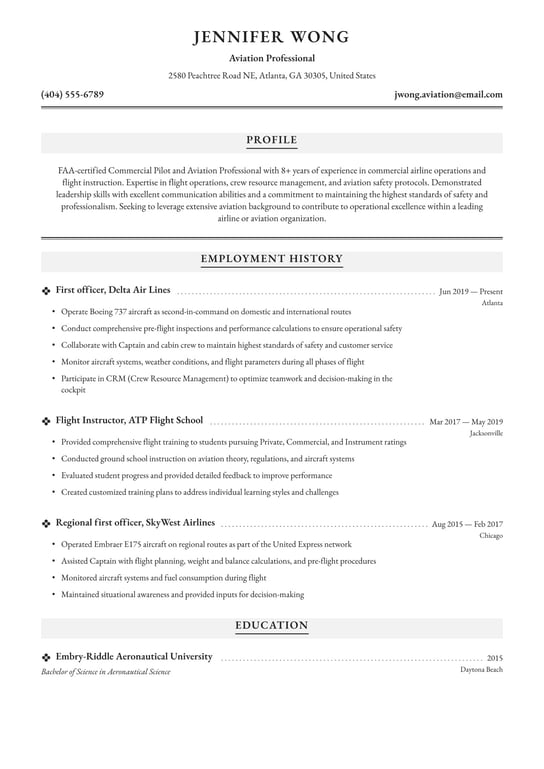
Take a look at the aviation CV employment history example below:
First officer at Delta Air Lines, Atlanta
June 2019 — Present
• Operate Boeing 737 aircraft as second-in-command on domestic and international
routes
• Conduct comprehensive pre-flight inspections and performance calculations to
ensure operational safety
• Collaborate with Captain and cabin crew to maintain highest standards of safety
and customer service
• Monitor aircraft systems, weather conditions, and flight parameters during all
phases of flight
• Participate in CRM (Crew Resource Management) to optimize teamwork and
decision-making in the cockpit
Flight Instructor at ATP Flight School , Jacksonville
March 2017 — May 2019
• Provided comprehensive flight training to students pursuing Private, Commercial,
and Instrument ratings
• Conducted ground school instruction on aviation theory, regulations, and aircraft
systems
• Evaluated student progress and provided detailed feedback to improve
performance
• Created customized training plans to address individual learning styles and
challenges
Regional first officer at SkyWest Airlines, Chicago
August 2015 — February 2017
• Operated Embraer E175 aircraft on regional routes as part of the United Express
network
• Assisted Captain with flight planning, weight and balance calculations, and
pre-flight procedures
• Monitored aircraft systems and fuel consumption during flight
• Maintained situational awareness and provided inputs for decision-making
How to write an aviation CV with no experience
Looking for your first job in the aviation industry? Your CV should highlight your relevant skills, education, and passion for aviation.
Start by describing the coursework, certifications, or training programs you’ve completed. For example, an aviation management course, cabin crew training, or vocational course in aviation operations should go near the top of your aviation CV.
When writing a CV with no experience, it’s important to highlight transferable skills—relevant abilities you’ve picked up from previous roles or experiences. For instance, if you’ve worked in customer service, those communication and problem-solving skills can be a strong asset as cabin crew.
Most importantly, your enthusiasm for the aviation sector should come across clearly on your CV, particularly if you’re new to the industry. Use your CV summary and cover letter to explain why you’re keen to join this field or why you’re making a career change.
Include your relevant key skills for aviation roles
Next, let’s talk about your skills section. To pique the hiring manager’s interest, you need to make sure that you have a healthy mixture of both hard and soft skills.
Hard skills are aligned directly with the aviation sector and are often called technical skills. They might include knowledge of safety regulations, aircraft operations, and security procedures. Think about the hard skills you have and how they contribute to safe and efficient operations.
Soft skills are also known as interpersonal skills and apply across many industries. These may include communication, teamwork, time management, adaptability, and organisation.
When choosing which skills to feature on your aviation CV, a helpful tip is to revisit the job advert and highlight the specific skills the employer is seeking. Tailoring your CV this way can improve your chances of being noticed.
Our CV builder offers pre-selected skills to choose from when creating your application. You will also have the chance to upload your own skills.
Here’s what the skills box looks like in our aviation CV example:
- Communication
- Adaptability
- Problem Solving
- Leadership
- Ability to Work Under Pressure
This section isn’t the only place where you should mention your skills. Be sure to weave your key skills throughout your aviation CV by highlighting specific examples of when you’ve used them successfully—in your personal statement, work experience, or other relevant sections.
For instance, you might choose to showcase skills like these in context:
- Technical expertise. Detail your experience inspecting, maintaining, or operating aircraft systems while ensuring full compliance with regulatory requirements.
- Communication skills. Explain how you build positive relationships with flight crews, ground staff, or control towers for safe, smooth operations.
- Leadership skills. For example, describe how you led a cabin crew to deliver excellent service, contributing to a 15% increase in passenger satisfaction levels.
Detail your education & relevant aviation certifications
In the highly regulated aviation sector, demonstrating the right qualifications on your CV is essential. Employers will expect to see evidence of your formal education, relevant licences, and any continued professional development that supports your role.
Present your qualifications in reverse chronological order, starting with your most recent or highest level of education. Include the degree or course title, institution name, and—if applicable—the date of completion. If you’re a recent graduate or newly certified, this section can help highlight your current knowledge.
Your education section can also contain these details:
- Professional training. If you've undertaken aviation-related training—such as cabin crew training, first aid, or aviation operations—be sure to include this information.
- Certifications and licences. For aviation roles that require a licence, such as a pilot or aircraft maintenance engineer, list this information in your education section. You can also include certifications, such as IOSH Managing Safely in Airports and Aviation.
- Professional development. List your memberships in relevant organisations, like the Royal Aeronautical Society (RAeS). This further demonstrates your commitment to the aviation industry.
Bachelor of Science in Aeronautical Science, Embry-Riddle Aeronautical University , Daytona Beach 2015
Pick the right layout & design for an aviation CV
The content of your aviation CV should be the star of the show. Choose a CV layout and design that doesn’t threaten to overshadow it.
To achieve this, keep these tips in mind:
- Use ample spacing. Generous margins and space between sections improve readability and give your CV a more polished appearance.
- Select a clear, readable font. Stick to one or two professional typefaces that are easy on the eyes and maintain a consistent look throughout.
- Keep the design understated. A conservative layout signals professionalism. Steer clear of any loud or overly decorative elements.
- Stick to a minimal colour palette. If you choose to incorporate colour, limit yourself to no more than two subdued tones to maintain a formal feel.
Need a starting point? Browse through our collection of CV templates designed specifically with professionalism in mind. These templates offer a streamlined way to present your qualifications without the hassle of starting from scratch.
Aviation job market & outlook
Opportunities within the UK aviation sector vary widely depending on the specific career path you're aiming for. Some roles, such as airline cabin crew and aircraft maintenance engineers, are seeing particularly strong demand due to industry shifts and workforce shortages.
Job growth in the aviation industry
- Employment of cabin crew is projected to grow in CAE’s 2025 Aviation Talent Forecast, with 678,000 new cabin crew needed by 2034 to meet the growing demand for air travel and cover staff shortages.
- According to the British Pilot Association, the recruitment outlook is extremely positive, with an increased demand for newly qualified pilots.
- A new report by AeroProfessional warns of a critical shortage in aircraft engineers over the next decade, creating a huge need for new professionals to enter the field.
What type of salary you can expect in aviation
The salary you earn in the aviation industry will depend on your job title, location, and experience level. For example, flight attendants make an average salary of £20,697 per year, while commercial pilots earn an average annual salary of £77,670.
Key takeaways for building an aviation CV
No matter if you're aiming for a role as an aircraft engineer or commercial pilot, your aviation CV should clearly reflect your key strengths, industry experience, and career achievements. A concise, targeted, and professional CV will help position you as a standout applicant and move you one step closer to advancing your aviation career.
Follow the advice in this guide and always tailor your CV to meet the needs of the hiring organisation. If you want to make the process easy, use our CV builder to create a winning application in no time.