


The skills for a CV that UK employers ask for most are communication, teamwork, problem-solving, adaptability, and time management.
Add the job-specific skills named in the advert, then prove each one with a real example from your work history.
This Resume.io guide covers 33 key skills, with CV lines you can adapt.
What are the most important skills to include on a CV?
The 5 key skills for a CV are communication, teamwork, problem-solving, adaptability, and time management.
Listing them is only the start. In a study of 9,700 resumes, communication was the most common skill, yet 15.3% of job seekers who listed it were hired, at or below the average rate (Careerminds, Best Skills on a Resume, 2026).
Because almost every applicant claims these five, the skill name alone rarely sets a CV apart, and a real example does far more of the work.
Amanda Augustine, a certified career coach, gives this advice to graduates entering the UK job market:
“Make sure to emphasise universally valued skills such as communication, problem solving, and adaptability in your CV. Use concrete examples from academic projects, internships, or volunteer work to demonstrate these skills.”
1. Communication
Communication covers how clearly you write and speak, and how well you listen.
Name the type you use most, such as written reports or phone support.
- Example CV line: “Wrote weekly stock updates for 12 store managers, cutting email queries to head office by a third.”
2. Teamwork
Teamwork proves you can share the load and support colleagues when things get busy.
It matters wherever work passes between people, from ward handovers to restaurant kitchens.
- Example CV line: “Covered two extra shifts a week during a staff shortage, keeping the café’s opening hours unchanged.”
3. Problem-solving
Problem-solving means spotting what has gone wrong, working out why, and putting it right without being asked.
Name the problem and the outcome so the reader can follow your thinking.
- Example CV line: “Traced repeated delivery delays to a booking error and changed the process, ending missed slots within a month.”
4. Adaptability
20.9% of job seekers who listed adaptability were hired, making it the only non-technical skill to match technical skills like Git and Java (Careerminds, Best Skills on a Resume, 2026).
Prove it with a change you handled well, such as a new system or a restructure.
- Example CV line: “Learned a new booking system in a week and trained four colleagues to use it before go-live.”
5. Time management
Time management tells an employer you can plan ahead, hit deadlines, and keep standards up when work piles up.
A deadline you met or a heavy workload you balanced makes the clearest proof.
- Example CV line: “Managed 30 client files at once, meeting every filing deadline in the 2025 tax year.”

What other good skills can I put on a CV?
Other good skills to put on a CV include active listening, attention to detail, critical thinking, Microsoft 365, project management, and commercial awareness.
When deciding what skills to put on a CV, choose the ones the job advert names, then use the tables to see what each looks like as evidence.
People and communication skills
Interpersonal skills cover how you deal with colleagues, customers, and the public.
| Skill | What to put on your CV |
|---|---|
| Active listening | Complaints resolved by summarising the issue back first |
| Written communication | Reports, newsletters, or procedures you wrote |
| Presenting | Talks given, audience size, and the result |
| Negotiation | A deal, rota, or price you agreed, with the saving |
| Empathy | Feedback from patients, customers, or colleagues |
Organisation skills
Organisation skills tell an employer you will finish work accurately and on time.
| Skill | What to put on your CV |
|---|---|
| Organisation | Systems you set up and what they improved |
| Attention to detail | Error rates, audits passed, or checks you introduced |
| Record keeping | Accurate logs for stock, patients, or compliance |
| Diary management | Calendars managed and meetings arranged each week |
Thinking and analysis skills
Thinking skills help you weigh up information before you act.
| Skill | What to put on your CV |
|---|---|
| Critical thinking | A process you questioned and improved |
| Analytical skills | Trends you spotted in sales, data, or feedback |
| Decision-making | A call you made under time pressure and its outcome |
| Creativity | An idea you introduced and what it changed |
Digital and technical skills
Named software and computer skills carry real weight on a CV.
20.1% of job seekers with at least one technical or analytical skill were hired, compared with 14.2% of those who listed only soft skills (Careerminds, Best Skills on a Resume, 2026).
| Skill | What to put on your CV |
|---|---|
| Microsoft 365 | Apps and level, such as Excel pivot tables |
| Google Workspace | Shared Drive systems or Sheets trackers you built |
| Data analysis | Reports built in Excel, Power BI, or SQL |
| AI tools | Tasks you speed up with ChatGPT or Copilot |
| CRM software | Salesforce or HubSpot, and what you tracked |
Leadership and management skills
Leadership skills count at every level, including running a project or training a new starter.
| Skill | What to put on your CV |
|---|---|
| Leadership | Team size, goals reached, or people promoted |
| Project management | Projects delivered on time, plus PRINCE2 or Agile if certified |
| Delegation | Work you shared out and the time it freed |
| Coaching and mentoring | Colleagues you trained and how they progressed |
| Initiative | Something you started without being asked |
Customer and commercial skills
Customer service, commercial, and language skills connect your work to customers and income.
| Skill | What to put on your CV |
|---|---|
| Customer service | Satisfaction scores, repeat customers, or complaints resolved |
| Commercial awareness | Competitors, prices, or market trends you tracked |
| Sales | Targets hit, average order value, or upsells |
| Budgeting | Budgets you managed and money saved |
| Foreign languages | Language and level, such as conversational French |
Which skills do UK employers look for in each industry?
UK employers look for a mix of job-specific and transferable skills, and the job-specific half changes most by industry.
A nurse needs clinical knowledge and a forklift driver needs the right licence, while both need reliability.
Use these CV skills examples by sector as a starting point, then match the wording to the job advert.
Healthcare
Clinical roles start with registration and checks, so nurses and paramedics should put their NMC or HCPC registration and DBS status near the top of the CV.
Care assistants can lead with the Care Certificate and shift experience instead.
| Job-specific skills | Transferable skills |
|---|---|
| Patient care and treatment plans | Bedside manner |
| Emergency and critical care | Clear handovers |
| Infection prevention and control | Calm in emergencies |
| Medicines administration | Respect for patient dignity |
| Safeguarding adults and children | Resilience on long shifts |
Technology
Tech hiring managers scan a CV for named languages and platforms first, so for a front end developer, that means frameworks and a portfolio link.
In IT support and cybersecurity, certifications such as CompTIA A+ or Security+ carry real weight.
| Job-specific skills | Transferable skills |
|---|---|
| Cloud platforms (AWS, Azure) | Explaining technical ideas simply |
| JavaScript, HTML, and CSS | Patience with users |
| Python and SQL | Curiosity about new tools |
| Network security | Working in sprints |
| Troubleshooting and ticketing systems | Documenting your work |
Education
Teaching posts in England usually ask for QTS, a subject specialism, and up-to-date safeguarding training.
Teachers and tutors should show pupil progress they contributed to, while a lecturer adds research and publications to the CV.
| Job-specific skills | Transferable skills |
|---|---|
| Curriculum planning | Encouraging mixed-ability groups |
| Special educational needs (SEN) support | Rapport with parents and carers |
| Classroom management | Clear instructions |
| Safeguarding and Ofsted standards | Inclusive approach |
| EdTech (Google Classroom, Nearpod) | Classroom presence |
Retail and customer service
Shop floors depend on people who can handle a till, a queue, and an unhappy customer in the same hour.
Sales figures and mystery shopper scores make strong CV proof for retail and shop assistant roles, and a customer service manager adds team results on top.
| Job-specific skills | Transferable skills |
|---|---|
| Point of sale (POS) systems | Friendly manner |
| Stock control and replenishment | Persuasion |
| Visual merchandising | Handling complaints calmly |
| Cash handling | Punctuality |
| Click and collect order processing | Leading a shift team |
Construction and trades
On site, cards and tickets come first, so a carpenter should list a CSCS card, NVQs, and any plant tickets near the top of the CV.
Office-based roles shift the focus to cost and contracts, which means a quantity surveyor or construction manager should lead with project values and delivery.
| Job-specific skills | Transferable skills |
|---|---|
| CSCS card and relevant NVQs | Safety-first mindset |
| Site safety certificates (SMSTS, SSSTS) | Coordinating trades |
| Cost estimating and tendering | Working to tight programmes |
| Technical drawings and building regulations | Physical fitness |
| Building information modelling (BIM) | Clear site communication |
Transport and logistics
Licences and safety records are the first thing a logistics recruiter checks on a CV.
As a driver or warehouse operative, list your licence categories, Driver CPC, and forklift tickets clearly.
Cabin crew swap these for safety training and a strong service record.
| Job-specific skills | Transferable skills |
|---|---|
| Driving licence categories (C, C+E) and Driver CPC | Dependability on early and late shifts |
| Forklift operation (counterbalance, reach) | Hazard awareness |
| Stock and inventory control | Composure with passengers |
| Route planning and tachograph rules | Independent working |
| Passenger safety procedures | Accuracy with paperwork |
Office and administration
Admin roles reward accuracy and discretion above most other qualities.
Whether you are an administrative assistant or an office administrator, name the systems you use daily on your CV, from Outlook to a company CRM.
| Job-specific skills | Transferable skills |
|---|---|
| Minute taking | Discretion with confidential information |
| Data entry | Tact |
| Bookkeeping basics | Multitasking |
| Reception and switchboard | Using initiative |
| Travel and event booking | Professional phone manner |
Hospitality and food service
A Level 2 food hygiene certificate is a common requirement in kitchens and front-of-house roles, so chefs and waiters should state it plainly on the CV.
For an event manager, supplier contacts and budgets matter more than kitchen certificates.
| Job-specific skills | Transferable skills |
|---|---|
| Food hygiene certificate (Level 2) | Speed during a rush |
| Food preparation | Warmth with guests |
| Allergen awareness | Brigade teamwork |
| Table service and POS (Toast, Lightspeed) | Stamina on your feet |
| Event planning and supplier liaison | Positivity |
Accounting and finance
Professional study carries weight in finance, so accountants and assistant accountants should give AAT, ACCA, or CIMA progress its own line on the CV.
Applications in banking lean more on regulation, client service, and sales targets.
| Job-specific skills | Transferable skills |
|---|---|
| Financial reporting | Integrity |
| Forecasting and variance analysis | Business partnering |
| Accounting software (Sage, Xero, QuickBooks) | Explaining numbers to non-finance staff |
| Audit and compliance | Commercial judgement |
| VAT and payroll | Meeting month-end deadlines |
Security and protective services
A security guard needs a valid SIA licence in the first few lines of the CV, because licensable door and site roles cannot legally start without one.
Applications to the police centre on judgement, report writing, and staying composed as situations escalate.
| Job-specific skills | Transferable skills |
|---|---|
| SIA licence | Situational awareness |
| CCTV and access control | Conflict de-escalation |
| First aid | Clear radio communication |
| Incident reporting | Professional manner |
| Physical intervention | Sound judgement |
School leavers, students, and interns
Coursework, part-time jobs, and volunteering all count as CV evidence for school leavers and students.
An internship application can go further with a project you delivered and the tools you used.
| Job-specific skills | Transferable skills |
|---|---|
| Research | Willingness to learn |
| Data analysis (Excel) | Group project teamwork |
| Presentation skills | Balancing study and work |
| Social media | Reliability in a Saturday job |
| Languages | Openness to feedback |
How do I list skills on a CV?
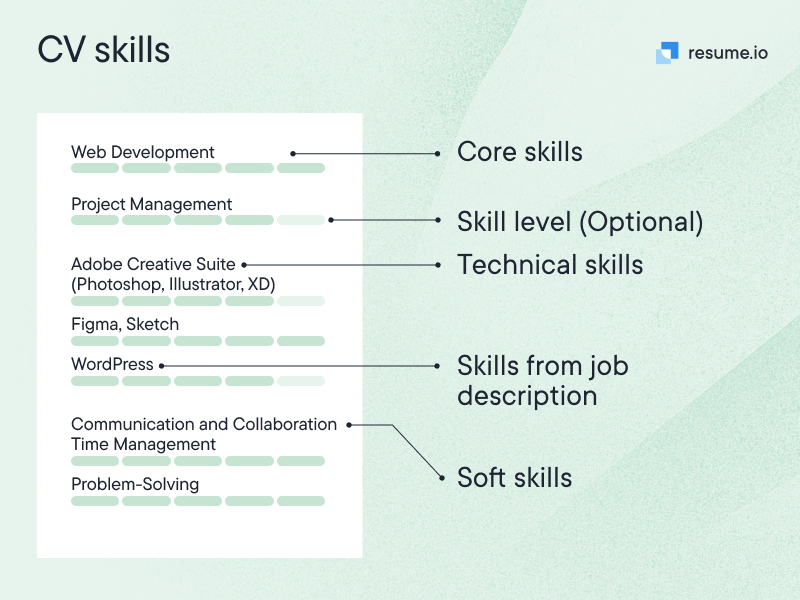
List skills on a CV in a short key skills section near the start of page one, then back each one up in your work history.
Match the wording to the job advert, and give every skill a result that someone could check.
- Read the job advert: Note the skills it repeats or marks as essential, and reuse the same keywords so your CV passes applicant tracking systems and a quick human scan.
- Add a key skills section: Place it under your personal profile, in two short columns, so a recruiter sees it without scrolling.
- Be specific: Write “Excel (pivot tables, VLOOKUP)” in place of “computer skills”, and “PRINCE2 Foundation” in place of “project management”.
- Prove each skill: Give every key skill at least one bullet in your work experience with a number, a result, or a named outcome.
The most common mistake is filling the section with traits like “hard-working” or “team player”, which every other applicant also uses and nobody can verify.
If you are changing careers, a skills-based CV moves this section to the front and groups your experience under each skill.
For software and languages, adding a proficiency level tells the employer how far your ability goes.
How many skills should I put on my CV?
Put no more than eight skills in the key skills section of your CV.
Eight fits neatly into two columns of four lines without pushing your work history down page one, and you can still mention other skills in your work experience.
Choosing which eight to keep is a matching exercise.
Picture a retail assistant applying for an office administrator role, where the advert asks for Microsoft Excel, diary management, customer service, attention to detail, and “a positive attitude”.
A focused key skills section for that application could read:
- Microsoft Excel (data entry, basic formulas)
- Outlook diary management
- Customer service
- Cash handling and reconciliation
- Attention to detail
- Stock records
- Teamwork
- Time management
“A positive attitude” stays out of the list because nobody can prove it in a single line, so it sits better in the personal profile.
Where two skills say the same thing, such as “organised” and “good at planning”, keep the one the advert uses.
Key takeaways
- Communication, teamwork, problem-solving, adaptability, and time management are the five skills UK employers ask for most on a CV.
- Common skills only help your application when a result in your work history backs them up.
- Specific tools and methods, such as Excel or PRINCE2, give recruiters something they can check.
- A key skills section works best with eight skills or fewer, placed near the start of page one.
- Matching the wording of your skills to each job advert helps both recruiters and applicant tracking systems find them.
Frequently asked questions
These answers cover the questions job seekers ask most about CV skills.
What skills should I put on a CV with no experience?
Put transferable skills from school, part-time work, volunteering, or hobbies on a CV with no experience, such as teamwork, time management, and customer service. Back each skill with a real example, like a group project or a Saturday job.
Should I list AI skills on my CV?
Yes, if you use AI tools in your work and can say what for. Name the tool and the task, such as “Drafted weekly reports with Microsoft Copilot”, so the employer can see how you apply it.
Can I include skills I am still learning on my CV?
Yes, as long as you label your level honestly. Write “Python (beginner)” or “conversational Spanish”, and be ready to talk about it at interview. Overstating a skill can damage an employer’s trust quickly.


