

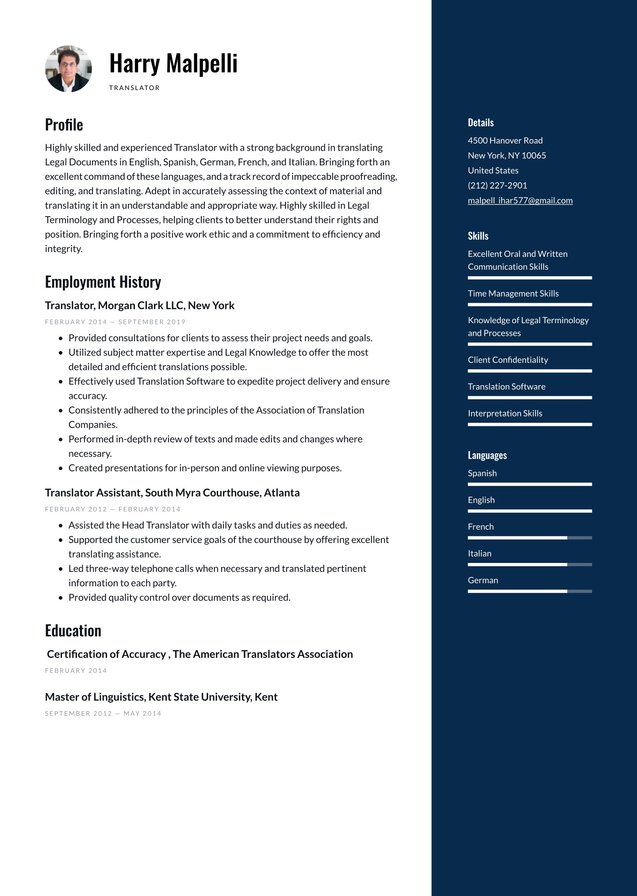
Highly skilled and experienced Translator with a strong background in translating Legal Documents in English, Spanish, German, French, and Italian. Bringing forth an excellent command of these languages, and a track record of impeccable proofreading, editing, and translating. Adept in accurately assessing the context of material and translating it in an understandable and appropriate way. Highly skilled in Legal Terminology and Processes, helping clients to better understand their rights and position. Bringing forth a positive work ethic and a commitment to efficiency and integrity.
02/2014 - 09/2019, Translator, Morgan Clark LLC, New York
- Provided consultations for clients to assess their project needs and goals.
- Utilized subject matter expertise and Legal Knowledge to offer the most detailed and efficient translations possible.
- Effectively used Translation Software to expedite project delivery and ensure accuracy.
- Consistently adhered to the principles of the Association of Translation Companies.
- Performed in-depth review of texts and made edits and changes where necessary.
- Created presentations for in-person and online viewing purposes.
02/2012 - 02/2014, Translator Assistant, South Myra Courthouse, Atlanta
- Assisted the Head Translator with daily tasks and duties as needed.
- Supported the customer service goals of the courthouse by offering excellent translating assistance.
- Led three-way telephone calls when necessary and translated pertinent information to each party.
- Provided quality control over documents as required.
02/2014 - present, Certification of Accuracy , The American Translators Association,
09/2012 - 05/2014, Master of Linguistics, Kent State University, Kent
- Spanish
- English
- French
- Italian
- German
- Excellent Oral and Written Communication Skills
- Time Management Skills
- Knowledge of Legal Terminology and Processes
- Client Confidentiality
- Translation Software
- Interpretation Skills
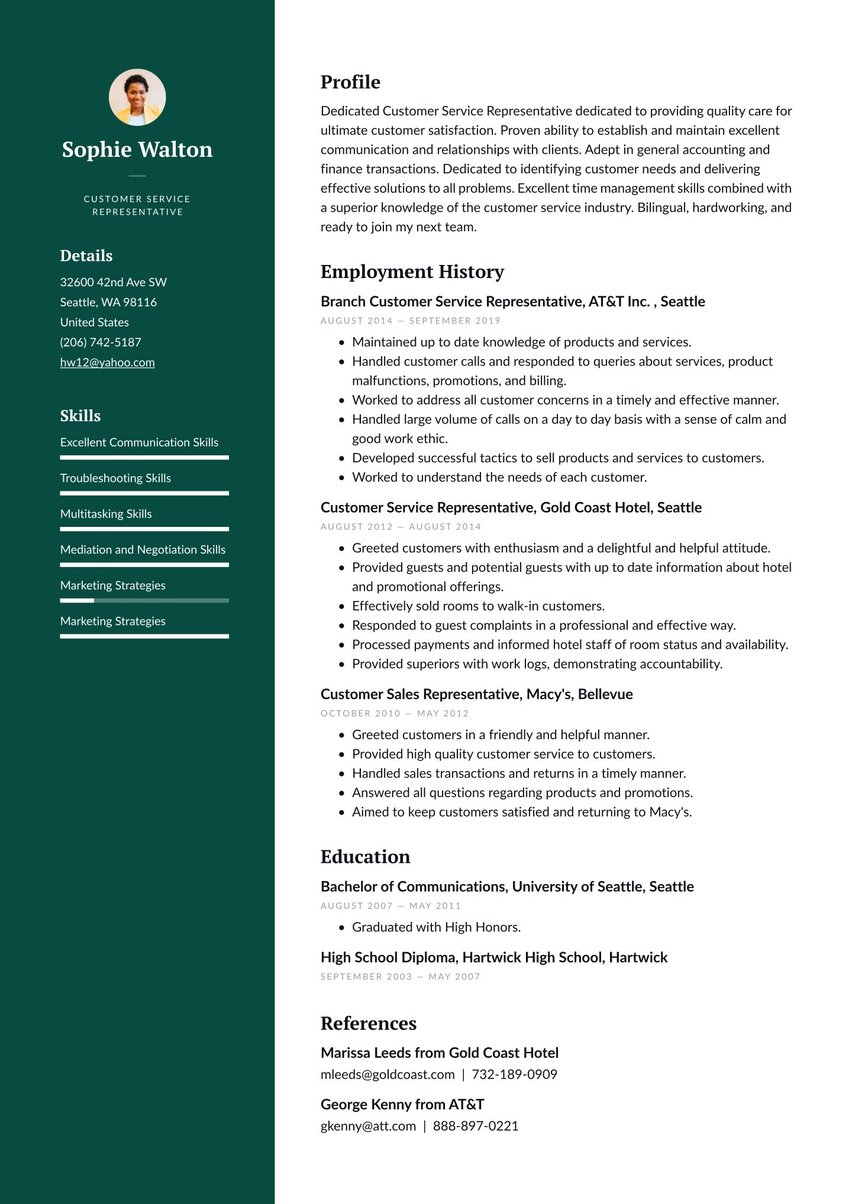
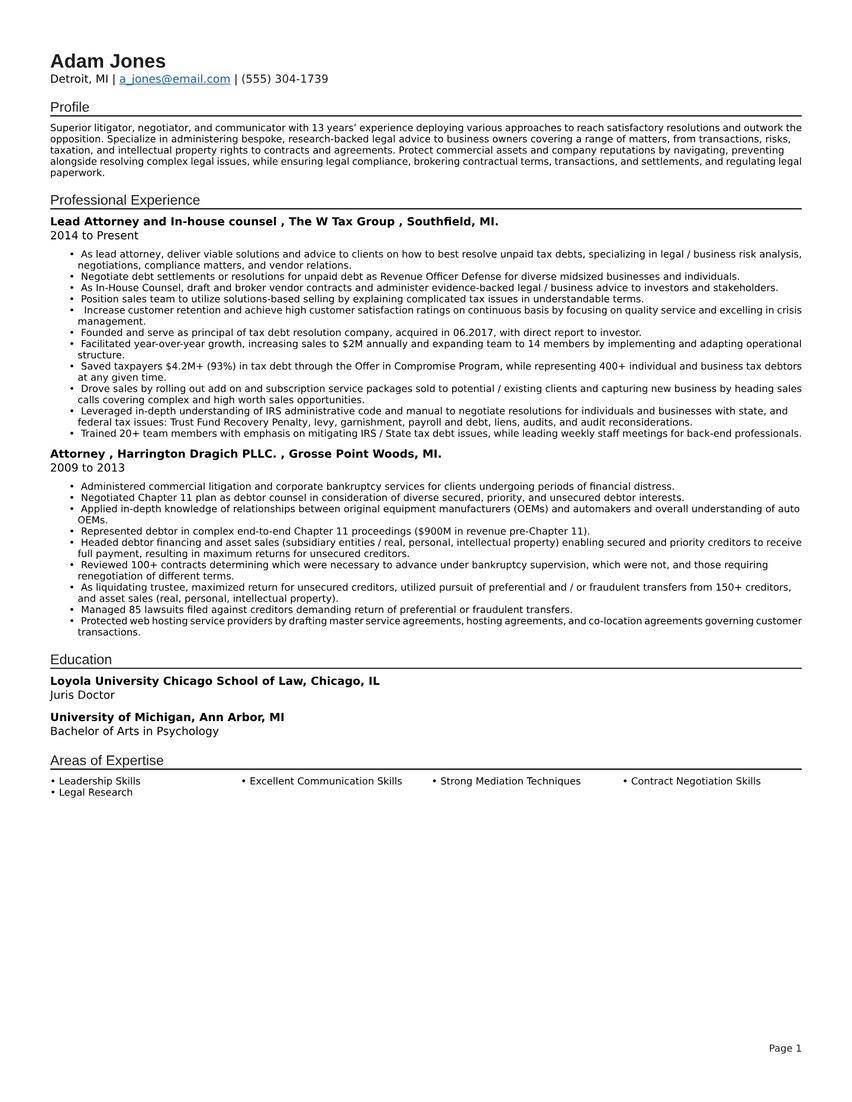
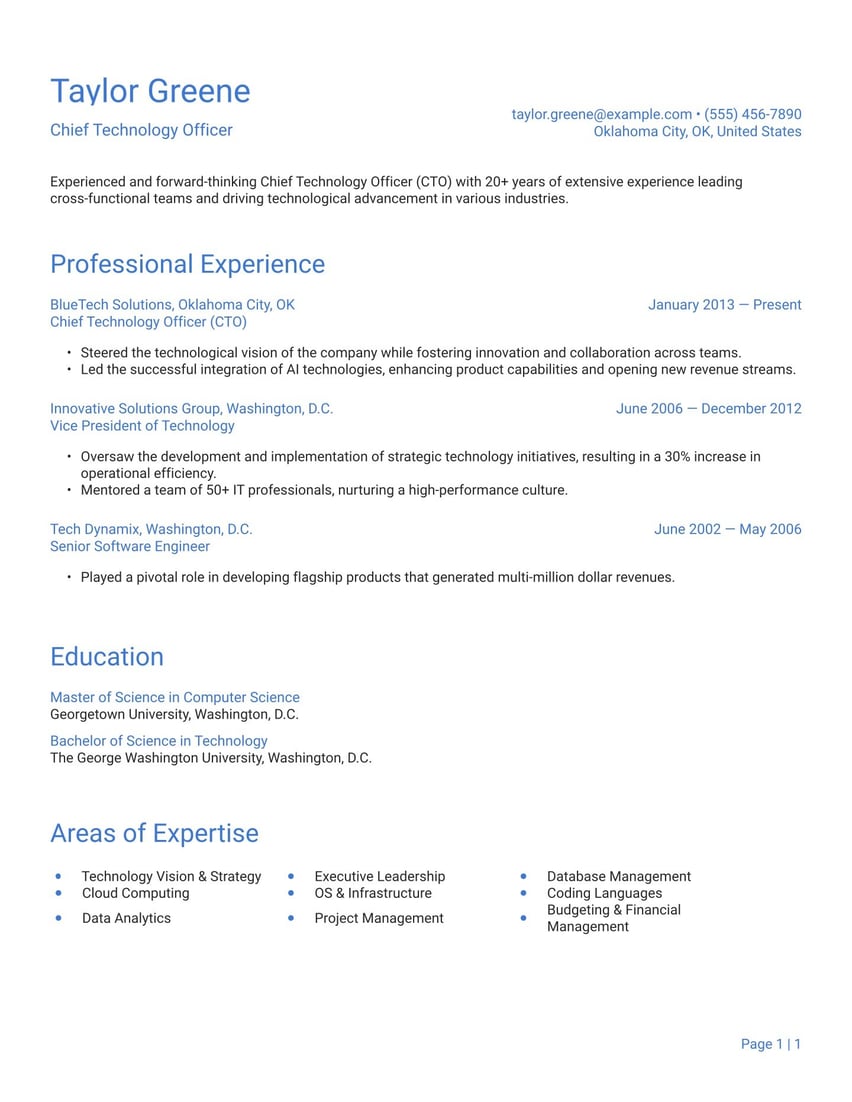
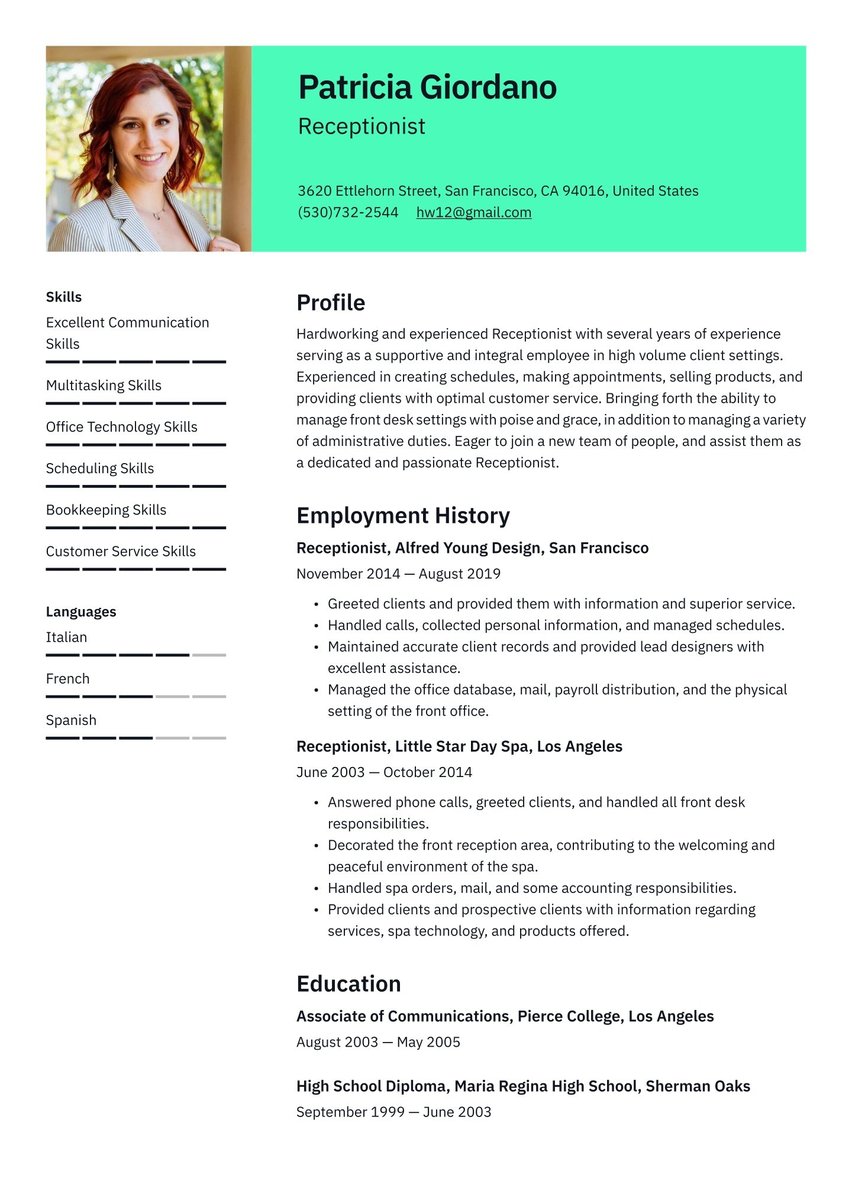
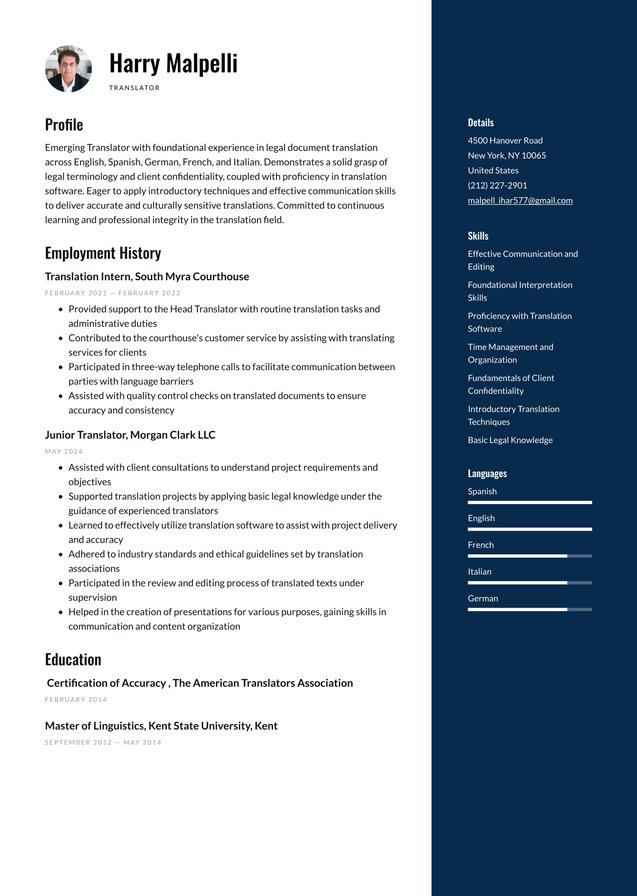
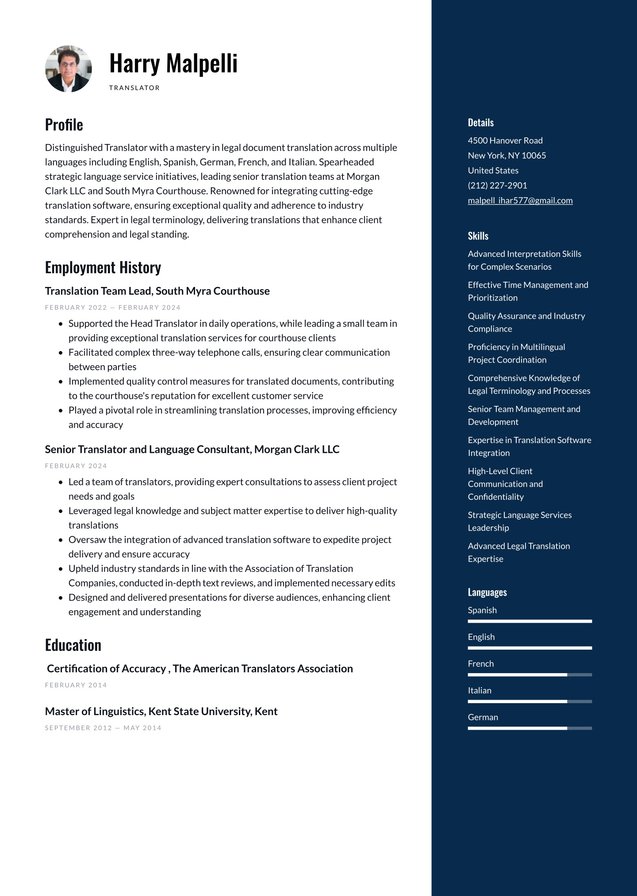
Great translation is invisible: the reader never notices the seams. Your translator resume has to pull off the same trick, showing years of linguistic judgment on a single, scannable page. This guide walks through translator resume examples and a clear method for building one that wins over hiring managers and applicant tracking systems alike.
Related Resume Examples
ESL Teacher resume example

Aligned with the collaborative and adaptable nature of ESL teaching, this template’s clean layout and structured sections highlight your expertise in language instruction. Its balanced design emphasizes your skills, fostering trust with schools and families alike.
Copywriter resume example

A smart fit for creative professionals, this sleek, modern layout spotlights your storytelling skills and marketing expertise as a Copywriter. Its clean structure and bold headers emphasize key achievements, helping you captivate clients and hiring managers alike.
The examples above show what effective translator resumes look like at entry, mid, and senior levels.
Adapt the wording to your own languages, specializations, and results.
How to write a translator resume
Writing a translator resume comes down to four moves: lead with your languages, prove your reliability, match the posting, and keep the format clean.
Work through them in order and the rest of the page falls into place.
1. Lead with your language pairs and a focused summary
Agencies scan for your language directions before anything else, so put them where the eye lands first.
Follow with a two-to-four sentence summary naming your niche, your certification, and one measurable result.
- Example: "ATA-certified French-to-English translator with eight years in medical texts, averaging 2,500 words per day."
2. Prove your record with quantified achievements
Numbers turn vague claims into evidence a hiring manager can trust.
Rather than listing duties, show volume translated, on-time rates, and quality scores.
- Example: "Translated 3,500 legal contracts from Spanish to English with a 99% client-approved accuracy rate."
3. Match the posting's tone and terminology
Translators, of all people, know that exact wording carries weight, so echo the posting's phrasing where it fits your experience.
When a role names localization or MTPE, use those precise words honestly.
- Example: "Performed machine translation post-editing (MTPE) on 500,000 words of technical documentation."
4. Choose a clean, ATS-safe format
A cluttered layout buries your best work and can trip screening software.
Use standard headings, clear sections, and no graphics or text boxes, then save as PDF unless asked otherwise.
Example: Keep "Experience," "Skills," "Education," and "Certifications" as plain, labeled sections.
What are some effective ways to format a translator resume?
Reverse chronological works best for most translators because it foregrounds a steady record of paid projects.
Freelancers and career changers can lean on a functional or combination layout to lead with skills instead.
The table below shows when each option fits.
| Format | Best for | Watch out for |
|---|---|---|
| Reverse chronological | Translators with steady work or a clear project history | Gaps between contracts show plainly |
| Functional / skills-based | Career changers and fragmented freelance histories | Some recruiters distrust it and hunt for dates |
| Combination | Freelancers with strong skills and solid history | Runs long; keep it to two pages maximum |
What are the best ways to make a translator resume stand out?
Standout resumes prove reliability, a clear niche, and current tooling, rather than simply listing languages.
Name your specialty, whether legal, medical, technical, or literary, because agencies hire specialists over generalists.
Quantify what those specialists care about: words per day, error rates, and repeat-client volume.
Show that you use AI and CAT tools fluently, including post-editing, since that is now table stakes.
One caution is worth remembering: fluency with AI in your workflow is an asset, but an AI-written resume is a liability.
49% of hiring managers automatically dismiss AI-generated resumes (Resume.io, Resume Rejections study, 2025), so let the tools speed your drafting, then rewrite every line in your own voice.
What skills should I highlight on a translator resume?
Highlight a balance of hard and soft skills, weighted toward the technical abilities agencies filter for.
41% of recruiters review the skills section first (Resume.io, Resume Statistics, 2025), so make it specific and easy to scan.
Group your skills so a project manager can read your qualifications in seconds:
- Languages and proficiency: Source and target languages with CEFR or JLPT levels, native language stated clearly
- CAT and QA tools: SDL Trados Studio, memoQ, Phrase, Smartcat, Wordfast, Xbench
- Specializations: Legal, medical, technical, localization, or literary translation
- Soft skills: Cultural adaptation, attention to detail, terminology management, meeting deadlines
Certification belongs here too. ATA certification is the credential US agencies recognize most.
Which keywords do hiring managers look for in translator resumes?
Yes, and most of them come straight from the job posting.
Translator keywords usually fall into three buckets: language pairs, subject-matter fields, and named software.
Because only 25% of resumes pass ATS screening (Resume.io Resume Statistics, 2024), the resumes that clear the filter tend to reuse the posting's exact phrasing.
Weave those terms into your summary, skills, and experience rather than piling them into a list.
Before submitting, confirm your resume passes ATS and read up on how ATS parsing actually works.
How do I present translation experience effectively?
Lead with your most recent work and move backward, since 61% of hiring managers read the experience section first (Resume.io, Resume Statistics, 2025).
Frame each role around outcomes rather than tasks: what you translated, how much, and to what standard.
Reach for the metrics that define strong translation work, such as words per day, turnaround time, and quality ratings.
When your history is thin, translate adjacent experience instead, for example tutoring, subtitling, or bilingual customer support.
Keep the last ten to fifteen years in view and let older roles fall away.
How should I tailor my resume for different translation jobs?
Read each posting closely, then reshape three things: your summary, your skills order, and your bullet emphasis.
A medical clinic and a game studio want very different proof, so lead with the specialty each one names.
Swap in the CAT tools and language pairs mentioned in the ad, then reorder your achievements so the most relevant sits first.
Done well, this takes minutes once your master resume exists, and it is the clearest signal that you fit the role.
What services can help me improve my translator resume and profile?
Several kinds of resources can sharpen both your resume and your professional profile.
Professional bodies come first: the American Translators Association offers resume guidance and a mentorship program, and local chapters run peer-review workshops.
Industry platforms help too, since ProZ.com, through its Certified PRO network, and TranslatorsCafé let experienced translators critique the profile that agencies actually see.
For the resume itself, an AI resume builder can structure and format a draft that stays ATS-friendly, which you then refine in your own words.
Whichever route you take, keep your language pairs, specializations, and CAT tools front and center.
What are common mistakes to avoid on a translator resume?
Most of the frequent errors are avoidable and specific to this field.
Listing languages without proficiency levels leaves recruiters guessing, so always attach a scale.
Omitting CAT tools reads as out of date, since software fluency is now expected.
Burying your language direction below a long profile forces agencies to hunt for the detail they scan for first.
Reusing one generic resume for every posting signals low effort.
And, as covered above, submitting an obviously AI-generated resume can end your application before a human reads it.
What is the job outlook and salary for translators?
The outlook is steady but no longer booming, and that honest framing shapes how you should position yourself.
Employment of interpreters and translators is projected to grow 2% from 2024 to 2034, slower than the average for all occupations, with about 6,900 openings each year (U.S. Bureau of Labor Statistics).
That same source notes AI and computer tools are making the work more efficient, though most roles cannot be fully automated.
On pay, the median wage was $59,440 in May 2024, the top 10% earned more than $99,830, and government roles paid the most.
The lesson for your resume: a clear specialty and proven reliability are what keep you valuable as routine work automates.
Key tips for writing a compelling translator resume
- Put your language pairs and native language at the very top, where recruiters look first.
- Quantify your work with words per day, on-time rates, and quality figures rather than duty lists.
- Name the CAT and QA tools you actually use, and add post-editing (MTPE) where it applies.
- State a clear specialization, since agencies hire specialists over generalists.
- Tailor the resume to each posting, and keep the format clean enough to pass ATS.
FAQs
A few quick answers to the questions translators ask most when building a resume.
How long should a translator resume be?
One page suits most translators with fewer than ten years of experience.
Move to two pages only when a longer record genuinely adds relevant detail.
Do you need ATA certification to work as a translator?
No, certification is not legally required for most translation work.
ATA certification is the most recognized US credential and can set you apart, and some court and government roles do require it.
Should you list language proficiency levels on a resume?
Yes, always pair each language with a level such as native, C2, or JLPT N2.
Vague labels like "fluent" leave hiring managers guessing about your real command.