
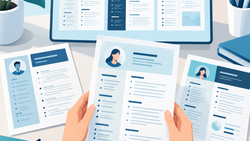


Practical skills are the abilities you use every day to get real work done, from writing a clear email to solving an unexpected problem.
We group them into hard skills you learn through training and soft skills you build through experience, and employers look for proof of both before an interview even begins.
Examples of practical skills useful in the workplace
Practical skills useful in the workplace fall into six broad groups: communication, digital literacy, time management, problem-solving, teamwork, and adaptability.
Most jobs ask for a blend of these rather than just one, since explaining an idea clearly counts for little if you cannot also organize the work needed to deliver it.
Recruiters scanning a resume are not looking for a single standout ability.
41% of recruiters review skills first on a resume, ahead of other sections (Resume.io, Resume Statistics, 2025), so the list needs to cover how you communicate, how you manage your time, and how you solve problems when a plan changes.
The groups below show up most often in job postings and interviews, with a note on where each one tends to matter most.
- Communication: Writing clear emails, explaining ideas to coworkers, and giving direct feedback.
- Time management: Prioritizing tasks, meeting deadlines, and adjusting a schedule when priorities shift.
- Digital literacy: Using spreadsheets, shared drives, and basic troubleshooting without waiting on IT support.
- Problem-solving: Finding the cause of an issue and proposing a workable fix rather than escalating every time.
- Teamwork: Sharing information, resolving disagreements professionally, and following through on shared commitments.
- Adaptability: Learning a new tool or process quickly when a job or a company changes direction.
A mistake is listing every skill from a job description word for word, regardless of whether you have used it.
Hiring managers notice when a skills section reads like the posting it was copied from, and it does not survive an interview question that asks for an example.
Pick the practical skills you can back up with a specific moment from your work history, and leave the rest off.

What is the difference between practical, hard, and soft skills?
Practical skills are the umbrella term for anything you use to get a task done, and they split into hard skills, which are learned through training or experience, and soft skills, which are behavioral and harder to measure.
A practical skill can be entirely hard, entirely soft, or a mix of both, depending on the task.
The distinction matters for how you present a skill on a resume, not just what you call it.
Hard skills like data analysis or a certification are demonstrated by a concrete, checkable ability.
Soft skills like communication or adaptability are demonstrated only through an example of when you used them, which is why a resume that lists soft skills without evidence tends to blur into every other application on the pile.
| Skill type | What it is | How you gain it | Example on a resume |
|---|---|---|---|
| Hard skill | A concrete, checkable ability tied to a task or tool | Training, certification, or repeated practice | Reduced reporting time by two hours a week using advanced Excel formulas |
| Soft skill | A behavioral trait that shapes how you work with others | Experience, feedback, and deliberate practice over time | Resolved a scheduling conflict between two departments without escalating to a manager |
| Hybrid practical skill | A task that requires both technical know-how and judgment | A combination of training and on-the-job experience | Managed a cross-team project timeline using project management software and daily check-ins |
Neither category outranks the other on its own.
What separates a resume that gets noticed is not whether a skill is hard or soft, but whether it is backed by an outcome the reader can picture.
Which practical skills actually help you get hired?
Technical and analytical practical skills consistently outperform soft skills alone at the interview stage.
20.1% of resumes listing at least one technical or analytical skill led to a hire, compared with 14.2% of resumes built on soft skills alone (Resume.io, Skills That Get You Hired Report, 2026).
This does not mean soft skills belong off the page.
It means a soft skill needs backup, the same way a hard skill needs a name and a level.
One soft skill broke the pattern entirely: adaptability placed at 20.9%, the only soft skill to match the placement rate of top technical skills (Resume.io, Skills That Get You Hired Report, 2026).
The pattern suggests recruiters read most soft skills as a claim rather than a qualification.
Adaptability is the exception because it usually shows up attached to a specific change, a new tool, a new team, or a new process, rather than as a personality trait on its own.
If your background includes a technical skill of any kind, a spreadsheet model, a coding language, or a specialized piece of software, list it by name rather than folding it into a general phrase like "detail-oriented" or "analytical thinker."
Save the general soft-skill language for adaptability, and prove it with one concrete change you handled well.
How can you improve your practical skills?
You improve practical skills by practicing them in a real context, not by reading about them.
Pick one skill connected to your current or target role, apply it to an actual task within the next week, and get feedback from someone who can judge the outcome.
- Choose one skill at a time: Trying to build communication, time management, and a new software tool in the same month usually means none of them stick.
- Attach it to a real task: Practice time management on your actual weekly workload, not a generic planner exercise.
- Ask for specific feedback: A general "good job" teaches you nothing; ask what worked and what to change next time.
- Track a measurable outcome: A shorter meeting, a faster turnaround, or a cleaner handoff gives you something concrete to add to your resume later.
- Repeat with a harder version: Once a skill holds up under normal conditions, apply it under a tighter deadline or a less familiar task.
Which skill to prioritize depends partly on where the market is moving.
Analytical thinking is the single most in-demand core skill among employers, cited as essential by seven in ten companies (World Economic Forum, Future of Jobs Report, 2025).
Building toward it does not require a technical job title.
It shows up in something as ordinary as diagnosing why a process keeps breaking down before you propose a fix.
Where can you learn and practice practical skills?
You can learn and practice practical skills through structured courses, on-the-job stretch assignments, and small personal projects that mimic real work.
The fastest path is a resource that ends in something you produce, a spreadsheet, a piece of writing, a finished project, rather than one that only covers theory.
- On-the-job stretch tasks: Volunteering for work slightly outside your usual role, with a manager or peer who can give feedback
- Structured online courses: Courses that end in a certificate or a graded project, not just video lectures
- Volunteer or freelance projects: Real deliverables for a nonprofit or a small client, which double as resume-ready examples
- Your current workload: Applying a target skill to next week's actual tasks instead of a hypothetical exercise
Whichever route you choose, the payoff only shows up on a resume if you can name what you produced with it.
A finished course is worth little without a project attached, and a project is worth little if you cannot describe the problem it solved.
How do you show practical skills to an employer?
You show practical skills to an employer by attaching each one to a work-experience bullet point that includes a number or a named outcome, not by relying on a standalone skills list.
Place the proof next to the task itself, in the line where you already describe what you did.
Amanda Augustine, CPRW, CPCC, frames this as needing a resume that "offers proof of your skills" and "is tailored to a specific role."
In practice, that means moving a skill out of the skills section and into a bullet where it did something measurable.
70% of employers now use skills-based hiring for entry-level roles, up from 65% the year before (National Association of Colleges and Employers, Job Outlook, 2026), which means this kind of proof increasingly decides who advances past the first screen.
Building this proof into a resume from scratch is easier with a structured resume builder that prompts you for the outcome behind each skill, rather than a blank text box that invites a list of adjectives.
Once you have a working list of proven skills, how you list skills on your resume determines whether an ATS and a hiring manager actually see them, and the skills to include on your resume should match the job posting in front of you, not a generic list.
Key takeaways
- Practical skills combine hard, technical abilities and soft, behavioral ones, and most jobs need a working mix of both.
- Technical and analytical skills tend to carry more weight with hiring outcomes than soft skills listed alone, based on Resume.io's hiring data.
- Adaptability stands out as the one soft skill that performs on par with strong technical skills.
- Improving a practical skill happens through repeated practice on a real task, not through reading about it.
- A practical skill only proves its value on a resume when it is attached to a measurable outcome.
FAQs
A few common questions come up when people start working on their practical skills.
Are practical skills the same as soft skills?
No. Practical skills are a broader category that includes both hard, technical abilities and soft, behavioral ones.
Soft skills are only one half of what counts as a practical skill.
What are the most practical skills to list on a resume?
The most useful practical skills to list are the ones you can support with a specific outcome from your work history.
Communication, time management, problem-solving, and any technical or analytical skill relevant to the role tend to carry the most weight with hiring managers.
Can you learn practical skills without work experience?
Yes. Practical skills can be built through coursework, volunteer work, internships, or personal projects, as long as you can describe a specific task you completed and what changed as a result.


