

Imaginative and detail-oriented writer with 8+ years of experience seeking a position at McSweeney's to craft unique and thought-provoking content, engage readers, and contribute to the publication's distinctive voice and style.
09/2018 - present, Staff Writer, The Onion, Chicago
- Write satirical news articles, opinion pieces, and multimedia content for the publication's print and digital platforms
- Develop and pitch original ideas that capture the zeitgeist and push the boundaries of humor and social commentary
- Collaborate with fellow writers, editors, and graphic designers to refine and enhance the comedic impact and visual presentation of content
06/2015 - 08/2018, Freelance Writer, Various Publications, San Francisco
- Contributed essays, short stories, and cultural criticism to publications such as The Believer, n+1, and Electric Literature
- Explored a wide range of themes and styles, showcasing versatility and a distinctive literary voice
- Participated in writing workshops and conferences to hone craft, network with industry professionals, and stay current with emerging trends
08/2013 - 05/2015, Master of Fine Arts (MFA) in Creative Writing, University of Iowa, Iowa City
08/2007 - 05/2011, Bachelor of Arts in English and American Studies, Vassar College, Poughkeepsie
- Creative ideation and execution
- Humor and satire writing
- Literary analysis and criticism
- Adaptability to various genres and forms
- Collaboration and feedback incorporation
A strong writers resume shows your ability to communicate clearly, specialize in a specific type of writing, and deliver measurable results. To stand out, highlight relevant work, include a portfolio link, and tailor your resume to the role.


Related Resume Examples
Content Marketing Associate resume example

Created for creative communicators, this sleek, modern layout spotlights your storytelling skills and marketing expertise as a Content Marketing Associate. Its clean structure and subtle accents amplify your adaptability and innovation for hiring managers.
Blog Writer resume example

Aligned with creative professionals, this clean, modern layout spotlights your storytelling and research skills as a Blog Writer. Its balanced structure and subtle color accents showcase your expertise, engaging potential clients and employers effortlessly.
Screenwriter resume example
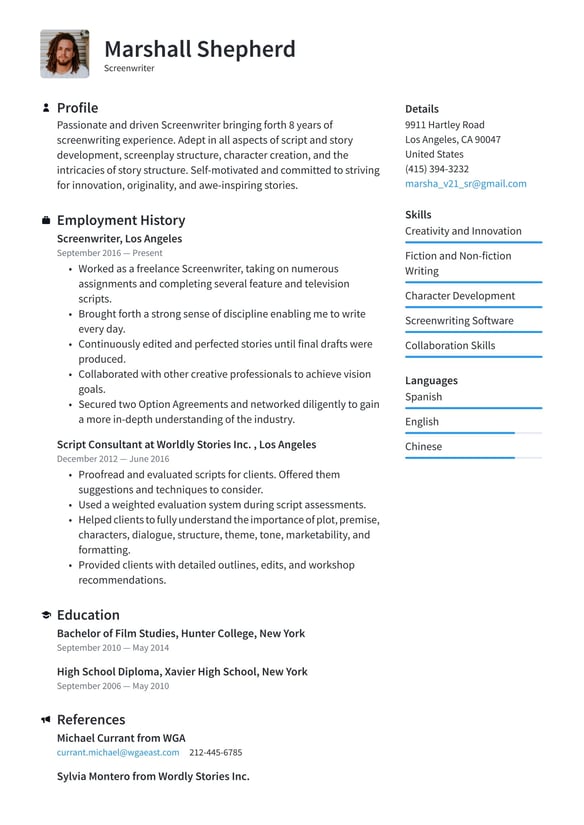
Optimized for creative storytellers, this sleek, cinematic layout spotlights your originality and narrative expertise as a Screenwriter. Its clean structure and bold headers amplify your storytelling achievements, captivating producers and collaborators alike.
Freelance Writer resume example

Created for freelance writers, this sleek, minimalist layout spotlights your versatility and creativity. Its clean structure and subtle accents emphasize your writing expertise, helping you connect with clients who value polished, professional storytelling.
Content Writer resume example

Structured for creative professionals, this sleek, minimal design highlights your storytelling skills and strategic thinking as a Content Writer. Its clean layout and balanced formatting showcase your expertise and adaptability, impressing clients and hiring managers alike.
Creative Director resume example
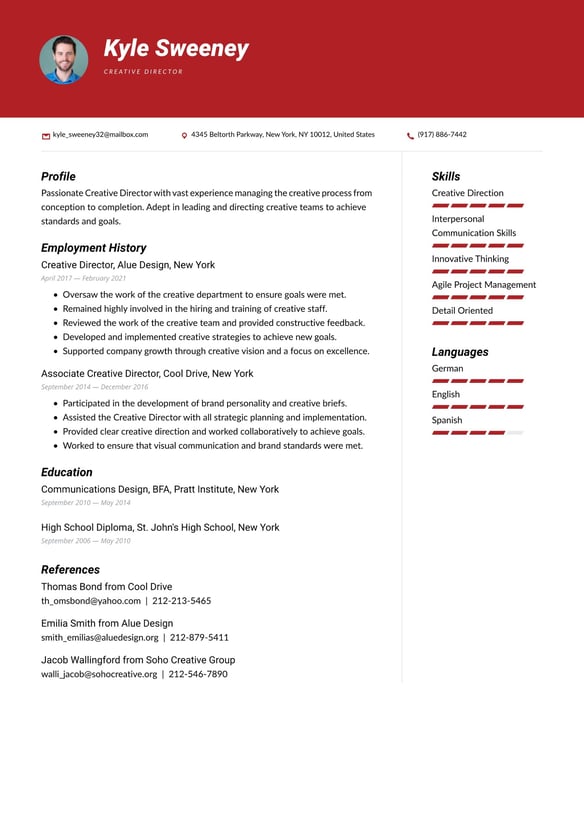
Optimized for bold visionaries, this sleek, modern layout spotlights your leadership and innovation as a Creative Director. Its clean structure and balanced design highlight your creative achievements, inspiring confidence in hiring teams seeking visionary leaders.
Journalist resume example

Optimized for storytelling professionals, this sleek, column-based layout spotlights your investigative skills and editorial expertise as a Journalist. Its clean structure highlights achievements, helping you connect with media outlets and editorial teams effortlessly.
Copywriter resume example

Structured for creative professionals, this template blends clean lines and modern typography to highlight your storytelling and marketing expertise as a Copywriter. Its balanced layout showcases your skills and achievements with clarity, impressing both agencies and clients.
Technical Writer resume example

Tuned for precision and clarity, this template’s clean, structured layout spotlights your technical writing expertise. Its balanced formatting highlights your skills in documentation, accessibility, and problem-solving, impressing hiring managers in tech-driven industries.
How do you write a resume for a writer?
To write a strong writer resume, focus on clear structure, relevant writing experience, and quantified results.
Employers want to quickly understand what you write, who you write for, and how your work performs.
Your resume should highlight your niche, include a portfolio link, and be specific to each role.
Writing a writer resume is about proving your ability to communicate effectively.
Most hiring managers will scan it briefly before deciding whether to review your portfolio.
1. Start with a focused summary
Your summary should explain what type of writer you are and what you do best.
Keep it short and tailored to the role.
Include:
- Your writing type
- Your experience level
- Your strongest result or specialty
2. Show results in your work experience
Your experience section should focus on outcomes, not tasks.
Avoid generic statements and show how your work performed.
For example:
- Increased organic traffic by 40% through SEO-focused content
- Produced 10+ long-form articles per month for a B2B audience
3. Make your writing niche clear
Employers need to swiftly understand your focus.
A general “writer” label is often too broad.
Be specific where possible, such as:
4. Add a portfolio link
Most writing roles require work samples.
Make it easy for hirers to find them.
Place your portfolio:
- In your header
- Or directly in your summary
5. Tailor your resume for each application
A generic resume is less likely to pass screening.
Adjust your wording to match the job description.
Focus on:
- Keywords
- Tone
- Relevant examples
Your strongest successes and writing focus should appear near the top, since recruiters often make decisions within seconds of scanning your resume.

How can you make your writer resume stand out?
To make your writer resume stand out, focus on specificity, measurable impact, and clear positioning.
Employers read hundreds of applications, so you need to show exactly what you write, who you write for, and how your work performs.
A strong resume demonstrates both your writing ability and your value.
1. Show published work or recognizable clients
Hiring managers look for proof that your work has been used in real contexts.
Mention publications, brands, or platforms where your writing has appeared to build credibility.
If you are freelance, include notable clients, industries, and the types of content you delivered.
2. Use measurable results
Results help employers understand the impact of your writing.
Metrics show that your work contributes to business or audience goals, not just output.
Where possible, include numbers related to traffic, engagement, conversions, or volume.
For example:
- Increased blog traffic by 40% through SEO strategy
- Improved email open rates by 25% with revised copy
- Delivered 50+ articles with consistent 5/5 client ratings
3. Define your niche
A general “writer” label can make your application harder to place.
Hiring managers often look for candidates with experience in a specific type of writing or industry.
Clearly stating your niche helps position you as a stronger match for the role.
4. Match the tone and keywords of the job
Each company has its own voice, audience, and priorities.
Your resume should reflect the language and focus used in the job description.
This improves your chances of passing applicant tracking systems and makes your application feel more relevant.
5. Make your portfolio easy to access
Recruiters expect to review writing samples before making decisions.
Including a visible and accessible portfolio link removes friction in the hiring process.
Make sure your samples are relevant, up to date, and easy to navigate.
6. Keep your writing clear and concise
Your resume acts as your first writing sample.
Employers will judge your clarity, structure, and attention to detail immediately.
Short, direct sentences and clean formatting help ensure your message is easy to understand.
A strong writer resume is not about saying more.
It is about showing clear, relevant evidence in a way that is easy to scan and understand.
How do you write a strong writer resume summary?
A strong writer resume summary quickly explains what type of writer you are, what you specialize in, and the value you bring.
It should be concise, targeted to the role, and focused on outcomes or expertise.
Hiring managers often read this first, so it needs to make your positioning immediately clear.
Key elements to include in your summary
A strong summary should cover the following points clearly and in as few words as possible:
- Your role and experience level: For example, "content writer with 5+ years of experience or freelance copywriter working across multiple industries"
- Your writing specialization: Such as SEO content, technical documentation, brand copy, or editorial writing
- A measurable result or strength: This could include traffic growth, publication volume, or client success
- Relevant tools or expertise: For example, CMS platforms, SEO tools, or specific style guides
Example of a strong writer resume summary
Content writer with 6+ years of experience specializing in SEO-driven blog and website content.
Increased organic traffic by up to 40% for SaaS clients through keyword research and content strategy.
Experienced in WordPress, content planning, and editing for clarity and performance.
Common mistakes to avoid
Many writer summaries fail because they are too vague or repetitive.
Avoid general statements that do not add value or differentiate you.
Watch out for:
- Generic phrases like “passionate writer”
- Repeating information from your experience section
- Listing skills without context or results
Your summary should make it easy for an employer to understand your focus and strengths within seconds.
If it feels too broad or unclear, refine it until your role and value are obvious.
What should you include in a writer resume?
A writer resume should include the core sections recruiters expect while clearly showing your writing focus and results.
Keep it structured, concise, and easy to scan.
Each section should support your ability to write effectively and meet the needs of the role.
Contact information
Start with your basic details at the top of the page.
This allows employers to identify you and get in touch.
Include:
- Full name
- Professional email address
- Phone number
- Location (city and state)
- Portfolio or LinkedIn link (if relevant)
Resume summary
Your summary gives a quick overview of your experience and writing focus.
It should position you clearly for the role you are applying for.
Keep it short and include:
- Your writing type
- Your experience level
- One key strength or result
Work experience
This is the most important section of your resume.
It should show what you have written and the impact of your work.
Focus on:
- Relevant writing roles or projects
- Measurable outcomes where possible
- Clear, outcome-based bullet points
Core skills
Your skills section should highlight both technical and transferable abilities.
It helps employers quickly assess whether you meet the role requirements.
Include a mix of:
- Writing and editing skills
- Tools and platforms
- Soft skills such as organization or communication
Key Skills and Proficiencies
Education and certifications
List your most relevant qualifications.
This helps support your background and credibility as a writer.
Include:
- Degrees (if relevant)
- Writing or content-related certifications
- Additional training or courses
Optional sections
Depending on your experience, you may also include additional sections.
These can help strengthen your application if they are relevant to the role.
Examples include:
- Publications
- Awards
- Professional memberships
Each section should be easy to read and directly related to the type of writing job you want.
For writing roles, publications and portfolio links often carry as much weight as formal work experience.
If something does not support your application, it is better to leave it out.
Should you include a writing portfolio on your resume?
Yes. Most writing roles require a portfolio, and including a visible link makes it easier for those hiring to assess your work.
Place your portfolio in your header or summary so it is easy to find.
Focus on relevant, high-quality samples that match the type of writing role you are applying for.
If you do not have published work, include personal projects or sample pieces that demonstrate your ability.
A clear, accessible portfolio often makes the difference between being shortlisted or overlooked.
What is the difference between a freelance writer resume and a technical writer resume?
The main difference is how you present your experience, skills, and results.
Freelance writer resumes focus on variety, clients, and content performance, while technical writer resumes focus on clarity, accuracy, and structured documentation.
Employers expect different strengths depending on the role, so your resume should reflect that focus clearly.
Here is a quick comparison:
| Element | Freelance writer resume | Technical writer resume |
|---|---|---|
| Focus | Variety of projects and clients | Accuracy and clarity of documentation |
| Experience | Multiple clients, industries, and content types | Structured roles creating manuals, guides, or documentation |
| Skills | SEO, blogging, copywriting, content strategy | Technical documentation, APIs, UX writing, tools |
| Metrics | Traffic, engagement, conversions, client satisfaction | Usability, accuracy, reduced support issues, efficiency |
| Portfolio | Broad range of writing samples | Structured documentation and technical examples |
How to adjust your resume for each role
For freelance writing roles, emphasize flexibility and success.
Show the range of clients you have worked with, the types of content you have produced, and the measurable outcomes of your work.
For technical writing roles, focus on precision and subject knowledge.
Highlight your ability to explain complex information clearly, work with technical teams, and produce structured, user-focused documentation.
What skills do you need on a writer resume?
A strong writer resume should include a mix of technical writing skills and transferable soft skills.
Employers look for candidates who can produce clear, accurate content while managing deadlines and adapting to different audiences.
The right combination of skills depends on the type of writing role you are applying for.
Hard skills for writers
Hard skills show your ability to complete specific writing tasks and use relevant tools.
These are often listed in job descriptions and are important for passing screening systems.
Common hard skills include:
- SEO writing and keyword research
- Editing and proofreading
- Content management systems such as WordPress
- Style guides such as AP or MLA
- Research and fact-checking
Soft skills for writers
Soft skills support how you work and communicate.
They are especially important when collaborating with editors, clients, or teams.
Key soft skills include:
- Communication
- Time management
- Attention to detail
- Adaptability
- Organization
Tailor your skills to the role
Not all writing roles require the same skills.
A technical writer may need documentation tools and subject knowledge, while a content writer may focus more on SEO and audience engagement.
Always review the job description and prioritize the skills that match the role.
This makes your resume more relevant and easier for employers to assess.
Use your experience section to demonstrate these skills in action.