

05/2015 - 09/2019, Veterinary Technician, Springfield Animal Clinic, Springfield
- Set up rooms for patients and greeted them upon arrival.
- Conducted thorough observations of animals and recorded their condition.
- Administered vaccines and medicines and cleaned wounds of animals.
- Professionally restrained animals during exams and procedures.
- Performed laboratory tests on blood, urine, and fecal samples.
- Maintained medical and exam room supplies and carefully organized vaccines, medicines, and veterinary equipment.
03/2012 - 04/2015, Veterinary Technician, South Lane Animal Medical Center, Poughkeepsie
- Assessed the overall health of animals using advanced medical practices.
- Prepared animals for surgical procedures.
- Educated animal owners on proper care methods for before and after procedures.
- Assisted in physical examinations of animals by recording basic vitals such as temperature and pulse.
- Prepared and administered medications and vaccines prescribed by veterinarians.
04/2007 - 04/2012, Pet Sitter, Self-Employed, Chappaqua
- Provided superior animal sitting services to clients.
- Watched animals on a daily or extended basis.
- Worked to ensure the safety and well-being of animals.
- Walked, fed, socialized, and monitored animals.
- Administered necessary medications or treatments to animals when necessary.
09/2004 - 05/2008, Bachelor of Biology, Marist College, Poughkeepsie
09/2000 - 05/2004, High School Diploma, Brookfield High School, Brookfield
- Excellent Communication Skills
- Patient Monitoring
- Adaptability
- Administrative Skills
Veterinary technicians, commonly known as vet techs, work with furry patients to provide compassionate care. If you’re applying for your next job as a vet tech, you need a resume that highlights your clinical skills and passion for animals.
A generic or cluttered resume can make employers overlook your top skills and qualifications. It takes a well-designed, professional vet tech resume to get their attention and land an interview.
Every section on your resume, including your summary, experience, and skills, can prove your value as a vet tech. Show employers that you’re ready to step into the exam room and bring your expertise and skills to the table.
Guide for a vet tech resume example
Fetch your next job with resume.io. We provide writing guides and resume examples for hundreds of professions. With our easy-to-use resume builder, you can create an impressive resume faster than ever.
This writing guide and vet tech resume example will show you the following:
- How to write a vet tech resume
- The best resume format to use
- How to provide your contact information
- Writing a professional summary
- Adding your vet tech experience
- How to list your relevant skills and education
- Selecting the right resume design and layout
- What the vet tech job market looks like and how much you can earn
How to write a vet tech resume
A strong vet tech resume needs to tell employers everything they should know about your passion for animals and your veterinary care knowledge.
It should have these elements:
- A resume header
- A resume summary (also known as a profile)
- An employment history section
- A resume skills section
- An education section
Your vet tech resume needs to show prospective employers why they should hire you to care for animals. It should be highly targeted to the job and the clinic, animal hospital, or other organization where you’re applying.
Follow these tips to write a resume that’ll have you scrubbing in at your next job in no time:
- Focus on achievements. Most veterinary technicians can handle similar duties, like collecting samples and taking x-rays. Differentiate your resume by focusing on the accomplishments or outcomes you’ve achieved. For example, highlight times when you improved efficiency or provided compassionate care.
- Prioritize your teamwork skills. Vet techs usually work on a team with veterinarians, other techs, and office staff. Explain the teamwork skills you use to collaborate effectively and keep operations running smoothly.
- Tailor your resume to the job. You shouldn’t send the same version of your resume to every employer. Tailor your resume to show that you can meet each organization’s needs. For example, an animal hospital may need a tech skilled in surgical assistance, while a large animal practice may need someone with fieldwork experience.
- Include keywords. Many clinics and hospitals use applicant tracking system (ATS) software to do the first review of candidates. Including resume keywords can improve your chances of moving past this step.
Consider the ATS
ATS software scans resumes to look for targeted keywords, including specific skills or requirements listed in the job description. Review the posting closely and identify similar words or phrases you can use on your resume to pass an ATS.
For example, consider a job posting with these requirements:
- Emergency veterinary technician
- Strong technical skills
- Team player with a growth mindset
When applying for this job, you can include these keywords in your resume summary:
Certified emergency veterinary technician with over two years of experience supporting busy ER departments. Proven track record of handling a variety of cases, ranging from critical to stable. Strong technical skills, including restraint, phlebotomy, and diagnostic imaging. Team player with a growth mindset and a passion for caring for small and large animals.
For more tips, check out our article about resume ATS optimization.
Choosing the right vet tech resume format
In a veterinary clinic, the details matter, whether you’re updating a chart or preparing medication dosages. A resume for a vet tech should follow the same principles and have a clear, logical structure.
For experienced veterinary techs, the chronological format will probably be the best choice. This resume style highlights your recent experience, showing clinic managers that you have the necessary skills for the role. It’s also a compatible format with ATS software.
If you’ve recently graduated from a veterinary technology program, a functional resume might be the better option. This format puts the focus on your most relevant qualifications, including your training and transferable skills.
You can also choose to use a combination (or hybrid) resume. With this format, you can display your skills and experience equally. It’s a good choice if you have a year or two of experience and want to move into a more specialized role.
Take a closer look at all three options by exploring the resume templates we have in our resume builder. You can also browse our resume examples to see all three formats in more detail.
Include your contact information
An employer needs to know how to reach you if they want to interview you for an open position. Your resume header should display your contact information in a clear, accessible way.
Include these details:
- Full name and title. List your first and last name and your job title. Include your specialization or certification if applicable, such as “Oncology Vet Tech” or “Certified Vet Tech.”
- Professional email address. Have a simple, professional email address you can provide to employers. Use an email with your name or initials, such as firstname_lastname@email.com.
- Phone number. Give employers the best phone number to reach you. Make sure that you have a professional voicemail greeting for recruiters if you miss their calls.
- Location. For safety reasons, don’t provide your full street address. Instead, just list your city and state.
- LinkedIn. While optional, you can include your LinkedIn profile if it’s updated with your recent experience.
Don’t include these details:
- Date of birth. Your resume shouldn’t list your age or date of birth, as it can lead to potential discrimination.
- Personal information. Don’t include personal details, like your marital status or Social Security number.
- Photo or headshot. You don’t need a photo of yourself on your vet tech resume.
Adam Patman
Certified Veterinary Technician
adam_patman@email.com
(347) 555-1743
Boise, ID
linkedin.com/adampatman
Adam Patman
Lover of All Animals!
dogs_rule3749@email.com
(347) 555-1743 or (347) 555-1394
123 Main St., Boise, ID
Single with no children (but three fur babies)
Provide a resume summary or profile statement
When a pet owner walks into the exam room, you want them to know that their furry friend is in good hands. Your resume summary (also known as a profile statement) sends the same signal to potential employers.
At the top of your vet tech resume, write two to three sentences outlining your skills, experience, and achievements. Highlight your clinical expertise, such as post-operative care or anesthesia monitoring. You can also mention the interpersonal skills you use on the job, like communication and teamwork.
Use strong action verbs in your resume summary, such as “supported,” “monitored,” and “documented.” Show your impact by mentioning the outcomes of your work. If you can, include numbers or data to highlight your value as a vet tech. For example, describe how your knowledge of emergency first aid contributed to a positive improvement in patient outcomes.
Your resume summary allows you to describe the type of vet tech you are and how you can contribute to a new team. For instance, you can position yourself as a meticulous technician with specialized clinical skills or as a compassionate caregiver known for your patience and empathy.
If you want more summary ideas, check out these related resumes: veterinarian resume examples, veterinary assistant resume examples, and dog trainer resume examples.
Find three adaptable summaries from vet tech resume examples below:
Dedicated veterinary technician graduate with an associate degree and hands-on training in animal handling and lab testing. Skilled at providing compassionate care to animals while communicating clearly with pet owners and veterinarians.
Skilled and compassionate veterinary technician with 5+ years of hands-on experience assisting veterinarians in animal care, surgery prep, and client communication. Strong knowledge of diagnostics, anesthesia monitoring, and post-op care in both emergency and general practice settings.
Highly skilled Certified Veterinary Technician with over 10+ years of experience in emergency settings. Proven expertise in phlebotomy, IV catheters, surgical prep, and recordkeeping. Known for training and mentoring junior vet techs to improve onboarding efficiency by over 18%. Recognized as Employee of the Year for contributions to smoother clinic operations and an increase in repeat client visits.
Outline your vet tech work experience: a history of exam room excellence
Clinic managers want to know that they’re hiring trained, qualified veterinary technicians to work with the animal patients in their care. In your work experience section, outline your employment history for the last 10 to 15 years. If you’ve had jobs outside of veterinary care, include them in a separate section titled “Other Experience.”
This section should state your job title, employer’s name, and employment dates in each position. Under this information, write bullet points explaining what you did and achieved in each role. Start each bullet point with a powerful action word, such as “administered,” “monitored,” “provided,” or “recorded.”
Your resume bullet points should go beyond listing your responsibilities or tasks. Employers see too many bullet points like these on applicants’ resumes:
- “Assisted with animal care.”
- “Updated patient records.”
- “Worked with veterinarians.”
If you want to set your vet tech resume apart, focus your statements on the outcomes of your actions. Mention the results you achieved in other roles, citing specific data or examples wherever possible.
To show you the difference, check out these reworked versions of the above bullet points:
- “Monitored over 15 animals in post-op care daily, adhering to compliance requirements with 100% accuracy.”
- “Updated and organized patient records to improve efficiency, leading to a 15% reduction in retrieval times.”
- “Assisted veterinarians with over 100 surgeries, providing technical expertise to optimize patient care and recovery.”
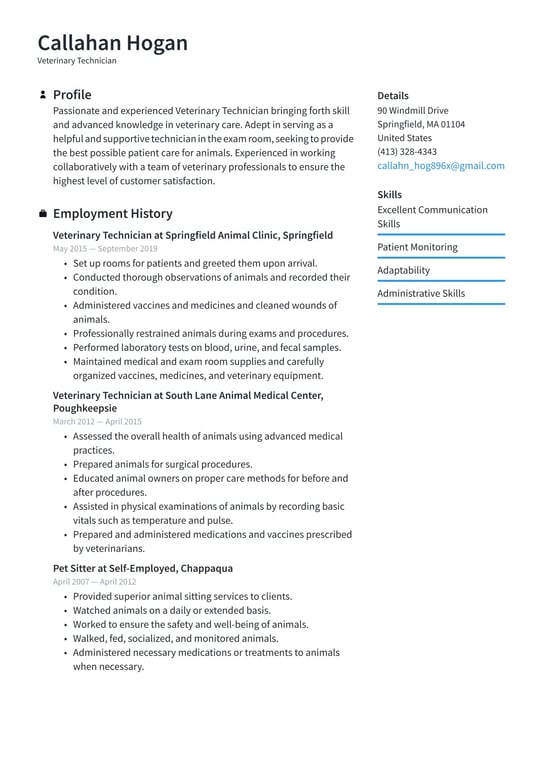
Get more ideas by reviewing our vet tech resume example work experience section below:
Veterinary Technician at Springfield Animal Clinic, Springfield
May 2015 — September 2019
• Set up rooms for patients and greeted them upon arrival.
• Conducted thorough observations of animals and recorded their
condition.
• Administered vaccines and medicines and cleaned wounds of
animals.
• Professionally restrained animals during exams and procedures.
• Performed laboratory tests on blood, urine, and fecal samples.
• Maintained medical and exam room supplies and carefully
organized vaccines, medicines, and veterinary equipment.
Veterinary Technician at South Lane Animal Medical Center,
Poughkeepsie
March 2012 — April 2015
• Assessed the overall health of animals using advanced medical
practices.
• Prepared animals for surgical procedures.
• Educated animal owners on proper care methods for before and
after procedures.
• Assisted in physical examinations of animals by recording basic
vitals such as temperature and pulse.
• Prepared and administered medications and vaccines prescribed
by veterinarians.
Pet Sitter at Self-Employed, Chappaqua
April 2007 — April 2012
• Provided superior animal sitting services to clients.
• Watched animals on a daily or extended basis.
• Worked to ensure the safety and well-being of animals.
• Walked, fed, socialized, and monitored animals.
• Administered necessary medications or treatments to animals
when necessary.
How to write a vet tech resume with no experience
If you’re applying for technician jobs without formal work experience, your resume should focus on your education, training, and transferable skills.
Move your education to the top of your resume, above your skills and experience. Highlight relevant courses you took during your vet tech program, such as veterinary medical terminology, clinical procedures, or animal care.
Your first resume should also emphasize the hands-on training or internships you completed during school. Describe what you did in your clinical rotations and the technical skills you gained, like administering medications or updating medical records.
Additionally, you can mention the transferable skills you’ve developed through school, volunteer work, or other jobs. For example, a customer service position may have taught you how to communicate effectively and practice patience.
A resume that combines your education, practical training, and transferable skills can help you land your first job at a veterinary clinic, even with no experience.
Include your relevant vet tech skills
A vet tech resume should showcase the hard and soft skills you use to care for animals and collaborate with team members.
When choosing vet tech skills for your resume, be specific about the technical strengths you have for the role. These may include anesthesia, medication administration, post-operative care, and laboratory tests. You can also include systems or equipment you’re familiar with, such as electronic medical records and diagnostic imaging equipment.
Your soft skills on a vet tech resume should show employers that you can communicate well, show compassion to animals and their owners, and stay focused in a fast-paced clinic environment. Include a range of interpersonal skills, such as communication, teamwork, empathy, and time management, to prove you can handle these parts of the job.
In our resume builder, you can choose from pre-written vet tech skills or add your own. You can also indicate your proficiency level in each skill.
Our vet tech resume example has a skills section that looks like this:
- Surgical assistance and anesthesia
- Animal handling and restraint
- Diagnostic imaging (x-ray, ultrasound)
- Client education
- Laboratory procedures
- EMR software (eVetPractice, Cornerstone)
- Fear Free certified
You should have a dedicated skills section on your vet tech resume, but don’t let that stop you from discussing your skills in other places.
For instance, in your resume summary and work experience sections, you can mention these skills:
- Clinical skills by describing how you handle animals, administer medications properly, and assist veterinarians with tests or procedures.
- Communication skills by explaining how you convey information to veterinarians, other technicians, and clients.
- Teamwork skills by outlining how you collaborate with others to improve efficiency or optimize operations in a clinic.
If you’re stuck on what skills to include, take another look at the job description. Employers will typically list the vet tech resume skills they want you to have, so start by mentioning those.
Detail your education & relevant vet tech certifications
Your education section should showcase your academic credentials. List your degree and the name of your school. If you’re a recent graduate, you can include your attendance dates; otherwise, leave them off your resume.
In this section, you should indicate that you’ve earned the required credentials to be a veterinary technician. Include your licensure or certification and list when you earned or last renewed the credential.
Your education section can also include other details about your professional development, including:
- Specialized certifications. If you’ve earned a specialized certification in an area of veterinary care, such as nutrition or emergency care, list it on your resume.
- Continuing education courses. Provide details about the ongoing education you’ve completed, such as courses, workshops, or webinars.
- Professional memberships. If you’ve joined a state or national organization, like the National Association of Veterinary Technicians in America (NAVTA), mention it in this section. This shows employers that you’re a dedicated vet tech interested in further developing your skills and expertise.
View the adaptable education section from our vet tech resume example below:
Bachelor of Biology, Marist College, Poughkeepsie September 2004 — May 2008
High School Diploma, Brookfield High School, Brookfield September 2000 — May 2004
Choose the right layout & design for a vet tech resume
When you prepare an exam room, you make sure that everything gets put in its place. Your resume design and layout need to have the same logic, structure, and organization.
Select a modern resume template with clean lines and white space between sections. Use a professional resume font, such as Georgia or Helvetica. Make your vet tech resume as easy as possible for a hiring manager to read, especially if they’re doing a quick review of your qualifications.
It’s fine to use muted colors, such as navy or olive, but avoid using bright, bold shades that can distract a hiring manager. Similarly, your resume should stay away from flashy graphics or design elements. When a hiring manager opens your resume, it should immediately convey the traits you want them to see, including organization and professionalism.
If you’re an entry- or mid-level veterinary tech, keep your resume to one page. Write concisely and use bullet points to draw attention to key details, like your achievements and technical skills. You can add a second page if you have 10 or more years of relevant experience.
Want a resume as organized as a medical record without the hassle of doing it yourself? Check out the optimized resume templates we offer, which take all of the design and formatting tasks off your to-do list.
Vet tech job market & outlook
Many households have pets and consider them to be members of the family. In the near future, there's likely to be a significant demand for vet techs who can work in clinics and provide care for these animals.
- The employment growth of vet techs is projected to be 9% between now and 2034, according to the US Bureau of Labor Statistics (BLS).
- Every year, the BLS expects employers to have around 14,300 job openings for vet techs.
- By 2034, there may be up to 146,400 veterinary technicians and technologists working in the field.
What type of salary you can make as a vet tech
Veterinary technicians make an average salary of $45,980 per year. How much you earn in this role depends on your employer, geographic area, experience, and specialization.
For example, technicians who work in educational institutions typically earn higher salaries than those working in vet clinics, according to BLS data.
Key takeaways for building a vet tech resume
As a veterinary technician, you have a unique blend of clinical expertise and compassion for your furry patients. Your resume should highlight the strengths and abilities that make you the perfect fit for a new vet tech position. Follow these guidelines to write a vet tech resume that impresses hiring managers and gets tails wagging in your next role.
Begin your job search with our resume builder, and then take it to the next level with resume.io.
Unlock 18 powerful career-boosting tools to easily search for vet tech positions, monitor your progress, prepare for interviews, and negotiate your salary with confidence using our complete career toolkit.