

Driven business development professional with 5+ years of experience identifying growth opportunities, nurturing leads, and building strategic partnerships. Skilled in lead generation, B2B outreach, and CRM systems. Focused on delivering measurable results and driving revenue in tech and SaaS industries.
01/2022 - present, Business Development Associate, Shopify, New York, NY (Hybrid)
- Prospected and closed deals with small to midsize e-commerce clients.
- Sourced 100+ qualified leads monthly through LinkedIn and email campaigns.
- Surpassed quarterly targets by an average of 15%.
10/2019 - 12/2021, Sales Development Representative, WeWork, New York, NY
- Reached out to startups and enterprises for workspace solutions.
- Scheduled over 400 qualified demos/year for the inside sales team.
- Contributed to a 23% increase in NYC region signups.
07/2017 - 09/2019, Business Development Intern → Junior Associate, Flatiron Health, New York, NY
- Supported market research for oncology software expansion.
- Assisted in coordinating outreach and partnership meetings.
- Promoted to junior associate after 12 months of internship.
- 01/2017, B.A. in Business Administration, Baruch College, City University of New York (CUNY),
- Sales Prospecting & Cold Outreach
- B2B Sales Strategy
- HubSpot
- Salesforce
- Market Research
- Lead Nurturing
- Contract Negotiation
- KPI Tracking
Your business development resume is like the opening pitch you make to a potential client. It needs to be clear, deliberate, and persuasive, showing a prospective employer that you’re the person who can lead a company toward a strategic vision and long-term growth.
A well-written business development resume highlights your value, including your measurable achievements and business acumen. Many hiring managers will know within a few seconds whether they want to take a closer look at your qualifications, so you need to make your resume count.
Don’t let your next job offer slip away. Build a business development resume that positions you as the results-driven professional any hiring manager would want to bring on board.
Guide for a business development resume example
Drive your career growth with resume.io. We offer writing guides and resume examples for over 500 professions, and our resume builder makes it easy to create a professional resume in minutes.
This guide, along with our business development resume example, will show you the following:
- How to write a business development resume
- The right resume format for business development
- Providing your contact information
- Writing an impactful resume summary
- How to list your business development experience
- Including your relevant skills and education
- How to choose the best resume design and layout
- Insights into the job market and the salary you can make
How to write a business development resume
Before you start writing your business development resume, you need to know what information to include.
Your resume should have these elements:
- A resume header
- A resume summary (also known as a profile)
- An employment history section
- A resume skills section
- An education section
Make your pitch to prospective employers with a powerful business development resume that sells your ability to bring in revenue, form new partnerships, and drive company growth. Research the company and role, and use your resume to convince the hiring manager that you’re the right person to help the organization meet its strategic goals.
Follow these tips to convert your prospective employers:
- Highlight your measurable achievements. Don’t simply list what responsibilities you’ve had in past positions. Instead, emphasize how you’ve delivered measurable results, such as increased revenue or higher conversion rates.
- Showcase your negotiation skills. Throughout your resume, provide examples to show how you’ve negotiated complex ventures or closed meaningful deals. These skills are essential for working in the business development field.
- Incorporate keywords on your resume. Many employers use applicant tracking system (ATS) software to filter resumes for keywords. Include keywords from the job description to improve your chances of moving forward.
Optimize for the ATS
ATS software scans resumes using algorithms to search for specific keywords, usually matching those found in the job description. Each time you apply for a job, customize your resume with appropriate keywords to help you pass this review.
For example, let’s look at a job posting with these listed requirements:
- Business development professional
- Revenue growth
- Market expansion
- Client relationship management
When you apply for this job, you can incorporate these words into your resume summary:
Highly skilled business development professional with over six years of experience driving revenue growth for technology companies. Proven success in market expansion with a strong record of client relationship management.
For more tips on beating the ATS, check out our article on resume ATS optimization.
Choosing the right business development resume format
Your resume should convey your ability to think strategically, which starts with choosing the best resume format.
For most business development professionals, the chronological format is the right choice. This resume style places your career achievements front and center, showing employers how you’ve delivered value in other roles. It’s the most common resume format and is usually compatible with ATS software.
However, you can also explore other formats that might better capture your true potential. A functional resume can be a good option if you’re returning to the workforce after a break or transitioning from another field, such as sales. Unlike a chronological resume, a functional resume prioritizes your skills over your professional experience.
If you want to give your skills and experience equal weight, consider a hybrid (or combination) resume. This is a solid choice if you have some experience and want to advance into a higher business development role with more responsibilities.
You can explore the resume templates we offer in our resume builder to find the right one for your career goals. If you’d like to see more examples of each style, check out the many resume examples we have available.
Include your contact information
When establishing a new business partnership, you always make sure that the other party knows how to get in touch with you. A resume header follows the same rules. It needs to provide your contact information in a clear, accessible way so that a hiring manager can easily reach out.
In your resume header, make sure to include:
- Your full name and title. Use your first and last name, followed by the job title you’re applying for, such as “Erika Jones, Business Development Manager.”
- Professional email address. Provide a clean, simple email using a combination of your name or initials, like firstinitial.lastname@email.com. Never provide a current work email or one that appears unprofessional.
- Phone number. List the phone number where recruiters and hiring managers can reach you quickly.
- Location. Provide the city and state where you’re located, but not your full address. If you’re willing to move for a new job, also add “ Willing to relocate.”
- LinkedIn. If you have an updated LinkedIn page showing your recent experience and business connections, include a link in your resume header.
Make sure not to include:
- Your age or date of birth. You shouldn’t list your age on your resume, since it can lead to potential discrimination.
- Other personal details. You don’t need to offer other personal details, like your marital status or Social Security number.
- Your photo. A photo isn’t relevant to your skills or qualifications, so you don’t need to have it on your resume.
Whitney Fields
Business Development Representative
whitney_fields@email.com
(734) 555-1374
Detroit, MI (Willing to relocate)
linkedin.com/whitney_fields
Whitney Fields
Business Whiz and Deal Closer
deal.closer989@email.com
(734) 555-1374 (cell) or (734) 555-1239 (office)
789 Main Street, Detroit, MI
Ready and eager to relocate!
DOB: 5/14/1988
Make use of a resume summary or profile
At the start of a negotiation, you want to make a confident opening statement that sets up your pitch. Treat your resume summary (also known as a profile statement) as the opening statement for your business development resume.
In two or three sentences, immediately position yourself as the right candidate to help a company increase sales, build client relationships, and identify new opportunities. Your summary should speak directly to a hiring manager who wants to know why you’re the person to lead a company toward strategic growth.
Start your summary with a brief description of your experience, including your industry expertise and market knowledge. The rest of your summary should focus on your career achievements and top skills. Provide specific details and quantifiable data to support your statements.
For example, your summary can mention how you grew a client portfolio by 18% or generated over 300 new leads for a sales team. These types of measurable results can quickly get an employer’s interest, especially when aligned with the target company’s goals.
Your resume summary should set you apart from other candidates, so avoid using generic phrases or buzzwords, like “hardworking professional” who “thrives under pressure.” Instead, highlight your unique strengths, skills, and accomplishments that showcase the potential value you can bring to a new company.
Looking for more summary ideas? Check out these related resumes from our library: business development manager resume examples, business marketing manager resume examples, sales manager resume examples, and business manager resume examples.
Review our adaptable business development resume summary examples below:
Ambitious and energetic business development professional with a strong foundation in sales and market research. Proven track record of building client relationships and generating leads with exceptional negotiation skills. Recognized for exceeding target sales by over 23% on average.
Driven business development professional with 5+ years of experience identifying growth opportunities, nurturing leads, and building strategic partnerships. Skilled in lead generation, B2B outreach, and CRM systems. Focused on delivering measurable results and driving revenue in tech and SaaS industries.
Driven business development manager with over a decade of experience leading global expansion strategies and securing strategic partnerships in the technology industry. Proven ability to identify and execute new opportunities, contributing to annual revenue growth exceeding $750k. Exceptional negotiator skilled at closing high-value deals, including over $1M in new contracts.
Outline your business development work experience: closing the deal
Your work experience section serves as your portfolio of career highlights. List your business development experience, beginning with your current or most recent job. Include all of your relevant work experience for the past 10 to 15 years. Older or less relevant jobs can go in a separate section titled “Other Experience.”
Each job on your business development resume should include your title, the company name, and your employment dates. Write bullet points to describe what you achieved in each position. Start each bullet point with a strong action verb, like “expanded,” “spearheaded,” or “executed.”
Make your statements as specific as possible, providing tangible evidence of your contributions. Generic or vague statements, like these bullet points, won’t seal the deal for a prospective employer:
- “Managed client accounts.”
- “Responsible for lead generation.”
- “Worked with the sales team.”
Your career statements need to offer additional details to impress employers and pique their interest. Focus on the results you’ve achieved, such as revenue growth or market expansion. Share how your vision and business acumen have directly contributed to a company’s bottom line.
Here are some reworked versions of the above bullet points, now focused on outcomes:
- “Secured 15 new clients in eight months, leading to a 36% increase in annual revenue.”
- “Generated over 50 new leads quarterly through strategic business partnerships, contributing to a 46% increase in conversion rates.”
- “Collaborated with a 14-person sales team to develop and implement targeted strategies that resulted in over $100,000 in new sales.”
Statements like these can help a hiring manager understand the value you can offer to their organization.
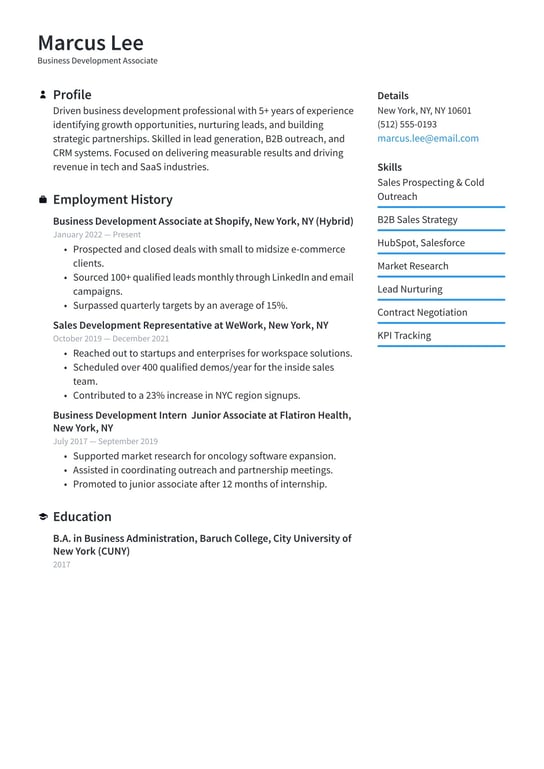
For more ideas, check out the work experience section from our business development resume example below:
Business Development Associate at Shopify, New York, NY (Hybrid)
January 2022 — Present
• Prospected and closed deals with small to midsize e-commerce
clients.
• Sourced 100+ qualified leads monthly through LinkedIn and email
campaigns.
• Surpassed quarterly targets by an average of 15%.
Sales Development Representative at WeWork, New York, NY
October 2019 — December 2021
• Reached out to startups and enterprises for workspace solutions.
• Scheduled over 400 qualified demos/year for the inside sales
team.
• Contributed to a 23% increase in NYC region signups.
Business Development Intern ’ Junior Associate at Flatiron Health,
New York, NY
July 2017 — September 2019
• Supported market research for oncology software expansion.
• Assisted in coordinating outreach and partnership meetings.
• Promoted to junior associate after 12 months of internship.
How to write a business development resume with no experience
Applying for your first business development position? Your resume should focus on your transferable skills and relevant achievements in other roles, internships, or projects.
If you have related experience in sales, client account management, or a similar area, emphasize those positions on your business development resume. Describe how you successfully managed client relationships or increased sales in those roles.
Your education can also help you overcome a lack of experience. Highlight the courses you’ve taken in business strategy, marketing, or operational planning. You can also describe student projects or internships, focusing on the relevant knowledge you gained from those experiences.
Finally, don’t forget to prioritize the transferable skills you can offer as a new business development professional. Skills such as negotiation and networking can prove that you have what it takes to deliver results in an entry-level business development role.
With these tips, you can show hiring managers that you have the passion and ability to succeed, even without formal experience.
Include your relevant business development skills
Your business development resume should include both the hard and soft skills you use to drive business growth.
Consider the hard skills you use every day as a business development professional. These may include sales prospecting, market research, lead nurturing, and technical programs like customer relationship management (CRM) software.
Your soft skills, on the other hand, are the inherent traits that allow you to build relationships and close deals. Soft skills on a business development resume often include communication, negotiation, and analytical thinking.
In our resume builder, you can choose from pre-written hard and soft skills for a business development professional. You can also add your unique skills and proficiency levels.
This is what the skills section looks like in our business development resume example:
- Sales prospecting and cold outreach
- B2B sales strategy
- HubSpot, Salesforce
- Market research
- Lead nurturing
- Contract negotiation
- KPI tracking
Don’t limit your skills to one section on your business development resume. Include them in other key places to show employers your strengths and abilities.
For example, you can highlight these skills in your resume summary and work experience sections:
- Business acumen by describing your knowledge of an industry or market, including recent trends and challenges.
- Negotiation skills by explaining how you’ve successfully closed contract deals or partnership agreements.
- Relationship-building skills by outlining how you’ve strengthened relationships with clients or partners and how those connections have benefited companies.
Not sure what skills to include? Review the job description and tailor your business development resume to highlight the abilities that an employer wants top candidates to have.
Detail your education & relevant business development certifications
In your education section, list your academic credentials and achievements. Provide your college degree and the name of the school you attended. If you have a Master of Business Administration (MBA) or other advanced degree, list it above your bachelor’s degree.
Beyond your formal education, you can also discuss other training you’ve completed for a business development role, including:
- Certifications. List relevant certifications you’ve earned, such as the Certified Business Development Expert (CBDE) credential.
- Professional training. Discuss the ongoing training you’ve done to keep your business development skills up to date. This training can include industry workshops, conferences, and continuing education courses.
- Professional memberships. Becoming a member of a professional organization can show your commitment to building your skills and expanding your network. Include your memberships in both national organizations and local groups, such as your regional chamber of commerce.
View the education section from our business development resume example below:
B.A. in Business Administration, Baruch College, City University of New York (CUNY)
2017
Select the best layout & design for a business development resume
When pitching a new prospective client, you want to put your best foot forward. In the same way, your resume should immediately convey the qualities you want a prospective employer to see in you: professionalism, strategic thinking, and a clear vision.
Choose a streamlined template for your business development resume. Use a traditional business font, such as Times New Roman or Arial. Set standard page margins and use white space consistently throughout your resume.
You want your resume to provide a clear, logical picture of your experience and skills without overwhelming the reader. Keep colors, graphics, and other stylistic elements to a minimum.
Write concisely so that your business development resume fits on one page. If you have too much relevant experience to fit onto one page, you can use a second page.
Want to spend less time on formatting? Use our optimized resume templates to design your resume quickly. We’ve handled the time-consuming process of structuring your resume, so that you can focus on what you do best: closing the deal.
Business development job market & outlook
The job market looks promising for business development professionals. The US Bureau of Labor Statistics projects that overall employment in business and financial occupations, including business development, will increase more quickly than other professions over the next decade.
- Between now and 2034, employment of business and financial professionals will likely grow faster than the average growth of the general workforce, which is projected to be 3.1%.
- Employers of business and financial professionals will have an estimated 942,500 openings yearly, on average, over the next decade.
What type of salary you can earn in business development
The salary you earn as a business development professional will largely depend on your role and experience level.
The highest-paid professionals in this field include chief business development officers, who make an average salary of $352,497 per year.
In contrast, more entry-level positions like business development associates earn anywhere from $68,292 per year to $150,008 per year.
Key takeaways for building a business development resume
Your resume is your pitch to prospective employers. It’s an opportunity to show them why you’re a qualified professional who can close deals and drive growth for a new company. Target your resume to the position, highlight your contributions, and focus on the impact you can make in a new role. With these tips, you can convert a promising lead into your next career move.
Kickstart your business development job search with our resume builder, and then supercharge it with resume.io.
Discover 18 comprehensive tools to search for jobs, track your progress, ace your interviews, and negotiate the best salary—all within our powerful career toolkit.