

Detail-oriented and analytical biology graduate seeking a lab assistant position at the Broad Institute of MIT and Harvard to contribute to cutting-edge research, develop technical skills, and gain valuable experience in a world-class scientific environment.
01/2019 - 05/2020, Undergraduate Research Assistant, Boston University, Boston
- Assisted in a study investigating the effects of environmental stressors on gene expression in Drosophila melanogaster
- Conducted PCR, gel electrophoresis, and RNA extraction experiments under the supervision of a postdoctoral researcher
- Analyzed and interpreted data using statistical software (R) and contributed to the preparation of a manuscript for publication
09/2016 - 05/2020, Bachelor of Science in Biology, Boston University, Boston
- GPA: 3.7/4.0
- Molecular biology techniques
- Cell culture and aseptic technique
- Laboratory equipment operation
- Laboratory safety protocols
- Data analysis software (R
- GraphPad Prism)
- Microsoft Office (Word
- Excel
- PowerPoint)
- ImageJ
- Basic programming (Python
- R)
A lab assistant resume needs to show three things fast: the techniques you can perform, the equipment you can operate, and the safety training you hold. This Resume.io lab assistant resume example gives you a complete sample, then works through each section, including what to do when you have no lab experience yet.


Related Resume Examples
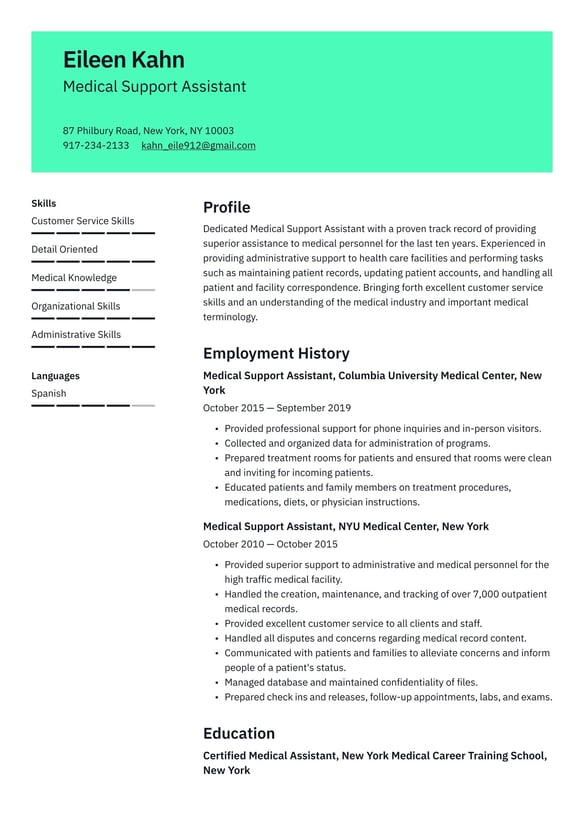
Medical Support Assistant resume example
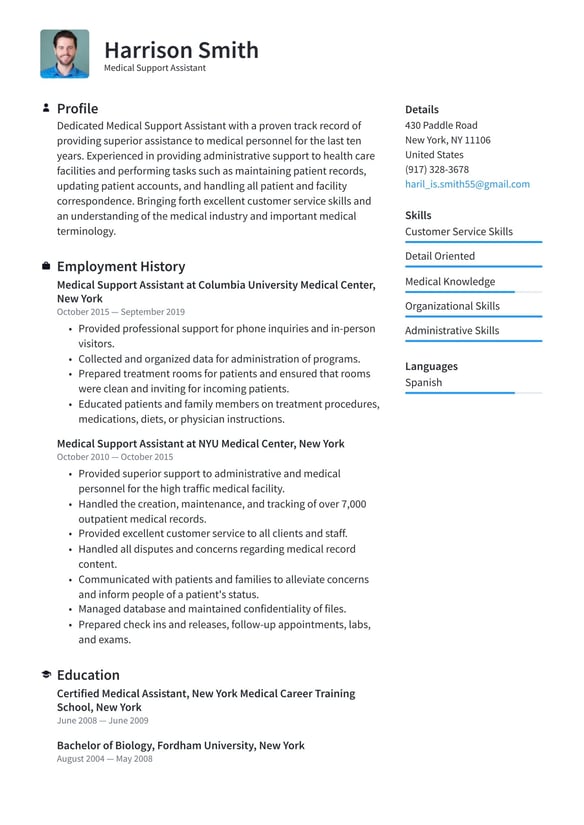
Focused on clean lines and a structured layout, this template highlights your organizational skills and professionalism as a Medical Support Assistant. Its subtle color accents and clear formatting showcase your expertise, fostering trust with healthcare employers.
Medical Receptionist resume example
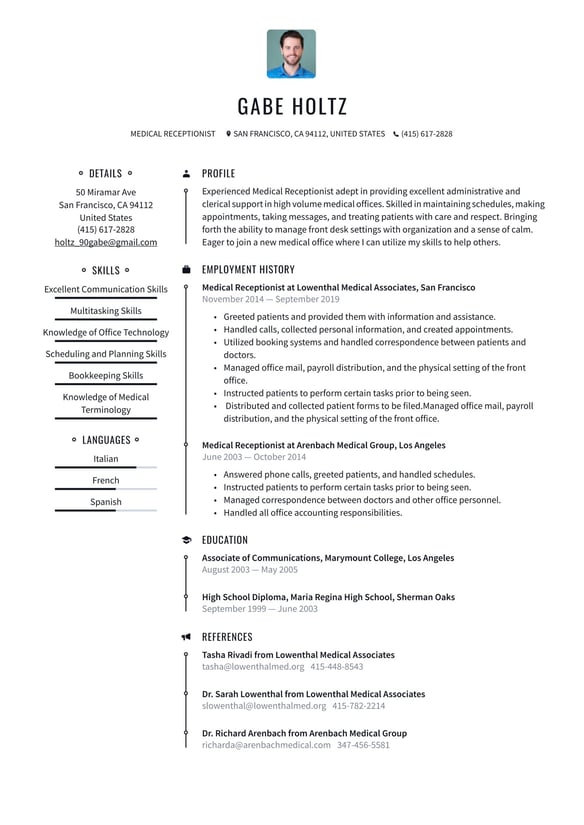
Created for medical receptionists, this clean, organized layout highlights your multitasking skills and professionalism in patient care. Its balanced structure and subtle design elements showcase your expertise, fostering trust with healthcare employers.
Healthcare Social Worker resume example
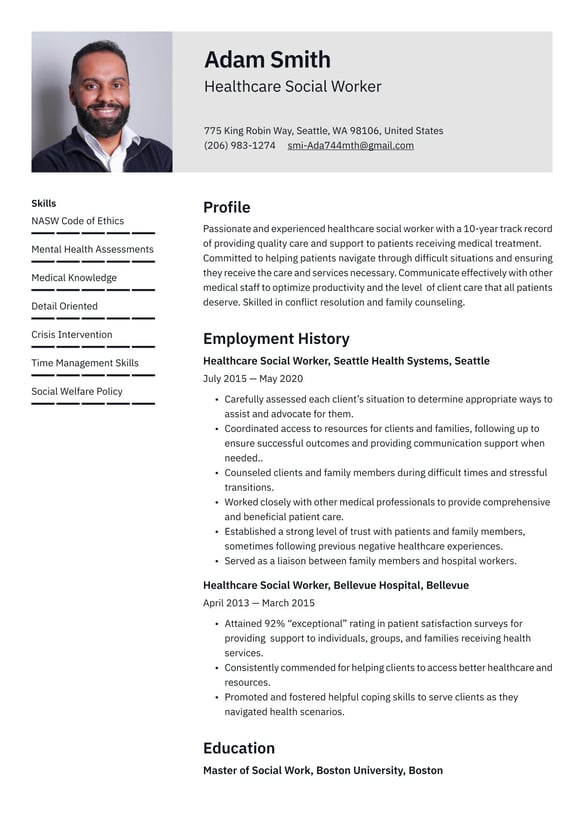
Aligned with the compassionate and resourceful nature of healthcare social work, this template’s clean layout and calming color palette highlight your expertise in patient advocacy and counseling. Its structured design ensures your skills resonate with medical teams and families alike.
Medical Administrative Assistant resume example
Crafted for healthcare professionals, this clean, organized layout highlights your administrative expertise and patient care skills. Its intuitive structure showcases your medical knowledge and customer service strengths, helping you connect with hiring managers in clinical settings.
Medical Coder resume example
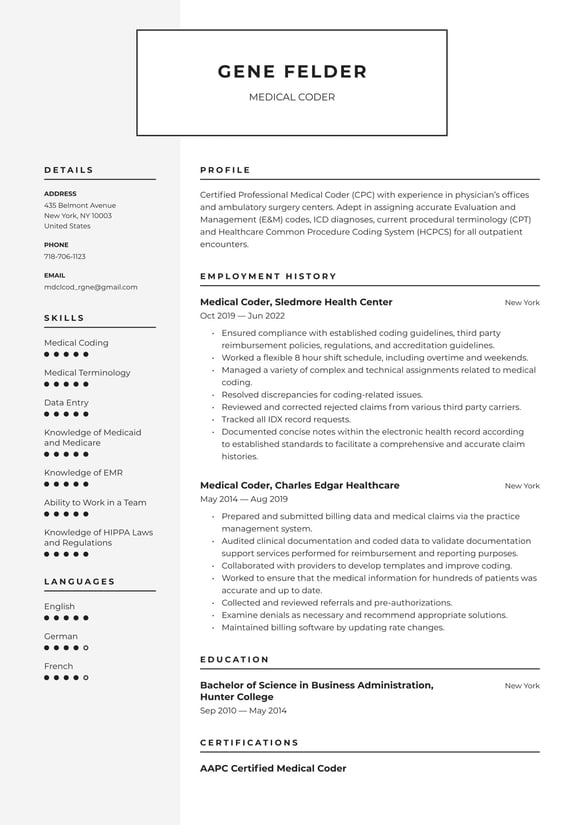
Crafted for precision-driven professionals, this clean, structured layout highlights your analytical expertise and attention to detail as a Medical Coder. Its organized sections showcase your coding accuracy and compliance skills, impressing healthcare employers and billing teams alike.
Phlebotomist resume example
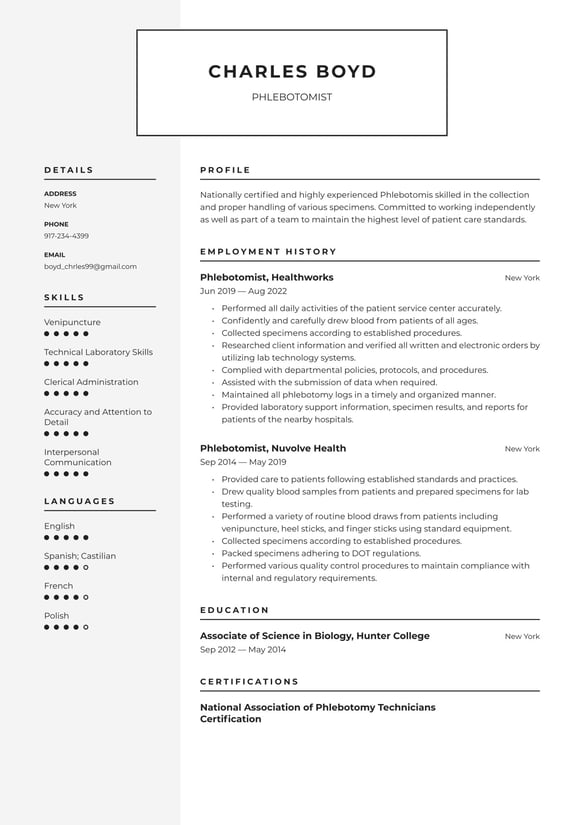
Created for phlebotomists, this clean, professional layout highlights precision and care. Its organized structure showcases your technical skills, certifications, and patient-focused experience, helping you connect with healthcare recruiters and stand out in clinical roles.
Lab Technician resume example
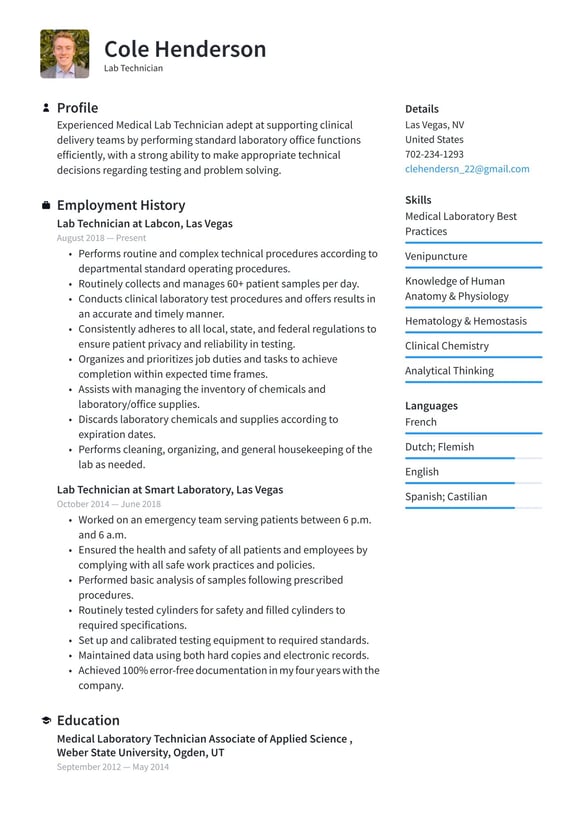
Engineered for precision and clarity, this template’s clean, organized layout highlights your technical expertise and problem-solving skills as a Lab Technician. Its structured design ensures your qualifications resonate with clinical and scientific audiences.
Clinical Research Coordinator resume example
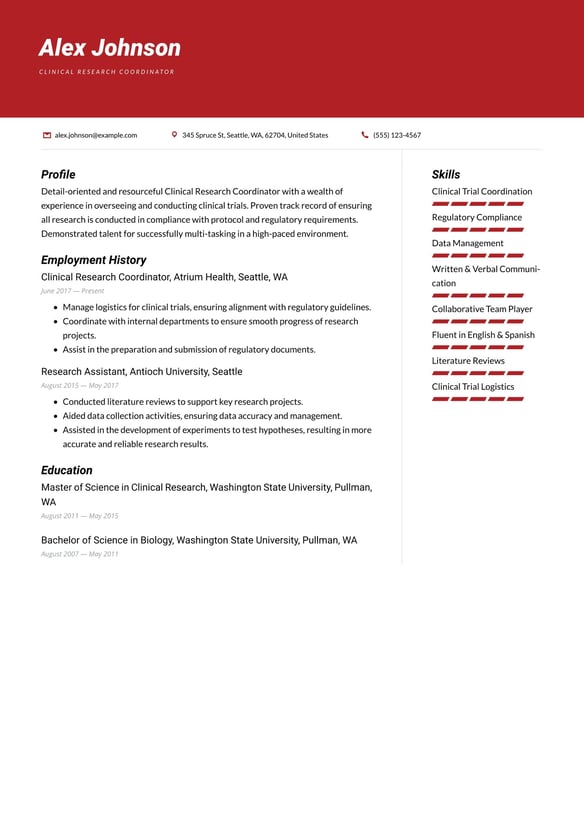
Targeted at Clinical Research Coordinators, this clean, organized layout highlights precision and professionalism. Its structured sections emphasize regulatory expertise and trial coordination skills, helping you confidently showcase your qualifications to research institutions and healthcare organizations.
Medical Assistant resume example
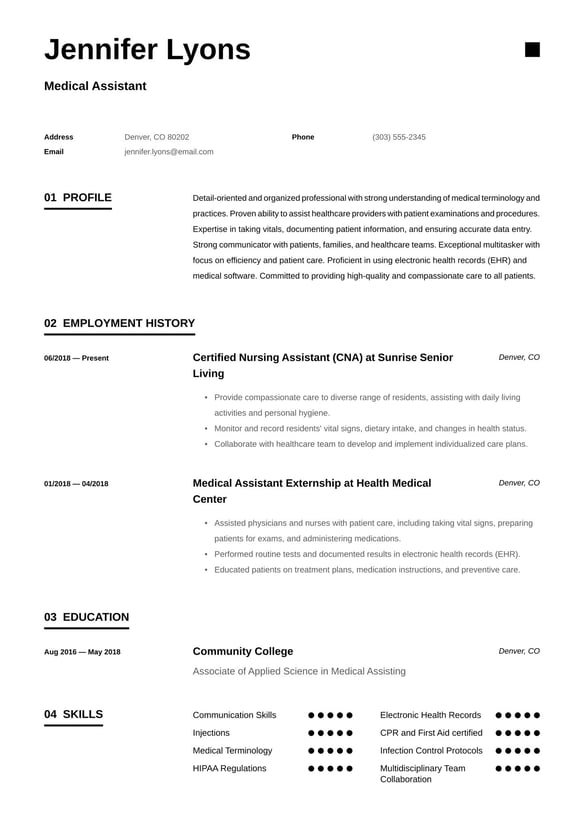
A smart fit for medical assistants, this clean, well-structured layout highlights your multitasking, patient care, and EHR expertise. Its professional formatting ensures your skills and certifications shine, appealing to healthcare providers and clinics.
Lab assistants support the scientists, technologists, and technicians who run testing and research.
The work happens in hospital and diagnostic labs, university research groups, industrial quality control, and school teaching labs.
Most roles are open to applicants with a high school diploma or an associate degree, so your skills section carries more weight here than your job titles.
At a glance
- Put techniques and equipment near the top, because a lab manager scans for them first.
- Name your safety training, such as OSHA standards, bloodborne pathogens, or chemical hygiene.
- Match your skills to the lab type, since clinical, research, and quality control labs want different things.
- No lab job yet is normal in this field, so lead with coursework, lab classes, and training instead.
Lab assistant resume example
Like the other resume examples on Resume.io, this one is written to be adapted rather than copied.
Marlon Aldaya
Biology Lab Assistant
Hammond, IN | Willing to relocate | marlon.aldaya@email.com | (219) 555-0194 | linkedin.com/in/marlonaldaya
Summary
Biology lab assistant with 4 years of experience in a high-volume research lab. Streamlined the specimen intake process to increase the number of samples analyzed by 8%. Skilled in PCR, gel electrophoresis, and RNA extraction, with a record of troubleshooting equipment issues before they delay a run.
Employment history
Lab Assistant, Midwest Genomics Research Center, Hammond, IN
June 2022–Present
- Prepare samples and reagents for a team of 6 researchers running gene expression studies
- Redesigned the specimen intake log, increasing the number of samples analyzed per week by 8%
- Validated data accuracy by introducing a two-person, double-entry protocol
- Train 2 new lab assistants each year on equipment handling and decontamination procedures
Undergraduate Research Assistant, Boston University, Boston, MA
January 2019–May 2020
- Assisted a study on the effects of environmental stressors on gene expression in Drosophila melanogaster
- Conducted PCR, gel electrophoresis, and RNA extraction under the supervision of a postdoctoral researcher
- Analyzed data in R and contributed to a manuscript prepared for publication
Skills
Molecular biology techniques, cell culture and aseptic technique, pipetting and centrifugation, laboratory equipment operation, laboratory safety protocols, data analysis in R and GraphPad Prism, ImageJ, Microsoft Excel
Education
Bachelor of Science in Biology, Boston University, Boston, MA
September 2016–May 2020
GPA 3.7/4.0
Training
Laboratory Safety Training, 2022
Bloodborne Pathogens Training, 2022
How do you write a lab assistant resume with no experience?
Write a lab assistant resume with no experience by leading with your lab coursework, the techniques you practiced in class, and any safety training you hold.
Lab managers hire assistants expecting to teach the local protocols, so what they look for is whether you can follow a procedure exactly and record what you did.
Every science class with a lab component gave you something to list.
If you ran titrations, prepared slides, used a microscope, or recorded results in a lab notebook, those are the techniques employers screen for.
- List relevant coursework by name, such as microbiology, organic chemistry, or genetics, rather than just your degree.
- Describe lab classes as experience: the techniques used, the equipment operated, and how results were documented.
- Include any internship, summer placement, or research placement, however short.
- Add volunteer work at a science center, hospital, or community program
- Draw on transferable skills from other jobs, since a stockroom job shows inventory control and a cafe job shows following procedure under time pressure.
- Put your education section above your employment history, so your training is the first thing read.
A functional or hybrid format suits this situation, because both give your skills and education more room than a short work history.
Should you use an objective if you are just starting out?
No. Use a summary instead, even as a recent graduate.
Amanda Augustine, CPRW, CPCC, Resume.io’s resident career expert, puts it directly: “Even for recent college graduates, a traditional career objective isn’t the best move. Instead, I recommend creating a professional summary that highlights your education, relevant coursework, internships, skills, and passion for the industry you’re targeting.”
The difference is what the opening lines are about.
An objective describes what you want from the lab but a summary describes what you bring to it.
What should you include in each section of a lab assistant resume?
A lab assistant resume should cover the key areas of a resume: a header, a summary, a skills section, your employment history, and your education and training.
Put skills high on the page, because in lab hiring your techniques and equipment matter more to a hiring manager than your job titles.
1. Summary
A lab assistant resume summary is two or three sentences that introduce you to the lab manager.
State the kind of lab you work in, your strongest techniques, and one result you achieved.
Avoid repeating lines from your work history, since a summary should give an overview rather than a preview.
Use confident verbs such as collect, examine, sterilize, and analyze, then follow them with evidence.
Entry-level summary example
Biology graduate with an associate degree in chemistry and a grounding in safety protocol, lab procedures, and instrumentation. Experienced in pipetting, microscopy, and solution preparation through two years of practical coursework. Keen eye for detail, with accurate data collection across every lab module.
Research lab assistant summary example
Resourceful biology lab assistant with 4 years of experience in a fast-paced research environment. Streamlined the intake process to increase the number of specimens analyzed by 8%. Skilled in troubleshooting equipment issues to optimize performance, and proficient in laboratory techniques, equipment operation, and data analysis methods.
Medical lab assistant summary example
Certified medical lab assistant with 3 years of experience processing blood, urine, and tissue specimens in a hospital diagnostic lab. Accessions and centrifuges an average of 120 specimens per shift while maintaining labelling accuracy. CMLA certified, with current bloodborne pathogens and HIPAA training.
2. Skills
Your resume skills section should name specific techniques, equipment, and software rather than general traits.
Hard skills tell a lab manager what you can do on your first day, which matters more in lab hiring than in most fields.
Data skills are worth listing wherever you have them.
Data analysis was among the highest-placing resume skills for hiring at 22.9%, followed by Python at 22.1% and SQL at 21.4%, against a cohort average of 15.8% (Resume.io, Resume Skills Study, 2026).
For lab assistants, that covers recording and analyzing results in R, Python, Excel, or a lab information management system (LIMS).
Match your list to the type of lab you are applying to.
| Lab type | Techniques and tools worth listing |
|---|---|
| Clinical and diagnostic | Specimen processing, accessioning, centrifugation, phlebotomy, labelling accuracy, LIMS or LIS data entry, HIPAA compliance |
| Research | PCR, DNA and RNA extraction, gel electrophoresis, cell culture, aseptic technique, ELISA, spectrophotometry, data analysis in R or Python |
| Academic and teaching | Solution and reagent preparation, equipment setup for student labs, microscopy, inventory control, supporting instructors |
| Industrial and quality control | Sample testing, titration, calibration, quality control procedures, Good Laboratory Practice, batch documentation |
List the equipment you have operated by name, such as centrifuges, spectrophotometers, analytical balances, light microscopes, and pH meters.
A lab manager reads an equipment list as the training they will not have to provide.
Soft skills belong on the page too, because lab assistants rarely work alone.
Collaboration with researchers, attention to detail when recording results, organizational skills for inventory and sample tracking, and problem solving when equipment misbehaves all have a place.
Prove each one in your work history rather than leaving it as a claim.
3. Safety and compliance
Name your safety training explicitly, because labs treat it as a hiring requirement rather than a bonus.
A candidate who already understands protocol is one the lab can put to work sooner, and one less likely to cause an incident.
Worth listing where you hold it:
- OSHA laboratory standards and general safety training
- Bloodborne pathogens training, for clinical and medical labs
- Chemical hygiene and safe handling of hazardous materials
- Personal protective equipment (PPE) procedures
- Safety data sheet (SDS) navigation
- Hazardous and biohazardous waste disposal
- Good Laboratory Practice (GLP), for industrial and quality control labs
- Decontamination and sterilization procedures
Show it in your experience as well.
A bullet such as “Trained 3 lab assistants in decontamination procedures and OSHA safety standards” does more than a line in a list.
4. Employment history
List your jobs in reverse chronological order, starting with the most recent.
Begin each bullet item with a strong action verb such as processed, prepared, calibrated, documented, or mentored.
Showcase your accomplishments rather than duties, since a list of tasks reads as though it was copied from the job ad.
A weak employment history section looks like this: “Collected data for experiments. Maintained lab equipment. Adhered to safety standards. Prepared samples.”
Nothing there separates you from any other applicant.
Quantifying your achievement is what changes that.
Lab work produces numbers readily: samples processed per shift, turnaround time, team size, accuracy or error rates, and inventory value.
| Instead of | Try |
|---|---|
| Collected data for experiments | Validated the accuracy of all data collected through an enhanced two-person, double-entry protocol |
| Maintained lab equipment | Created a checking system that kept all equipment at optimal working level |
| Adhered to safety standards | Cleaned and sterilized equipment and organized supplies to meet all safety standards |
| Prepared samples | Prepared 200+ biological samples using aseptic technique while maintaining accurate records |
Student and placement roles count here.
A semester as an undergraduate research assistant is lab experience, so list it as a job rather than burying it in your education section.
5. Education and certifications
The education section of a lab assistant resume is a straightforward list of your qualifications.
Most labs set the bar at a high school diploma or GED, though many prefer an associate’s degree in a science subject.
List relevant coursework by name if you are early in your career, because a line reading microbiology, biochemistry, and genetics tells a lab manager which techniques you have met.
Include a degree in progress with the school, the program, and your expected completion date.
Education example
- Bachelor of Science in Biology, Boston University, Boston, MA
September 2016–May 2020
GPA 3.7/4.0
A certification is not required for most lab assistant jobs, but it separates you in clinical settings.
The Certified Medical Laboratory Assistant (CMLA) credential from American Medical Technologists is the common one.
You can qualify either by completing an approved training program, or through the work experience route, which asks for at least 1,040 hours, about six months, of work in the past three years where laboratory technology was the main focus (American Medical Technologists).
Phlebotomy certification, CPR or BLS, and professional memberships in science organizations are also worth a line.
6. Layout and format
Precision and attention to detail are the qualities a lab manager is hiring for, so your layout should demonstrate both.
Proofread carefully, including the spelling of techniques, species names, and equipment, since an error in scientific terminology is noticed immediately in this field.
Keep the design clear by avoiding graphics and images, and if you choose to add color, keep it minimal and well away from the text.
Use clear section separation, ample margins, and easy-to-read fonts.
Reverse chronological is the standard format for experienced lab assistants.
A simple layout from our resume templates handles the formatting for you, and the resume builder online saves the result as a PDF.
7. Tailoring to the job posting
Send a customized resume for every application, because a phlebotomy lab and a genetics research group want different things from the same job title.
Research the lab, the kind of testing it performs, and the techniques named in its posting.
Most online applications pass through ATS filtering software, which ranks resumes on keywords drawn from the listing.
A template optimized for the ATS helps your document parse cleanly.
Say a posting asks for a medical lab assistant, excellent attention to detail, two years of experience in a lab setting, an associate degree in a science field, and CMLA certification preferred.
A tailored summary could read:
“CMLA certified medical lab assistant with an associate degree in biotechnology. Two years of experience in a fast-paced phlebotomy lab environment. Excellent attention to detail and adherence to all health and safety standards.”
Every term the lab asked for appears, and every one of them is true.
What mistakes should you avoid on a lab assistant resume?
The most common lab assistant resume mistakes are leaving techniques and equipment unnamed, describing duties instead of results, and omitting safety training.
Each one makes a capable candidate look interchangeable with every other applicant.
| Mistake | Fix |
|---|---|
| Writing “assisted with experiments” | Name the techniques, such as pipetting, PCR, or spectrophotometry |
| Leaving equipment out | List the instruments you have operated by name |
| Skipping safety training | State your OSHA, bloodborne pathogens, or chemical hygiene training |
| Listing duties rather than results | Add numbers: samples per shift, turnaround time, team size |
| Omitting coursework when early in your career | List relevant science modules by name |
| Using the same resume for every lab | Match your skills to the lab type in the posting |
| Letting a typo through | Check the spelling of every technique, species, and instrument |
Frequently asked questions
Here are answers to three questions lab assistants often ask about their resumes.
How do you describe a lab assistant on a resume?
Describe a lab assistant by the support you provide and the techniques you perform, not by the job title alone.
A strong description names the lab setting, the samples or experiments you handle, and the procedures you follow, for example: “Prepared samples and reagents for a team of six researchers running gene expression studies.”
Should a lab assistant resume be one page?
Yes, a one-page resume suits most lab assistants, particularly at entry level.
One page holds a summary, your skills, recent roles, education, and training.
Lab assistants with long histories across several labs can use two pages if every line earns its place.
Do you need a degree to be a lab assistant?
Not usually. Most lab assistant roles ask for a high school diploma or GED, and many employers prefer an associate degree in a science subject.
A degree, a CMLA certification, or completed lab coursework all strengthen an application, and research labs often expect a bachelor’s degree in a relevant science.