

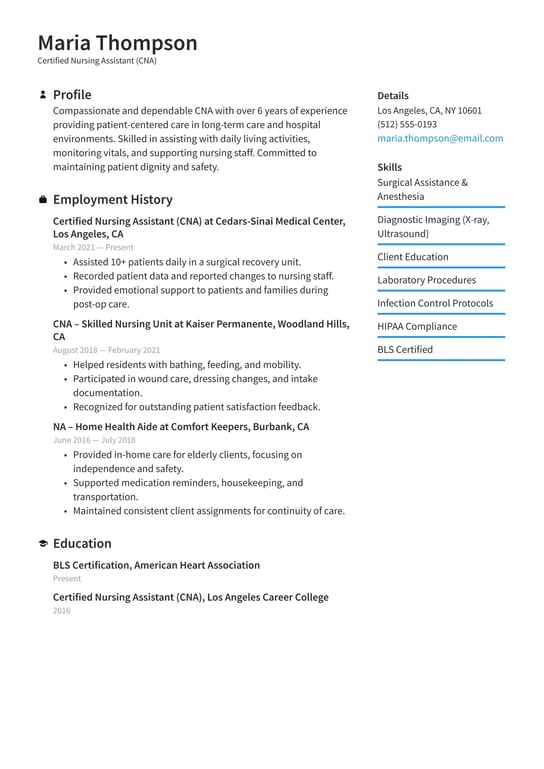
Compassionate and dependable CNA with over 6 years of experience providing patient-centered care in long-term care and hospital environments. Skilled in assisting with daily living activities, monitoring vitals, and supporting nursing staff. Committed to maintaining patient dignity and safety.
03/2021 - present, Certified Nursing Assistant (CNA), Cedars-Sinai Medical Center, Los Angeles, CA
- Assisted 10+ patients daily in a surgical recovery unit.
- Recorded patient data and reported changes to nursing staff.
- Provided emotional support to patients and families during post-op care.
08/2018 - 02/2021, CNA – Skilled Nursing Unit, Kaiser Permanente, Woodland Hills, CA
- Helped residents with bathing, feeding, and mobility.
- Participated in wound care, dressing changes, and intake documentation.
- Recognized for outstanding patient satisfaction feedback.
06/2016 - 07/2018, NA – Home Health Aide, Comfort Keepers, Burbank, CA
- Provided in-home care for elderly clients, focusing on independence and safety.
- Supported medication reminders, housekeeping, and transportation.
- Maintained consistent client assignments for continuity of care.
- 01/2016, Certified Nursing Assistant (CNA), Los Angeles Career College,
- Surgical Assistance & Anesthesia
- Diagnostic Imaging (X-ray
- Ultrasound)
- Client Education
- Laboratory Procedures
- Infection Control Protocols
- HIPAA Compliance
- BLS Certified
Ready to land your next nursing assistant job? Your resume is the first chance you have to show employers that you can handle the vital signs of patient care and teamwork.
A nursing assistant resume needs to give hiring managers a clear understanding of your patient care skills and experience. It should show your ability to assist patients with daily living tasks, such as bathing, dressing, and mobility, while making them feel cared for and supported.
Just as you meticulously document patient charts, your resume needs to be precise and specific to convince an employer that you’re the right person to join a caregiving team. A powerful, well-crafted nursing assistant resume can be the prescription that jump-starts your career.
Guide for a nursing assistant resume example
Give your job search a boost with resume.io. Our writing guides and resume examples cover over 500 professions, and we offer an easy-to-use resume builder to help you create one in minutes.
This writing guide and corresponding nursing assistant resume example will cover these topics:
- How to write a nursing assistant resume
- Picking the best resume format
- How to include your contact information
- Writing an attention-worthy summary
- Adding your healthcare experience
- How to provide your skills and education
- Choosing the right resume design and layout
- The job market and salary expectations for nursing assistants
How to write a nursing assistant resume
Know what information to include before you start writing your nursing assistant resume.
It should have these sections:
- A resume header
- A resume summary (also known as a profile)
- An employment history section
- A resume skills section
- An education section
Your nursing assistant resume should read like a patient chart: clear, organized, and detailed. Take the time to understand the facility’s needs and patients. On your resume, show a nurse manager why you’d make an excellent addition to the organization’s care team.
Make your case to prospective employers with these tips:
- Highlight your achievements. Along with your practical knowledge and skills, a nursing assistant resume should showcase your achievements, such as increasing patient satisfaction scores or reducing safety incidents. Mention these accomplishments throughout your resume.
- Tailor your resume for each job. If you’re applying for multiple jobs, customize your resume to each facility and role. For example, a hospital may want nursing assistants with experience administering medications, while a nursing home may value candidates who can offer emotional support to elderly patients.
- Showcase hard and soft skills. Your resume should outline your clinical knowledge, such as vital signs and infection control. It should also describe the soft skills you use to build relationships with patients, like communication and compassion.
- Choose an ATS-friendly template. Some healthcare facilities use applicant tracking system (ATS) software to filter resumes. To optimize your resume for the ATS, use a clean, modern template with a one- or two-column format.
Conquer the ATS
If you want to give your resume the best chance of moving forward, think about the ATS as you’re writing. Incorporate keywords from the job description throughout your resume.
For example, let’s look at a job posting with these keywords listed as requirements:
- Certified Nursing Assistant
- Compassionate and team-oriented
- Basic nursing skills
- Maintains a safe patient environment
If you’re applying for this job, you can include these keywords in your resume summary:
Compassionate and team-oriented Certified Nursing Assistant with over three years of experience caring for elderly patients in long-term care settings. Capable of providing basic nursing skills, including vital signs, pulse oximetry, and venipuncture. Skilled in specialized care for patients with cognitive decline and committed to maintaining a safe patient environment for all.
Want more tips on the ATS? Read our article about resume ATS optimization.
Choosing the right nursing assistant resume format
When you arrive for a shift, you take a few moments to prepare and get organized. Your resume format also needs the same structure to be effective.
For most nursing assistants, the chronological resume format will be the best fit. This style tells your career story by putting your professional experience at the forefront. It lists your nursing assistant jobs in reverse order, starting with your most recent position.
If you’re new to the healthcare field, another resume format may work better. Choose a functional resume if you’re applying for your first job or transitioning from another field. This format focuses on the relevant skills you have, rather than your limited or irrelevant experience.
A combination (or hybrid) resume is a third option if you want to highlight both your skills and experience. This format often works well for those with some healthcare experience who also have specialized clinical skills.
Struggling to choose the right format? Check out the resume templates we offer or explore our resume examples to see variations of each format.
Include your contact information
You know how to communicate clearly with patients, nurses, and other healthcare providers. Make sure that you do the same with hiring managers. This starts with having a prominent resume header with your contact information clearly listed.
In this section, include these details:
- Your full name and title. List your full name and the title of the job you’re pursuing, such as nursing assistant. Only call yourself a “Certified Nursing Assistant” if you’ve earned this credential.
- Professional email address. If you don’t have one, set up a professional email using your name, initials, or a combination thereof. For example, you can use the format firstname.lastname@email.com.
- Phone number. List the best phone number for recruiters to reach you. Record a professional voicemail greeting in case you miss a hiring manager’s call.
- Location. Your location should only include your city and state, never your full address. If you’re applying for jobs in another area, include the phrase “ Willing to relocate.”
- LinkedIn. If you have an updated LinkedIn profile showing your recent nursing assistant experience, you can provide a link in your resume header.
Don’t include these details:
- Date of birth. Leave your age and birthdate off your resume to prevent potential age discrimination.
- Personal details. Your resume doesn’t need to include your marital status, driver’s license number, or other personal information.
- Photo or headshot. It’s unnecessary to have a photo of yourself on a nursing assistant resume.
Brenda Whitfield
Nursing Assistant
b_whitfield@email.com
(374) 555-4713
Minneapolis, MN
linkedin.com/b_whitfield
Brenda Whitfield
Compassionate Caregiver
aidans_mom_4739@email.com
(374) 555-4713 (no calls after 5 p.m. please)
123 Oak Avenue, Minneapolis, MN
Married with one child
Write a resume summary or profile statement
Like your bedside manner, your resume summary (also known as a profile statement) should be warm and inviting while showing hiring managers that you’re a competent, qualified nursing assistant.
At the top of your resume, write two to three sentences outlining your career, clinical skills, and biggest strengths as a nursing assistant. Mention the facilities where you’ve worked and the types of patients you’ve helped.
You don’t need to list all of your clinical abilities in a resume summary. Instead, focus on demonstrating your impact as a nursing assistant. Include specific examples or evidence of your accomplishments. For example, you can mention how you earned formal recognition from a past employer for your diligence in updating patient records.
If you can, back up your accomplishments with quantifiable data or statistics. Include the number of patients you supported during shifts or the increase in satisfaction scores during your tenure. These numbers can impress prospective employers and instantly give you more credibility.
Your resume summary is also the best place to show your personality. Define yourself as a nursing assistant who remains calm under pressure or a nurturing caregiver who excels at earning patients’ trust. Give a hiring manager some understanding of the role you can fill on a healthcare team.
Looking for more summary guidance? Review these related resumes: nurse resume examples, new graduate nursing resume examples, licensed practical nurse resume examples, and nursing home resume examples.
Check out these adaptable summaries from nursing assistant resume examples:
Friendly and energetic nursing assistant with recent certification and clinical training in long-term care settings. Knowledgeable about assisting patients with daily living activities to support their well-being. Passionate about bringing empathy to every shift and patient.
Compassionate and dependable CNA with over 6 years of experience providing patient-centered care in long-term care and hospital environments. Skilled in assisting with daily living activities, monitoring vitals, and supporting nursing staff. Committed to maintaining patient dignity and safety.
Highly skilled Certified Nursing Assistant with over 10 years of experience providing patient support in acute and long-term care facilities. Proven ability to train junior CNAs and lead teams to maintain compliance with professional care standards. Contributed to an 18% increase in satisfaction scores through a commitment to providing patient-focused care.
Outline your nursing assistant work experience: your career vital signs
In your work experience section, explain the impact you’ve made on patients and healthcare teams. List your previous healthcare jobs, starting with your most recent position. Include all of the relevant jobs you’ve had for the past 10 to 15 years.
Each job should list your title, your employer’s name, and the dates you worked there. Below this information, write bullet points summarizing your core duties and achievements in the role. Start each bullet point with a strong action verb, such as “monitored,” “documented,” or “supported.”
Be as specific as possible about the outcomes of your work, not just what you did. Many nursing assistant resumes will have similar task-focused bullet points, like these:
- “Supported patients in daily activities.”
- “Assisted nursing staff.”
- “Helped with patient care.”
When prospective employers see these vague statements, it leaves them wondering about the difference you’ve made in other roles. Rework these bullet points with more details to show your measurable impact:
- “Supported 10+ patients per shift with personal hygiene and mobility to improve their comfort and quality of life.”
- “Collaborated with nursing staff to organize shift changes more effectively, leading to a 14% increase in efficiency.”
- “Documented patients’ vital signs and updated electronic health records to promote better coordination across departments.”
For more help, check out our adaptable nursing assistant resume example work experience section below:
Cedars-Sinai Medical Center, Los Angeles, CA
Certified Nursing Assistant (CNA)
March 2021 — Present
• Assisted 10+ patients daily in a surgical recovery unit.
• Recorded patient data and reported changes to nursing staff.
• Provided emotional support to patients and families during post-op care.`
Kaiser Permanente, Woodland Hills, CA
CNA – Skilled Nursing Unit
August 2018 — February 2021
• Helped residents with bathing, feeding, and mobility.
• Participated in wound care, dressing changes, and intake documentation.
• Recognized for outstanding patient satisfaction feedback.``
Comfort Keepers, Burbank, CA
NA – Home Health Aide
June 2016 — July 2018
• Provided in-home care for elderly clients, focusing on independence and safety.
• Supported medication reminders, housekeeping, and transportation.
• Maintained consistent client assignments for continuity of care.
How to write a nursing assistant resume with no experience
If you’re applying for your first nursing assistant job, you can portray confidence in your abilities by highlighting your relevant skills and training. Discuss the coursework you completed, such as anatomy, medical terminology, or patient care delivery.
You should also showcase the hands-on training you received as part of your nursing assistant program. Highlight the clinical rotations you completed and the experience you gained in caring for patients.
Your first nursing assistant resume can also focus on your transferable skills. These may include communication, teamwork, empathy, and time management. Share ways you’ve built or used those skills in other settings, such as through volunteer work or part-time jobs in other industries.
These tips can help you make a convincing case for employers to hire you, even if you may not have any on-the-job experience yet.
Include your relevant nursing assistant skills
Your nursing assistant resume should have a healthy balance of hard and soft skills to show both your clinical strengths and your ability to provide compassionate, patient-centered care.
Some clinical nursing assistant skills for a resume include vital signs, documentation, infection control, medical equipment, and electronic health records. These hard skills prove that you have the core competencies required to provide basic patient care.
Other skills on your resume should highlight your interpersonal strengths. Soft skills for a nursing assistant resume often include organization, compassion, patience, communication, and relationship building.
With our resume builder, you can choose from pre-written nursing assistant skills for your resume, or provide your own. You can also add your proficiency level in each skill.
Here’s what the skills section looks like in our nursing assistant resume example:
- Surgical assistance and anesthesia
- Diagnostic imaging (x-ray, ultrasound)
- Client education
- Laboratory procedures
- Infection control protocols
- HIPAA compliance
- BLS certified
While a skills section simply lists your abilities, you can also showcase them in other parts of your nursing assistant resume.
For example, in your resume summary and work experience sections, you can provide examples of these skills in action:
- Basic nursing skills by explaining how you take vitals and assist patients with daily living activities, such as eating, dressing, or bathing.
- Communication skills by outlining how you educate patients and family members, and collaborate with nurses and other healthcare professionals to provide comprehensive care.
- Compassion and empathy by describing how you provide emotional support to patients and build relationships to earn their trust.
If you’re unclear about the best skills to put on your resume, look at the job description for guidance. Employers usually list the skills they want or require nursing assistants to have. Do your best to match the skills on your resume to those listed in the job posting.
Detail your education & relevant nursing assistant certifications
Your education section should highlight your nursing assistant education. List the program you completed and the institution you attended. If you’re currently working toward your nursing assistant certificate, list your expected graduation date.
Along with your formal education, you should also list other training and professional development you’ve done. For nursing assistants, this can include:
- License and certification. If you’re licensed or certified to be a nursing assistant in your state, list this credential in your education section. Include the name of the certifying agency.
- CPR and BLS certifications. Many employers require nursing assistants to have CPR and Basic Life Support certifications. Make sure to include these additional credentials if you have them.
- Ongoing education or training. You can list ongoing training you’ve completed or specialized courses you’ve taken in specific areas, such as dementia care or patient safety.
For new nursing assistants, it’s beneficial to list your education above your work experience when applying for your first job. This format allows you to showcase your most relevant qualifications right at the top of your resume.
View the adaptable education section from our nursing assistant resume example below:
BLS Certification American Heart Association `
Certified Nursing Assistant (CNA) Los Angeles Career College
Select the right layout & design for a nursing assistant resume
First impressions matter when working with patients. You want them to view you as someone trustworthy, competent, and understanding. The design of your nursing assistant resume should accomplish the same purpose.
For your resume template, choose a clean, uncluttered design that’s easy to read. Create bold section headers for your experience, skills, and education. Make sure that it’s easy for hiring managers to scan your resume quickly.
Your resume should use a professional font in a readable size. Use bullet points and white space to guide a hiring manager through each section of your resume.
If you want to make your resume stand out, you can use a splash of color or subtle stylistic features like lines for some visual interest. However, steer clear of overusing colors, graphics, and other elements that can distract from your qualifications.
If you need an extra set of hands for designing your resume, check out our resume templates, which come pre-formatted with all of the tedious design tasks already done. We make it easy to create a well-formatted resume, so that you can focus your attention on highlighting your skills and experience.
Nursing assistant job market & outlook
Nursing assistants can work in hospitals, nursing homes, and assisted living facilities, or they can provide in-home care for patients. There’s a continuing need for nursing assistants who can provide care, especially as the population ages, according to the US Bureau of Labor Statistics (BLS).
- Between now and 2034, the demand for nursing assistants will increase by 2%, the BLS projects.
- Employers will have around 211,800 job openings each year for nursing assistants over the next decade.
- By 2034, there will be about 1,474,000 nursing assistants working in the United States.
How much money you can make as a nursing assistant
Some nursing assistants earn an hourly wage, while others make a yearly salary. Your pay structure and compensation will depend on your employer, geographic area, and experience.
The average nursing assistant in the US makes $39,530 per year, according to the BLS, although some can earn over $50,000 per year.
Key takeaways for building a nursing assistant resume
A well-written nursing assistant resume is the prescription for landing your next job. Your resume should highlight your clinical experience and training, the compassion you show patients, and your commitment to delivering excellent care. With these tips, your resume can make a healthy first impression and move you to the interview stage.
Start your job search with our resume builder, but don’t stop there! With resume.io’s 18 powerful tools, you can search for nursing assistant jobs, track your progress, get ready for interviews, and negotiate salary—all with our powerful career toolkit at your fingertips.