

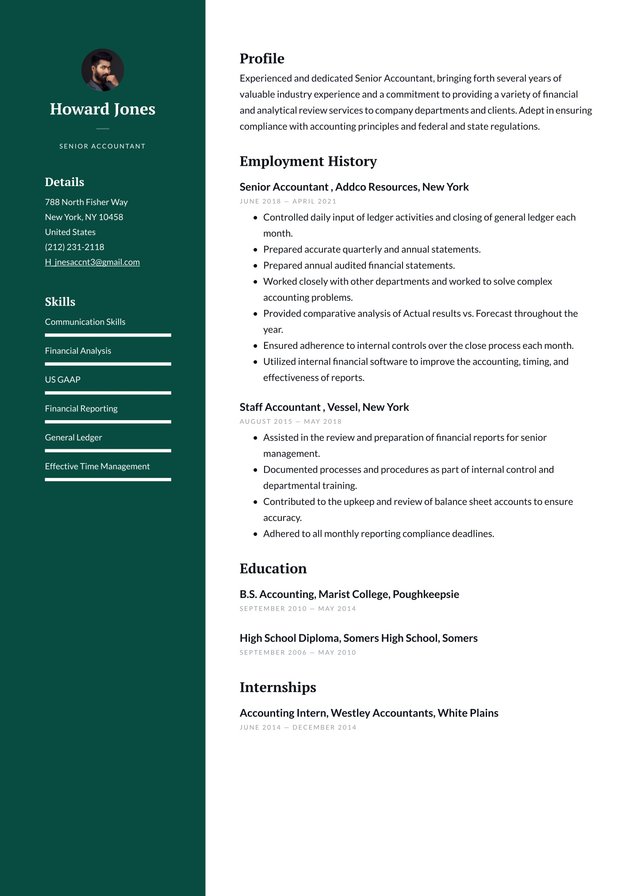
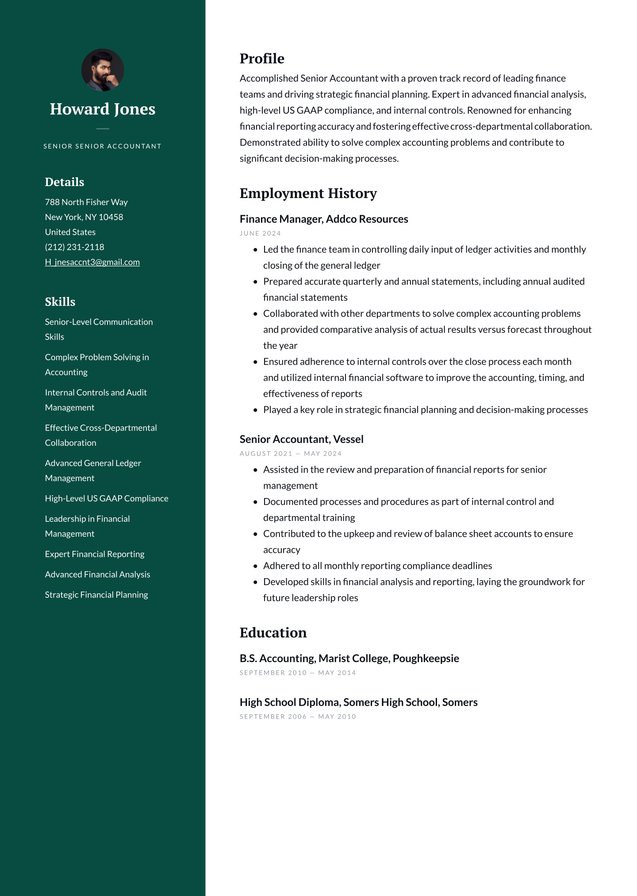
Experienced and dedicated Senior Accountant, bringing forth several years of valuable industry experience and a commitment to providing a variety of financial and analytical review services to company departments and clients. Adept in ensuring compliance with accounting principles and federal and state regulations.
06/2018 - 04/2021, Senior Accountant , Addco Resources, New York
- Controlled daily input of ledger activities and closing of general ledger each month.
- Prepared accurate quarterly and annual statements.
- Prepared annual audited financial statements.
- Worked closely with other departments and worked to solve complex accounting problems.
- Provided comparative analysis of Actual results vs. Forecast throughout the year.
- Ensured adherence to internal controls over the close process each month.
- Utilized internal financial software to improve the accounting, timing, and effectiveness of reports.
08/2015 - 05/2018, Staff Accountant , Vessel, New York
- Assisted in the review and preparation of financial reports for senior management.
- Documented processes and procedures as part of internal control and departmental training.
- Contributed to the upkeep and review of balance sheet accounts to ensure accuracy.
- Adhered to all monthly reporting compliance deadlines.
09/2010 - 05/2014, B.S. Accounting, Marist College, Poughkeepsie
09/2006 - 05/2010, High School Diploma, Somers High School, Somers
- Communication Skills
- Financial Analysis
- US GAAP
- Financial Reporting
- General Ledger
- Effective Time Management
A strong senior accountant resume shows more than clean books. It shows that you can own the month-end close, guide a team, and turn financial data into decisions that leaders trust. This guide walks you through how to write a senior accountant resume that hiring managers and applicant tracking systems both respond to, with adaptable examples you can shape around your own career.
Related Resume Examples
Auditing Clerk resume example

Aligned with the precision and structure required in auditing, this clean, professional template highlights your attention to detail and organizational expertise. Its clear layout and balanced formatting showcase your skills for compliance-driven roles.
Accounting Assistant resume example

Structured for precision and professionalism, this clean, organized layout highlights your attention to detail and multitasking skills as an Accounting Assistant. Its balanced design showcases your expertise in financial records, ensuring confidence for employers.
Accounts Payable resume example

Primed for precision, this clean, structured template highlights your detail-oriented skills essential for Accounts Payable roles. Its organized layout emphasizes expertise in processes, compliance, and software, ensuring your qualifications resonate with finance-focused employers.
Auditor resume example

Shaped for precision and professionalism, this clean, structured layout highlights your analytical expertise and leadership as a Senior Auditor. Its balanced design emphasizes key achievements, helping you connect with detail-oriented, compliance-driven employers.
Internal auditor resume example

Optimized for precision and professionalism, this clean, structured layout highlights your analytical expertise and compliance mastery as an Internal Auditor. Its balanced design emphasizes key achievements, helping you build trust with leadership and stakeholders.
Accounts Receivable resume example

Tuned for precision and professionalism, this clean, structured layout highlights your analytical skills and attention to detail as an Accounts Receivable Clerk. Its organized sections showcase your expertise in payment processing and collections, impressing finance-focused employers.
CPA resume example

A smart fit for Certified Public Accountants, this clean, professional layout highlights precision and structure. Its balanced formatting showcases your financial expertise and regulatory skills, helping you connect with detail-focused employers and clients.
Tax Accountant resume example

Aligned with the precision and professionalism required in tax accounting, this clean, structured template highlights your expertise in compliance, advising, and financial analysis. Its organized layout ensures your skills resonate with detail-oriented employers.
Staff Accountant resume example

Tailored to highlight precision and professionalism, this clean, structured layout amplifies your analytical expertise as a Staff Accountant. Its balanced design showcases financial reporting, tax preparation, and auditing skills, impressing both corporate clients and hiring managers.
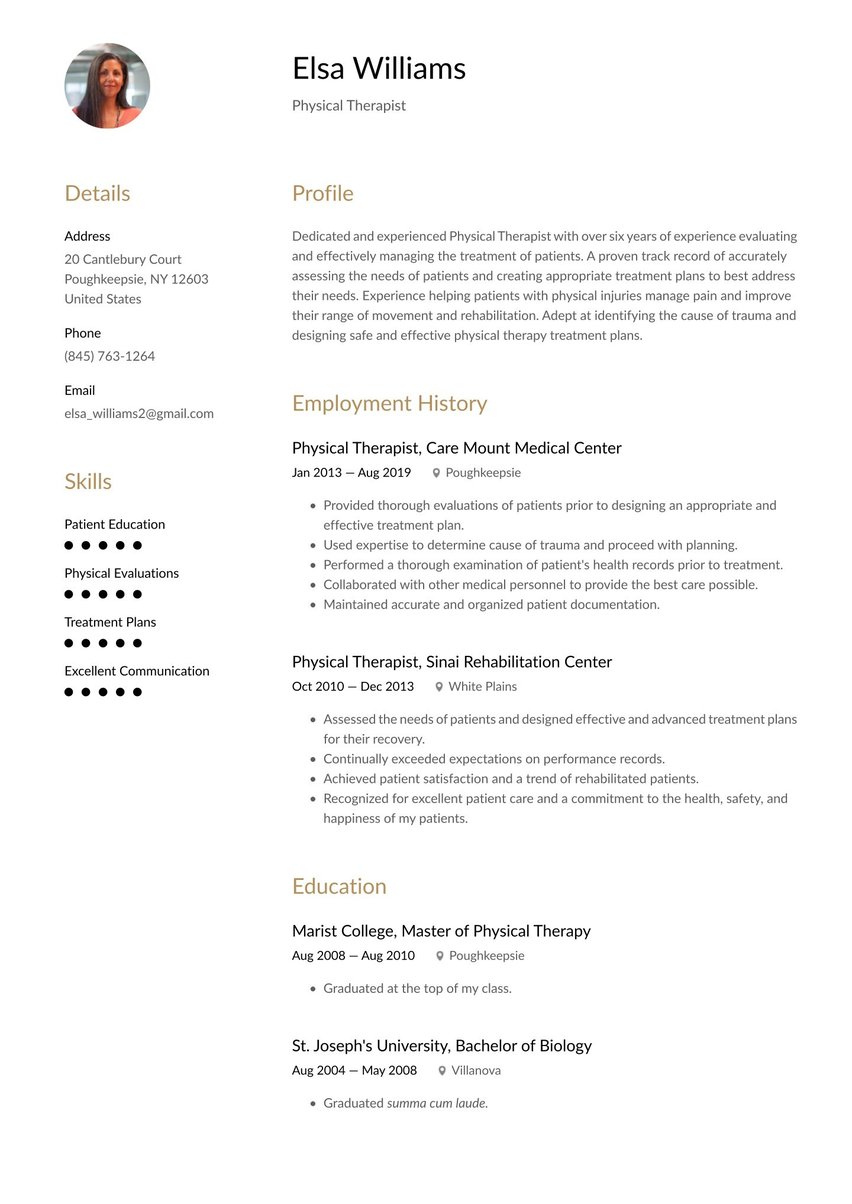
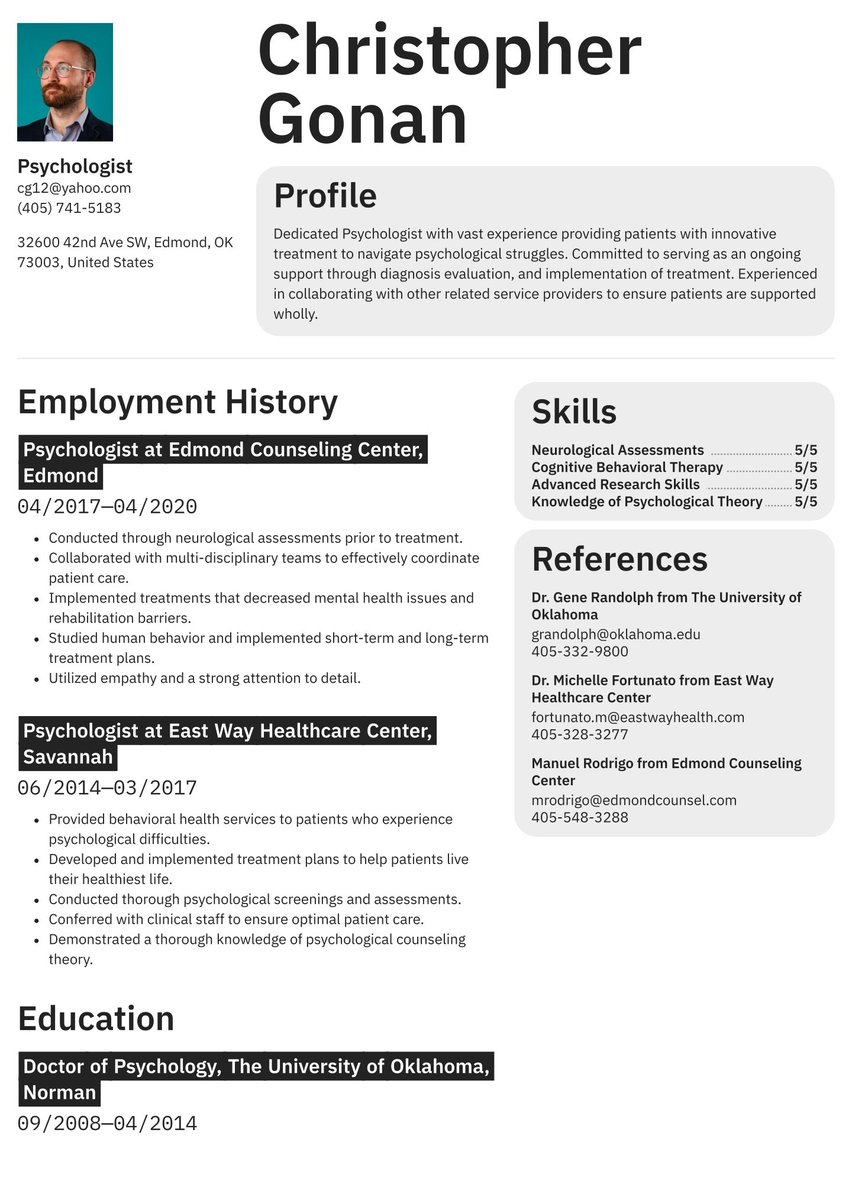
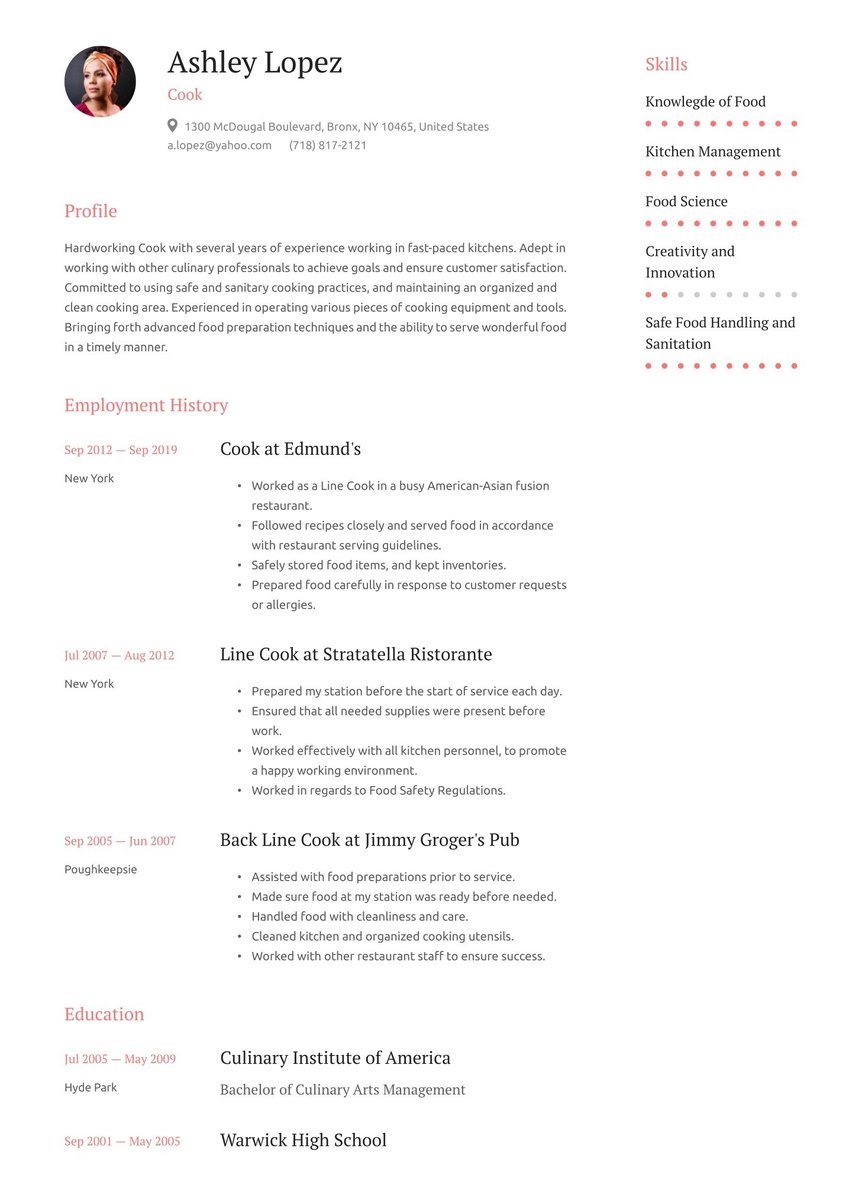
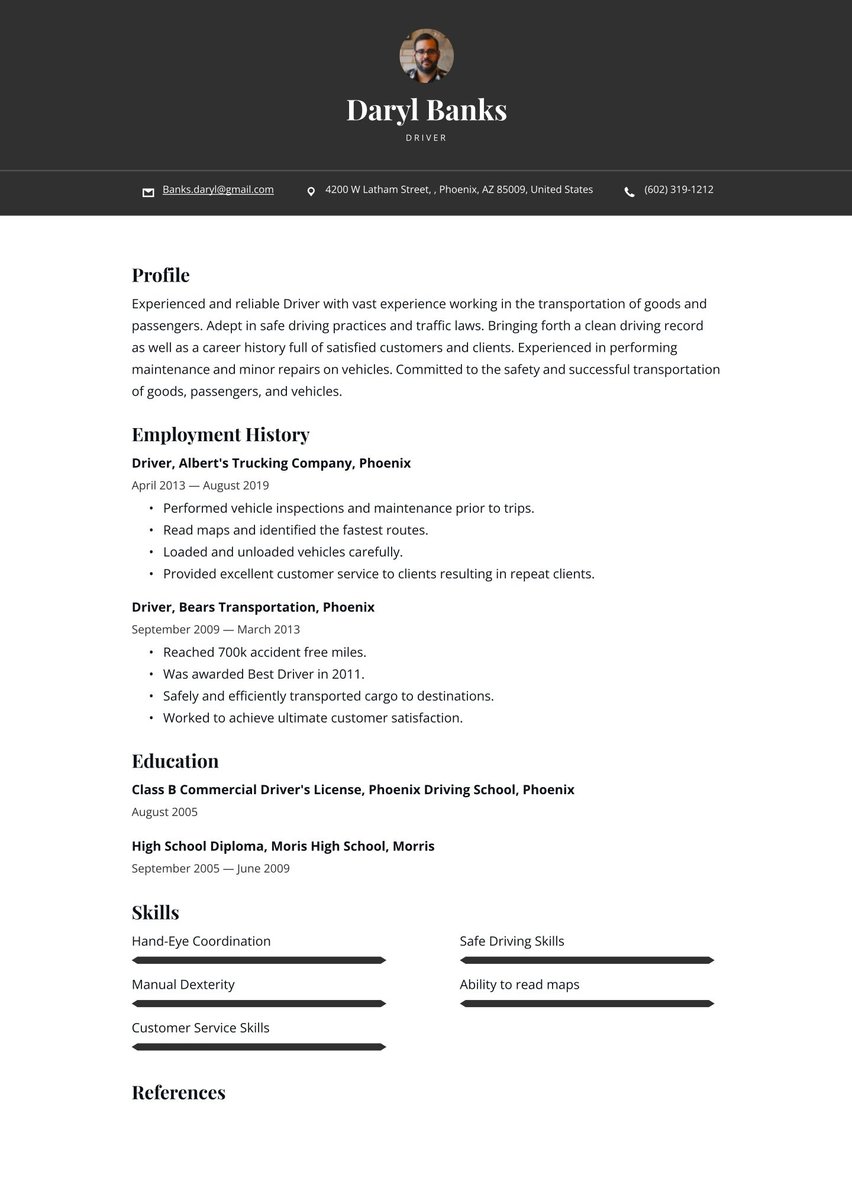
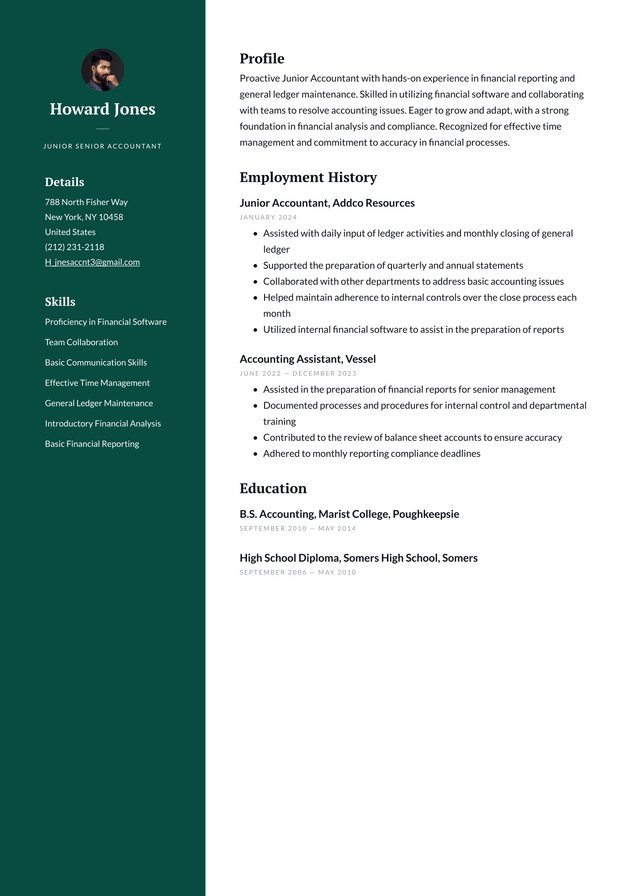
These examples show what effective senior accountant resumes look like at entry, mid, and senior levels, so you can see the structure in practice before you adapt one to your own experience.
How to write a senior accountant resume
Writing a senior accountant resume comes down to four clear steps: open with a sharp summary, lead with quantified achievements, mirror the job description, and finish with a clean, ATS-safe format.
Work through them in order and you will have a focused resume that reads as senior from the first line.
1. Open with a focused summary
Your summary is the first thing a recruiter reads, so use it to state your years of experience, your specialty, and one measurable win.
Keep it to two or three sentences, and place any credential such as a CPA right at the top.
- Example: "CPA with 7 years in corporate accounting, specializing in month-end close and financial reporting, who cut close time by 30%."
2. Lead with quantified achievements
Under each role, replace duty statements with results that use a number.
The simplest structure is a strong verb, the task, and the outcome it produced.
- Example: "Reconciled 20+ high-volume accounts monthly and resolved discrepancies within a 48-hour window."
3. Match the job description
Read the posting closely and reflect its priorities back in your wording.
If the role stresses audits, revenue recognition, or a specific system, those points belong near the top of your resume.
- Example: "Served as primary liaison for the annual external audit, completed two weeks ahead of schedule."
4. Choose a clean, ATS-safe format
A senior accountant resume should look as precise as the work it describes.
Use a standard layout, clear section headings, and a professional font, and avoid columns or graphics that automated screening can misread.
- Example: "Header, summary, skills, experience, education, then certifications, in that order."
What are some effective ways to format a senior accountant resume?
Reverse chronological is the best format for most senior accountants, because it shows a clear climb in scope and responsibility.
A combination format can work if you are changing industries or leading with systems expertise, but a fully functional format tends to raise questions at senior level.
The table below compares the options.
| Format | Best for | Watch out for |
|---|---|---|
| Reverse chronological | Most senior accountants with a steady career progression | Can expose short employment gaps |
| Combination (hybrid) | Career changers or those leading with systems and skills | Can bury dates if the skills block runs too long |
| Functional | Rarely ideal at senior level | Recruiters and ATS may distrust a missing timeline |
Senior accountant text-only resume example
Profile
Experienced and dedicated Senior Accountant, bringing forth several years of valuable industry experience and a commitment to providing a variety of financial and analytical review services to company departments and clients. Adept in ensuring compliance with accounting principles and federal and state regulations.
Employment history
Senior Accountant, Addco Resources, New York
June 2018 - April 2021
- Controlled daily input of ledger activities and closing of general ledger each month.
- Prepared accurate quarterly and annual statements.
- Prepared annual audited financial statements.
- Worked closely with other departments and worked to solve complex accounting problems.
- Provided comparative analysis of Actual results vs. Forecast throughout the year.
- Ensured adherence to internal controls over the close process each month.
- Utilized internal financial software to improve the accounting, timing, and effectiveness of reports.
Staff Accountant, Vessel, New York
August 2015 - May 2018
- Assisted in the review and preparation of financial reports for senior management.
- Documented processes and procedures as part of internal control and departmental training.
- Contributed to the upkeep and review of balance sheet accounts to ensure accuracy.
- Adhered to all monthly reporting compliance deadlines.
Skills
- Communication Skills
- Financial Analysis
- US GAAP, Financial Reporting
- General Ledger
- Effective Time Management
Education
B.S. Accounting, Marist College, Poughkeepsie
September 2010 - May 2014
High School Diploma, Somers High School, Somers
September 2006 - May 2010
How can I make my senior accountant resume stand out to employers?
To stand out, show scope and impact instead of tasks.
Employers judge a senior accountant on the size of what they own, such as budgets, entities, close cycles, and team headcount, and on the results those responsibilities produced.
Lead with quantified outcomes and make your leadership visible early.
Compare these two bullets:
- Weak: "Responsible for the month-end close process."
- Strong: "Reduced the month-end close from 8 days to 5 by automating reconciliations in NetSuite, cutting team overtime by 15%."
Numbers are your strongest signal, and they are rarer than you might expect.
Only 26% of candidates include measurable data on their resumes (Resume.io Resume Statistics, 2025), so a resume built on quantified results stands apart from most of the field.
That effort is well rewarded at this level.
The median annual wage for accountants and auditors was $81,680 in May 2024, with the top 10% earning more than $141,420, and employment is projected to grow 5% from 2024 to 2034 (US Bureau of Labor Statistics, Occupational Outlook Handbook).
Senior roles at the higher end of that band draw strong applicants, so clear proof of impact is what moves you up the pile.
What skills should I highlight in a senior accountant resume?
Highlight a balanced mix of technical accounting skills and leadership skills.
At senior level, employers expect command of core accounting and the modern systems that run it, plus the people skills to guide staff and brief executives.
List the hard skills that match the posting first, then a shorter set of soft skills you can back up in your experience section.
- Core accounting: GAAP and IFRS compliance, general ledger and month-end close, financial reporting, variance analysis, audit preparation.
- Systems and tools: SAP, Oracle NetSuite, Workday, advanced Excel with pivot tables and macros, BlackLine, Power BI or Tableau.
- Leadership and soft skills: Team mentorship, cross-functional collaboration, process improvement, and clear communication with non-finance stakeholders.
Choose the items that appear in the job description rather than listing everything you have touched.
A tight, relevant set carries more credibility than a long inventory, and it leaves room for your experience bullets to prove each claim.
Are there specific keywords that hiring managers look for in senior accountant resumes?
Yes. The keywords that matter most are the exact terms in the job posting, because that is what an ATS scans for before a person reviews your resume.
For senior accountant roles, recruiters look for a consistent cluster: GAAP, month-end close, reconciliations, financial reporting, variance analysis, and named systems such as SAP or NetSuite.
The average job description contains 43 keywords that can be used in a resume (Resume.io Resume Statistics, 2025), so the posting itself is your keyword list.
Compliance terms such as SOX, ASC 606, and ASC 842 are worth including when the role calls for them, since they signal current, senior-level knowledge.
The goal is natural coverage, not stuffing, because a resume packed with disconnected terms reads poorly to the human who reviews it next.
How can I optimize my senior accountant resume with the right keywords?
Place your keywords where they carry the most weight: the summary, the skills section, and your achievement bullets.
Applicant tracking systems weigh these areas heavily, and a hiring manager scans them first, so a term buried in the final line of an old role does little for you.
Work each keyword into a phrase that is true for you, rather than dropping it in as a label.
For example, instead of listing "SOX" alone, write "Managed SOX controls across three entities," which proves the skill and places the keyword at the same time.
Use only the terms you can stand behind in an interview, because honesty on the page protects you once the conversation starts.
This is the difference between a resume that merely passes a filter and one that also convinces the person on the other side of it.
How can I highlight my experience effectively in a senior accountant resume?
List your roles in reverse chronological order, most recent first, and lead each one with the scope you owned: team size, budget, entities, and reporting lines.
This framing tells a reviewer how senior the role actually was before they read a single bullet.
Give the most space to your recent, senior positions.
Focus your detail on the last 10 years.
Older or entry-level roles can be condensed to a line or two, since their purpose now is to show progression rather than detail every task.
If you led people or projects, name that plainly, because supervising staff or owning an implementation is the clearest marker of seniority.
Here is how a senior role can read:
- Senior Accountant, Meridian Group, Austin, TX, March 2021 to present
- Led the monthly close for four entities, reducing cycle time from 9 days to 6.
- Managed a $12M fixed-asset portfolio and its depreciation schedules.
- Mentored three staff accountants, improving journal-entry accuracy by 15%.
Each line pairs scope with a result, which is what turns an ordinary work history into evidence of impact.
How should I tailor my senior accountant resume for different job applications?
Tailor every application by treating the job description as a checklist.
Read the posting, note the skills and systems it repeats, and reorder your achievements so the ones that match sit near the top of each role.
A senior accountant with a broad background will have more relevant material than any one job needs, and tailoring decides what leads.
This matters because two senior roles can look alike and reward very different things.
One may center on technical accounting and audit, another on a systems migration or team leadership.
A quick tailoring pass looks like this:
- Move the achievements that match the posting to the top of each role.
- Adjust your summary so its opening line speaks to this employer's main need.
- Swap generic phrasing for the employer's own terms, such as SOX compliance or intercompany reconciliations.
A few minutes of tailoring per application does more for your chances than one polished resume sent everywhere, because relevance is what both recruiters and screening software reward.
What are common mistakes to avoid when writing a senior accountant resume?
One of the most common mistakes is listing duties without results, which makes a senior candidate look like a junior one.
A generic summary is another, since it wastes the most valuable space on the page.
Typos matter more here than in most fields, because attention to detail is part of the job itself.
Watch for these traps in particular:
- Do quantify outcomes, name the systems you use, and keep the layout clean.
- Do not stuff keywords, hide gaps behind a functional format, or stretch the resume with roles from 15 years ago.
Above all, avoid vague, borrowed phrasing.
Language that could describe anyone tells a hiring manager nothing about you, while a specific result they can picture stays with them after the scan.
Read the finished resume aloud once, since that is the fastest way to catch both awkward wording and the small errors a spellchecker misses.
Key tips for writing a compelling senior accountant resume
- Lead every work bullet with a quantified result, such as a shorter close cycle or a cost saving, since most candidates never add numbers.
- Place your CPA or CMA next to your name so recruiters see your credentials at a glance.
- Use a reverse chronological layout and a clean, ATS-safe design with no columns or graphics.
- Mirror the exact language of each job posting in your summary and skills to clear applicant tracking systems.
- Feature modern accounting systems such as SAP, NetSuite, and advanced Excel alongside your core accounting knowledge.

FAQs
A few questions come up often when people write a senior accountant resume.
What should a senior accountant resume summary include?
It should include your years of experience, your main specialty, and at least one measurable achievement.
Two or three sentences is enough, and a credential such as a CPA belongs here or beside your name.
Think of it as a short pitch that tells a recruiter why to keep reading.
How far back should a senior accountant resume go?
Focus on the last 10 years, where your senior experience sits.
Older roles can appear as brief entries that show progression, and positions beyond about 15 years can usually be dropped unless they are directly relevant.
The aim is to show a clear climb without crowding the page.
Do senior accountants need a CPA on their resume?
Not always, but it helps. A CPA or CMA is a strong signal at senior level, and many employers list one as preferred rather than required.
If you hold the credential, feature it prominently; if you are working toward it, note your progress so the effort is visible.